

 News & Tips
Nearly 40 percent of American and British adventure travelers report confusion over local vocabulary during European trips. Smooth communication can make the difference between an easy journey and a stressful mishap. If you want to explore Europe’s famous cities or remote trails, mastering practical travel words brings a new level of confidence. This guide helps you get the language right for seamless bookings, clear directions, and memorable conversations across every European country.
Table of Contents
- Essential Travel Vocabulary for Europe
- Types of Tours and Experience Jargon
- Booking and Accommodation Terminology
- Visa, Entry, and Border Control Terms
- Transportation and Navigation Words
- Common Mistakes With European Travel Terms
Essential Travel Vocabulary for Europe
| Point | Details |
|---|---|
| Learn Key Travel Vocabulary | Familiarize yourself with essential terms related to transportation, accommodations, and dining to navigate Europe with confidence. |
| Embrace Local Languages | Use basic local phrases like “hello” and “thank you” to enhance interactions and demonstrate respect for local cultures. |
| Understand Accommodation Terms | Grasp booking terminology and types of accommodations to make informed decisions during your travels. |
| Know Visa and Border Control Terms | Familiarize yourself with visa requirements and border terminology to ensure a smooth entry into European countries. |
Essential Travel Vocabulary for Europe
Understanding key European travel terminology transforms your journey from potentially stressful to smoothly navigable. Knowing the right words and phrases helps you confidently navigate transportation systems, communicate effectively with locals, and handle practical travel situations across different countries. Mastering essential travel vocabulary ensures you can ask directions, order meals, book accommodations, and manage unexpected challenges with greater ease.
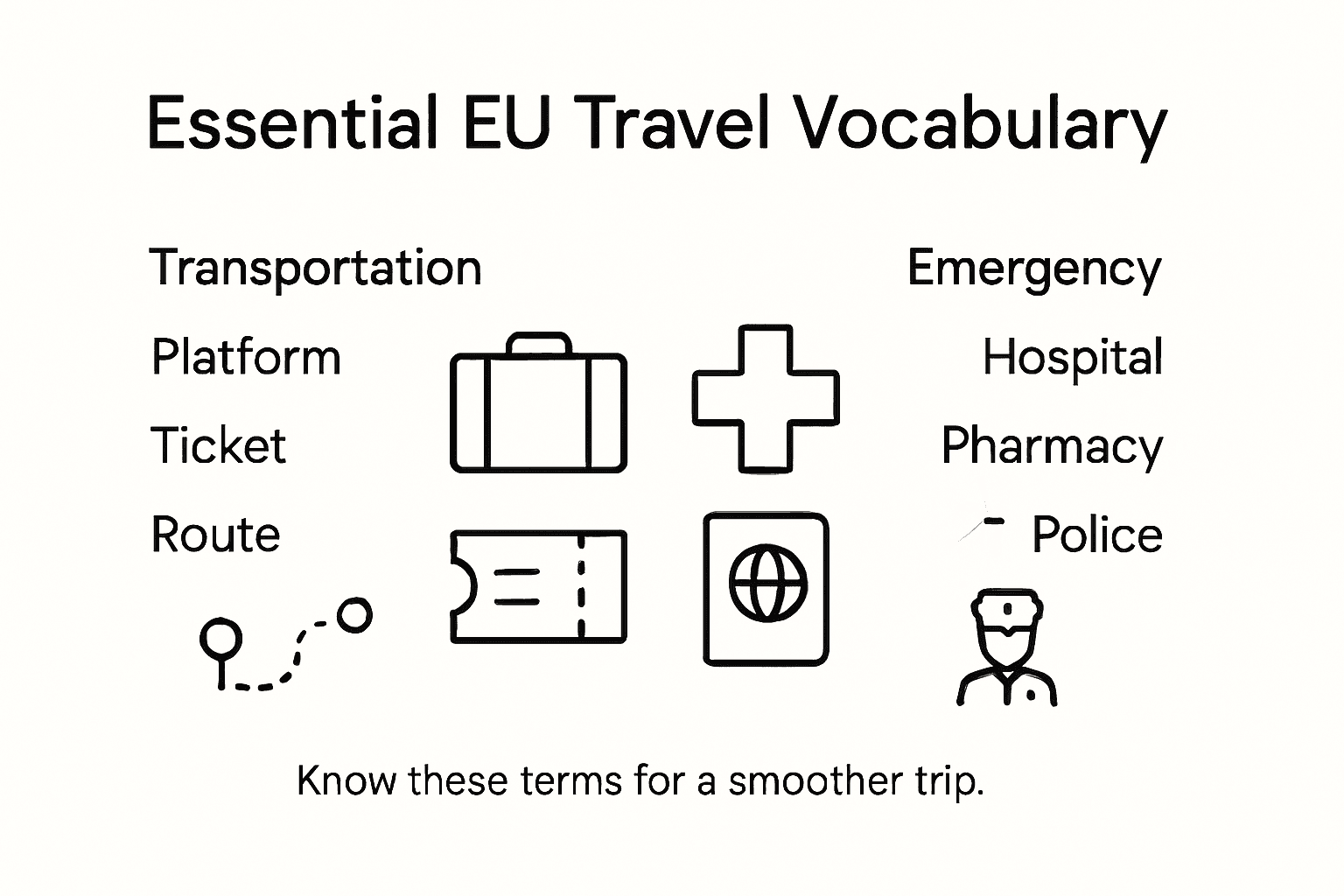
European travel vocabulary spans several critical communication domains. Transportation terms are crucial – understanding words like “platform” (for train stations), “ticket booth,” “departure,” and “arrival” helps you navigate public transit systems. Accommodation vocabulary includes essential words like “reservation,” “check-in,” “room types” (single, double, twin), and “amenities.” Restaurant and dining phrases prove equally important: learning words for “menu,” “bill,” “vegetarian,” and basic dietary requests can significantly enhance your dining experiences.
Language preparation extends beyond mere words to understanding cultural communication nuances. While English is widely spoken in many European tourist destinations, learning basic local language phrases demonstrates respect and often generates goodwill. Key phrases like “hello,” “thank you,” “please,” and “do you speak English?” in the local language can dramatically improve your interactions. Regional variations matter too – what works in Paris might differ from communication styles in Prague or Budapest.
Pro tip: Download a multilingual translation app before your trip and download offline language packs to ensure you have communication support even without internet access.
Practical travel vocabulary also includes critical emergency and administrative terms. Learn words related to medical assistance, police help, embassy contacts, and basic health conditions. Understanding how to ask about “pharmacy,” “hospital,” “embassy,” or explaining basic medical symptoms can be lifesaving in unexpected situations.
Pro tip: Create a small, laminated emergency phrase card with key translation phrases and important contact numbers to carry with you during your European travels.
Types of Tours and Experience Jargon
Navigating the world of European travel requires understanding the nuanced terminology that defines different tour experiences. Tourism industry jargon provides travelers with a comprehensive framework for selecting the perfect travel adventure. Tour types range from fully structured group experiences to completely independent journeys, each with distinct characteristics and appeal to different traveler preferences.
Travel experiences can be categorized into several key types. Group tours involve predetermined itineraries with set departure dates and shared transportation, ideal for travelers seeking structured experiences and social interactions. Independent tours offer more flexibility, with pre-arranged accommodations and transportation but minimal guided intervention. Adventure tours focus on active experiences like hiking, cycling, or exploring challenging terrains, while cultural immersion tours prioritize deep engagement with local traditions, cuisine, and community interactions.

The taxonomy of travel experiences extends beyond traditional categorizations. Immersive travel experiences now encompass digital, physical, and hybrid models that blur traditional boundaries. Educational tours combine learning objectives with travel, historical tours provide deep contextual understanding of specific regions, and specialized experiences like culinary tours, photography expeditions, and wellness retreats offer targeted experiences for niche interests. Understanding these distinctions helps travelers select experiences that align precisely with their personal goals and preferences.
Pro tip: Research multiple tour descriptions and compare their specific inclusions, group sizes, and activity levels to find the most suitable travel experience for your interests and comfort level.
Modern travel taxonomy also recognizes emerging experience types like sustainable tourism, voluntourism, and digital nomad experiences. These categories reflect evolving traveler motivations beyond traditional sightseeing, emphasizing personal growth, cultural exchange, and meaningful global interactions. Each tour type carries unique expectations, pricing structures, and participant demographics, making it crucial for travelers to understand the subtle distinctions.
Pro tip: Create a personal travel preference profile that outlines your comfort with group dynamics, desired activity levels, and learning objectives to help narrow down the most appropriate tour types.
Booking and Accommodation Terminology
Understanding the complex landscape of booking and accommodation terminology is crucial for smooth European travel experiences. Hospitality industry language can be intricate, with specialized terms that significantly impact your reservation and stay. Knowing these terms helps travelers navigate bookings, understand pricing structures, and make informed decisions about their accommodations.
Accommodation classifications range widely across European destinations. Room types include standard options like single, double, twin, triple, and family rooms, each with specific configurations and pricing. Booking categories such as non-refundable rates, flexible rates, and prepaid bookings offer different levels of cancellation flexibility and potential cost savings. Hospitality terminology also introduces critical concepts like rack rates (standard published prices), net rates (wholesale prices), and negotiated rates for specific groups or corporate travelers.
European accommodation terminology includes several unique classification systems. Pension in German-speaking countries refers to bed and breakfast style accommodations, while chambre d’hôte in France represents similar small, family-run lodging options. Travelers should understand terms like full board (meals included), half board (breakfast and dinner included), and bed and breakfast to accurately compare accommodation packages. Additional terms like en-suite (private bathroom), walk-up (no elevator), and street-facing versus courtyard-facing rooms provide critical information about room characteristics.
Here’s a quick comparison of popular European accommodation types and what sets them apart:
| Accommodation Type | Common Features | Typical Location | Best For |
|---|---|---|---|
| Hotel | Private rooms, daily cleaning | Urban & tourist areas | Comfort, amenities |
| Pension | Family-run, breakfast included | Germany, Austria | Local charm, budgets |
| Chambre d’hôte | Homey, hosted lodging | France, countryside | Cultural immersion |
| Hostel | Shared rooms, social spaces | Major cities, towns | Solo, youth travelers |
| Apartment Rental | Kitchen, private space | Cities, long stays | Families, independence |
| Resort | Onsite recreation, full board | Beaches, rural areas | Relaxation, activities |
Pro tip: Always confirm specific room amenities and inclusions during booking, as terminology can vary significantly between different European countries and accommodation types.
Digital booking platforms have introduced additional specialized terminology. Cancellation windows, dynamic pricing, yield management, and inventory allocation are complex systems that directly impact reservation costs and availability. Understanding these terms helps travelers identify the best booking strategies, recognize potential price fluctuations, and make more informed travel decisions.
Pro tip: Create a standardized checklist of must-have amenities and room characteristics before searching for accommodations to streamline your booking process and ensure you select the most appropriate option.
Visa, Entry, and Border Control Terms
Schengen Area regulations represent a complex system of border control and travel permissions that every European traveler must understand. Navigating the intricate landscape of visa requirements, entry stamps, and border control terminology can significantly impact your travel experience. Understanding these terms helps travelers prepare documentation, anticipate potential challenges, and move smoothly across European borders.
European visa categories are nuanced and vary based on traveler type and purpose. Schengen visa allows travel across 26 European countries with a single entry permit, while short-stay visas typically permit stays up to 90 days. Business visas, tourist visas, and transit visas each have specific requirements and restrictions. Entry and exit system terminology introduces additional complexity with concepts like biometric registration, EES (Entry/Exit System), and specific passport validity requirements that travelers must comprehend.
Border control terminology encompasses several critical concepts travelers must understand. Internal borders refer to boundaries between Schengen countries where passport checks are minimal, while external borders involve more rigorous documentation verification. Key terms include visa-free entry, visa-on-arrival, pre-travel authorization, and electronic travel authorization. Travelers should also be familiar with passport validity requirements (typically six months beyond travel dates), return ticket expectations, and proof of sufficient funds documentation.
This summary highlights key European border and entry terms travelers should know:
| Term | What It Means | Impact on Traveler |
|---|---|---|
| Schengen Visa | Single visa for 26 countries | Easy multi-country entry |
| Entry/Exit System (EES) | Registers border crossings | Faster, automated controls |
| Biometric Registration | Fingerprint & photo at border | Added security, ID checks |
| Visa-Free Entry | No visa required for short stays | Simplified entry process |
| Pre-Travel Authorization | Online approval before arrival | Must apply before traveling |
| Return Ticket | Proof of onward journey | Required for entry approval |
Pro tip: Create a digital folder with high-resolution scans of all travel documents, including passport, visa, travel insurance, and return ticket, to expedite border control processes.
Recent technological innovations have transformed border control procedures. Automated border control gates, biometric scanning, and electronic passport chips represent modern border management techniques. Understanding these systems helps travelers prepare appropriate documentation and navigate increasingly sophisticated border control technologies. Some countries now require advanced passenger information submission and utilize complex risk assessment algorithms to determine entry permissions.
Pro tip: Check specific entry requirements for each country at least 60 days before travel, as visa and entry regulations can change rapidly and without extensive public notification.
Transportation and Navigation Words
European transportation terminology forms a complex linguistic landscape that travelers must navigate confidently. Understanding the nuanced vocabulary of mobility helps travelers communicate effectively, read transportation signs, and comprehend travel instructions across different European countries. From public transit systems to navigation apps, knowing the right words can transform a potentially confusing journey into a seamless experience.
Public transportation terminology varies significantly across European countries. Multimodal transport refers to journeys using multiple transportation types, while intermodal connections describe seamless transfers between different transportation modes like trains, buses, and metros. Eurostat transport definitions introduce critical concepts such as modal split (percentage of travelers using different transportation types) and passenger kilometers (measurement of passenger travel distance). Key navigation terms include route map, platform, terminal, departure board, and transfer point, which are essential for understanding complex transportation networks.
European transportation vocabulary extends beyond traditional terms. Dynamic routing describes real-time navigation adjustments, while last mile connectivity refers to transportation options completing the final segment of a journey. Regional variations matter significantly – a metro in Paris differs from an underground in London or a subway in Prague. Travelers should familiarize themselves with local transportation terminology, ticket types (single ride, day pass, weekly ticket), and validation procedures to navigate public transit systems effectively.
Pro tip: Download offline transportation apps with local language support to ensure navigation capabilities even without consistent internet access.
Modern transportation terminology increasingly incorporates technological innovations. Smart ticketing, contactless payment, mobility as a service (MaaS), and integrated transportation platforms represent emerging concepts transforming how travelers move through European cities. Understanding these terms helps travelers leverage digital tools, optimize travel routes, and make more informed transportation decisions.
Pro tip: Research local transportation apps specific to each city you’re visiting, as many European cities have unique digital platforms for real-time navigation and ticketing.
Common Mistakes With European Travel Terms
European travel terminology errors can significantly complicate travel experiences and lead to misunderstandings. Travelers often struggle with nuanced language distinctions that seem subtle but carry substantial meaning across different European contexts. Understanding these linguistic pitfalls helps prevent communication breakdowns and ensures smoother interactions during international journeys.
Communication mistakes frequently arise from false friends – words that sound similar but have different meanings in various languages. For instance, the English word “actually” does not translate directly in many European languages and can cause confusion. Translation challenges in tourist communication reveal complex linguistic nuances where direct word-for-word translations often fail. Common errors include misinterpreting hospitality terms, transportation vocabulary, and cultural expressions that don’t have direct equivalents.
Regional terminology variations pose significant challenges for travelers. A reservation might mean different things in Germany versus France, and transportation terms like platform, terminal, or ticket can have subtle contextual differences. Pronunciation and stress can completely alter word meanings, making it crucial to understand not just vocabulary but also cultural communication contexts. Travelers must be particularly careful with idiomatic expressions that can be misunderstood or appear offensive when translated literally.
Pro tip: Learn key phrases from native speakers through language exchange apps to understand contextual nuances beyond dictionary definitions.
Technological and professional jargon introduce additional complexity in European travel communication. Misunderstanding technical terms related to transportation, accommodation, or services can lead to significant travel disruptions. Travelers should focus on developing flexible communication strategies, using context clues, and maintaining a patient, respectful approach when navigating language differences.
Pro tip: Carry a small phrasebook or digital translation tool that provides context and cultural explanations, not just direct word translations.
Take the Stress Out of European Travel Planning with Next View Tours
Understanding the key terms and travel vocabulary highlighted in this article is the first step to feeling confident and prepared for your European adventures. At Next View Tours, we know that navigating complex tour types, transportation jargon, and accommodation terminology can be overwhelming. That is why our wide selection of carefully designed experiences—from Adventure Tours to private and group tours across iconic cities like Vienna, Salzburg, and Prague—are created to take the guesswork out of your journey.

Start your journey with clear expectations and expert guidance today. Explore our full array of customizable tours and experience firsthand how knowing the right terms makes all the difference. Visit Next View Tours now to find the perfect trip that matches your style and preferences. Don’t let unfamiliar vocabulary hold you back—empower your travels and book your next unforgettable European adventure now.
Frequently Asked Questions
What are essential travel terms I should know for Europe?
Knowing key travel terms such as “platform,” “ticket booth,” “reservation,” and “menu” can greatly enhance your travel experience in Europe by facilitating communication in transportation, accommodation, and dining settings.
How can knowing basic local phrases improve my European travel experience?
Using basic local phrases like “hello,” “thank you,” and “do you speak English?” shows respect for the culture and can facilitate better interactions with locals, ultimately enriching your travel experience.
What types of tours are available in Europe and how do they differ?
Tours can be categorized into group tours, independent tours, adventure tours, and cultural immersion tours, each offering different levels of structure, social interaction, and engagement with local culture.
What should I look for when booking accommodations in Europe?
When booking accommodations, pay attention to room types (like single or double), meal options (full board or half board), and amenities. Understanding terms like “non-refundable rates” or “flexible rates” can help in making informed decisions.


Comments are closed