

 Uncategorized
TL;DR:
- Europe’s diverse destinations require careful planning to match your travel goals, timing, and budget effectively. Focusing on shoulder seasons and experiences rather than prices ensures a more authentic and satisfying trip while avoiding overcrowding and high costs. Using a structured scoring and filtering process helps travelers make informed decisions, preparing thoroughly for smooth and memorable European adventures.
Europe does not make choosing easy. You have dozens of countries, hundreds of cities, and an almost endless catalog of experiences pulling your attention in every direction. Knowing how to pick best destinations means going beyond what looks good on social media and thinking carefully about what will actually satisfy you, fit your schedule, and stay within your budget. This guide gives you a practical, expert-backed framework for selecting ideal vacation locations across Europe, whether you’re planning a romantic short break, a family adventure, or a deep cultural tour.
Table of Contents
- Understanding your travel goals and constraints
- Evaluating European destinations by season and value
- Step-by-step method to choose your best destination
- Preparing for European travel: logistics and regulations
- Why the smartest travelers choose shoulder seasons and plan beyond lowest cost
- Explore personalized European tours tailored to your perfect destination
- Frequently asked questions
Key Takeaways
| Point | Details |
|---|---|
| Define your trip goals | Clarify what experiences you want and your constraints before choosing destinations to narrow options. |
| Choose shoulder seasons | Traveling during shoulder seasons offers better prices, fewer crowds, and pleasant weather. |
| Score destinations objectively | Use comparison of cost, safety, and convenience to select the best match for your needs. |
| Prepare essential travel documents | Ensure visas, vaccinations, insurance, and registrations like STEP are arranged well before travel. |
| Value planning over cheapness | Consider full travel costs and quality to avoid costly mistakes and enjoy more fulfilling trips. |
Understanding your travel goals and constraints

The single most important step in how to pick best destinations is figuring out what kind of experience you’re truly after. Adventure and relaxation require entirely different places. A traveler chasing alpine hikes should not be shortlisting beach resorts in Croatia just because the photos are beautiful.
Start by identifying your primary experience type. Ask yourself honestly:
- Relaxation: Do you want long, slow days with little structured activity?
- Adventure: Are you looking for hiking, cycling, water sports, or winter sports?
- Culture and history: Do museums, architecture, and local traditions energize you?
- Food and wine: Is the culinary scene your anchor for destination choice?
- A mix: Do you want some of each, and if so, in what proportion?
Once you know your experience type, layer in your constraints. These are not just financial. Your travel dates, available vacation days, physical mobility, and group size all shape which destinations are realistic. A 5-day trip from Vienna lends itself to a cluster of nearby cities. A 14-day trip opens up multiple countries.
A smart approach is to write your “experience headline” before you open a booking site. As travel planning experts note, the cheapest option does not always mean best value because logistics and poor planning carry their own “mistake tax.” If a budget destination requires three connecting flights and a long bus ride, the time and stress you lose may cost more than a slightly pricier, more accessible location.
Use this numbered process to build your shortlist:
- Write one sentence describing your ideal trip experience.
- Set a realistic total budget, including local transport and activities, not just flights.
- Note any fixed constraints: travel window, group needs, dietary requirements, accessibility.
- List your must-have features (e.g., English-speaking guides, safe solo travel environment).
- List your nice-to-have features (e.g., thermal baths, Christmas markets, coastal views).
- Use those filters to narrow your options to 3 to 5 destinations.
Pro Tip: When planning European travel, avoid building your list from destination names alone. Build it from experiences first, then match destinations to those experiences. You’ll be far less likely to feel disappointed on arrival.
If you’re traveling with others, involve them in this step. Group trips benefit enormously from early alignment on priorities. The group travel planning process works best when everyone agrees on the experience type before any booking happens.
Evaluating European destinations by season and value
Timing shapes your entire experience. The same destination can feel magical in May and genuinely exhausting in August. Understanding how seasons affect crowd levels, cost, and atmosphere is one of the most underused best travel destination tips available.
Shoulder seasons in Europe, typically May through June and September through October, deliver pleasant weather, fewer tourists, and notably lower prices. These windows offer something that peak summer simply cannot: breathing room. You can walk into the Hallstatt lakefront at 9 a.m. without fighting through a wall of visitors. You can book a quality hotel in Prague for a fraction of July’s rates.
Here’s a comparison to help you see the difference clearly:
| Factor | Peak season (July to August) | Shoulder season (May, June, September, October) |
|---|---|---|
| Cost (accommodation) | High, often 40 to 60% above average | Moderate, better deals available |
| Crowd levels | Very high, especially in cities | Comfortable, manageable |
| Weather | Hot, sometimes uncomfortably so | Mild to warm, very pleasant |
| Booking flexibility | Limited, book months ahead | Much more flexible |
| Authentic local experience | Harder to find | Easier to access |
“Shoulder seasons reduce overcrowding that can push popular destinations beyond their carrying capacity. Peak summer strains infrastructure, increases costs, and degrades the visitor experience significantly.” UNWTO seasonality research
Some destinations reward shoulder season travelers especially well:
- Lisbon, Portugal: Spring and fall bring warm days, open museums, and café seats you can actually find.
- Salzburg, Austria: September offers golden light, fewer tour groups, and the full beauty of the surrounding Alps.
- Budapest, Hungary: May and October are ideal. Summer river cruises are packed; spring cruises are glorious.
- Greek islands: The shoulder months allow you to actually see the architecture instead of photographing the back of someone’s head.
Pro Tip: Check the seasonal travel trends for specific regions before you finalize dates. A “shoulder month” in one country may still be peak season in another due to local festivals or events.
If your goal is a premium experience at a resort-style destination, shoulder season is where luxury becomes genuinely accessible. The resort travel options across Europe look very different when you’re not competing with half of Europe’s summer vacationers for the same pool chair.
Step-by-step method to choose your best destination
Now that you understand your goals and timing, you need a method to make the final call. This is where many travelers stall. Having five destinations on a list feels like progress, but choosing one requires a structured approach.
Follow these steps:
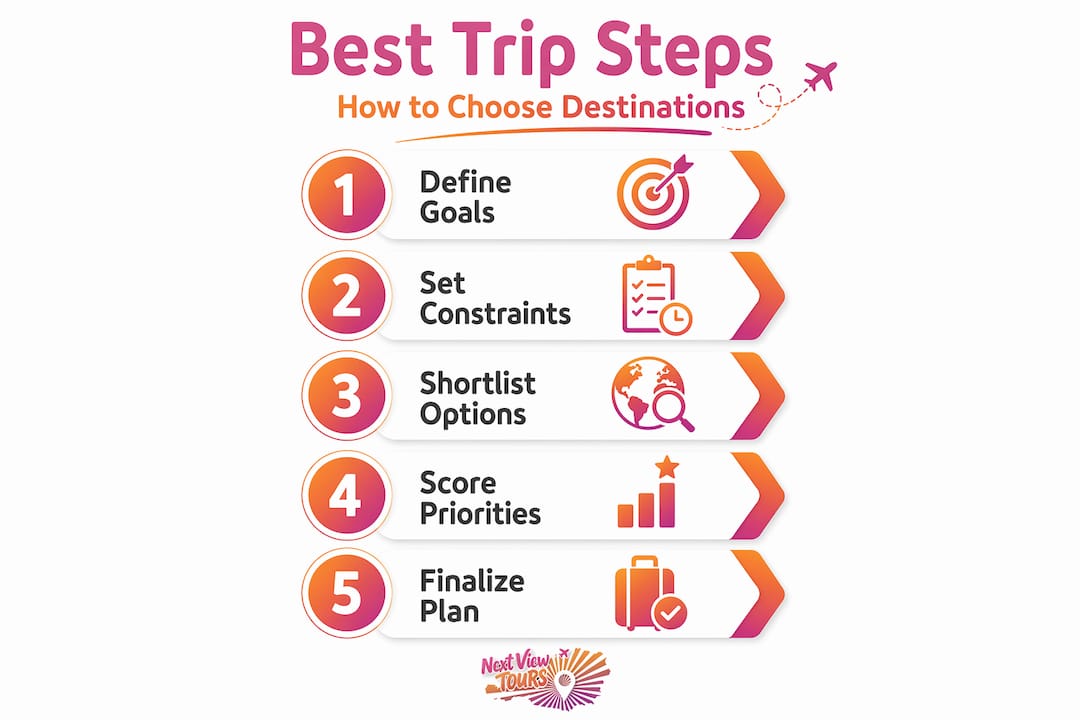
- List your 3 to 5 candidate destinations based on your experience goals and seasonal fit.
- Score each destination across four key criteria: cost, safety, accessibility, and available activities.
- Build a pros and cons list for your top two or three options to surface non-obvious trade-offs.
- Consider proximity. Short trips benefit from destinations close to a hub city. Multi-day tours can cluster nearby countries efficiently.
- Choose the destination with the highest overall score relative to your personal priorities.
Narrowing to 3 to 5 options that match your goals, budget, and interests is the most effective way to avoid decision fatigue. Scoring each on cost, safety, and convenience prevents you from choosing based on emotion alone.
Here’s how a sample scoring table might look:
| Destination | Cost (1 to 5) | Safety (1 to 5) | Accessibility (1 to 5) | Activities fit (1 to 5) | Total |
|---|---|---|---|---|---|
| Vienna, Austria | 3 | 5 | 5 | 4 | 17 |
| Dubrovnik, Croatia | 2 | 4 | 3 | 4 | 13 |
| Prague, Czech Republic | 4 | 4 | 5 | 5 | 18 |
| Hallstatt, Austria | 3 | 5 | 4 | 3 | 15 |
Score categories according to your own priorities. If safety is your top concern, weight it double. If you’re on a tight budget, cost matters most.
Pro Tip: Explore the benefits of customized tours when your scoring table reveals a tie. A customized itinerary can blend the best elements of two destinations into one trip, which is something rigid package tours rarely offer.
Also consider whether you want a private or group experience. The right tour format changes how you interact with a destination entirely. Group tours work beautifully for social travelers. Private tours give you pace and access that groups cannot.
Preparing for European travel: logistics and regulations
Choosing your destination is only part of the work. Preparing correctly determines whether your trip unfolds smoothly or collapses under preventable complications.
Here are the essential steps every traveler should complete:
- Visa and entry requirements: Non-EU nationals can stay up to 90 days in any 180-day period within the Schengen area without a visa. Overstaying can result in travel bans across all Schengen countries.
- STEP enrollment: U.S. travelers should enroll in the STEP program to receive travel alerts, safety advisories, and embassy contact information during their trip.
- Travel insurance: Purchase a policy that covers medical evacuation, trip cancellation, and lost luggage. Standard health insurance, including Medicare for U.S. residents, does not cover medical expenses abroad.
- Vaccinations: Check vaccination requirements at least 4 to 6 weeks before departure, and verify compliance with the Schengen 90/180 rule to avoid unexpected complications at entry points.
- Documentation: Carry your passport, an international driver’s permit if renting a car, and any documents related to minors traveling with you.
“A complete travel checklist for international trips includes visa verification, STEP enrollment, travel health review, insurance coverage, and financial preparations like notifying your bank.” U.S. State Department
Pro Tip: Review your travel preparation checklist at least 6 weeks before departure. Some vaccinations require multiple doses, and visa applications for certain destinations can take several weeks to process.
If you’re joining a group trip, your group travel preparation should include confirming what documentation the tour operator needs from you in advance. Missing paperwork on departure day is one of the most avoidable travel disasters.
Why the smartest travelers choose shoulder seasons and plan beyond lowest cost
Here is the perspective most travel guides won’t give you directly: the traveler chasing the cheapest fare is usually getting the most expensive experience.
Think about what happens when you choose a destination based on a flight deal. You arrive in the peak of summer in a city that’s at absolute capacity. The museum queue takes three hours. Your “affordable” hotel is a 45-minute metro ride from anything interesting. Every restaurant near the main square is running a tourist menu that bears no resemblance to local food. You’ve saved money on the flight and spent it on frustration.
Real travel costs include lodging, local transport, activity fees, and the “mistake tax” that comes from poor planning. That tax shows up as missed reservations, wrong neighborhoods, wasted time, and the low-grade stress of feeling like you’re fighting a destination rather than enjoying it.
The travelers who come back from Europe genuinely satisfied tend to share a few habits. They plan around shoulder seasons. They choose destinations matched to their actual interests, not just reputation. They invest in quality travel experiences that are designed around their pace and preferences rather than defaulting to the most-photographed city on a map.
This is not about spending more money. It’s about spending deliberately. A well-timed trip to Salzburg in September, staying in a centrally located property, with a knowledgeable guide covering the Altstadt (old town) and surrounding lake district, will deliver more lasting memory than a rushed August weekend packed with queues and noise. The destination is not the whole story. The conditions in which you experience it are what you’ll actually remember.
Explore personalized European tours tailored to your perfect destination
Ready to take the next step? Next View Tours offers tailored travel experiences that bring your destination choices to life, whether you’re drawn to Vienna’s imperial grandeur, the alpine silence of Hallstatt, or the medieval charm of Prague and Budapest.
We match every traveler to trip types that align with their goals, timing, and budget, from private day trips to multi-day group adventures across Central and Eastern Europe. Our expert planning support covers seasonal advice, logistics, and visa guidance so you don’t have to piece it together alone. If you’re curious about a specific type of experience, start with our guide to choosing adventure trips or explore private tour options designed for travelers who want flexibility and personal attention. Your ideal European trip is closer than you think.
Frequently asked questions
What is shoulder season and why is it beneficial for travel?
Shoulder season refers to the months just before or after peak tourist season, typically May, June, September, and October in Europe, and it offers better prices, pleasant weather, and far fewer crowds for a more rewarding experience. Shoulder seasons reduce overcrowding and deliver better value compared to peak summer travel.
How long can non-EU travelers stay in the Schengen area without a visa?
Non-EU nationals can stay up to 90 days in any 180-day period within the Schengen area without a visa, and exceeding this limit can result in travel bans across all member countries.
What factors should I consider beyond airfare when choosing a destination?
Consider accommodation quality, local transportation costs, activity fees, safety conditions, and logistical convenience, because real travel costs include far more than the headline flight price.
How can I ensure I’m prepared for European travel regarding health and safety?
Check vaccination requirements at least 4 to 6 weeks before departure, enroll in the STEP program if you’re a U.S. traveler, and carry comprehensive travel insurance that covers medical evacuation and cancellations abroad.


Comments are closed