
 Uncategorized
TL;DR:
- Sustainable tourism balances economic, social, and environmental impacts to benefit destinations, communities, and travelers. This approach relies on measurable standards like GSTC certification to ensure responsible practices and genuine impact. Practicing sustainable tourism involves choosing certified accommodations, supporting local economies, and reducing environmental footprints during travel.
Sustainable tourism is defined by UN Tourism (UNWTO) as tourism that fully accounts for its current and future economic, social, and environmental impacts, meeting the needs of visitors, industry, host communities, and the environment in equal measure. The Global Sustainable Tourism Council (GSTC) operationalizes this through globally recognized standards that certify hotels, tour operators, and destinations. What separates sustainable tourism from a vague “green travel” label is its insistence on three measurable pillars, not just carbon offsets or recycling bins. For travelers and environmental enthusiasts, understanding this framework changes how you choose where to go, where to sleep, and who you pay.
What is sustainable tourism and why does it matter?
Sustainable tourism is built on three pillars: environmental protection, social and cultural respect, and economic viability. This is not a marketing phrase. It is a structured approach to managing the real costs and benefits that travel creates for places and people. The UNWTO definition frames it as a balance across all three areas, not a trade-off where one dominates.

The stakes are real. Tourism contributes to overcrowding, pollution, and ecosystem destruction, and climate change intensifies every one of those pressures. A beach eroded by unmanaged foot traffic, a mountain village priced out of its own housing market, a coral reef bleached by sunscreen runoff: these are the outcomes that sustainable tourism is designed to prevent. The key question is not just “how do we reduce harm today?” but how we manage both current and future impacts to maintain a destination’s capacity over time.
For travelers, this matters because your choices directly fund either the problem or the solution. Booking a certified eco-lodge in Austria or joining a small-group nature tour in the Czech Republic sends money to operators who have agreed to measurable standards. That is a different outcome than booking the cheapest option with no accountability.
What are the three pillars of sustainable tourism?
The three pillars give sustainable tourism its structure, and each one addresses a distinct category of impact.
Environmental pillar
- Conserving natural resources such as water, energy, and biodiversity
- Reducing pollution from transportation, waste, and chemical use
- Protecting ecosystems, wildlife habitats, and landscapes from degradation
Social and cultural pillar
- Respecting local traditions, customs, and cultural heritage
- Ensuring host communities have access to resources and are not displaced
- Supporting cultural preservation rather than commodifying it for tourist consumption
Economic pillar
- Directing financial benefits to local businesses, guides, and artisans
- Creating fair employment conditions for nationals and local workers
- Ensuring long-term destination viability so communities can thrive beyond any single tourist season
The social pillar is the one most often overlooked. Travelers frequently focus on carbon footprints while ignoring whether the hotel they booked employs local staff or whether the tour they joined pays guides a living wage. Local community welfare and cultural preservation are as central to sustainability as solar panels.
Pro Tip: When researching a destination, look for tour operators that publish their local employment rates and community investment figures. Numbers are harder to fake than mission statements.
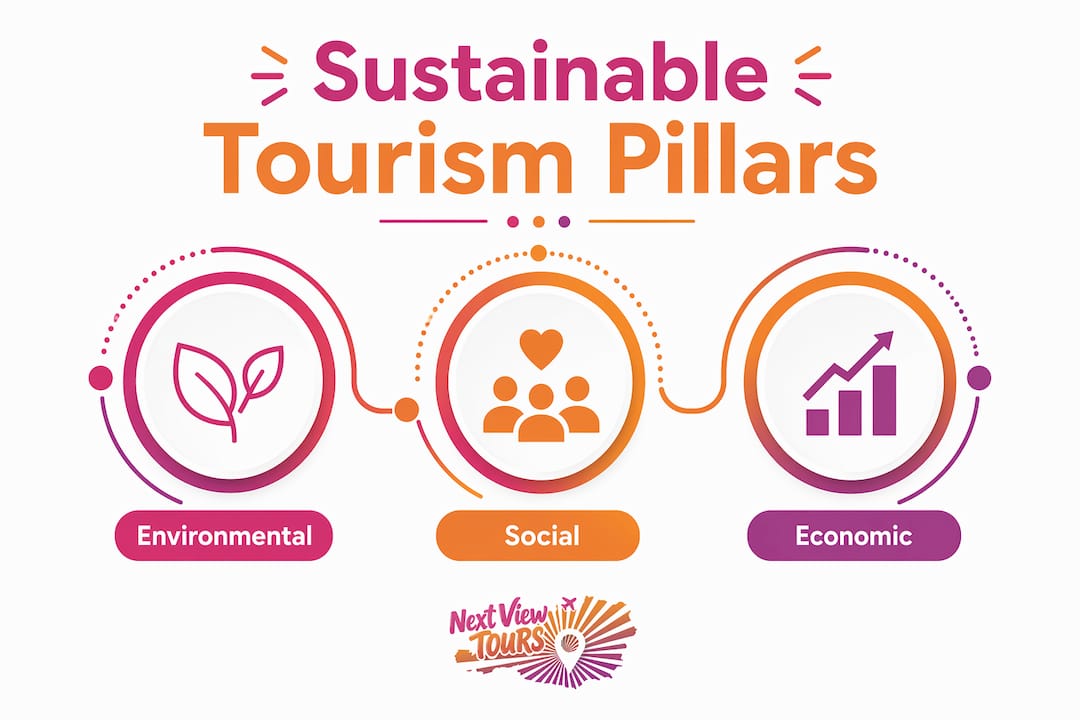
Balancing all three pillars is what separates genuine sustainable tourism from greenwashing. A resort can install solar panels and still displace a fishing village. A tour operator can hire local guides and still leave trails littered with single-use plastics. Sustainability requires all three pillars working together.
How do certifications like GSTC set the standard?
The Global Sustainable Tourism Council (GSTC) provides global standards and accredits certification bodies for hotels, tour operators, and destinations. This matters because the travel industry is full of self-declared “eco-friendly” claims with no independent verification. GSTC accreditation means a third party has audited the operation against a defined set of criteria.
The measurable difference is significant. A 2017 TUI Group survey found that certified hotels had 10% lower CO2 emissions and 24% less waste per guest night compared to non-certified properties, along with greater use of renewable energy and higher employment of nationals. That is not a marginal improvement. It represents a structural difference in how a property operates.
| Metric | Certified hotels | Non-certified hotels |
|---|---|---|
| CO2 emissions per guest night | 10% lower | Baseline |
| Waste per guest night | 24% less | Baseline |
| Renewable energy use | Higher | Lower |
| Employment of nationals | Higher | Lower |
Travelers achieve more consistent outcomes by choosing certified accommodations and operators that follow GSTC standards. The certification removes the guesswork. You are not relying on a hotel’s marketing copy. You are relying on an audited record.
Pro Tip: Before booking, search the GSTC website directly for accredited certification bodies in your destination country. A property claiming sustainability should be able to name its certifier.
Inconsistent measurement of sustainability claims is one of the industry’s biggest problems. GSTC standards and accreditation exist precisely to address that gap, giving travelers and the industry a shared, trusted reference point.
Sustainable tourism vs. ecotourism: what’s the real difference?
These terms are often used interchangeably, but they describe different scopes of concern.
- Sustainable tourism covers all forms of travel and addresses economic, social, and environmental impacts across entire destinations and industries. A city hotel, a ski resort, and a river cruise can all practice sustainable tourism.
- Ecotourism focuses specifically on natural environments, conservation, and minimal impact. It is a subset of sustainable tourism, not a synonym. A wildlife safari in Kenya designed to fund conservation and employ local rangers is ecotourism. A Vienna city break with a certified hotel and locally sourced meals is sustainable tourism but not ecotourism.
- Responsible travel describes the personal behavior of the traveler, not the destination or operator. Carrying a reusable water bottle, respecting photography restrictions at sacred sites, and tipping local guides fairly are all acts of responsible travel. They complement sustainable tourism but do not replace it.
Sustainable tourism covers broader economic and social factors than ecotourism’s conservation focus. Understanding this distinction matters because it sets realistic expectations. You do not need to hike through a rainforest to travel sustainably. You can practice sustainable tourism on a guided tour of Salzburg or a multi-day trip through Slovakia, provided the operator meets the right standards.
The overlap between these concepts is real and valuable. The best ecotourism experiences are also economically and socially sustainable. The best sustainable tourism destinations often include strong conservation programs. Think of them as concentric circles, not competing categories.
How to practice sustainable tourism on your next trip
Adopting sustainable travel practices does not require a complete overhaul of how you travel. It requires deliberate choices at each decision point.
- Choose certified accommodations. Look for properties with GSTC-accredited certifications or recognized national eco-labels. Certification is the clearest signal that sustainability claims have been independently verified.
- Book with responsible operators. Select tour operators that publish their environmental and social policies, employ local guides, and limit group sizes to reduce site pressure. Nextviewtours’ nature trips are designed with exactly this philosophy in mind.
- Support local economies directly. Buy food from local markets, hire local guides rather than international agencies, and choose locally owned restaurants over international chains. Every euro spent locally stays in the community.
- Reduce your environmental footprint. Carry a reusable water bottle and bag, decline unnecessary single-use plastics, reuse towels and linens, and turn off air conditioning when you leave your room. These are small actions with cumulative impact across millions of travelers.
- Respect cultural norms. Research dress codes, photography restrictions, and local customs before you arrive. Treating a destination’s culture with the same care you give its environment is a core part of sustainable travel.
- Choose lower-impact transportation. Train travel across Europe produces a fraction of the carbon emissions of short-haul flights. Where possible, take the train between cities and walk or cycle within them.
Sustainable tourism initiatives produce measurable benefits for local economies, environments, and cultural heritage when travelers make these choices consistently. The cumulative effect of individual decisions is not symbolic. It is structural.
Pro Tip: When joining a group tour, ask the operator directly: “What percentage of our guides and staff are from this region?” A high local employment rate is one of the strongest indicators of genuine community investment.
Sustainable tourism examples with measurable impact
Real-world examples show what the three pillars look like in practice, and the results are concrete.
Community-based tourism in Central Europe connects travelers directly with rural communities in Slovakia and the Czech Republic, where local families host guests, prepare traditional meals, and lead cultural experiences. The financial benefit stays almost entirely within the community, and cultural traditions are preserved through active participation rather than passive observation.
Destinations adopting GSTC Destination Standards commit to managing visitor flows, protecting natural and cultural assets, and measuring their progress against defined benchmarks. This is destination-level sustainability, not just property-level. It addresses carrying capacity, seasonality, and infrastructure in ways that individual hotels cannot.
Regenerative tourism goes a step further than sustainability by actively restoring ecosystems and communities rather than simply reducing harm. Projects in the Austrian Alps, for example, combine guided hiking with trail restoration work, giving travelers a direct role in maintaining the landscapes they visit. This is the emerging direction of European tours in 2025 and 2026.
| Approach | Primary focus | Measurable outcome |
|---|---|---|
| Community-based tourism | Local economic benefit | Income stays within host community |
| GSTC-certified destinations | Destination management | Reduced overcrowding and resource use |
| Regenerative tourism | Ecosystem restoration | Active habitat and trail improvement |
| Certified eco-accommodations | Property-level sustainability | Lower emissions and waste per guest night |
The pattern across all these examples is the same: measurable standards, local involvement, and long-term thinking produce better outcomes than good intentions alone.
Key takeaways
Sustainable tourism works because it balances environmental protection, social equity, and economic viability through measurable standards, certified operators, and deliberate traveler choices.
| Point | Details |
|---|---|
| Three-pillar framework | Sustainable tourism requires environmental, social, and economic balance, not just green gestures. |
| GSTC certification matters | Certified hotels show 10% lower CO2 and 24% less waste per guest night versus non-certified peers. |
| Ecotourism is a subset | Ecotourism focuses on conservation; sustainable tourism covers all travel types and broader impacts. |
| Traveler choices drive outcomes | Booking certified operators and spending locally produces direct, measurable community and environmental benefits. |
| Regenerative tourism is next | The most advanced sustainable tourism now actively restores ecosystems rather than just reducing harm. |
Why I think sustainable tourism is the most misunderstood idea in travel
At Nextviewtours, we have spent years designing trips across Europe, and the single most common misconception we encounter is that sustainable tourism means inconvenient tourism. Travelers assume it means roughing it, paying more, or sacrificing comfort for conscience. That is not what the evidence shows.
The certified properties in the TUI Group data were not austere retreats. They were hotels that had made operational decisions: better waste systems, local hiring, renewable energy contracts. The guest experience was not diminished. In many cases, it was richer, because locally employed staff bring genuine knowledge of their region that no international chain can replicate.
What I have found genuinely challenging is the certification gap. Too many operators in Central and Eastern Europe still rely on self-declaration rather than third-party verification. Travelers cannot always tell the difference, and that creates a trust problem for the entire sector. The answer is not cynicism. It is asking better questions before you book.
The guided tours trends for 2025 point clearly toward smaller groups, local expertise, and measurable impact. That is not a niche preference. It is where the market is moving, and for good reason. Travelers who experience a destination through its own people and landscapes consistently report deeper satisfaction than those who move through it at scale.
Sustainable tourism is not a sacrifice. It is a better way to travel.
— Next
Explore sustainable travel with Nextviewtours

Nextviewtours designs trips across Europe with sustainability built into the structure, not added as an afterthought. From small-group nature trips through the Austrian Alps to culturally immersive experiences in Prague, Budapest, and Salzburg, every itinerary prioritizes local guides, responsible operators, and meaningful community engagement. The goal is travel that leaves destinations better than you found them. Browse the full range of trip types at Nextviewtours to find an experience that matches your values and your sense of adventure. Whether you are planning a private tour, a family trip, or a multi-day adventure, there is a sustainable option designed for you.
FAQ
What is the simplest definition of sustainable tourism?
Sustainable tourism is tourism that balances economic, social, and environmental impacts to meet the needs of visitors, local communities, and the environment both now and in the future, as defined by UN Tourism (UNWTO).
How is sustainable tourism different from ecotourism?
Ecotourism focuses specifically on natural environments and conservation, while sustainable tourism covers all travel types and addresses broader economic and social impacts alongside environmental ones.
What does GSTC certification mean for travelers?
GSTC-accredited certification means an independent body has verified that a hotel, tour operator, or destination meets global sustainable tourism standards, giving travelers a reliable signal beyond marketing claims.
What are the easiest sustainable travel practices to adopt?
Choosing certified accommodations, supporting local businesses, reducing single-use plastics, and booking with operators that employ local guides are the most direct ways to practice sustainable tourism on any trip.
Does sustainable tourism cost more?
Not necessarily. Many certified properties and responsible operators price competitively, and spending locally, on markets, local restaurants, and regional guides, often costs less than international alternatives while delivering greater community benefit.


Comments are closed