

 Uncategorized
TL;DR:
- Effective summer trip planning in 2026 requires booking flights and hotels early, with a focus on flexibility. Travelers should organize their itineraries around one main activity daily and prepare for unexpected changes with insurance and contingency plans. Proper sequencing of bookings and defining trip purpose early significantly increase trip satisfaction and efficiency.
The summer tour planning process is the series of strategic steps travelers take to organize, book, and structure their summer vacations for a smooth and rewarding experience. Done well, it turns a chaotic wish list into a confident, day-by-day plan. Done poorly, it means paying more for less, missing sold-out attractions, and scrambling at the airport. With flight prices to Europe running 6–12% higher in 2026 compared to 2024, the margin for unplanned decisions has never been thinner. A structured approach is not optional this year. It is the difference between a trip you remember fondly and one you wish you had planned better.
What are the essential prerequisites for planning your summer tour?
Before you open a single booking tab, you need three things in order: valid documents, a realistic budget, and a clear sense of what you actually want from the trip. Skipping this step is the most common reason summer vacations fall apart before they begin.
Documents first. Your passport must be valid for at least 6 months after your return date. Many countries enforce this rule strictly, and airlines will deny boarding without it. Check your passport now, not the week before departure.
Budget with honesty. Rising costs in 2026 mean your 2023 budget estimates are outdated. Factor in flights, accommodation, daily meals, attraction tickets, local transport, and travel insurance. Travel insurance with medical evacuation coverage is now a mandatory budget line, not an optional add-on. Build a 10–15% buffer for unexpected costs.
Tools that actually help:
- A shared digital folder (Google Drive or similar) for all booking confirmations, passport scans, and insurance documents
- A travel itinerary template to map days, cities, and activities
- A shared spreadsheet for group trips to track costs and preferences
- A travel app for real-time flight and weather monitoring
Pro Tip: Create one master folder with subfolders labeled “Flights,” “Hotels,” “Activities,” and “Documents.” Share it with every traveler in your group before the first booking is made. This single habit eliminates 90% of the “where did I save that?” panic.
For travelers new to European group trips, Nextviewtours offers a detailed group tour preparation guide that covers packing, timing, and what to expect on arrival.
How should you sequence bookings for flights, hotels, and activities?
The sequence of booking matters more than speed. Booking the wrong thing first locks you into a rigid, expensive structure. The right order protects your budget and your flexibility.

The correct booking sequence:
| Booking Stage | What to Book | When to Book |
|---|---|---|
| Stage 1 | Flights (refundable where possible) | 7–9 months before travel |
| Stage 2 | Anchor hotels in peak-demand cities | 7–9 months before travel |
| Stage 3 | Skip-the-line tickets for major attractions | 3–4 months before travel |
| Stage 4 | Secondary accommodations and regional transport | 3–4 months before travel |
| Stage 5 | Restaurants, day tours, and flexible activities | 4–6 weeks before travel |
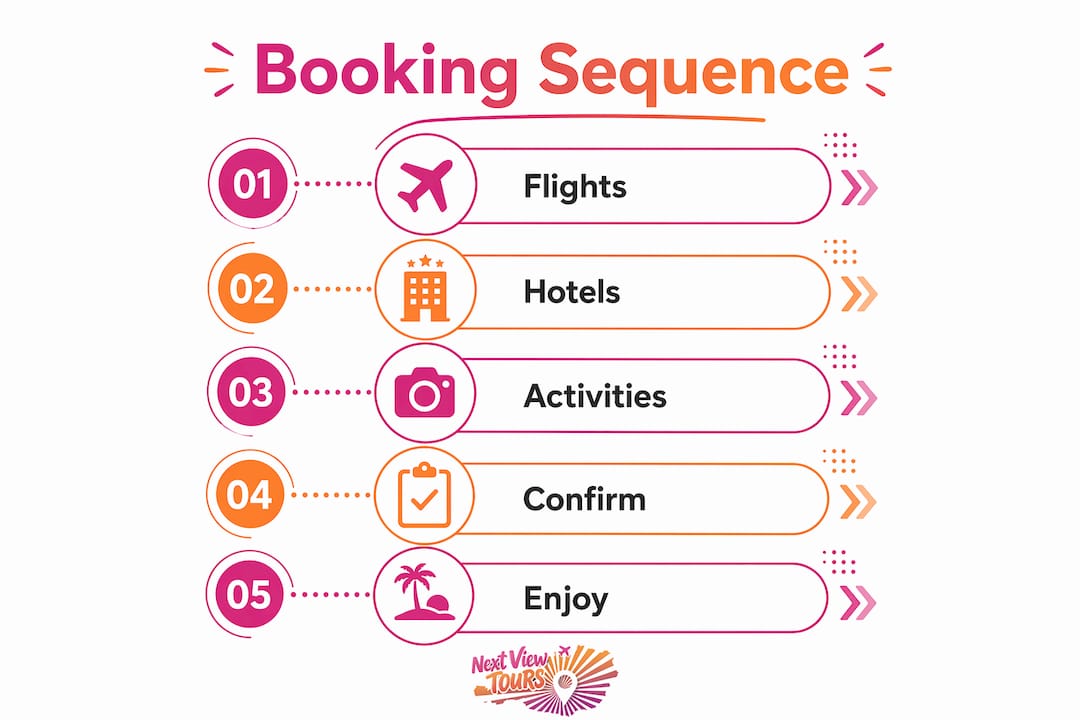
Flights and coastal hotels sell out 7–9 months in advance for peak summer dates. That means a trip in july or august requires action by october or november of the prior year. Popular skip-the-line tickets for places like the Vatican Museums or the Alhambra sell out 60–90 days in advance, so booking 3–4 months out gives you a meaningful safety margin.
Travel advisors recommend booking refundable flights and hotels early, then confirming non-refundable activity tickets closer to your travel dates. This approach gives you the best of both worlds: secured availability and the freedom to adjust if plans shift.
Pro Tip: Multi-city flights often cost the same as or less than round trips to a single hub, and they save you full travel days. If you plan to visit Vienna, Salzburg, and Prague, fly into one city and out of another instead of backtracking.
Check the European summer travel guide from Nextviewtours for city-specific booking advice across Austria, the Czech Republic, Hungary, and Slovakia.
What are effective methods to build your summer trip itinerary?
A strong itinerary starts with a clear answer to one question: why are you taking this trip? Most travelers underemphasize the trip’s core purpose and overemphasize logistics like restaurant lists. Defining your “why” first, whether that is history, food, outdoor adventure, or family connection, makes every subsequent decision faster and more consistent.
Build your itinerary in this order:
- Choose 2–4 base cities. Fewer bases mean less time on trains and more time experiencing each place. Two weeks across six cities is exhausting. Two weeks across three cities is memorable.
- Assign travel days. Mark the days you move between cities as travel days. Do not schedule major activities on those days.
- Anchor each day with one main activity. Organizing your itinerary around one anchor activity per day leaves room for spontaneous discoveries without leaving you directionless.
- Schedule demanding activities in the morning or evening. Smart travelers avoid midday heat by placing outdoor walks, markets, and strenuous sightseeing before 11 a.m. or after 5 p.m. Use midday for museums, cafes, or rest.
- Draft, then revise. Effective itinerary building benefits from multiple draft passes: first pass for bases and anchor activities, second pass for optional walks and neighborhood discoveries.
Common itinerary mistakes to avoid:
- Scheduling back-to-back full-day tours with no buffer time
- Ignoring travel time between attractions within the same city
- Planning the same intensity every single day without rest
- Booking every meal in advance and leaving no room for local finds
Pro Tip: For group trips, use a shared Google Doc with a day-by-day table. Let each traveler add one “must-do” per city. Then build the anchor activities around those inputs. This prevents resentment and keeps everyone invested in the plan.
Nextviewtours publishes specific summer tour tips for European vacations that cover pacing, city selection, and guided versus self-guided trade-offs.
How do you manage unexpected changes during your summer tour?
The “wait-and-see” approach does not work in 2026. Higher demand, tighter routes, and unpredictable weather mean you need a contingency plan before you leave home, not after something goes wrong.
“Digital tools and apps can rapidly adapt travel plans when disruption occurs, but on-the-ground intelligence and personal judgment remain vital.” — Summer Travel Tips 2026
Contingency strategies that actually work:
- Buy travel insurance that includes medical evacuation, trip cancellation, and flight delay coverage. Read the policy before you buy it.
- Book refundable rates for hotels whenever the price difference is under 15%. The flexibility is worth the small premium.
- Keep one unscheduled half-day per city in your itinerary. Use it for recovery, weather delays, or a spontaneous detour.
- Download offline maps and save hotel and transport confirmation numbers to your phone before you land.
- Monitor weather forecasts 72 hours out and adjust outdoor activities accordingly.
- For restaurant reservations, book the ones that matter 2–3 weeks ahead and leave the rest open.
Pitfalls to avoid:
- Overbooking every hour of every day with no slack time
- Relying solely on one app or platform for real-time updates
- Ignoring airline rebooking policies until you need them
- Assuming your credit card travel insurance covers medical evacuation (most do not)
Due to rising costs and uncertainty, many travelers in 2026 are choosing shorter trips or destinations closer to home. Adjusting your planning scope to match your actual budget is not a compromise. It is smart travel.
Key Takeaways
A successful summer tour in 2026 requires booking flights and anchor hotels 7–9 months early, structuring each itinerary day around one anchor activity, and pairing early refundable bookings with flexible activity planning closer to travel dates.
| Point | Details |
|---|---|
| Book in the right order | Secure flights first, then anchor hotels, then attraction tickets 3–4 months out. |
| Validate your documents early | Your passport must be valid for at least 6 months past your return date. |
| Anchor each day with one activity | One main activity per day leaves room for discovery without losing structure. |
| Build in flexibility | Book refundable rates early and confirm non-refundable tickets closer to travel. |
| Plan for disruption | Travel insurance with medical evacuation coverage is a required budget item in 2026. |
What I have learned from planning summer tours across Europe
After years of helping travelers plan summer trips across Vienna, Salzburg, Prague, Budapest, and beyond, one pattern stands out clearly. The travelers who enjoy their trips the most are not the ones with the most detailed itineraries. They are the ones who defined their trip’s purpose early and then stayed flexible about everything else.
The biggest mistake I see is treating the itinerary as a fixed contract. You book a tour for 10 a.m., a museum for 1 p.m., and a restaurant for 7 p.m., and then a single delay unravels the entire day. The travelers who build in breathing room, one anchor activity per day, one unscheduled afternoon per city, consistently report higher satisfaction.
I also think the conventional wisdom about “booking everything in advance” is only half right. Book your flights and anchor hotels as early as possible. But keep your activity schedule loose until 4–6 weeks out. By then, you will know your group’s energy level, the weather forecast, and which neighborhoods you actually want to spend more time in.
One more thing: the trend toward shorter, nearby trips is not a failure of ambition. Rising costs and shifting priorities mean a four-day trip done well beats a two-week trip done poorly. A day trip from Vienna to Hallstatt or a weekend in Prague can be just as rewarding as a month-long circuit, if you plan it with intention.
The best summer trips are not the longest or the most expensive. They are the ones where you knew what you wanted, booked what mattered, and left room for the rest.
— Next
Plan your summer tour with Nextviewtours
Nextviewtours specializes in European tours and experiences across Vienna, Salzburg, Prague, Budapest, Slovakia, and the Czech Republic, with options for every travel style and group size.
Whether you are looking for a structured multi-day adventure across Europe, a private customized tour built around your exact interests, or a group tour package that handles the logistics for you, Nextviewtours offers flexible booking policies designed for 2026 travel realities. Every itinerary is built with the right balance of structure and freedom, so you spend less time managing details and more time experiencing Europe. Browse the full range of trip types at Nextviewtours to find the format that fits your summer plans.
FAQ
How far in advance should I book summer flights to Europe?
Book flights 7–9 months before your travel dates. Flight prices in 2026 are 6–12% higher than in 2024, and peak summer seats sell out well before spring.
What is the 6-month passport rule?
Your passport must remain valid for at least 6 months after your return date. Airlines and border authorities enforce this rule strictly, and failing to meet it results in denied boarding.
How many cities should I include in a two-week summer itinerary?
Two to four base cities is the recommended range for a two-week trip. More than four cities means more travel days and less time experiencing each destination.
Should I book all activities before I leave home?
Book skip-the-line tickets for major attractions 3–4 months ahead. Leave restaurants and flexible day activities until 4–6 weeks out, when you have a clearer picture of your group’s pace and preferences.
Is travel insurance really necessary for summer 2026?
Travel insurance with medical evacuation coverage is a required part of trip budgeting in 2026. Standard credit card coverage rarely includes medical evacuation, so a dedicated policy is the safer choice.


Comments are closed