
 News & Tips
Many parents believe planning a multi-generational European vacation requires months of spreadsheet juggling and stress. Yet thousands of families discover a simpler path: organized family tours that handle logistics while delivering enriching cultural experiences. In 2026, with new ETIAS travel requirements and surging demand for meaningful family travel, booking a well-designed tour transforms complex itineraries into seamless adventures. This guide reveals why family tours offer unmatched value for convenience, education, and bonding across generations, helping you decide if this approach fits your next European journey.
Table of Contents
- Understanding The Unique Benefits Of Family Tours In Europe
- How Family Tours Simplify Complex European Travel Planning In 2026
- Balancing Flexibility And Structure: Choosing The Right Family Tour Style
- Practical Tips For Booking And Enjoying Family Tours In Europe In 2026
- Explore Tailored Family Tours With Next View Tours
- Frequently Asked Questions
Key takeaways
| Point | Details |
|---|---|
| Age-appropriate enrichment | Family tours design activities that engage children and adults simultaneously, fostering shared learning and cultural immersion. |
| Stress-free logistics | Tours manage complex transport, lodging, ETIAS compliance, and crowd navigation, saving families hours of planning. |
| Multi-generational benefits | Grandparents, parents, and kids travel together safely with structured support and flexible schedules. |
| Balanced convenience | Hybrid tour models blend guided experiences with free time, offering structure without sacrificing exploration. |
| Tailored family needs | Flexible booking options suit first-timers, busy parents, and safety-conscious families seeking expert guidance. |
Understanding the unique benefits of family tours in Europe
Europe’s rich tapestry of history, art, and cuisine creates unparalleled opportunities for families to learn together. Family tours offer enriching, age-appropriate activities that foster intergenerational bonding, education, and cultural immersion across the continent. Unlike generic vacations, these tours craft experiences where a seven-year-old explores Roman ruins with the same fascination as their grandparent, creating shared memories that last decades.
The educational value extends beyond museums and monuments. Children absorb new languages, taste unfamiliar foods, and witness diverse cultures firsthand, building empathy and global awareness. Parents and grandparents rediscover wonder through younger eyes, strengthening family connections in ways daily routines rarely allow. Tours designed for family-friendly trips across Europe balance learning with play, ensuring no age group feels left behind.
Consider how a well-structured tour transforms abstract history into tangible experience. Walking Vienna’s imperial palaces becomes a story about real emperors and empresses. Tasting fresh pasta in Prague connects geography to culinary tradition. These moments create what psychologists call “collective memory,” where families build a shared narrative that defines their relationships.
Key benefits include:
- Activities scaled to multiple age groups simultaneously
- Expert guides who engage children with storytelling while satisfying adult curiosity
- Safety measures tailored for traveling with young kids and elderly relatives
- Structured schedules that prevent overstimulation and exhaustion
- Cultural immersion opportunities that independent travel often misses
Pro Tip: Choose tours that incorporate hands-on activities like cooking classes or craft workshops. Kids retain cultural lessons far better when they create something tangible, and these activities give adults a chance to relax while children stay engaged.
“Travel is the only thing you buy that makes you richer. For families, organized tours multiply that wealth by ensuring every generation participates fully in the experience.”
How family tours simplify complex European travel planning in 2026
Planning a European family vacation in 2026 involves navigating intricate logistics that overwhelm even experienced travelers. Train schedules across six countries, hotel bookings for varying group sizes, restaurant reservations accommodating dietary restrictions, and crowd management at peak attractions create a planning burden few parents anticipate. Organized tours excel in handling these complexities, particularly for families juggling work schedules and childcare alongside trip preparation.

The 2026 ETIAS requirement adds another layer of complexity for US families and other non-EU visitors. This new electronic travel authorization system requires advance application, passport verification, and fee payment before entering Europe’s Schengen zone. Family tour operators integrate ETIAS compliance into their booking process, ensuring every family member has proper authorization without parents tracking multiple deadlines and document requirements.
The family travel market reflects growing demand for organized solutions, reaching $209 billion globally with average US families spending $8,000 on vacations in 2024. This investment drives families to seek maximum value, and tours deliver by eliminating wasted time on logistics. Instead of spending vacation hours deciphering train schedules or finding kid-friendly restaurants, families focus entirely on experiences.
Safety considerations amplify for multi-generational groups. Elderly grandparents need accessible routes and rest periods. Young children require constant supervision in crowded tourist areas. Tours provide professional guides trained in group management, emergency protocols, and local healthcare access. This support network proves invaluable when unexpected situations arise, from lost passports to sudden illness.
Logistical advantages include:
- Pre-arranged transportation between cities and attractions
- Hotels vetted for family-friendly amenities and locations
- Skip-the-line access at major museums and landmarks
- Meal planning that accommodates allergies and preferences
- Local expertise preventing common tourist mistakes
Pro Tip: Request detailed daily itineraries before booking. Quality family-friendly Europe guides provide hour-by-hour schedules showing exactly when you’ll have free time versus structured activities, helping you assess if the pace suits your family’s energy levels.
| Planning Element | Independent Travel Time | Tour-Managed Time |
|---|---|---|
| Transport research | 15-20 hours | 0 hours |
| Accommodation booking | 8-12 hours | 0 hours |
| Activity reservations | 10-15 hours | 0 hours |
| ETIAS applications | 2-3 hours | Included |
| Daily navigation | 1-2 hours daily | 0 hours |
Balancing flexibility and structure: choosing the right family tour style
The guided versus independent travel debate centers on control versus convenience. Guided tours offer structured itineraries, professional support, and predictable costs, but lack flexibility for spontaneous exploration. Independent travel allows customization and potentially lower costs but demands extensive planning and carries higher stress when logistics fail. Understanding these trade-offs helps families select the approach matching their priorities and travel experience.
Cost comparisons reveal surprising nuances. Guided family tours typically run $250 to $400 per person daily, covering transport, lodging, most meals, and activities. Independent travel averages $150 to $250 per night for accommodations alone, with transport, food, and attraction fees adding substantially. When factoring in time spent planning and potential mistakes, the price gap narrows considerably for families lacking European travel experience.
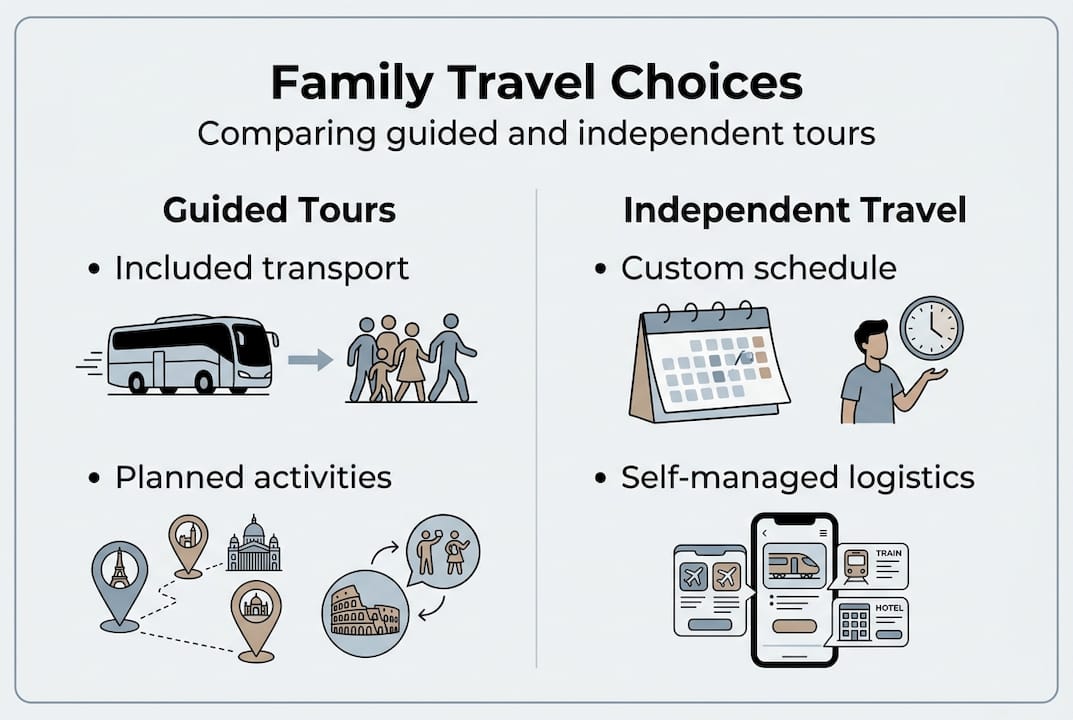
Multi-generational groups and first-time European travelers benefit most from guided tours. Grandparents appreciate not managing logistics while keeping pace with grandchildren. Parents value the safety net of professional guides. First-timers avoid costly mistakes like booking hotels far from attractions or missing cultural context at historical sites. Busy professionals unable to invest planning time find tours eliminate administrative burden entirely.
Hybrid models emerge as a compelling middle ground. These tours provide structured activities for key experiences while building in free afternoons or evenings for independent exploration. Families enjoy expert-guided visits to major attractions while maintaining autonomy for personal interests. This flexibility particularly suits families with older children who want some independence or parents seeking occasional adult-only dining.
| Tour Style | Best For | Cost Range | Flexibility Level |
|---|---|---|---|
| Fully Guided | First-timers, multi-gen groups | $250-$400/day | Low |
| Hybrid | Experienced travelers wanting support | $200-$300/day | Medium |
| Independent | Budget-conscious, control-focused | $150-$250/night base | High |
| Private Custom | Families with specific needs | $400-$600/day | Very High |
Decision framework considerations:
- Travel experience level in Europe
- Family size and age range of participants
- Budget flexibility and value priorities
- Desire for cultural depth versus surface coverage
- Tolerance for planning stress and potential problems
Understanding differences between group and private tours adds another dimension. Group tours offer social interaction and lower costs but fixed schedules. Private tours provide ultimate customization and pace control at premium pricing. Families with young children often prefer private options to accommodate nap schedules and energy fluctuations without impacting other travelers.
Pro Tip: Test your family’s tour compatibility with a short two to three day guided experience before committing to a week-long or longer tour. This trial run reveals whether your family thrives with structured schedules or chafes against limited spontaneity.
Practical tips for booking and enjoying family tours in Europe in 2026
Securing the right family tour requires strategic planning and clear priorities. Early booking proves essential in 2026 as family travel demand surges post-pandemic. Tours fill six to nine months ahead for peak summer dates, and early reservations often unlock discounts of 10 to 15 percent. Beyond pricing, early booking provides better selection of departure dates, accommodation options, and group sizes that fit your family dynamics.
Age-appropriate activity selection separates memorable tours from mediocre ones. Prioritize flexible itineraries and age-tailored activities when evaluating tour operators. Quality providers offer multiple activity tiers, allowing teenagers to choose challenging hikes while younger siblings enjoy gentler nature walks. Look for tours incorporating interactive elements like scavenger hunts at historical sites or hands-on craft workshops that maintain engagement across age groups.
Safety measures deserve careful scrutiny for multi-generational travel. Confirm tour operators maintain appropriate adult-to-child ratios, typically one guide per eight to ten participants for families. Verify guides carry first aid certification and emergency contact protocols. Ask about accessibility accommodations for elderly relatives, including rest periods, wheelchair access at attractions, and flexibility for those unable to maintain group pace.
Hybrid tours offering structured mornings with free afternoons provide optimal balance for many families. This format ensures you experience must-see attractions with expert guidance while preserving energy and autonomy for personal interests. Free time lets families recharge at different paces, crucial when traveling with both energetic children and older adults needing rest.
Actionable booking steps:
- Define your family’s non-negotiable requirements (budget, pace, must-see destinations)
- Research tour operators specializing in family travel with verified reviews
- Request detailed itineraries showing activity levels and free time allocation
- Confirm cancellation policies and travel insurance options
- Verify ETIAS and passport requirements for all family members
- Book early to secure preferred dates and potential discounts
- Engage children in activity selection to boost their investment and excitement
Pro Tip: Create a family travel council where each member chooses one must-do activity. This democratic approach ensures everyone feels heard and invested in the trip’s success, dramatically reducing complaints and resistance during the actual tour.
Packing strategies matter more for tours than independent travel. Tours move quickly between destinations, making light, organized luggage essential. Each family member should manage their own daypack with essentials like water, snacks, and layers. This distribution prevents parents from becoming pack mules while teaching children responsibility for their belongings.
Consider essential family travel tips covering everything from jet lag management to keeping kids engaged during long museum visits. Small preparations like downloading offline maps, packing familiar snacks for picky eaters, and establishing family meeting points at crowded attractions prevent common frustrations that derail otherwise excellent tours.
Explore tailored family tours with Next View Tours
Transforming European travel aspirations into reality requires a partner who understands family dynamics and delivers seamless experiences. Next View Tours specializes in crafting journeys where logistics fade into the background and memories take center stage. Whether you envision exploring Vienna’s imperial grandeur, discovering Hallstatt’s alpine beauty, or immersing in Prague’s medieval charm, expert planning removes the stress from multi-generational adventures.
Discover diverse trip types designed specifically for families, from day excursions perfect for younger children to comprehensive multi-day adventures that satisfy curious teenagers and adults alike. Each itinerary balances cultural enrichment with practical considerations like rest periods, age-appropriate activities, and flexible scheduling. Professional guides bring destinations alive with stories that captivate every generation, while behind-the-scenes coordination ensures smooth transitions between cities and experiences. Explore family tour options and start planning the European adventure your family will treasure for decades.
Frequently asked questions
Are family tours worth the investment compared to independent travel?
Family tours deliver exceptional value when you factor in time savings, stress reduction, and enriched experiences. The $250 to $400 daily cost includes expert guides, pre-arranged logistics, skip-the-line access, and safety support that independent travelers must secure separately. For first-time European visitors and multi-generational groups, tours prevent costly mistakes and maximize limited vacation time, making the premium worthwhile.
How do tours accommodate different age groups effectively?
Quality family tour operators design tiered activities where each age group engages at appropriate levels simultaneously. While teenagers tackle challenging historical analysis, younger children participate through interactive games and storytelling. Flexible schedules include rest periods for elderly relatives and high-energy options for active kids, ensuring no one feels left out or overwhelmed.
What safety advantages do organized tours provide families?
Tours offer professional guides trained in emergency protocols, group management in crowded spaces, and local healthcare access. They maintain appropriate adult-to-child supervision ratios and provide constant accountability for family members. This structured support proves invaluable when traveling with young children or elderly relatives in unfamiliar European cities.
Can families maintain flexibility within structured tour itineraries?
Hybrid tour models balance guided experiences with substantial free time, typically offering structured mornings at major attractions and open afternoons for independent exploration. Families enjoy expert guidance for complex sites while retaining autonomy for personal interests, dining preferences, and rest periods. This approach satisfies both structure-seekers and spontaneity-lovers within the same family.
Which families benefit most from booking organized tours?
Multi-generational groups traveling together, first-time European visitors, safety-conscious parents, and busy professionals unable to invest extensive planning time gain maximum value from tours. Families with young children appreciate predictable schedules and vetted accommodations, while those with elderly relatives value accessibility considerations and managed pacing that independent travel rarely provides.
How early should families book European tours for 2026 travel?
Book six to nine months ahead for peak summer dates to secure preferred departure times and group sizes. Early reservations often unlock 10 to 15 percent discounts and provide better accommodation selection. For shoulder season travel in spring or fall, three to four months advance booking typically suffices, though popular destinations like Vienna and Prague fill quickly year-round.
Recommended
- Family Tours Explained: Creating Unforgettable Europe Trips – Next View Tours
- Guided Tours Trends 2025: Impact on European Travel – Next View Tours
- Trend in Europe Tours 2025: Immersive, Sustainable, Social – Next View Tours
- Family-Friendly Trips Europe: Complete Planning Guide – Next View Tours
- Complete Guide to Family Travel Booking – PilotTravelDeals.com


Comments are closed