
 Uncategorized
TL;DR:
- Multi-country touring involves traveling across two or more European countries with purpose and depth.
- Planning benefits from focusing on fewer destinations, using reliable transport, and allowing buffer time.
- Guided, independent, and hybrid tours offer different levels of support and flexibility for travelers.
Discover multi-country touring in Europe: step-by-step guide
Europe is one of the world’s most rewarding playgrounds for curious travelers. With 1.4 billion outbound trips made across European countries every year, it’s clear that the continent has an almost magnetic pull. Yet most first-timers don’t fully realize what they’re stepping into when they decide to cross multiple borders in a single journey. Multi-country touring is exciting, layered, and sometimes overwhelming. This guide cuts through the noise and walks you through everything you need to know, from defining what multi-country touring actually is to choosing your format, planning your itinerary, and personalizing your adventure.
Table of Contents
- Understanding multi-country touring: Definition and scope
- Major touring formats: Escorted, independent, and hybrid options
- How to plan a seamless multi-country itinerary
- Adventure trips and customized experiences across Europe
- Why most travelers underestimate multi-country touring
- Planning your next multi-country adventure with Next View Tours
- Frequently asked questions
Key Takeaways
| Point | Details |
|---|---|
| Trip length benchmarks | Most multi-country European tours cover 3-4 countries in about two weeks. |
| Planning complexity | 60% of travelers find multi-country touring challenging, especially itinerary design. |
| Tour format choices | Escorted, independent, and hybrid tour models each offer unique benefits for travelers. |
| Adventure personalization | Customized and adventure itineraries elevate touring, making trips more immersive and memorable. |
| Professional support | Tour operators and expert advice can help avoid common pitfalls and maximize your trip’s value. |
Understanding multi-country touring: Definition and scope
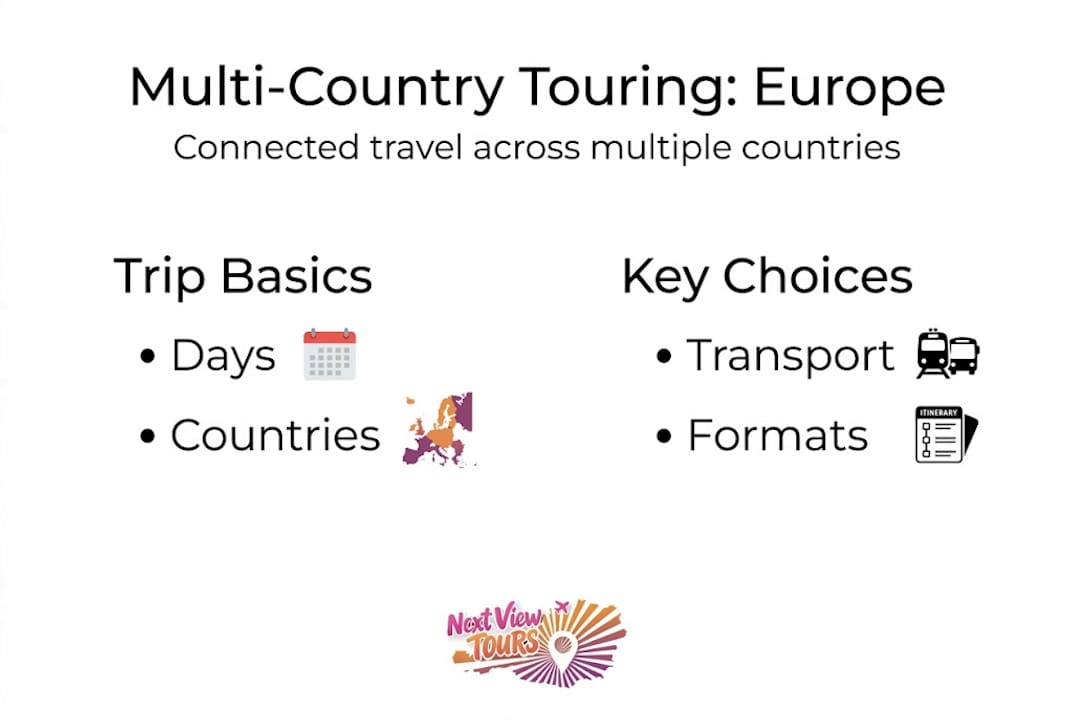
Multi-country touring simply means traveling across two or more countries in one connected trip. You move through each destination with purpose, experiencing different cultures, languages, landscapes, and histories in a single journey. It’s not a rushed checklist of airports. Done right, it’s a layered experience that builds on itself as you travel from one country to the next.
This style of travel has exploded in popularity because Europe makes it genuinely easy. Shared rail networks, open borders within the Schengen Area, and a dense concentration of world-class cities mean you can be in Vienna one morning and Budapest that same evening. Few other regions on earth offer this kind of geographic convenience.
Who is this kind of travel for?
Multi-country touring suits a wide range of travelers. It works well for:
- First-time European visitors who want to experience multiple cultures without booking separate trips
- Seasoned travelers looking for efficiency and depth in a limited time window
- Families wanting to show children different countries, languages, and customs in one go
- Couples seeking romantic variety, moving from the baroque grandeur of Vienna to the thermal spas of Budapest
- Adventure seekers who want to combine outdoor landscapes with historical cities
According to European travel trends, there’s been a marked rise in travelers combining Central European hubs like Prague, Vienna, Salzburg, and Budapest into single itineraries.
Typical trip parameters
Understanding the realistic scope of a multi-country tour helps you set expectations before you book anything. The empirical benchmark is clear: a two-week trip covers 3 to 4 countries comfortably, with a mid-range daily budget of €80 to €120 in Western Europe and an average total trip spend around €1,240.
| Trip length | Countries covered | Daily budget (mid-range) |
|---|---|---|
| 1 week | 2 countries | €80 to €100/day |
| 2 weeks | 3 to 4 countries | €80 to €120/day |
| 3 weeks | 5 to 6 countries | €90 to €130/day |
Transport modes play a big role in cost and experience. Eurail passes are popular for long-distance travel between major hubs, while regional buses and day trip services connect smaller towns and rural landscapes. Budget airlines are fast but can fragment the experience and add hidden costs. Rail travel, by contrast, keeps you grounded in the scenery and builds a natural rhythm into your journey.

The most common routes for multi-country Central European tours include Vienna to Prague, Budapest to Salzburg, and the Bratislava to Kraków corridor. Each route offers dramatically different cultural textures, from imperial Austro-Hungarian architecture to medieval Slovak towns and Polish mountain villages.
Major touring formats: Escorted, independent, and hybrid options
Knowing the difference between your touring formats is one of the most important decisions you’ll make before booking. Each format has a fundamentally different relationship with time, flexibility, and support.
Escorted group tours
Escorted tours have an expert guide leading a group through a pre-arranged itinerary. Logistics are handled for you: hotels, transport, entry tickets, and meals are typically included or pre-organized. You show up and experience.
The advantages are significant. You benefit from group rates, local expertise, and the social dimension of traveling with others. For travelers who find itinerary planning stressful, escorted tours remove that burden entirely.
The trade-offs are equally real. Escorted tour pros and cons include rigid pace, possible group dynamics friction, and occasional upsell pressure. If you prefer lingering in a museum or skipping a site that doesn’t interest you, escorted formats can feel limiting.
Independent travel
Independent travel gives you full control. You choose every hotel, train, and activity. The flexibility is unmatched. You can stay longer in places you love and skip those that don’t resonate. This depth of personalization is what draws many experienced travelers to going solo or booking everything themselves.
The challenges are just as real. Planning a seamless multi-country trip takes real time and research. Missed connections, poorly timed bookings, or navigation errors can eat into your precious travel days. Independent travel rewards preparation but punishes improvisation in unfamiliar regions.
Hybrid touring
Hybrid tours blend structure with freedom. You might join a guided group tour for major city highlights, then break off for independent exploration during free afternoons or side trips. This format has grown in appeal because it offers the best of both worlds.
“The hybrid approach works especially well in Central Europe, where city centers are compact and walkable but intercity logistics can be tricky without local knowledge.”
Here’s a quick comparison:
| Format | Best for | Main advantage | Main challenge |
|---|---|---|---|
| Escorted | First-timers, comfort seekers | Expert guidance, logistics handled | Less flexibility |
| Independent | Experienced travelers | Full control, deep exploration | High planning burden |
| Hybrid | Most travelers | Balance of freedom and support | Requires careful sequencing |
Learning from best tour providers in Europe can help you identify which operators offer genuine hybrid flexibility versus rigid group structures dressed up with a “free afternoon.”
Understanding the role of tour operators is also valuable. A good operator does far more than book hotels. They negotiate access, manage timing, and bring cultural context that you simply can’t replicate through a travel app.
Pro Tip: If you’re unsure which format suits you, start with a hybrid tour. You’ll get professional logistics support for the complex parts while still having enough personal freedom to feel like you’re genuinely exploring.
How to plan a seamless multi-country itinerary
Planning a multi-country European trip is genuinely exciting, but it comes with real complexity. 60% of European travelers report struggling with multi-country itinerary planning, particularly around timing and transport logistics. The good news is that a clear process makes it far more manageable.
Step-by-step planning framework
-
Define your anchor cities. Start with 2 to 3 cities that feel essential to your trip. These become the structural pillars of your itinerary. For Central Europe, Vienna, Prague, and Budapest are natural anchors with deep cultural and historical significance.
-
Assign realistic days per location. A common mistake is spending only one night in a major city. You need at least two full days in any city to move beyond surface-level tourism. Three days allows you to go deeper and discover neighborhoods, local food markets, and hidden museums.
-
Map your transport connections. Look at train or bus routes between each city before locking in your sequence. The Vienna to Bratislava corridor, for example, is only about an hour by train, making it ideal as a half-day detour rather than a separate overnight stop.
-
Build in buffer time. Every multi-country trip should have at least one “empty” half-day per week. These unplanned windows absorb delays, unexpected discoveries, and the simple need for rest.
-
Set a realistic daily budget. Factor in transport, accommodation, meals, and activities separately. Mid-range travelers in Central Europe typically spend €80 to €100 per day outside of transport costs.
-
Identify seasonal considerations. Summer in Prague or Vienna means crowds and higher prices. Late spring and early fall offer better weather balance, thinner crowds, and more authentic local experiences.
-
Use pass-based transport strategically. Rail passes like Eurail are most cost-effective when you’re making frequent moves between cities. For trips where you stay 3 or more nights per city, individual tickets often work out cheaper.
The process of customizing private tours in Europe can also simplify these logistics substantially. Private tour operators handle the sequencing and connections, leaving you free to focus on the experience itself.
Pro Tip: Use Google Maps in trip-planning mode alongside a railway booking platform like Omio or Rail Europe to visualize both geography and travel time simultaneously. This prevents the classic mistake of booking cities that look close on a map but require a four-hour journey between them.
Common pitfalls to avoid
- Overloading your first few days with activities before you’ve adjusted to a new time zone and travel rhythm
- Booking accommodation far from city centers to save money, then losing hours of exploration time in transit
- Underestimating the cultural shift between countries, which can be mentally tiring
- Packing too many countries into a short trip, which turns meaningful travel into a photo-collecting sprint
Travel fatigue is real. The excitement of crossing borders wears off quickly if you’re moving every single night. Give yourself enough time in each country to actually feel its distinct character.
Adventure trips and customized experiences across Europe
Multi-country touring doesn’t have to mean moving from one famous cathedral to the next. Adventure and custom tours bring a different energy to European travel, and they’ve become one of the fastest-growing segments in the region.
Eurail is best for frequent movers, and notably, 47% of Europeans take only domestic trips, which means the moment you cross that first border, you’re already doing something the majority of people in the region never do. That’s worth appreciating.
What makes adventure tours different
Adventure multi-country tours blend physical activity, immersive local experiences, and cultural exploration in ways that standard sightseeing can’t match. Think hiking in the Austrian Alps in the morning, visiting Hallstatt by the lake at midday, and arriving in Salzburg for a classical music evening. Each element feeds the next.
Key features of adventure-style multi-country tours include:
- Active components like hiking, cycling, kayaking, or winter sports integrated into the itinerary
- Smaller group sizes that allow for more personalized attention and flexibility
- Access to locations that mass tourism rarely reaches, including mountain villages, forest trails, and river valleys
- Local guides with specialist knowledge of natural landscapes and regional traditions
- Accommodation choices that prioritize location and character over standardized hotel chains
“The most memorable trips aren’t the ones with the longest list of sights. They’re the ones where you felt genuinely present in a place.”
Customization is equally powerful. You can build a tour around a specific interest, whether that’s wine regions, architectural history, folk music traditions, or culinary routes. A food-focused tour moving from Vienna’s coffee house culture to Budapest’s ruin bar scene to Prague’s traditional Czech pub culture tells a coherent, delicious story across three countries.
For those ready to move from planning to action, a step-by-step group tour guide can show you exactly how structured adventure tours operate across multiple countries. You can also browse guided European tours to see how specific itineraries are structured by region and interest.
Pro Tip: When booking an adventure tour across multiple countries, always ask the operator how they handle weather disruptions or route changes. A good operator has contingency plans and local contacts that allow the tour to adapt without losing quality.
Mixing adventure and comfort
Not everyone wants to sleep in a tent or wake up before dawn for a summit hike. The beauty of modern adventure touring is that it spans a wide spectrum. You can have a full day of alpine hiking followed by dinner at a lakeside restaurant and a comfortable hotel. Adventure doesn’t mean sacrifice. It means choosing experiences that challenge and reward you in equal measure.
Why most travelers underestimate multi-country touring
Here’s something we’ve observed consistently in our work planning European tours: travelers dramatically underestimate what multi-country trips demand from them, not physically but cognitively and emotionally.
The most common error isn’t booking the wrong hotel or missing a train. It’s assuming that more countries means more value. It doesn’t. Two weeks in three countries with genuine depth will always outperform two weeks in seven countries where you barely scratch the surface. The instinct to maximize coverage is understandable, but it works against the very thing you’re traveling for.
Expert help is also chronically undervalued. Many travelers assume that operator involvement means giving up control. What it actually means is gaining access to local knowledge, pre-negotiated access, and logistical safety nets that simply aren’t available to solo planners. Travel workflow advice from experienced operators reflects this clearly: the travelers who report the most satisfying multi-country experiences are those who combine some professional support with personal exploration time.
The most memorable tours are built on restraint and intentionality. Choose fewer places. Stay longer. Go deeper. That’s the insight most travelers only gain after their first trip.
Planning your next multi-country adventure with Next View Tours
If this guide has sparked the urge to actually book something, you’re in the right place. Next View Tours offers expert-planned multi-country experiences across Central Europe and beyond, with options for group tours, private tours, adventure trips, family tours, and fully customized itineraries.
Explore the full range of trip types to find the format that matches your travel style, whether that’s a relaxed multi-day scenic tour or an active adventure crossing four countries in two weeks. For inspiration, browse multi-day trip examples that show how real itineraries are structured. And if you’re still deciding between styles, our guide to choosing adventure trips makes the decision much clearer. We’re here to help you travel with confidence, curiosity, and a great story to bring home.
Frequently asked questions
What is the average cost of a multi-country tour in Europe?
Mid-range tours in Western Europe typically cost €80 to €120 per day, with an average total trip spend around €1,240, depending on accommodation choices and transport modes.
Is it better to travel independently or join a group tour?
Group tours offer convenience and a social experience, while independent travel delivers greater flexibility and personal depth; the hybrid model blends both and suits most first-time multi-country travelers well.
How many countries can I realistically visit in two weeks?
The practical benchmark for two weeks is 3 to 4 countries, which allows enough time in each destination for meaningful exploration rather than rushed sightseeing.
What are the biggest challenges in planning a multi-country trip?
Most travelers face difficulty with itinerary complexity and transport sequencing, which explains why 60% of European travelers report struggling specifically with multi-country planning logistics.


Comments are closed