

 Uncategorized
TL;DR:
- Planning itineraries enhances travel enjoyment by reducing stress and freeing up spontaneous moments.
- A well-structured trip considers geographic clustering, pacing, and tailored activities for groups and families.
- Balancing flexibility with essential booking ensures efficient logistics and memorable experiences across Europe.
Most travelers assume that the best European adventures happen by accident. Skip the plan, follow your instincts, and see where the cobblestones lead. It sounds romantic, but it often leads to missed trains, overpriced restaurants chosen out of desperation, and exhausted families arguing outside a closed museum. The truth is, smart itinerary planning does not cage your experience. It frees you. It removes the logistical noise so you can actually enjoy the moments that matter. Whether you are crossing Austria’s Alpine towns, exploring Bratislava’s old town, or wandering Prague’s medieval streets, a well-built plan is what separates a stressful trip from a truly memorable one.
Table of Contents
- Why itinerary planning matters for European adventures
- Key strategies to optimize your European itinerary
- Family-friendly itinerary planning: Making every trip rewarding for all ages
- Blending adventure with flexibility: Itinerary planning for thrill-seekers
- A smarter way to travel: What most guides miss about itinerary planning
- Ready to plan your best European adventure?
- Frequently asked questions
Key Takeaways
| Point | Details |
|---|---|
| Itinerary planning boosts satisfaction | Coordinated planning increases enjoyment and reduces travel stress for all types of travelers. |
| Smart strategies maximize your trip | Clustering cities, the right transport choices, and built-in rest days make European travels smoother and richer. |
| Customization matters | Involving all travelers, especially families, leads to more inclusive and memorable experiences. |
| Planning enables adventure | A well-designed itinerary frees space for spontaneous explorations and unexpected fun. |
Why itinerary planning matters for European adventures
Itinerary planning is, at its core, the practice of organizing your activities, destinations, and travel timing into a single, coherent structure. Think of it as a road map that does not tell you where to stop and stare, but makes sure you never miss the turn. For travelers exploring multiple countries like Austria, Slovakia, and the Czech Republic, this kind of structure is not optional. It is what makes the difference between arriving in Vienna refreshed and ready, or arriving confused about which train platform to find.
One of the biggest myths in travel culture is that planning kills spontaneity. In reality, the opposite is true. When you know your base logistics are handled, your mind is free to notice the street jazz performer, the hidden courtyard café, or the festival that popped up in the main square. Itinerary planning streamlines trip organization by combining activities, locations, and timing into coordinated plans, reducing the need for multiple tools and supporting efficient preparation. That mental bandwidth you save is exactly what spontaneous joy runs on.
“Good planning does not restrict travel. It creates the conditions for your best travel moments to happen naturally.”
The research backs this up. Travel satisfaction from good planning boosts life satisfaction and traveler loyalty, and even in challenging environments, quality experiences sustain tourism and keep visitors coming back. In other words, a well-planned trip is not just more enjoyable in the moment. It creates lasting positive memories that make you want to return.
For families, the stakes are even higher. A family of four crossing three countries has wildly different needs than a solo backpacker. Kids have energy limits. Grandparents need rest breaks. Teenagers want Instagram-worthy moments. A strong itinerary accounts for all of these variables simultaneously, which is something winging it simply cannot do.
Here is why itinerary planning matters for your European trip specifically:
- Customization: You can align the plan with your group’s specific mix of interests, from history and architecture to outdoor adventure and culinary exploration.
- Cost control: Knowing your schedule in advance means you can book accommodations and transport at better prices, often weeks ahead.
- Time efficiency: Clustering nearby attractions saves hours of unnecessary travel. In central Europe, cities like Salzburg, Vienna, and Bratislava are remarkably close, and a smart route takes full advantage of that.
- Reduced stress: Decisions made calmly at home are almost always better than panicked decisions made at a crowded railway station.
For anyone serious about maximizing your Europe adventure, understanding why planning works is the essential first step before learning how to do it well.
Key strategies to optimize your European itinerary
With the benefits clear, let’s dive into the strategies experts recommend for building a seamless itinerary. The single most powerful concept in multi-country European travel planning is geographic clustering. This means grouping destinations that are physically close to each other and visiting them in sequence, rather than zigzagging across the continent. It sounds obvious, but a surprising number of travelers violate this principle and pay for it with exhaustion and wasted transit time.
Key methodologies include geographic clustering to minimize backtracking, using trains for legs under 6 hours and flights for longer distances, building loops or open-jaw tickets, and allocating 3 to 4 nights per major city with buffer and rest days built in. This framework works exceptionally well in the Austria, Slovakia, and Czech Republic corridor, where Vienna, Bratislava, and Prague sit along a natural geographic arc.
Here is a practical approach to structuring your European route:
- Map your destinations geographically before assigning any dates. Lay them out visually and identify a logical flow from one cluster to the next.
- Choose your transport mode by route length. Trains are faster and more comfortable for routes under 6 hours, while flights make sense for longer legs or when repositioning for an open-jaw trip.
- Build your loop or one-way route. A loop returns you to the starting city. An open-jaw route lets you fly into one city and out of another, which works beautifully for a Vienna-in, Prague-out journey.
- Assign nights per city based on depth, not prestige. Major cities like Vienna and Prague deserve 3 to 4 nights each. Smaller stops like Bratislava or Cesky Krumlov can be deeply satisfying in 1 to 2 nights.
- Insert one rest day per week. Experienced travelers know this is non-negotiable. A half-day with no agenda keeps energy levels sustainable.
| Transport option | Best for | Approximate time | Key advantage |
|---|---|---|---|
| Train | Vienna to Bratislava | 1 hour | City center to city center |
| Train | Vienna to Prague | 4 hours | Comfortable, scenic |
| Bus | Bratislava to Prague | 4.5 hours | Budget-friendly |
| Flight | Salzburg to Prague | 1 hour | Time-saving on longer legs |
Following a consistent European travel workflow helps you avoid the most common planning errors. And if you are traveling with a group, a structured group travel planning workflow becomes even more essential for keeping everyone aligned on timing and expectations.
Pro Tip: Always check local festival calendars before finalizing your dates. Prague’s music festivals, Vienna’s Philharmonic events, and Slovakia’s folk celebrations can either be highlights you plan around or crowds you want to avoid. Knowing in advance lets you choose.
Family-friendly itinerary planning: Making every trip rewarding for all ages
Now that you know the fundamentals, let’s focus on how family travelers can use itinerary planning to keep everyone happy. Traveling with children across multiple European countries is one of the most rewarding experiences you can give your family. It is also one of the most logistically demanding. The gap between a smooth family trip and a chaotic one usually comes down to one thing: how well the itinerary was designed with every age group in mind.
Family-friendly planning involves involving kids in approximately 48% of activity decisions, building 20% buffer time into each day, offering parallel activities for different age groups, choosing apartments over hotels where possible, and blending structure with genuine flexibility. These are not just nice ideas. They are proven tactics that reduce conflict and increase enjoyment for every member of the group.

The involvement piece is particularly powerful. When children have a say in what they experience, they arrive with ownership and excitement rather than reluctant compliance. Ask your kids to pick one activity per day. Let teenagers research a neighborhood they want to explore. You will be surprised how smoothly things flow when everyone feels included.
| Family planning element | Recommended approach | Why it works |
|---|---|---|
| Kid input on activities | 48% of choices | Increases engagement and buy-in |
| Daily buffer time | 20% of scheduled hours | Absorbs delays and meltdowns |
| Accommodation type | Apartments preferred | Cooking, space, and laundry access |
| Parallel activities | Age-specific options | Satisfies different interests simultaneously |
| Trip size | Manageable destinations | Reduces travel fatigue for younger children |
Here are the most effective family planning tactics for your central European adventure:
- Choose accommodation with kitchen access. Apartments in Vienna’s inner districts or Prague’s Vinohrady neighborhood let you prepare simple meals, saving money and giving kids the comfort of routine.
- Schedule bigger attractions in the morning. Energy peaks early for most children. Use mornings for museums, castles, and structured tours, and leave afternoons for relaxed exploration or pool time.
- Build in one “kids pick” activity per destination. Whether it is a boat ride on the Danube, a castle dungeon tour, or a chocolate workshop in Prague, these moments become the memories that define the trip.
- Plan your transit around nap windows. Train rides during early afternoon work perfectly for toddlers and younger children who still nap.
Pro Tip: Research parallel activity options at each major stop. In Vienna, for example, adults can tour the Kunsthistorisches Museum while older kids visit the Natural History Museum next door. Same location, same time, different experiences, and everyone meets for lunch recharged. A good family-friendly trips planning guide will map out these opportunities for you in advance.
Blending adventure with flexibility: Itinerary planning for thrill-seekers
For those seeking a rush or wishing to explore beyond the guidebooks, here is how itinerary planning can unlock genuine adventure without compromise. The word “planning” can sound like the enemy of adventure. But seasoned adventure travelers know that the best unscripted moments happen within a structure that leaves room for them. Pre-planning does not eliminate the unexpected. It makes room for it.
When you handle the logistics ahead of time, flights, key accommodations, and core activity slots, you free up the mental energy needed to chase the unexpected. That morning you wake up in Salzburg to fresh snow and decide to go hiking instead of visiting a museum? That is only possible because your bags are already packed and your next train ticket is already purchased.
Itinerary planning streamlines trip organization by combining activities, locations, and timing into coordinated plans, reducing the need for multiple tools. For adventure travelers, this means you spend less time managing logistics and more time actually doing the things that excite you.
Here is how adventure travelers can build maximum flexibility into their itinerary:
- Pre-book only the non-negotiables. Flights, first-night accommodation, and any limited-entry experiences like Hallstatt lake cruises or Tatras hiking permits. Leave the rest open.
- Research backup options for weather-dependent activities. If your white-water rafting trip in Slovakia gets rained out, know in advance what indoor or alternative experience fills that slot.
- Use buffer days strategically. Place them after physically demanding activities. Your body will thank you, and those buffer days become the platform for your best spontaneous decisions.
- Stay in central locations. A well-placed base in Vienna or Bratislava gives you easy access to surrounding nature, day trips, and transportation hubs without over-committing your schedule.
- Track local events weekly. Folk festivals in rural Slovakia, night markets in Prague, and outdoor cinema events in Vienna often appear on short notice. Flexibility means being positioned to say yes.
Knowing how to understand the customised tour advantages helps you build a trip that reflects your specific risk appetite and adventure goals. And if you want inspiration for what is possible, browse through customised adventure tour ideas to see what others have done across the region. You can also significantly reduce the cost of repositioning between adventure zones by saving on European flights, which frees up budget for the experiences themselves.
Pro Tip: Combine one adventure goal, one cultural highlight, and one unplanned afternoon in every destination. This rhythm satisfies the thrill-seeker without ignoring the beauty and history that makes central Europe so remarkable.
A smarter way to travel: What most guides miss about itinerary planning
Most planning guides focus on the activities you schedule. We think the real power of itinerary planning lies somewhere else entirely.
The travelers who get the most out of central Europe are rarely the ones with the longest lists of sights. They are the ones who figured out how to protect their energy. A brilliant itinerary is not measured by how much it contains. It is measured by how well it manages the human bandwidth needed to actually be present and curious throughout the trip.
Over-planners pack every hour and arrive home needing a vacation from their vacation. Under-planners spend precious decision-making energy on logistics that should have been handled weeks ago. The sweet spot is what we call a minimum viable itinerary: the smallest structure that guarantees logistics flow smoothly, with the maximum amount of open space for real life to happen.
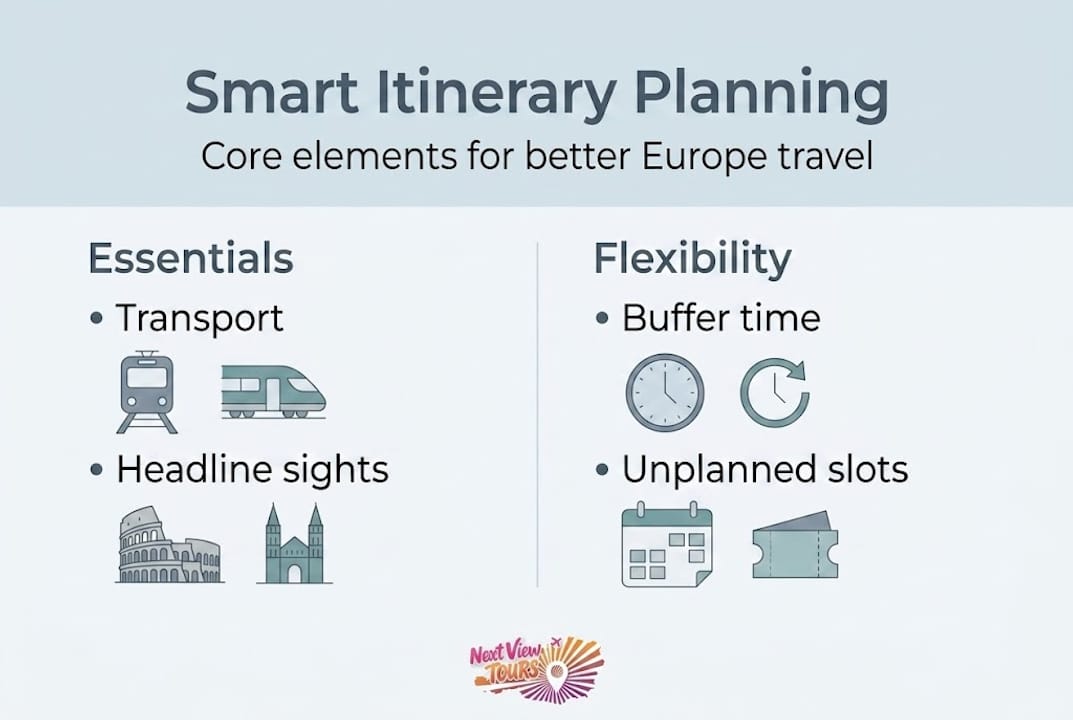
That means booking your core transport, locking in one or two headline experiences per city, and then deliberately leaving the rest unscheduled. Your tour itinerary strategies should always serve your enjoyment, not the other way around. The goal is not a perfectly executed schedule. It is the feeling of moving through one of the world’s most beautiful regions with confidence, curiosity, and just enough structure to never feel lost.
Ready to plan your best European adventure?
Understanding itinerary planning is the first step. Turning that knowledge into an actual trip is where we come in.
At Next View Tours, we design expert-crafted itineraries for families, adventure seekers, couples, and groups across Austria, Slovakia, the Czech Republic, and beyond. Whether you want a fully structured experience or a flexible framework you can build on, our team is ready to help. Explore our customized tours expert guide to see how we tailor every trip to your goals. Browse our explore trip types page to find the format that fits your group. And for inspiration on what a truly memorable journey looks like, check out our adventure trip examples in Europe. Your best European trip starts with one good plan.
Frequently asked questions
How many cities should I visit on a two-week trip across Austria, Slovakia, and the Czech Republic?
Aim for 3 to 5 major cities over two weeks, spending 3 to 4 nights in each. This pace gives you enough time to explore deeply without rushing between destinations.
What’s the best way to balance activities for different age groups in a family trip?
Blend group activities with parallel options tailored to different ages, and let kids influence about 48% of activity choices. This balance keeps everyone engaged and reduces friction during the trip.
Is train or air travel better for connecting European cities?
Use trains for routes under 6 hours and choose flights for longer distances or open-jaw routes. Trains offer city-center convenience, while flights save time on longer legs.
How much buffer time should I include in my daily itinerary?
Plan at least 20% buffer time each day to absorb unexpected delays, especially when traveling with family. This cushion turns small disruptions into manageable moments rather than stressful setbacks.
Does itinerary planning eliminate spontaneity from travel?
A well-structured itinerary actually creates more space for spontaneity by handling logistics in advance. Planning streamlines trip organization so your mental energy is free for the unexpected moments that make travel memorable.


Comments are closed