

 Uncategorized
TL;DR:
- Choosing between day trips and multi-day tours depends on your travel goals, available time, and desired immersion.
- Day trips offer flexibility and easy planning for short visits to nearby attractions, while multi-day tours provide in-depth regional exploration.
Planning a European vacation often starts with excitement and quickly turns into a maze of decisions. One of the most underestimated choices you will face is whether to fill your itinerary with day trips, commit to multi-day tours, or blend both. Many travelers assume all organized tours deliver the same basic experience, but the structure of your trip shapes everything from how rested you feel to how deeply you connect with a destination. This guide breaks down the real differences, gives you honest frameworks for choosing, and helps you plan with genuine confidence.
Table of Contents
- Defining day trips and multi-day trips
- Key differences: logistics, cost, and flexibility
- When to choose a day trip or a multi-day trip
- Pros and cons: efficiency, experience, and challenges
- What most guides miss: Getting the best of both worlds
- Find your ideal trip mix with Next View Tours
- Frequently asked questions
Key Takeaways
| Point | Details |
|---|---|
| Day vs multi-day defined | Day trips last a single day with no overnight stay, while multi-day trips include multiple days and accommodations. |
| Logistics and cost | Day trips are simpler to plan and pay for, but multi-day trips package hotels, transport, and experiences for more value. |
| Flexibility and depth | Day trips offer flexibility and quick experiences; multi-day trips provide deeper immersion but require more planning. |
| Best-of-both strategy | Savvy travelers often combine city stays with day and multi-day tours for maximum value and variety. |
Defining day trips and multi-day trips
Before we analyze how to choose, let’s clarify exactly what is meant by each trip type. The distinction sounds simple, but it carries real consequences for your experience on the ground.
A day trip is a single-day excursion completed within one day, with no overnight stay, typically returning you to your home base by evening. You depart in the morning, explore a destination or attraction, and are back in time for dinner at your hotel. This structure makes day trips a natural fit for travelers who have a stable base city and want to reach nearby highlights without uprooting themselves.
Multi-day trips, on the other hand, run for two or more days and include an accommodation component. They let you go deeper into a region, connect multiple stops under a single itinerary, and truly settle into the places you visit. Think of a four-day journey from Vienna through Salzburg and into the Austrian Alps, with guided hikes, cultural dinners, and curated hotel stays all woven together. You can explore what a multi-day tour really involves to understand how this structure opens up an entirely different quality of travel.
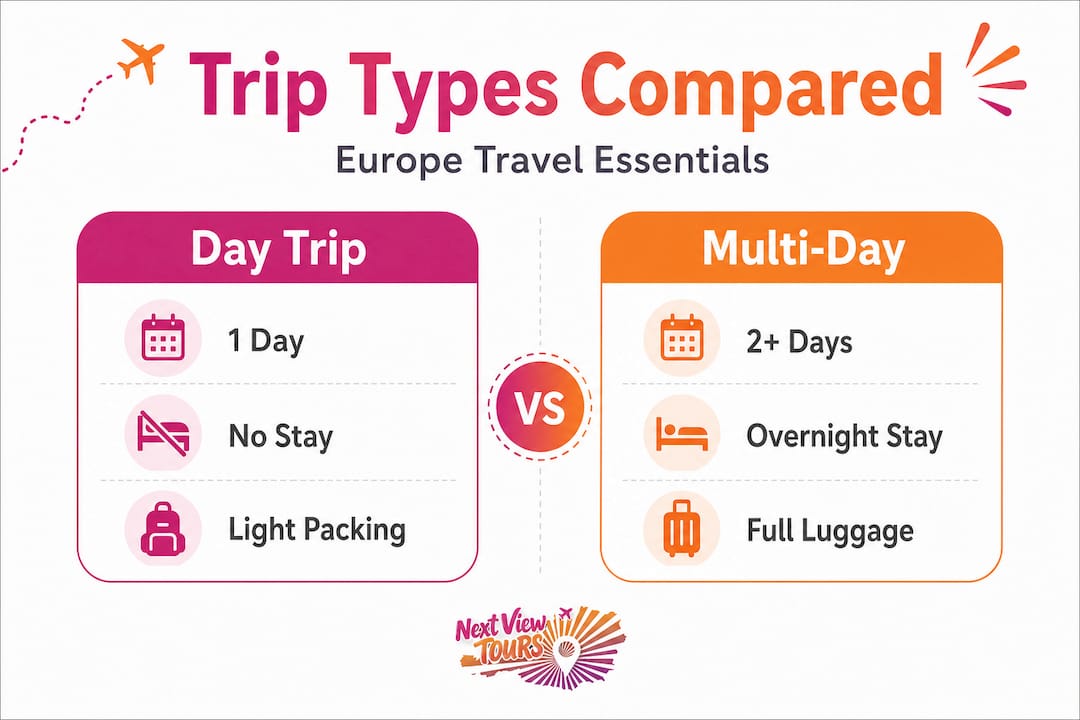
Here is a side-by-side overview of what each format typically includes:
| Feature | Day trip | Multi-day trip |
|---|---|---|
| Duration | Single day | Two or more days |
| Overnight stay | No | Yes |
| Accommodation included | No | Usually yes |
| Meals included | Sometimes | Often yes |
| Transport included | Yes | Yes |
| Guide included | Usually yes | Usually yes |
| Entry fees included | Often | Often |
| Destinations covered | One or nearby few | Multiple or in-depth |
Most day trips bundle transport, a guide, and entry fees into one ready-made experience. Multi-day trips expand that bundle to cover accommodation, meals, and a sequence of activities across several days. The key insight is that the more that is bundled, the less you have to manage yourself, but also the less room you have to improvise. The comparison of trip types across formats can help you visualize which structure suits your travel personality.
Key inclusions at a glance:
- Day trips: Transport to and from your base, a local or expert guide, entry to key sites, a focused itinerary, return by evening
- Multi-day trips: All of the above plus overnight accommodation, select meals, multi-destination routing, and a longer narrative arc through a region
Key differences: logistics, cost, and flexibility
With definitions settled, it’s important to see exactly how these trip types differ when you start planning. The differences reach deeper than just the number of nights.

The biggest planning difference lies in where the logistics burden sits. Day trips externalize logistics into a single, same-day window. You simply show up, follow the guide, and return home. Multi-day trips spread logistics across multiple days and nights, involving rooms, meals, and multi-leg routing. This is not a criticism of multi-day tours. It simply means the planning is more layered, and for that reason, working with an experienced tour operator becomes even more valuable.
Cost structures explained
Day trips are priced per experience. You pay for one outing, one entry fee, one day of guiding. The cost is easy to predict and budget for. Multi-day trips price across several days, so the upfront number looks larger. But when you break it down per day, considering that accommodation, transport, and often meals are included, the value can be significantly higher. A three-day trip that costs €450 is essentially covering your hotel, daily transport, guiding, and cultural experiences across 72 hours.
Flexibility comparison:
- Day trips allow you to swap or cancel with relatively short notice
- Multi-day trips have more fixed structures because accommodation is pre-booked
- Day trips let you choose activities à la carte based on energy and interest
- Multi-day trips commit you to a schedule that rewards consistency
“The more days included in a tour, the greater the potential for deep exploration, but also the more coordination it requires across multiple moving parts.”
Pro Tip: If you are testing a new destination or travel style, start with a day trip to get a feel for the pace and content before committing to a longer format in that same region.
A useful way to think about this is through a group travel planning workflow lens. Group day trips are easy to coordinate because the schedule is short. Group multi-day trips require more alignment on availability, sleeping preferences, and daily energy levels. If you are traveling with family or a mixed group, factoring in this complexity early will save you stress. You can also look at how to organize multi-day tours to prepare effectively for longer group adventures.
When to choose a day trip or a multi-day trip
Understanding the practical tradeoffs leads naturally to the big question: which type of trip belongs in YOUR itinerary?
The answer depends on three factors: how much time you have, how deeply you want to engage with a place, and how much variety you want across your vacation. Here are the three most common traveler scenarios and what they suggest.
-
You have a short trip or a fixed base city. If you are spending five days in Vienna and want to visit Hallstatt, the Wachau Valley, and Bratislava, day trips are your best tool. Each outing returns you to your familiar hotel, you avoid the hassle of packing and repacking, and you still see an impressive range of destinations. Day trips from cities like Vienna, Salzburg, or Budapest are designed exactly for this need.
-
You want deep immersion in a region. If you have ten days and want to genuinely experience the Bohemian countryside, the Hungarian plains, or the Austrian Alps, a multi-day tour allows you to slow down and absorb the culture, cuisine, and landscape in a way a day trip simply cannot replicate. You eat where locals eat, stay in characterful accommodations, and build a real narrative memory of the place.
-
You want variety across several regions. This is where combining city stays with guided excursions becomes the most powerful approach. You anchor in Prague for three nights, take a full-day tour of Kutná Hora or Český Krumlov, then move to Vienna for four nights and add day trips to Bratislava and the Salzkammergut lake district. Variety is high, fatigue is managed, and you still enjoy the comfort of a consistent home base.
A common best practice for Europe planning is to base yourself in cities for staying power and then add guided day tours selectively. This reduces stress while still achieving some of the depth you would get from multi-day itineraries. It is a strategy that experienced travelers rely on because it balances freedom with structure beautifully.
Pro Tip: Before you book anything, write down your single biggest travel goal for the trip. If it is “see as many countries as possible,” lean toward day trips from hub cities. If it is “truly understand one place,” build a multi-day itinerary around that destination.
Understanding the difference between guided and self-guided tours adds another layer to this decision. Guided formats, whether day trips or multi-day, are especially valuable in culturally rich destinations like Prague’s Old Town or Vienna’s Ringstrasse, where context transforms a walk into a story.
Pros and cons: efficiency, experience, and challenges
Now that you know when to choose each trip type, it’s useful to step back and weigh the lived experience of each, advantages and challenges included.
Travelers frequently debate whether organized tours are more efficient or too rigid. What is clear is that the underlying difference between day trips and multi-day trips tends to amplify this tension. Multi-day tours increase immersion but also increase schedule complexity compared with shorter, single-day excursions.
Day trip advantages:
- Easy to book, even last minute
- Low financial commitment per outing
- No packing or unpacking between stops
- Great for solo travelers or those with unpredictable schedules
- Allows you to rest on days when energy is low
Day trip challenges:
- Can feel rushed, especially at popular sites
- Limited time to go beyond the highlights
- May not capture the atmosphere of a destination after the tour groups leave
- Repeated travel back to a single base can feel repetitive over a long trip
Multi-day trip advantages:
- True cultural immersion across several days
- Maximizes time spent in destinations by eliminating daily return travel
- Builds a coherent travel narrative across a region
- Allows for morning and evening experiences unavailable on day trips
- Ideal for covering large geographic distances efficiently
Multi-day trip challenges:
- Requires early booking and more upfront planning
- Less flexibility to change your mind mid-trip
- Can lead to fatigue if the pace is too high
- Higher upfront cost, even if overall value is strong
“Every extra day on a multi-day trip is an opportunity for deeper discovery, but it also demands more of your energy, adaptability, and trust in the itinerary you have chosen.”
A common pitfall travelers underestimate is travel fatigue. Europe is exciting, but moving between cities every day can exhaust even the most enthusiastic explorer. Effective multi-day trip organization builds in buffer time and rest periods so the journey sustains energy rather than draining it. Similarly, understanding the difference between group and private tours helps you match the social intensity of the trip to what you actually enjoy.
Pro Tip: If you find yourself torn, check the departure and return times. A day trip that runs 7 am to 9 pm is very different from one that runs 9 am to 6 pm. Pacing within a single day matters just as much as the format itself.
What most guides miss: Getting the best of both worlds
Most travel guides frame this as a binary choice: pick day trips or commit to multi-day tours. That framing misses the point entirely. The travelers who consistently have the best European experiences are the ones who treat both formats as tools in a single, flexible toolkit.
Think of it this way. A day trip is a sharp scalpel. It lets you precisely target one destination, extract maximum value in a focused window, and return home clean. A multi-day tour is more like a slow river journey. It carries you through a landscape gradually, allowing you to notice things you would never see at speed.
The strongest itineraries we see are built around a city anchor strategy. You choose one or two cities as home bases, rest there in the evenings, and then use a combination of day trips and shorter multi-day tours to fill the space between. This approach solves the fatigue problem and the variety problem simultaneously.
What most guides also miss is that flexibility within structure is the real skill. Booking a customized tour means you are not locked into someone else’s idea of what a trip should look like. You can decide, for example, that you want four days in the Czech Republic with two full-day excursions and two free afternoons. That is not a day trip format and it is not a standard multi-day tour. It is a thoughtful blend that reflects your pace, your interests, and your energy.
There is no universal right answer here. What there is, however, is a right answer for you. And finding it requires honest reflection on what you actually want from travel, not just what sounds impressive on paper.
Find your ideal trip mix with Next View Tours
Ready to put these insights into action? Next View Tours makes it easy to select or customize the right trip style for any traveler.
Whether you are drawn to efficient day trips from Vienna or Budapest, or ready to explore a full multi-day adventure through Austria, the Czech Republic, or Slovakia, Next View Tours has curated options to match every travel style and pace. You can explore trip types to find the format that fits your goals, browse multi-day adventure examples from across Europe, or work directly with the team through a customized tours guide to design your perfect blend. From private to group formats, family trips to couple escapes, the goal is the same: to make every day of your European adventure feel purposeful, immersive, and genuinely memorable.
Frequently asked questions
Is a day trip always cheaper than a multi-day trip?
Most day trips are less expensive upfront, but multi-day trips typically bundle accommodation, transport, and meals into the price, often making them a stronger value when measured day by day.
Can you combine day trips and multi-day trips in one European vacation?
Yes, and many experienced travelers do exactly this. Basing yourself in cities and layering in both day and multi-day tours gives you flexibility, variety, and genuine depth across a single trip.
What should I pack for a multi-day trip compared to a day trip?
Multi-day trips require packing for overnight stays, multiple weather conditions, and changing outfits, while day trips need only a daypack with essentials like water, a camera, comfortable shoes, and a light jacket.
Are day trips suitable for solo travelers in Europe?
Day trips are one of the best options for solo travelers in Europe because they offer a safe, structured environment, built-in companionship from the group, and the freedom to return to your own accommodation each evening.
How far in advance should I book a multi-day trip?
Booking at least four to six weeks in advance is strongly recommended for multi-day trips, especially on popular routes through Austria, Hungary, or the Czech Republic during peak summer and winter seasons when availability fills quickly.


Comments are closed