

 Uncategorized
TL;DR:
- Choosing genuine eco-friendly tours helps protect Europe’s natural and cultural heritage through responsible travel practices. Certified operators track measurable impacts, support local communities, and prioritize sustainability pillars, ensuring authentic experiences. Your booking decisions directly influence conservation efforts and promote sustainable tourism that benefits both destinations and travelers.
Choosing eco-friendly tours is one of the most meaningful decisions you can make as a traveler, yet most people misunderstand what that actually means. An eco-tour is not simply a hike in the forest or a scenic drive through the countryside. It is a form of travel built around measurable responsibility: protecting natural environments, supporting local economies, and preserving the cultural identity of every destination you visit. Europe’s most celebrated landscapes and communities are under real pressure from mass tourism, and your choices as a traveler carry genuine weight. This guide shows you exactly why eco-friendly tours deserve your attention and your booking.
Table of Contents
- Understanding eco-friendly tours: principles and impact
- How credible eco tours measure and manage sustainability
- The value of certification and ecolabels in choosing eco-friendly tours
- Mainstream demand and benefits of eco-friendly tours in 2026
- How to choose an authentic eco-friendly tour in Europe
- Why genuine eco-friendly tours matter more than ever for European travelers
- Explore authentic eco-friendly tours with Next View Tours
- Frequently asked questions
Understanding eco-friendly tours: principles and impact
The word “ecotourism” gets used loosely, so let’s anchor it with a clear definition. Ecotourism is responsible travel that minimizes negative impacts, supports conservation, benefits locals, and builds respect through education. That is four distinct pillars working together, not one isolated gesture toward nature.
Those four pillars break down into real, practical commitments:
- Minimizing environmental harm: Eco tours limit group sizes, avoid sensitive ecosystems during breeding seasons, and reduce single-use plastics on every itinerary.
- Supporting conservation: A portion of your tour fee often funds habitat restoration, wildlife monitoring, or national park maintenance directly.
- Benefiting local communities: Guides, drivers, accommodation, and food sourcing are prioritized locally, keeping income within the destination economy.
- Education and cultural respect: Travelers learn the history and ecology of a place rather than just photographing it, fostering genuine connection.
When you choose nature tours in Europe designed around these principles, you are not just sightseeing. You are participating in a model of tourism that actively works to preserve what makes Europe extraordinary. The advantages of green tourism extend far beyond your personal experience. They create a feedback loop where destinations remain viable, communities stay empowered, and ecosystems recover rather than degrade.
One thing many travelers overlook is the cumulative weight of individual choices. Your decision to book a certified eco tour in the Bohemian Switzerland National Park, for example, contributes directly to trail maintenance funding. Your choice of a locally owned guesthouse in Slovakia keeps profits in the village rather than flowing to a distant corporation. These are not abstract benefits. They are measurable community outcomes that you can trace and verify.
How credible eco tours measure and manage sustainability
It is easy for any operator to call a tour “green.” What separates genuine eco-friendly tours from marketing claims is measurable management and independent accountability. This is where international standards play a defining role.
The GSTC Tour Operator Standard establishes Europe-aligned sustainability benchmarks that focus on planning, community benefits, cultural heritage, and reducing environmental impacts through verifiable criteria. These are minimum requirements, not aspirational goals. Operators meeting this standard must document their environmental indicators, track outcomes over time, and demonstrate improvement rather than just intention.
What does that look like in practice? A credible eco tour operator will:
- Maintain a written sustainability plan with specific, measurable targets
- Track indicators such as carbon emissions per tour, waste generated, and percentage of locally sourced spending
- Engage community stakeholders in tour design and delivery
- Conduct risk assessments for ecological and cultural sensitivity at each destination
The difference between a tour that claims sustainability and one that practices it shows up in documentation. You can ask an operator for their sustainability report or community benefit data. If they cannot produce it, that tells you something important.
Understanding what makes a guided tour credible goes hand in hand with understanding sustainability management. Guides who are locally trained and knowledgeable about both ecology and history are themselves an indicator of a serious operator. They are not just narrators. They are stewards of the places they lead you through.

Pro Tip: Before booking, ask your tour operator two direct questions: “What percentage of your revenue stays in the local economy?” and “How do you measure your environmental impact?” Operators who have genuine answers are almost always the real thing.
Keeping pace with guided tour trends in 2025 and beyond reveals that traveler demand for this level of transparency is accelerating rapidly. Operators who cannot meet it are losing business to those who can.
The value of certification and ecolabels in choosing eco-friendly tours
Certifications are the shortcut that saves you from doing all the research yourself. They represent independent, third-party verification that an operator has met a defined set of standards across multiple sustainability dimensions.
The EU Ecolabel guarantees environmental improvements with measurable energy, water, and waste reductions, offering transparency and cost savings for hospitality businesses including tour-linked accommodations. This is the European Union’s own quality mark, and it carries legal accountability behind it.
Not all certifications are equal, though. Here is a comparison of what leading programs actually require:
| Certification | Scope | Verification method | Pillars covered |
|---|---|---|---|
| EU Ecolabel | Accommodation and services | Independent audit | Energy, water, waste, emissions |
| GSTC Tour Operator Standard | Tour operators | Third-party certification body | Environment, community, culture, management |
| Ecotourism Australia | All tourism operators | 300+ independent criteria | Environment, social, cultural, management |
The breadth of criteria matters. A certification covering only energy consumption tells you far less than one covering community benefit, cultural respect, and management practices together. Ecotourism Australia’s program uses over 300 independent criteria, reducing greenwashing risk by ensuring no single dimension of sustainability can mask failures in others.
When selecting eco tours, look for operators who carry at least one multi-pillar certification. This is especially relevant when exploring the sustainable tours market trend across Europe, where certification adoption is growing but still far from universal.
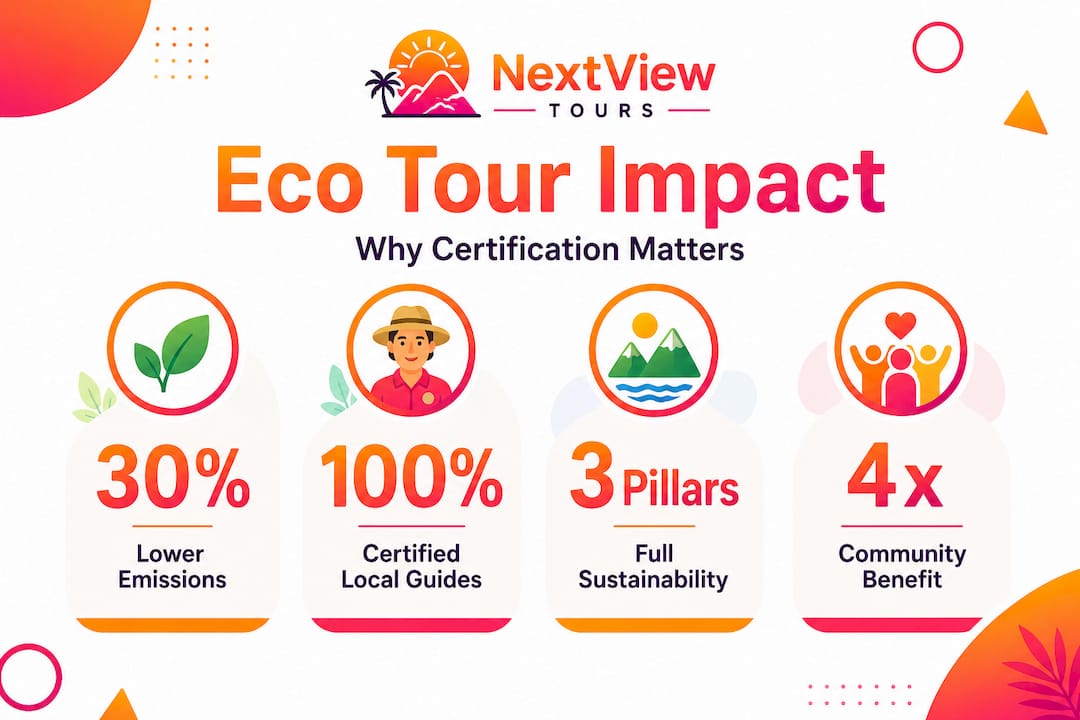
The eco-conscious travel benefits of choosing certified operators are concrete: you know exactly what your money supports, you avoid inadvertently funding operations that damage the places you love, and you contribute to a market signal that rewards genuine practice over empty promises. Certified operators also tend to offer richer, more authentic experiences because they are genuinely embedded in local culture and ecology rather than simply passing through it.
Mainstream demand and benefits of eco-friendly tours in 2026
Eco-friendly travel is no longer a niche interest reserved for dedicated environmentalists. It has crossed into the mainstream, and the numbers reflect this clearly.
35% of travelers actively seek eco-friendly tours supporting the environment and local communities, making such options a top sustainability priority according to Agoda’s 2026 survey. That is more than one in three travelers, drawn from a global, mainstream audience.
This shift is meaningful for a few reasons. First, it tells you that choosing eco-friendly tours is no longer a compromise. You are joining a large and growing segment of travelers who expect quality, value, and genuine impact alongside sustainability. Second, it creates commercial incentives for operators to invest in real sustainability practices. Demand shapes supply.
The practical benefits of eco-friendly tours in 2026 are significant:
- Direct conservation funding: Many operators allocate a fixed percentage of revenue to conservation projects, meaning your booking has a traceable positive outcome.
- Richer cultural immersion: Eco tours designed around cultural respect tend to offer access that standard group tours do not, including visits to communities, traditional craft demonstrations, and conversations with local experts.
- Smaller groups, deeper experiences: Environmental limits on group sizes are a feature, not a restriction. Smaller groups mean more attentive guides, more flexible itineraries, and more genuine moments.
- Economic equity: Spending stays local. Guides, food vendors, accommodation owners, and artisans in the destination benefit directly.
Check out the nature trips guide for 2026 for concrete examples of how lower-impact itineraries across Europe are delivering richer adventure without the footprint. If your travel preferences are specific, customized tours can align your itinerary with your personal sustainability values even more precisely.
Pro Tip: Look for operators who publish their conservation funding amounts publicly. Even a modest figure like “3% of all booking revenue goes to trail maintenance in Bohemian Switzerland” tells you the commitment is real and tracked.
How to choose an authentic eco-friendly tour in Europe
Knowing why eco tours matter is only half the equation. Knowing how to identify genuine ones is where your effort pays off. Follow these steps when evaluating any operator:
- Check for multi-pillar certification. Look for GSTC, EU Ecolabel, or equivalent programs that cover environment, community, culture, and management together. Single-dimension certifications or vague “eco” badges are insufficient.
- Ask for a sustainability report or impact statement. Credible operators produce these regularly. If an operator cannot explain and measure their conservation and community benefits, they may not meet ecotourism principles.
- Verify local community involvement. Find out what percentage of guides and staff are local, whether local businesses supply food and accommodation, and whether communities were consulted in tour design.
- Evaluate transparency in marketing. Genuine operators are specific. “We fund trail restoration in the Tatra Mountains through a per-booking contribution” is verifiable. “We care about the planet” is not.
- Compare certifications across dimensions. Tours optimized only on one sustainability dimension often underdeliver. Prioritize certifications covering environment, socio-economic, cultural, and management pillars together.
- Review itinerary design for conservation logic. Does the route avoid protected areas during nesting season? Does the group size have a stated ecological limit? These details signal that sustainability informs the product rather than just the marketing.
Understanding the difference between guided and self-guided tours is also relevant here. Expert-guided eco tours typically generate stronger community benefit and more accurate conservation practices because knowledgeable, locally embedded guides are central to the experience.
Why genuine eco-friendly tours matter more than ever for European travelers
Here is something the standard travel advice rarely acknowledges: eco-friendly tours are not a premium category or a virtuous add-on. They are becoming the only sustainable model for preserving the European destinations that travelers most want to visit.
Overtourism has visibly damaged places like the Croatian coast, the Amalfi Coast, and Amsterdam’s historic center. The conventional wisdom says this is a problem of too many visitors. But the deeper issue is the wrong kind of visiting, where money flows to international chains, guests have no meaningful connection to the place, and local communities feel the costs of tourism without receiving its benefits.
Genuine eco-friendly tours address this at the root level. Serious operators treat sustainability not as a marketing angle but as operational governance. It shapes who they hire, how they design routes, which partners they work with, and how they report outcomes. That is a fundamentally different business model, and it produces fundamentally different results for the destination.
What this means for you as a traveler is that your individual booking decisions carry more weight than you probably realize. When you book a certified, locally embedded eco tour across Europe’s most visited regions, you are directing funds toward a model that keeps those regions worth visiting. You are also sending a clear signal to the market: transparency and measurable impact are what you expect.
The travelers who demand genuine eco practices today are the reason genuine operators can continue to exist tomorrow. That is not an abstraction. It is a direct cause-and-effect relationship worth understanding and acting on.
Explore authentic eco-friendly tours with Next View Tours
You now understand what separates a genuine eco-friendly tour from a green label on a standard itinerary. The next step is finding an operator whose tours actually deliver on those principles across Europe.
Next View Tours designs eco-conscious experiences following sustainability and cultural respect principles across Austria, Czech Republic, Slovakia, Hungary, and beyond. Their approach prioritizes certified and verified partners who minimize environmental impact while maximizing authentic local connection. Whether you are drawn to multi-day adventure trips through Central European landscapes or prefer the depth of private, personalized eco tours shaped around your values, Next View Tours offers itineraries that benefit communities and protect the places you explore. Reach out to their team for expert guidance on choosing the right sustainable travel experience for you.
Frequently asked questions
What makes a tour truly eco-friendly rather than just “green” marketing?
A truly eco-friendly tour follows measurable conservation and community support practices, is independently certified, and reports its environmental and social impact transparently rather than making vague claims.
Are eco-friendly tours more expensive than regular tours?
While some eco tours may cost more due to sustainable practices, many are competitively priced. 35% of travelers actively seek eco tours that balance cost and conservation value, showing mainstream accessibility.
How can I verify that a European eco-friendly tour is certified?
Check for the GSTC Tour Operator Standard or EU Ecolabel, both of which require independent audits covering environmental, social, cultural, and management criteria.
What are the benefits of choosing an eco-friendly tour for local communities?
Eco-friendly tours provide income through fair local employment and empower communities as equal partners, with funds contributing directly to conservation and cultural heritage protection.
Can eco-friendly tours help reduce overtourism impacts in Europe?
Yes. By promoting responsible travel that minimizes environmental footprint and distributes benefits equitably, eco tours help balance conservation with community benefit and visitor experience, reducing overtourism pressure.


Comments are closed