

 Uncategorized
TL;DR:
- Effective multi-day tour planning involves defining your objectives and routes to ensure geographic efficiency and pacing. Building flexible itineraries with 1 to 3 anchor activities per day and allowing buffer times enhances travel satisfaction and prevents exhaustion. Prioritizing centralized accommodations, realistic transport bookings, and contingency plans ensures smooth logistics and a memorable experience.
Multi-day tour planning is the structured process of sequencing destinations, activities, transport, and accommodation into a coherent, realistic itinerary that delivers genuine travel satisfaction. The core multi-day tour planning steps follow a clear order: define objectives, set a budget, build a paced itinerary, coordinate logistics, and build in flexibility. Most tours that fall apart do so because of poor routing, unrealistic scheduling, or dead miles from poor budgeting. This guide gives you the exact framework to avoid those failures, whether you are organizing a private escape through Central Europe or a group adventure across Austria, the Czech Republic, and beyond.
What are the multi-day tour planning steps?
Multi-day tour planning, also called itinerary design or trip structuring in the travel industry, begins with one deceptively simple question: what do you actually want from this trip? The answer shapes every decision that follows, from which cities make the cut to how many hours you spend at each stop.

Start by defining your tour’s theme and focus. Cultural immersion, outdoor adventure, culinary exploration, and historical discovery each demand different pacing and different types of destinations. A cultural tour through Vienna, Salzburg, and Prague calls for museum mornings and leisurely afternoons. An adventure tour through the Slovak mountains requires early starts and physical recovery time built into the schedule.
Once your theme is clear, shortlist destinations using these criteria:
- Geographic proximity: Choose locations that form a logical loop or line rather than scattered points. Minimizing dead miles by routing destinations efficiently cuts both cost and transit fatigue.
- Anchor locations: Identify two or three cities or sites that are non-negotiable. Build the rest of the route around them.
- Transit realism: Use Google Maps to check actual travel times between each stop, not just distances. A 200-kilometer drive through mountain roads takes far longer than the same distance on a motorway.
- Interest balance: Mix high-stimulation destinations like Budapest or Prague with quieter, slower-paced stops like the Hallstatt lake district or the Slovak countryside.
Pinning destinations in Google Maps or plotting them in a shared spreadsheet gives you an immediate visual check on whether your route makes geographic sense. If your pins zigzag across the map, your routing needs work before you touch anything else.
How should you budget for a multi-day tour?
Budgeting is the planning step most travelers underestimate, and it is the one that most directly determines whether your tour is enjoyable or stressful. Set your total budget ceiling before you book a single thing. That ceiling then guides every subsequent choice.
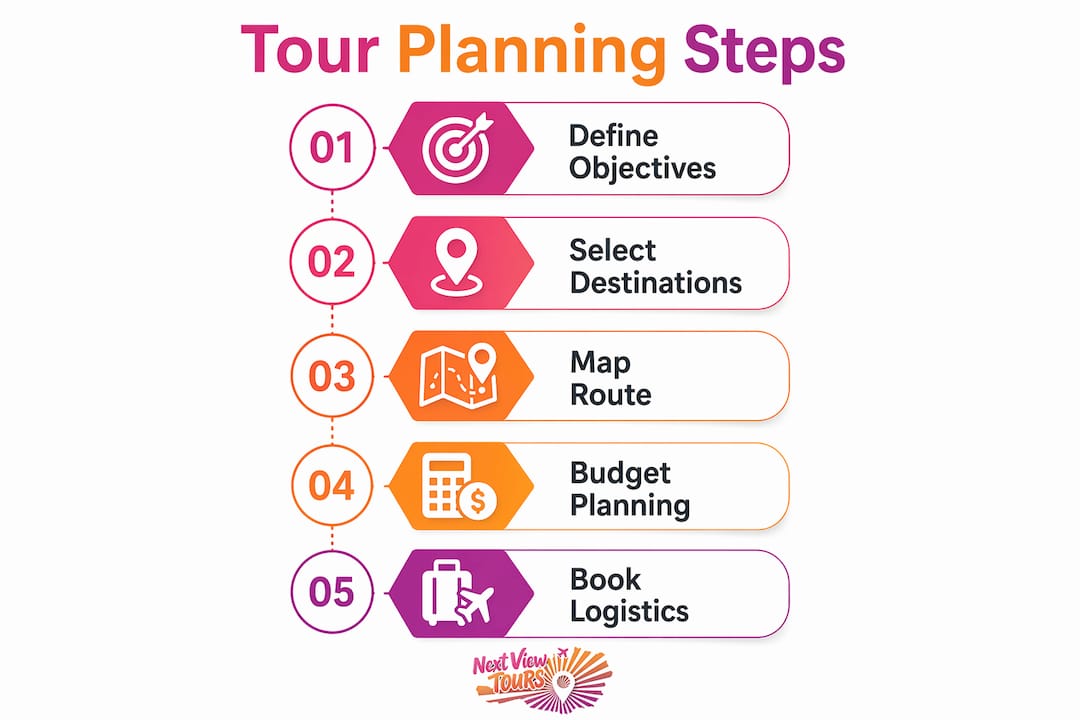
A practical budget for a multi-day European tour typically breaks down across five categories:
| Category | Typical allocation |
|---|---|
| Accommodation | 35–40% of total budget |
| Transportation (flights, trains, transfers) | 25–30% of total budget |
| Activities and entrance fees | 15–20% of total budget |
| Food and dining | 15–20% of total budget |
| Contingency fund | 10% of total budget |
The contingency fund is not optional. Unexpected costs appear on every multi-day trip, from a missed connection to a spontaneous detour that turns out to be the highlight of the whole experience.
On transportation, booking domestic segments on the same ticket as your intercontinental flights simplifies rebooking if cancellations occur. This single habit reduces planning complexity and protects you from being stranded mid-route. For train and bus travel within Europe, booking at least three to four weeks in advance typically yields the best fares on routes like Vienna to Budapest or Prague to Salzburg.
Pro Tip: Allocate your contingency fund in cash, not just as a mental reserve. Having physical euros or local currency available means you can handle delays, missed bookings, or unplanned opportunities without scrambling for a card payment.
How to build your itinerary: pacing, anchors, and logistics
Itinerary building is where most planners either get it right or collapse under the weight of over-scheduling. The most effective approach is to plan 1 to 3 anchor activities per day rather than filling every hour. Anchor activities serve as the day’s pillars. Everything else, the coffee stop, the unexpected street market, the longer-than-expected castle tour, fits around them organically.
Follow these steps to build a day-by-day structure that holds up in practice:
- List your anchor activities first. Write down the experiences that are non-negotiable for each destination. For Vienna, that might be the Schönbrunn Palace and the Naschmarkt. For Hallstatt, it is the lake walk and the salt mine.
- Group activities by neighborhood, not by time. Clustering activities geographically cuts transit time and eliminates the frustrating backtracking that drains energy and eats into your day.
- Alternate high-energy and low-energy days. Balancing intense sightseeing with slower days prevents burnout on trips longer than three or four days. A full day at Prague Castle followed by a relaxed morning in Malá Strana is more sustainable than two consecutive packed days.
- Build in buffer time. Industry guidelines recommend 30 to 60 minutes of unscheduled buffer per major activity. This is not wasted time. It is the margin that keeps your day from unraveling when a museum queue runs long or a train is delayed.
- Schedule travel days as light days. Any day that involves moving between cities should have minimal activity commitments. Arriving in Budapest after a three-hour train ride from Vienna and then attempting a full evening tour is a recipe for exhaustion.
- Use flexible digital tools. Shared spreadsheets outperform rigid apps for multi-day tour management because they accommodate contingency notes, expense tracking, and real-time edits by multiple people simultaneously.
Pro Tip: Build a “wildcard” slot into every two or three days. Leave one afternoon or morning completely unscheduled. These open windows consistently produce the most memorable moments of any trip.
What are the best practices for booking transport and accommodation?
Logistics coordination is the operational backbone of any multi-day travel guide. Get it wrong and even a beautifully designed itinerary falls apart on day two.
For accommodation, location relative to your planned activities matters more than star rating. A centrally located three-star hotel in Prague’s Old Town saves you 30 to 45 minutes of transit per day compared to a four-star property on the outskirts. Over a five-day trip, that adds up to several hours of reclaimed time.
Key booking practices to follow:
- Book accommodation before transport. Securing your base in each city first gives you a fixed point to plan transport around, rather than the reverse.
- Allow layover buffers on connections. Travel experts recommend at least 2 hours of buffer for domestic-to-international connections, with longer buffers at weather-prone hubs. This applies equally to train connections at busy stations like Vienna Hauptbahnhof.
- Match transport mode to group needs. A private vehicle works best for groups of four or more traveling between smaller destinations like Hallstatt or Ceský Krumlov. Trains are faster and less stressful for city-to-city routes between major hubs.
- Confirm all bookings 48 hours before travel. Cancellations and schedule changes happen. A quick confirmation call or email check prevents surprises at the station or hotel front desk.
- Keep digital and printed copies of all reservations. Connectivity in rural Central Europe is not always reliable. A printed backup has saved more than a few travelers from a very stressful afternoon.
For group tours specifically, the logistics of flexible scheduling become even more critical, since one delayed participant can affect the entire group’s timeline. Build group assembly times with a 10 to 15-minute buffer beyond what you think you need.
How do you stay flexible and avoid common tour mistakes?
Rigidity is the single biggest threat to a satisfying multi-day tour. Plans are tools, not contracts. The travelers who enjoy their trips most are those who hold their itineraries lightly enough to adapt when conditions change.
The most common mistakes in multi-day tour planning include:
- Overbooking activities: Scheduling six to eight attractions per day leaves no room for the unexpected and guarantees exhaustion by day three.
- Ignoring geographic logic: Visiting sites scattered across a city or region without clustering them wastes transit time and fragments the experience.
- Skipping rest days: On trips of seven days or more, at least one full rest day is recommended. A rest day in a city like Vienna or Budapest, with no agenda beyond a coffee and a walk, often becomes a traveler’s favorite memory.
- Failing to plan contingencies: Every itinerary needs at least one backup option per destination. If the Hallstatt boat tour is cancelled due to weather, what is the alternative? Having an answer in advance removes the stress of improvising under pressure.
- Underestimating transit times: Google Maps driving estimates assume ideal conditions. Add 20 to 30 percent to any transit estimate involving mountain roads, border crossings, or peak-season traffic.
Adapting on the go means reading your group’s energy honestly. If everyone is visibly tired by day four, drop an activity and find a quiet café or a park. The multi-day trip organization guide from Nextviewtours covers additional pitfalls specific to European routes in detail.
Key takeaways
Effective multi-day tour planning requires clear objectives, geographic routing, realistic pacing, and built-in flexibility to produce a trip that is both memorable and manageable.
| Point | Details |
|---|---|
| Set objectives first | Define your tour’s theme before selecting destinations to keep every decision aligned. |
| Budget with a contingency | Allocate 10% of your total budget as a cash reserve for unexpected costs and opportunities. |
| Use anchor activities | Plan 1 to 3 key activities per day and leave open time around them for spontaneity. |
| Cluster geographically | Group activities by neighborhood to cut transit time and prevent backtracking. |
| Build in buffer time | Allow 30 to 60 minutes of unscheduled time per major activity to absorb delays gracefully. |
Why pacing is the skill that separates good tours from great ones
After years of planning and running multi-day tours across Central Europe, from the grand boulevards of Vienna to the medieval lanes of Ceský Krumlov, the lesson that keeps proving itself is this: pacing is not a soft preference. It is a structural requirement.
I have seen beautifully researched itineraries collapse because the planner treated every hour as an opportunity to add one more thing. By day three, travelers are physically tired and emotionally checked out. The sites they spent months researching become a blur. The irony is that doing less, deliberately, produces richer memories and higher satisfaction.
The anchor activity model changed how I approach every itinerary. When you commit to two or three meaningful experiences per day and protect the time around them, something unexpected happens. Travelers start noticing things. They linger. They ask questions. They find the hidden courtyard or the local market that no guidebook mentions. That is the version of travel most people are actually looking for.
My honest recommendation: build your itinerary, then remove 20 percent of what you planned. What remains will almost always be better.
— Next
Discover multi-day tours designed around these principles
Nextviewtours designs multi-day experiences across Austria, the Czech Republic, Hungary, Slovakia, and beyond with exactly this framework in mind. Every itinerary balances anchor experiences with breathing room, and every route is built around geographic logic rather than wishful thinking. Whether you are looking for a private or group tour through Vienna, Salzburg, Prague, or Budapest, or you want a fully customized route built around your specific interests, Nextviewtours offers the expertise and local knowledge to make it work. Explore the full range of adventure and multi-day options and find the format that fits your travel style.
FAQ
What are the first steps to plan a multi-day tour?
Define your tour’s theme and objectives before selecting destinations. Then shortlist locations based on geographic proximity, anchor experiences, and realistic transit times.
How many activities should you plan per day on a multi-day tour?
Experts recommend 1 to 3 anchor activities per day to maintain energy and allow flexibility. Scheduling more than three major activities consistently leads to burnout by mid-trip.
How much buffer time should you build into a travel itinerary?
Allow 30 to 60 minutes of buffer per major activity and at least one full rest day per week-long trip. For flight connections, a minimum 2-hour buffer is the standard recommendation.
What is the best tool for managing a multi-day tour itinerary?
Shared spreadsheets are preferred by many travel professionals for their flexibility, allowing contingency notes, expense tracking, and real-time collaboration across a planning team.
How do you avoid burnout on a long multi-day trip?
Alternate high-energy and low-energy days throughout your itinerary. Pairing an intensive sightseeing day with a slower, unstructured day keeps travelers engaged and physically capable for the full duration of the tour.


Comments are closed