

 Uncategorized
TL;DR:
- Creating a personalized travel itinerary involves detailed geographic clustering and limiting daily activities to two major anchor points.
- Verifying all reservations, opening hours, and local events within 48 hours before travel is essential for a reliable schedule.
A personalized travel itinerary is a day-by-day travel plan designed around your specific interests, pace, and travel style. In the travel industry, this process is formally called itinerary design, and knowing how to create custom itineraries separates memorable trips from exhausting ones. Structured planning delivers up to 40% higher satisfaction compared to improvised travel. That single statistic explains why experienced travelers treat their itinerary as the most important document they carry.
How to create custom itineraries: tools and prerequisites
Before you write a single activity into your plan, you need two things: fixed information and the right tools. Fixed information includes your travel dates, flight times, confirmed accommodation addresses, and any pre-booked reservations. These are your anchors. Everything else builds around them.
Multiple tools serve distinct planning needs: AI itinerary builders like ChatGPT or TripIt handle speed and initial structure, Google Maps handles routing and geographic visualization, travel guidebooks like Lonely Planet provide cultural depth, and local blogs deliver neighborhood-level tips that no algorithm captures. Choosing the right combination depends on your trip’s complexity and your personal planning style.
The table below compares the most common planning tools across four practical dimensions.
| Tool | Speed | Cost | Depth | Best use case |
|---|---|---|---|---|
| AI itinerary builders (ChatGPT, TripIt) | Very fast | Free to low | Moderate | First draft and structure |
| Google Maps / Google My Maps | Fast | Free | Low to moderate | Routing and geographic clustering |
| Travel blogs and forums (Reddit, TripAdvisor) | Moderate | Free | High | Local tips and recent updates |
| Professional travel planners | Slow | ~$40/day | Very high | Complex, multi-destination trips |
| Guidebooks (Lonely Planet, Rick Steves) | Slow | Low | High | Cultural context and hidden gems |
Pro Tip: If your trip spans more than five days or crosses three or more cities, combine an AI builder for the initial draft with a local blog or forum for verification. Single-destination trips of three days or fewer can often be planned entirely through Google My Maps and one trusted travel blog.
Manual planning typically takes 2 to 3 hours, with destination research consuming 30 to 60 minutes and day sequencing another 30 to 45 minutes. Knowing this upfront helps you allocate time realistically rather than rushing the process.
How to research and organize destination activities
Great research is not about finding the most activities. It is about finding the right ones and placing them in the right order. Start with a broad discovery phase using a mix of sources: AI tools for an initial list, local travel forums on Reddit or Facebook Groups for recent traveler feedback, and Instagram or Google Maps photo reviews for visual confirmation that a place is still worth visiting.
Once you have a raw list of 20 to 30 potential activities, the next step is geographic clustering. Focusing each day on one or two neighborhoods reduces transit time and deepens cultural immersion far more than trying to cover a city’s breadth in a single day. A morning in Vienna’s first district followed by an afternoon in the Naschmarkt area, for example, keeps you within walking distance of multiple experiences without a single metro ride.
Here is a practical process for organizing your research into a workable structure:
- Drop every potential activity as a pin in Google My Maps, color-coded by category (food, culture, nature, shopping).
- Identify natural geographic clusters where multiple pins sit within a 15-minute walk of each other.
- Assign each cluster to a specific day or half-day block.
- Within each cluster, rank activities by personal priority so you always do the most important ones first.
- Flag any activity that requires advance booking and handle those reservations immediately.
When balancing popular landmarks with hidden gems, apply a simple rule: one major landmark per half-day, paired with one local discovery. In Prague, that might mean the Old Town Square in the morning followed by a lesser-known café in Žižkov in the afternoon. This rhythm prevents the “museum fatigue” that ruins so many well-intentioned trips.
The sources that consistently surface the best hidden gems include:
- Local Facebook Groups for expats and travelers in your destination city
- Recent TripAdvisor reviews filtered to the last three months
- Neighborhood-specific posts on travel subreddits like r/solotravel or r/travel
- The Nextviewtours blog, which covers customized tour ideas across Central Europe with genuine local knowledge
Step-by-step process to build a day-by-day itinerary
With your research organized by geography, you are ready to build the actual schedule. The most effective framework is the three-block structure: morning, afternoon, and evening. Each block holds one anchor activity and open time for meals, transit, and spontaneity. This block approach provides structure without rigidity, which is exactly what good travel feels like.

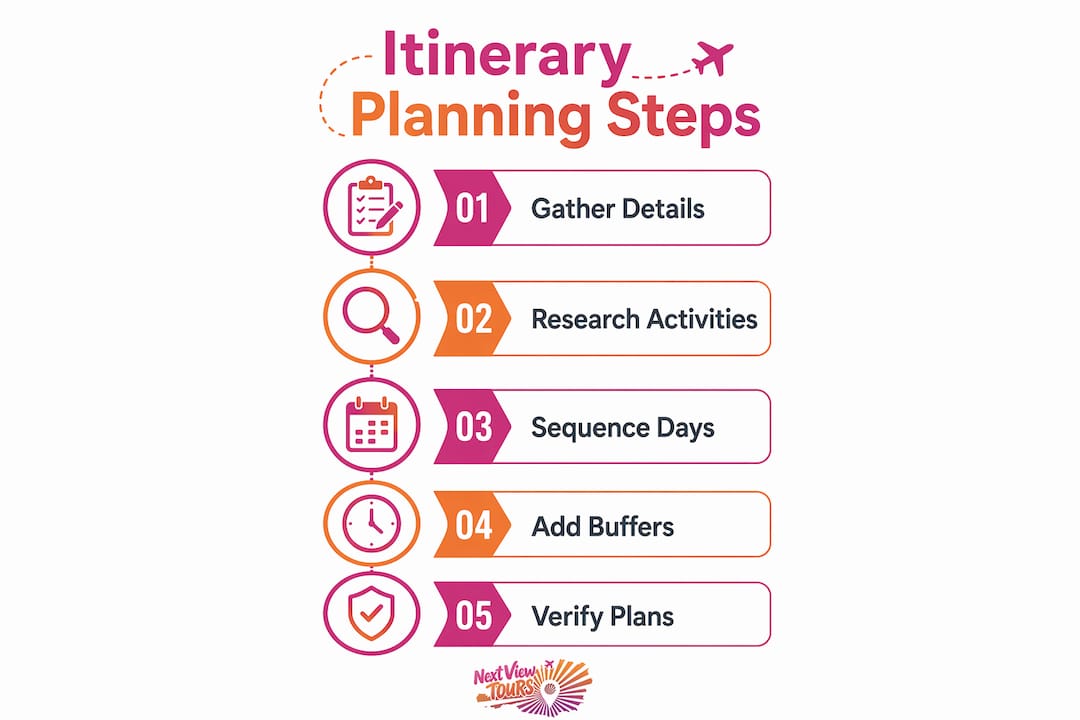
Follow these steps to assemble your custom travel plan:
Step 1: Sequence your days geographically. Place days that cover the same area of a city or region next to each other. If you are traveling from Vienna to Hallstatt to Salzburg, sequence those days in a logical geographic arc rather than backtracking.
Step 2: Cap each day at two anchor activities. Overscheduling is the top cause of itinerary failure. Two anchored events per day, with flexible time around them, consistently produces better traveler satisfaction than a packed schedule.
Step 3: Build in transit and meal time explicitly. Do not assume transit is instant. A 20-minute metro ride plus a 10-minute walk equals 30 minutes minimum. Add that to your plan as a real block, not a mental note.
Step 4: Verify every practical detail. Check opening hours, booking requirements, and seasonal closures for each anchor activity. A verified itinerary converts a wish list into a reliable travel tool. This step alone prevents the most common day-of disasters.
Step 5: Add unscheduled buffer time. Every day should include at least one 60 to 90-minute block with no plan attached. This is where the best travel memories are made.
The table below shows average time allocation per planning step for a 7-day trip.
| Planning step | Average time required |
|---|---|
| Gathering fixed trip details | 20 to 30 minutes |
| Destination research and activity list | 45 to 60 minutes |
| Geographic clustering and day assignment | 30 to 45 minutes |
| Day-by-day sequencing and scheduling | 30 to 45 minutes |
| Verification of bookings and hours | 20 to 30 minutes |
| Final review and formatting | 15 to 20 minutes |
Pro Tip: When designing travel routes across multiple cities, use Google Maps’ “directions” feature with multiple stops to calculate realistic driving or transit times before committing to a sequence. What looks logical on a map can add two hours of daily travel if the routing is wrong.
Common mistakes to avoid when creating travel schedules
Even experienced planners make predictable errors. Knowing them in advance is the fastest way to build a better itinerary on the first attempt.
- Overscheduling every hour. Minute-by-minute schedules collapse at the first delay. A rough structure with rest blocks yields better satisfaction than a perfectly timed plan that falls apart by 11 a.m.
- Trusting AI outputs without verification. Combining AI tools with manual vetting produces the best results. AI suggestions can reference closed attractions, outdated hours, or discontinued transport routes. Always cross-check with current sources.
- Ignoring local event calendars. A major festival in Budapest or a national holiday in Austria can close museums, fill restaurants, and double transit times. Check local event calendars at least two weeks before departure.
- Underestimating transit time between neighborhoods. Cities like Prague and Vienna look compact on a map but have significant elevation changes and pedestrian-only zones that add real time to any route.
- Skipping community feedback. Local forums and social media groups surface last-minute closures, construction detours, and seasonal changes that no guidebook captures in real time.
- Failing to plan for weather. Central European weather in spring and autumn is unpredictable. Always have one indoor alternative for each outdoor anchor activity.
The fix for most of these mistakes is the same: build flexibility into the structure from the start, and verify every assumption with a current source before you travel.
How to finalize and maintain your itinerary for travel
A finished itinerary is only useful if you can access it reliably during your trip. The format you choose matters as much as the content inside it.
- Use a dedicated travel app like TripIt, Wanderlog, or Google Trips to store your full itinerary with reservation numbers, addresses, and contact details in one place. These apps work offline, which is critical in areas with poor connectivity.
- Create a shared document in Google Docs or Notion if you are traveling with companions. Real-time editing means everyone sees the same updated plan without version confusion.
- Export a printable PDF as a backup. Paper does not run out of battery. A one-page-per-day summary with key addresses and phone numbers has saved countless trips when phones died or apps crashed.
- Include offline maps for every destination. Download Google Maps offline areas before you leave home, covering a radius that includes all your planned locations.
- Review the itinerary critically 48 hours before departure. Check for weather forecasts, any news about closures or strikes, and whether your transit connections still make sense. A stepwise verification covering schedules, bookings, transport, and local feedback is what separates a reliable plan from a fragile one.
- Sync with travel companions explicitly. Shared apps work best when everyone has downloaded them and agreed on the update protocol before the trip starts.
For group travel specifically, Nextviewtours has a detailed guide on group travel planning workflows that covers synchronization and logistics at scale.
Key takeaways
A custom itinerary built on geographic clustering, two anchor activities per day, and thorough verification consistently outperforms both improvised travel and over-packed schedules.
| Point | Details |
|---|---|
| Structure increases satisfaction | Planned itineraries deliver up to 40% higher travel satisfaction than improvised trips. |
| Two anchors per day | Cap each day at two major activities to prevent exhaustion and preserve flexibility. |
| Geographic clustering | Assigning each day to one neighborhood reduces transit time and deepens immersion. |
| Hybrid tool approach | Combine AI builders for speed with local forums and blogs for accuracy and depth. |
| Verify before you travel | Check hours, bookings, transport, and local events within 48 hours of departure. |
What I have learned from years of planning European itineraries
The most common mistake I see is treating an itinerary like a contract rather than a framework. Travelers spend hours building a perfect schedule and then feel like they have failed when a museum closes unexpectedly or a rainstorm changes the afternoon. The plan is not the trip. The plan is the preparation.
What actually works is depth over breadth. Spending two full days in Salzburg and genuinely understanding its Baroque architecture, its Mozart history, and its surrounding Alpine scenery produces a richer experience than touching five Austrian cities in the same time. The advantages of customized travel are most visible when you resist the urge to maximize destinations and instead maximize engagement with fewer places.
The hybrid approach is also non-negotiable in my experience. AI tools are genuinely useful for generating a first draft in minutes, but they have a blind spot: they do not know that the tram line near your hotel is under construction this month, or that a particular viewpoint in Budapest is currently closed for restoration. Local knowledge, sourced from recent travelers and community forums, fills that gap every time.
My honest advice: build your itinerary in blocks, not minutes. Give yourself permission to leave half a day completely unplanned in every destination. The best moments I have witnessed travelers have in Vienna, Prague, and across Central Europe were never on any schedule.
— Next
Let Nextviewtours design your next European adventure

Building a personalized travel itinerary from scratch takes real time and local knowledge that most travelers simply do not have. Nextviewtours specializes in customized tours across Europe, crafting day trips, multi-day routes, and private experiences from Vienna, Salzburg, Prague, Budapest, and beyond. Every itinerary is built around your pace, your interests, and your travel style. Professional planning services average around $40 per travel day, and the value shows in every detail. If you want expert-curated routes without the hours of research, explore private tour options and see how Nextviewtours turns a good trip into an unforgettable one.
FAQ
What is the best way to start a custom travel plan?
Start by collecting all fixed details: dates, flights, and accommodation. Then define your top three priorities for the trip before researching any activities, so every decision filters through what matters most to you.
How many activities should a personalized travel itinerary include per day?
Two anchor activities per day is the recommended maximum. Overscheduling is the leading cause of itinerary failure, and leaving flexible time around two main events consistently produces better traveler satisfaction.
How do I design travel routes across multiple cities efficiently?
Use Google Maps with multiple stops to calculate realistic transit times before finalizing your sequence. Arrange cities in a geographic arc to avoid backtracking, and assign at least one full day per city to allow meaningful exploration.
Should I use AI tools for trip planning?
AI tools are excellent for generating a first draft quickly, but always verify their suggestions with current local sources. A hybrid approach combining AI speed with manual vetting from forums like Reddit or TripAdvisor produces the most accurate and reliable results.
How far in advance should I finalize my itinerary?
Complete your itinerary at least one week before departure, then run a final verification check 48 hours before you leave. This final check should cover opening hours, booking confirmations, weather forecasts, and any local events that could affect your plans.


Comments are closed