
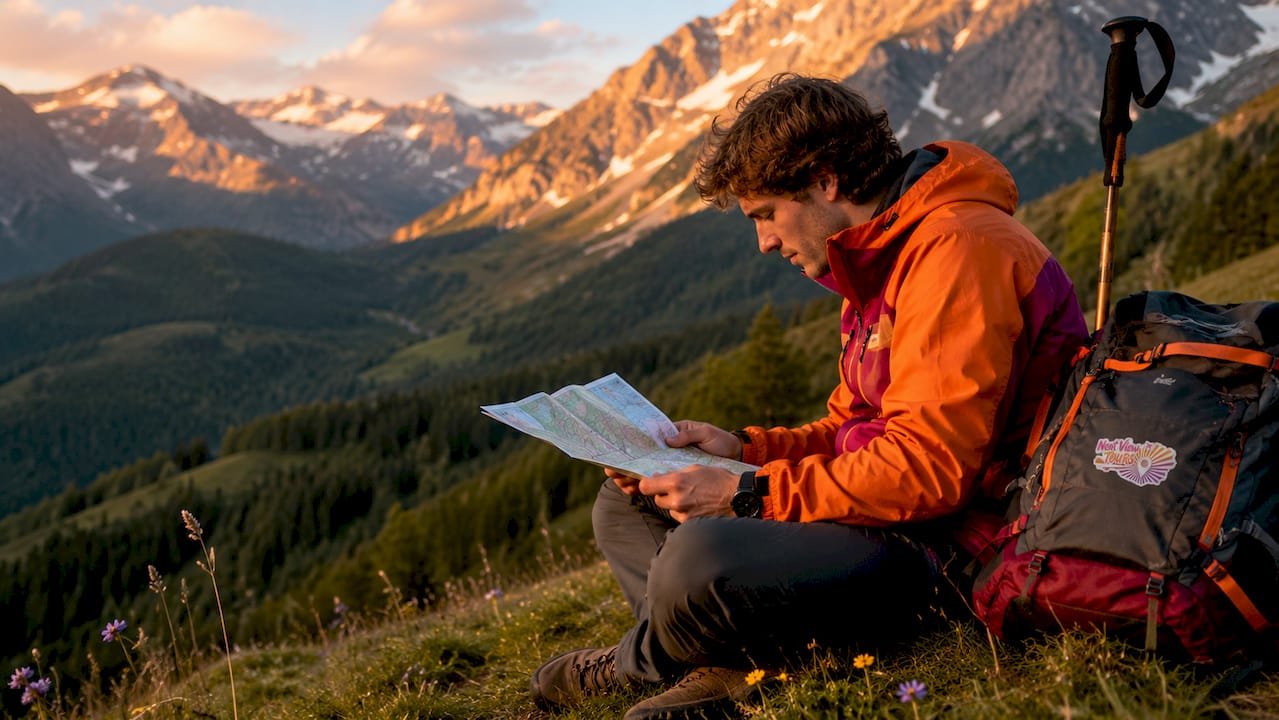
 Uncategorized
TL;DR:
- Austria is a landlocked country in Central Europe with a rich imperial history and a stable economy. Its diverse geography includes the Alps covering 62% of the territory, shaping climate and outdoor activities year-round. Visitors can enjoy a mix of cultural traditions, historic sites, and natural landscapes by exploring different regions at their own pace.
Austria is a landlocked Central European country defined by its alpine terrain, imperial history, and one of Europe’s most stable economies. These austria country facts establish the foundation: a population of 9.2 million as of january 2026, a GDP of €512.8 billion in 2025, and a cultural identity shaped by centuries of Habsburg rule. Austria sits at the heart of Europe, sharing borders with eight countries, and draws millions of visitors each year with its combination of world-class music, mountain scenery, and historic cities. Understanding Austria means understanding a country that has turned its past into a living, breathing present.
What are the key Austria country facts about geography and climate?
Austria covers 83,871 square kilometers, making it roughly the size of South Carolina. That area is not flat farmland. The Alps occupy 62% of the country’s territory, shaping everything from local weather patterns to the national economy. Austria has no coastline, which surprises many first-time visitors who assume Central Europe is more varied in terrain.
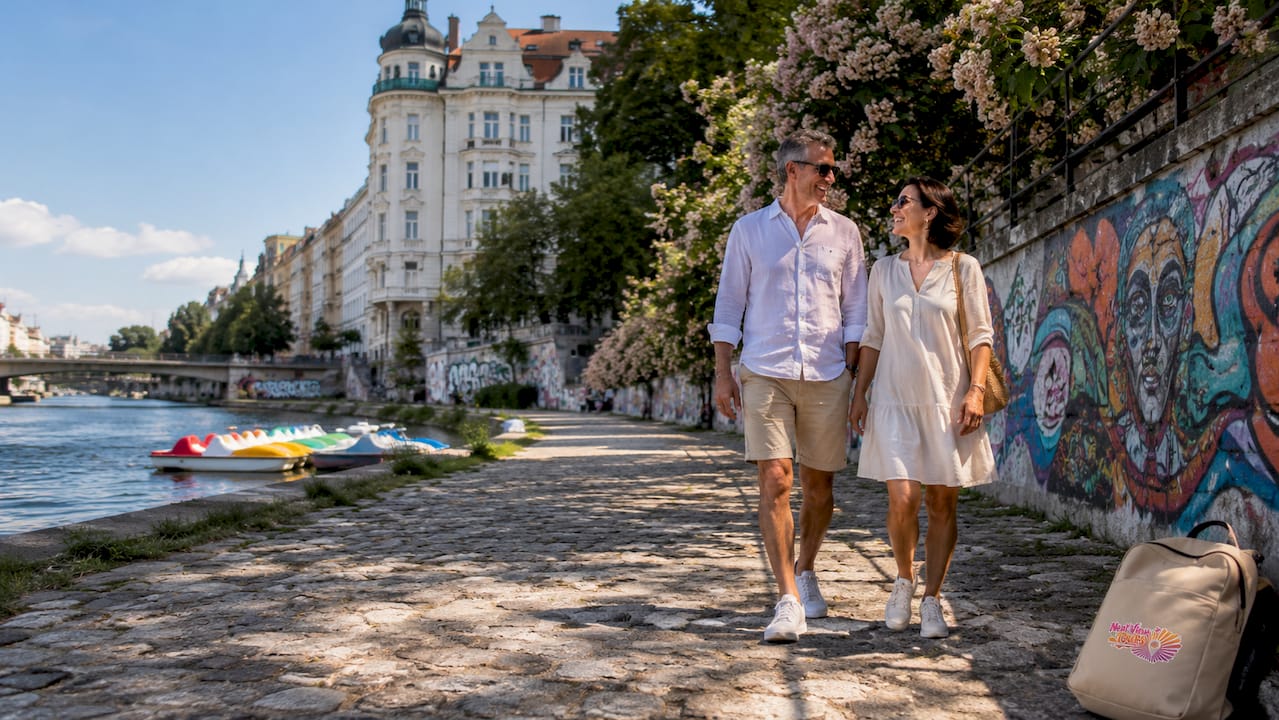
The climate varies sharply by altitude. Lower regions like Vienna and the Danube Valley experience a moderate continental climate, with warm summers reaching around 25°C and cold winters that regularly drop below freezing. Higher alpine zones see heavy snowfall from november through april, making them ideal for skiing. The contrast between valley warmth and mountain cold within a single country is one of Austria’s most striking geographic features.
| Region | Climate Type | Best Season |
|---|---|---|
| Vienna and eastern plains | Continental, moderate | Spring and summer |
| Salzburg and foothills | Temperate, wetter | Year-round |
| Tyrol and alpine zones | Alpine, heavy snow | Winter and summer |
| Styria and southern Austria | Warmer, Mediterranean influence | Late spring to fall |
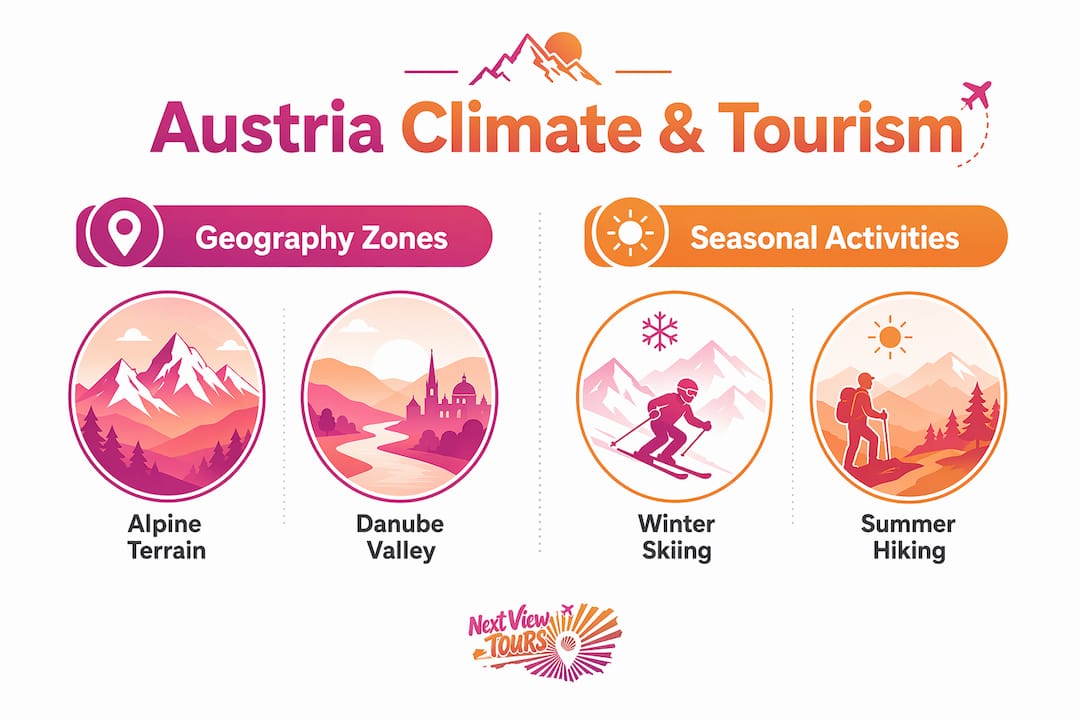
This geographic diversity directly shapes Austria’s tourism calendar. Skiing in the Tyrol, hiking in Styria, and attending open-air concerts in Salzburg all happen in the same country but in completely different environments. Austria’s year-round outdoor activities make it one of Europe’s most versatile destinations.
Pro Tip: Pack layers regardless of the season. Even a warm july day in Vienna can turn cold at higher elevations just an hour’s drive away.
What are notable cultural highlights and traditions in Austria?
Austrian culture runs deep, and it shows in daily life as much as in formal institutions. The country produced composers like Wolfgang Amadeus Mozart, Ludwig van Beethoven (who spent much of his career in Vienna), and Franz Schubert. Classical music is not just history here. It is a living institution, with the Vienna Philharmonic and the Vienna State Opera performing year-round to sold-out audiences.
Austrian cuisine reflects the country’s imperial past and regional variety. Key dishes include:
- Wiener Schnitzel: A breaded and pan-fried veal cutlet, the country’s most recognized dish
- Apfelstrudel: Thin pastry filled with spiced apples, a staple in every Austrian coffeehouse
- Tafelspitz: Boiled beef in broth, a Viennese classic with roots in Habsburg court dining
- Käsespätzle: Egg noodles baked with cheese and onions, popular in western alpine regions
- Sachertorte: A dense chocolate cake with apricot jam, invented at the Hotel Sacher in Vienna in 1832
Cultural events and festivals define the Austrian social calendar. The Salzburg Festival, held each summer, is one of the world’s most prestigious classical music and theater events. Christmas markets across Vienna, Salzburg, and Innsbruck draw visitors from across Europe and beyond. These are not tourist traps. They are genuine community traditions that Austrians have celebrated for generations.
Pro Tip: Book Salzburg Festival tickets at least six months in advance. The most sought-after performances sell out within hours of release.
Regional customs add another layer of richness. In Tyrol, traditional folk music and alpine horn playing remain active practices. In Carinthia, Slovenian cultural influences shape local food and language. Austria’s nine federal states each carry distinct identities, which rewards travelers who move beyond Vienna.
How has Austria’s history shaped its present identity?
Austria’s modern identity is inseparable from its imperial past. The Habsburg dynasty ruled Austria for over six centuries, from 1273 to 1918, building an empire that at its peak stretched from Spain to Hungary. That legacy left behind an extraordinary concentration of palaces, churches, and cultural institutions that now anchor Austria’s tourism industry.
Key historical turning points that shaped present-day Austria:
- The Habsburg Empire (1273–1918): Six centuries of dynastic rule created Vienna as a European cultural capital and established Austria’s role as a political center of the continent.
- The First Republic (1918): After World War I, the empire collapsed and Austria became a small republic, a dramatic reduction in size and influence that forced a complete national reinvention.
- World War II and occupation (1938–1955): Austria was annexed by Nazi Germany in 1938 and later occupied by Allied forces after the war, a period that deeply shaped its postwar political culture.
- The State Treaty of 1955: Austria regained full sovereignty and declared permanent neutrality, a status it maintains today even as an EU member since 1995.
- EU membership and modern prosperity: Austria joined the European Union in 1995, integrating its economy with Europe’s single market and cementing its role as a stable, prosperous democracy.
This history is visible everywhere. The Schönbrunn Palace in Vienna, a UNESCO World Heritage Site, was the summer residence of Habsburg emperors. The Spanish Riding School, also in Vienna, has trained its famous Lipizzaner horses using methods unchanged since the 16th century. Austria’s rich imperial heritage is not preserved behind glass. It is woven into the city’s daily rhythm.
What should travelers know about visiting Austria?
Austria is one of Europe’s most welcoming destinations for international visitors. Citizens of over 60 non-EU countries can enter visa-free for up to 90 days under Schengen Area rules. Your passport must remain valid for at least six months beyond your planned departure date.
Safety is a genuine strength. Austria ranks 4th worldwide on the Global Peace Index 2026. That ranking reflects low crime rates, political stability, and reliable public institutions. Travelers should still apply standard urban precautions, particularly in crowded tourist areas of Vienna where pickpocketing is common near major attractions and on public transit.
Practical travel essentials for Austria:
- Rail travel: Austria’s rail network, operated by ÖBB, connects all major cities efficiently. The Railjet service links Vienna, Salzburg, and Innsbruck with fast, comfortable trains.
- Driving: Austria requires a highway vignette (toll sticker) for motorway use. Purchase one at border crossings or gas stations before driving on the autobahn.
- Best time to visit: June through september suits hiking and festivals. December through march is ideal for skiing and Christmas markets.
- Alpine rescue insurance: Mountain rescue can cost over €5,000 for a helicopter extraction. Standard travel insurance does not cover this. Purchase specialized alpine rescue insurance or join the Austrian Alpine Club (Alpenverein) before heading into the mountains.
- Pharmacies: Austrian pharmacies operate on a rotation system to guarantee coverage on nights and holidays. Look for the red “A” sign and posted schedules showing the nearest open pharmacy after hours.
Pro Tip: Download the ÖBB app before you arrive. It handles train tickets, real-time schedules, and seat reservations across Austria’s entire rail network in English.
For winter travel specifically, Nextviewtours offers detailed guidance on Austria’s winter highlights to help you plan around the best seasonal experiences.
What are Austria’s economic and demographic essentials?
Austria’s economy is one of the most stable in the European Union. The GDP reached €512.8 billion in 2025, placing Austria among Europe’s wealthier mid-sized economies. The country’s economic strength comes from a diversified base rather than dependence on any single sector.
Tourism contributes roughly 9% of GDP and employs about 10% of the workforce. That makes it one of the most tourism-dependent economies in Western Europe. Manufacturing, particularly in machinery, vehicles, and chemicals, forms another major pillar. The services sector, including finance and professional services, rounds out the economy.
| Indicator | Figure |
|---|---|
| Total population | 9.2 million (2026) |
| Vienna population | ~2 million |
| GDP | €512.8 billion (2025) |
| Tourism share of GDP | ~9% |
| Global Peace Index rank | 4th (2026) |
| Total area | 83,871 km² |
Vienna, home to approximately 2 million people, is the capital and by far the largest city. Graz, Linz, Salzburg, and Innsbruck follow as significant regional centers. Austria’s population is concentrated in urban areas, with rural alpine regions remaining sparsely settled. Austria is a founding member of the United Nations and holds membership in the OECD, the Council of Europe, and the OSCE, reflecting its active role in international institutions.
Key Takeaways
Austria’s blend of alpine geography, imperial culture, and economic stability makes it one of Europe’s most complete destinations for curious travelers and knowledge seekers alike.
| Point | Details |
|---|---|
| Geography and size | Austria covers 83,871 km² with 62% alpine terrain and no coastline. |
| Economic strength | GDP of €512.8 billion in 2025, with tourism contributing roughly 9%. |
| Safety and access | Ranked 4th on the Global Peace Index 2026; visa-free for 60+ nationalities up to 90 days. |
| Cultural depth | Home to Mozart, the Salzburg Festival, and centuries of Habsburg imperial heritage. |
| Travel preparation | Alpine rescue insurance and a rail pass are the two most practical investments before arrival. |
Why Austria rewards the curious traveler more than the rushed one
Austria is one of those countries that reveals itself slowly. I have seen travelers spend three days in Vienna, check off the Schönbrunn Palace and the Kunsthistorisches Museum, and leave feeling satisfied. They are not wrong to feel that way. Vienna is extraordinary. But they have missed the country.
The real depth of Austria sits in its regions. Styria’s wine country feels nothing like the Tyrolean Alps. The Wachau Valley, a UNESCO-listed stretch of the Danube lined with vineyards and medieval castles, operates at a pace that Vienna cannot replicate. Salzburg is not just Mozart’s birthplace. It is a city where baroque architecture and mountain views create a setting that feels almost theatrical in the best possible way.
Austria’s 4th-place ranking on the Global Peace Index is not just a travel statistic. It means you can walk freely, use public transit without anxiety, and focus entirely on the experience rather than logistics. That kind of ease is rarer than it sounds. Focusing on 2–3 regions per trip rather than trying to cover the whole country produces a far richer experience. Austria rewards depth over breadth, every time.
— Next
How Nextviewtours brings Austria’s best experiences to you
Austria’s geography, history, and culture are best absorbed with expert guidance and a well-planned itinerary. Nextviewtours offers private tours, group tours, and fully customized experiences built around Austria’s most compelling destinations, from Vienna’s imperial palaces to the alpine villages of Tyrol and the festival stages of Salzburg.
Whether you prefer a focused day trip from Vienna or a multi-day adventure across several regions, Nextviewtours matches your pace and interests with local expertise. Browse the full range of Austria and Europe trip types to find the format that fits your travel style, group size, and timing. Expert guides handle the details so you can focus on the experience.
FAQ
What is Austria’s total population in 2026?
Austria’s population is approximately 9.2 million as of january 2026. Vienna, the capital, accounts for roughly 2 million of those residents.
Is Austria safe for tourists?
Austria ranks 4th worldwide on the Global Peace Index 2026, making it one of the safest countries in the world. Standard urban precautions apply in crowded tourist areas of Vienna.
Do I need a visa to visit Austria?
Citizens of over 60 non-EU countries can enter Austria visa-free for up to 90 days under Schengen Area rules. Your passport must be valid for at least six months beyond your departure date.
What is the best time of year to visit Austria?
June through september is best for hiking, festivals, and outdoor sightseeing. December through march suits skiing and Christmas markets in cities like Vienna, Salzburg, and Innsbruck.
Why is alpine rescue insurance important in Austria?
Mountain rescue in the Alps can cost over €5,000 for a helicopter extraction, and standard travel insurance does not cover it. Specialized alpine rescue insurance or Alpenverein membership is the safest solution before any mountain activity.


Comments are closed