

 Uncategorized
TL;DR:
- Travel agents now serve as expert advisors who design complex itineraries, manage crises, and secure exclusive deals. They add value by filtering options with personal judgment, leveraging supplier relationships, and providing end-to-end support for high-stakes trips. For simple trips, DIY booking suffices, but for intricate or group travel, professional advocacy significantly reduces stress and error.
A travel agent is defined as a professional advisor who plans, books, and advocates for travelers across every stage of a trip. The role of travel agent in tourism has shifted far beyond simple ticket booking. Modern travel advisors now serve as consultative experts who design itineraries, manage crises, handle visa documentation, and secure exclusive deals that travelers cannot access on their own. Whether you are planning a honeymoon in Vienna, a group adventure through Central Europe, or a multi-day nature trip across Austria, a skilled travel agent transforms what could be a stressful process into a confident, well-supported experience.
What is the role of travel agent in tourism?
The travel agent’s core role is to act as a professional intermediary between travelers and the full range of travel products and services. This means more than clicking “book now” on a flight. Modern travel advisors provide expert guidance, personalized service, and hands-on support before, during, and after a trip.

The profession has moved decisively from transactional to consultative. A travel agent today is part planner, part researcher, part advocate, and part problem-solver. That shift matters because travel has grown more complex, with more destinations, more booking platforms, and more variables than any single traveler can reasonably track.
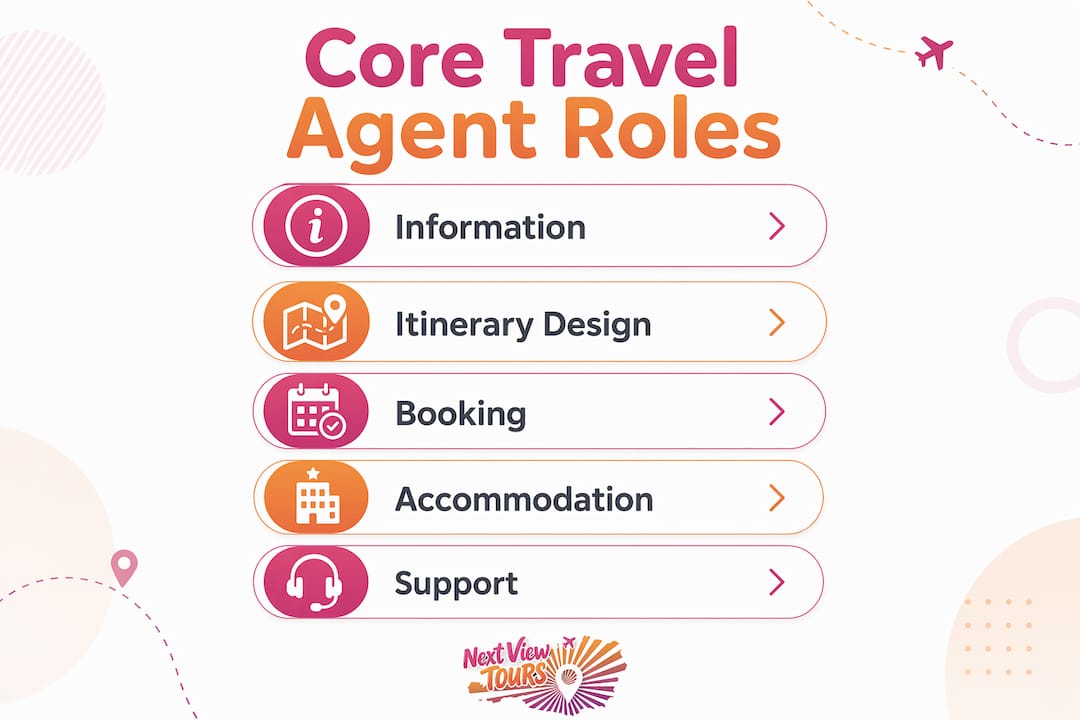
The industry now recognizes eight core agency functions: Information, Itinerary Design, Reservation and Ticketing, Accommodation, Package Design, Document and Visa Handling, Marketing, and Crisis Management. That last function is the newest and arguably the most valuable. When flights are canceled, political situations shift, or natural events disrupt travel, a skilled agent becomes your human safety net in a way that no automated booking app can replicate.
How do travel agents simplify complex trip planning?
Complex trips are where travel agents earn their value most clearly. Honeymoons, multi-country tours, cruises, and group travel for 15 or more people involve layered logistics that quickly overwhelm even experienced DIY travelers.
Travel agents access wholesale rates and packages not available to the public. That access can translate into savings of hundreds to thousands of dollars on complex bookings, particularly for groups where small per-person discounts multiply significantly. Beyond price, agents minimize costly booking errors that are easy to make when coordinating flights, hotels, transfers, and activities across multiple destinations.
Here is what a travel agent typically handles for a complex trip:
- Multi-destination routing: Sequencing stops to minimize travel time and cost
- Group coordination: Managing room blocks, meal arrangements, and activity bookings for large parties
- Cruise logistics: Selecting cabin categories, shore excursions, and embarkation logistics
- Honeymoon upgrades: Leveraging supplier relationships to secure room upgrades and amenity packages
- Visa and document prep: Tracking entry requirements for each destination and flagging deadlines
- Travel insurance guidance: Matching coverage to the specific risks of your trip type
The time savings alone justify the relationship for many travelers. Researching a two-week European itinerary across five countries can take dozens of hours. An experienced agent compresses that process dramatically by drawing on firsthand destination knowledge and trusted supplier networks.
Pro Tip: Tell your agent about your worst travel experience, not just your best. Knowing what you want to avoid is just as useful as knowing your dream destinations.
What specialized services do travel agents provide beyond booking?
Travel agents provide a structured set of advisory services that go well beyond reserving seats and rooms. Each of the eight recognized agency functions addresses a specific traveler need.
- Information: Agents provide current, vetted destination knowledge including entry requirements, local customs, health advisories, and seasonal conditions.
- Itinerary Design: Agents build day-by-day plans that balance sightseeing, rest, and logistics, tailored to your pace and interests.
- Reservation and Ticketing: Agents handle all bookings across flights, trains, ferries, and ground transport, often through Global Distribution Systems unavailable to the public.
- Accommodation: Agents match properties to your budget, style, and location needs, often with access to preferred rates and added perks.
- Package Design: Agents bundle components into cohesive packages that are frequently more cost-effective than booking each element separately.
- Document and Visa Handling: Agents track visa requirements, passport validity rules, and health documentation for every destination on your itinerary.
- Marketing: For group organizers and corporate clients, agents help communicate and promote travel programs to participants.
- Crisis Management: Agents advocate directly with airlines, hotels, and tour operators when disruptions occur, often resolving issues faster than travelers can on their own.
That crisis management function deserves particular attention. When a flight cancellation strands you in Prague at midnight, an agent with direct supplier contacts can rebook you, secure hotel accommodation, and update your entire downstream itinerary within hours. A booking app sends you a notification.
“The travel agent profession has shifted from transactional to consultative, acting as personal advocates providing end-to-end trip support and personalized design.” — The Travel Institute
Personalized advocacy is the thread connecting all eight functions. Your agent is not managing a generic traveler. They are managing you, your preferences, your budget, and your timeline. That specificity produces better outcomes than any algorithm built for the average traveler.
Why does human judgment matter more than DIY booking?
Online booking platforms give travelers access to enormous amounts of information. That is also their biggest problem. The sheer volume of options, reviews, and price variations creates decision fatigue that leads to poor choices or hours of unproductive research.
Travel advisors filter that noise by applying experience, client knowledge, and trusted supplier networks. They do not present you with 200 hotel options. They present you with three that genuinely fit your needs. That judgment, built from years of firsthand travel and client feedback, is something no search algorithm replicates.
The contrast between DIY and agent-assisted booking becomes clearest in specific scenarios:
| Scenario | DIY booking | Agent-assisted booking |
|---|---|---|
| Simple weekend city trip | Fully manageable | Unnecessary for most travelers |
| Multi-country European tour | Time-consuming, error-prone | Efficient, with insider routing |
| Group travel for 15+ people | Highly complex, costly errors likely | Managed with group rates and coordination |
| Honeymoon or anniversary trip | Misses upgrade opportunities | Leverages supplier relationships for perks |
| Crisis or disruption mid-trip | Self-managed, slow resolution | Agent advocates directly with suppliers |
Professional agents do not hold travel inventory but use Global Distribution Systems and direct supplier relationships to secure privileges that never appear on public booking sites. These include room upgrades, early check-ins, late checkouts, complimentary amenities, and priority rebooking during disruptions. Those benefits have real monetary value and meaningfully improve the travel experience.
Pro Tip: Ask your agent specifically what supplier relationships they hold. An agent with strong hotel and airline contacts in your destination region will deliver noticeably better perks than a generalist.
How do you maximize your relationship with a travel agent?
Getting the most from a travel agent starts before your first conversation. Agents work most efficiently when you arrive with clear goals, not vague wishes.
Come prepared with your non-negotiables: your total budget, travel dates, must-see experiences, and any hard limits on pace or accommodation type. That clarity lets your agent source best-fit options immediately rather than spending time narrowing down your preferences through trial and error.
Key steps to a productive agent relationship:
- Clarify fees upfront: Travel agents earn income from both supplier commissions and direct client fees. Ask whether they charge a flat itinerary fee, a percentage-based service charge, or both. Knowing this upfront prevents surprises.
- Share your travel history: Tell your agent where you have been, what you loved, and what disappointed you. That context shapes every recommendation.
- State your pace preference: Some travelers want every hour planned. Others need breathing room. Your agent needs to know which you are.
- Ask about destination expertise: Choose an agent with firsthand knowledge of your target region. An agent who has personally traveled through Central Europe will give you far better guidance on Salzburg or Budapest than one who has only researched it online.
- Discuss contingency planning: Ask how your agent handles disruptions. A good agent will explain their crisis management process before you ever need it.
For [group travel planning](https://nextviewtours.com/group-travel-planning-workflow-seamless Trips), the relationship becomes even more critical. Agents managing groups coordinate rooming lists, dietary needs, activity preferences, and payment logistics across many people simultaneously. The more information you provide early, the smoother that coordination runs.
Key Takeaways
Travel agents deliver the most value when trips are complex, unfamiliar, or high-stakes, combining exclusive access, expert judgment, and crisis advocacy that no booking platform can match.
| Point | Details |
|---|---|
| Eight core functions | Agents now cover Information, Itinerary Design, Booking, Accommodation, Packages, Visas, Marketing, and Crisis Management. |
| Complex trips justify agents | Honeymoons, cruises, and group travel of 15+ people benefit most from agent access to wholesale rates and logistics expertise. |
| Human judgment filters overload | Agents narrow hundreds of options to a curated shortlist based on your specific preferences and travel history. |
| Supplier relationships add real value | GDS access and direct supplier contacts unlock upgrades, perks, and priority rebooking unavailable on public platforms. |
| Preparation improves outcomes | Arriving with a clear budget, pace preference, and non-negotiables lets agents source best-fit options immediately. |
Why I think the “just book it yourself” era has real limits
I have watched the travel industry change considerably over the years, and one pattern stands out clearly. Travelers who dismiss agents for simple trips are usually right. A weekend in a familiar city does not need a professional intermediary.
But the travelers who regret going solo are almost always the ones who underestimated complexity. A couple who booked their own honeymoon across four European countries and spent three days of it sorting out a hotel error. A group of twenty friends whose self-organized trip fell apart when one airline changed its schedule and cascaded into missed connections. These are not edge cases. They are predictable outcomes of complex logistics managed without expertise.
The crisis management function is what I find most underappreciated. When something goes wrong mid-trip, the difference between having an agent and not having one is not just convenience. It is hours of stress, potentially hundreds of dollars, and sometimes the difference between salvaging a trip and losing it entirely. Agents have direct lines to supplier contacts that travelers simply do not have.
The profession has genuinely matured. Today’s travel advisor is not a booking clerk. They are a destination expert, a logistics coordinator, and a personal advocate rolled into one. For anyone planning a trip with real stakes, whether that means significant cost, unfamiliar territory, or a group to coordinate, the functions of a travel agency are worth understanding before you decide to go it alone.
— Next
How Nextviewtours brings expert travel planning to life
Nextviewtours designs trips across Europe with the same advisory depth this article describes. From private day trips out of Vienna and Salzburg to multi-day adventures through Austria, the Czech Republic, Slovakia, Hungary, and beyond, every experience is built around your preferences, not a generic template.

Whether you are planning a family tour, a couple’s getaway, or a group adventure, Nextviewtours pairs you with expert advisors who know these destinations firsthand. Explore the full range of trip types available to find the format that fits your travel goals. For those weighing options, the guide on private tours in Europe explains exactly how tailored planning works in practice.
FAQ
What is the main role of a travel agent in tourism?
A travel agent serves as a professional advisor who plans, books, and advocates for travelers across all stages of a trip. Their role covers eight core functions including itinerary design, visa handling, accommodation, and crisis management.
Why use a travel agent instead of booking online?
Travel agents provide access to wholesale rates, supplier relationships, and curated recommendations that public booking platforms do not offer. They are especially valuable for complex trips involving multiple destinations, groups, or high-cost bookings.
What does a travel agent do during a travel disruption?
A travel agent contacts airlines, hotels, and tour operators directly to rebook and resolve issues on your behalf. This direct access typically resolves disruptions faster than travelers can manage independently.
How do travel agents charge for their services?
Agents earn income through supplier commissions and direct client fees, which may be flat itinerary fees or percentage-based service charges. Always clarify the fee structure before engaging an agent.
When is it worth using a travel agent?
Travel agents deliver the clearest value for honeymoons, cruises, group travel, multi-country itineraries, and trips to unfamiliar destinations. Simple, familiar trips are generally manageable without professional assistance.


Comments are closed