
 Uncategorized
TL;DR:
- Group travel offers significant savings through shared costs, group discounts, and avoiding single supplements. It enhances social bonds and personal growth while simplifying logistics with pre-planned itineraries and local guides. Small groups of up to 16 balance personalized experiences with cost benefits and social opportunities.
Group travel is defined as two or more people sharing a planned itinerary, transportation, and accommodation, and the travelling in group advantages go far beyond simple cost splitting. You gain financial savings, social connection, and a level of logistical ease that solo travel rarely delivers. Research confirms that group travel can be up to 90% cheaper than solo travel when you factor in shared accommodation, transportation, and bulk discounts on activities. That figure is not a rounding error. It reflects a structural shift in how travel costs distribute across a group. Nextviewtours has built its entire European tour program around these advantages, offering everything from day trips out of Vienna to multi-day adventures across Austria, the Czech Republic, and beyond.
What are the travelling in group advantages for your budget?

Shared costs are the most immediate and measurable benefit of group travel. When five people split a villa in Salzburg, each person pays a fraction of what a hotel room would cost individually. The same logic applies to private transfers, boat rentals, and guided entry fees.
Group rates and bulk discounts add another layer of savings. Tour operators, museums, and restaurants routinely offer reduced pricing for groups, and those savings compound across a multi-day trip. Nextviewtours, for example, structures its group tour packages to capture these discounts at every stage of the itinerary.
One underappreciated savings mechanism is what travel economists call the “food economy.” Sharing dishes family-style among five people costs less per person than ordering individual entrées, and it lets everyone taste more of the local cuisine. A table of five sharing ten plates in Budapest spends less and eats better than five solo diners ordering separately.
Groups also sidestep the single supplement, a surcharge that solo travelers pay when occupying a double room alone. This fee can add 30–50% to accommodation costs on organized tours. Traveling with even one other person eliminates it entirely.
- Shared accommodation: Split villa, apartment, or multi-room hotel costs across the group.
- Group activity rates: Bulk pricing on guided tours, entry tickets, and equipment rentals.
- Food economy: Order shared plates to reduce per-person meal costs and broaden tasting options.
- No single supplement: Paired or grouped travelers avoid the solo room surcharge.
- Sinking fund: Pool a small amount per person before departure to cover unexpected group expenses without conflict.
Pro Tip: Set up a shared group fund before the trip. Collecting a fixed amount per person upfront covers surprise costs like a missed connection or a spontaneous detour, and it removes the awkwardness of splitting bills on the road.
What social and emotional advantages come with group travel?
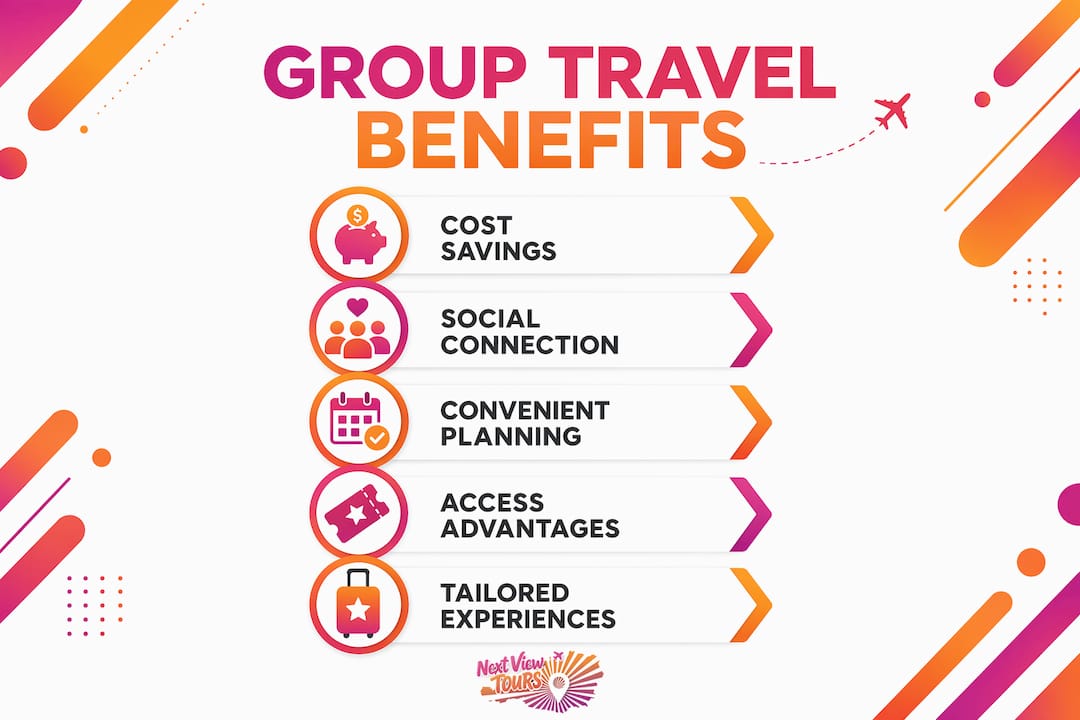
Group travel reduces social friction because participants already share a common interest: the trip itself. Social friction drops when travelers arrive with aligned goals, which means conversations start faster and bonds form more naturally than in everyday social settings. You skip the small talk and move straight to shared experience.
The relationships that form on group trips tend to outlast the trip itself. Shared meals, travel segments, and activities create natural openings for meaningful conversation. A long train ride through the Austrian Alps or a cooking class in Prague gives people the time and context to connect in ways that a dinner party rarely does.
Group travel also supports personal growth in a way that solo travel sometimes cannot. Stepping into an unfamiliar culture feels less intimidating when you have peers alongside you. The group provides a safety net that encourages you to try things you might skip alone, whether that is a night hike, a local market, or a conversation with a stranger.
“Group travel in 2026 provides the ability to travel ‘solo but not alone,’ balancing independence and social support during trips. This balance enhances both safety and social satisfaction in ways that neither solo nor fully packaged travel can replicate.”
The social structure of a group also creates built-in accountability. When you commit to a shared itinerary, you show up. That commitment pushes travelers to experience things they might otherwise postpone or skip. The result is a richer, denser trip with fewer wasted days. For more on how shared spaces shape travel dynamics, the research is clear: curated social environments accelerate connection.
In what ways does group travel simplify trip planning and logistics?
A fixed itinerary removes decision fatigue. Group travelers rely on knowledgeable leaders to manage local navigation, transport, and scheduling, which means you spend your mental energy on the experience rather than the logistics. You do not spend the morning of your Prague visit debating which castle to see first.
Pre-booked group slots solve a problem that independent travelers increasingly face: over-tourism. Organized groups secure priority access to popular sites that are otherwise sold out or restricted to walk-in visitors. In cities like Hallstatt or Vienna, where timed entry is now standard, this access is a genuine competitive advantage.
Experienced group leaders also use local knowledge to steer travelers away from tourist traps. Local expertise helps groups access hidden restaurants, off-peak routes, and authentic experiences that independent travelers rarely find. That knowledge translates directly into a better trip at a lower cost.
Modern small-group tours build in managed flexibility. Planned activities and free time coexist within the same itinerary, so you are never locked into a rigid schedule. You get the structure of a planned trip with enough breathing room to wander.
| Logistics challenge | How group travel solves it |
|---|---|
| Decision fatigue | Pre-planned itinerary removes daily choices |
| Over-tourism access | Pre-booked group slots bypass sold-out entry |
| Local navigation | Expert guides handle routes and transport |
| Budget overruns | Fixed group pricing caps most variable costs |
| Language barriers | Guides provide real-time cultural and linguistic support |
- Book a tour with a pre-planned itinerary to eliminate daily scheduling decisions.
- Confirm that your group has reserved entry slots at high-demand sites before departure.
- Choose a tour led by a local guide who knows the area beyond the standard tourist circuit.
- Review the itinerary for built-in free time so you can personalize parts of the trip.
- Verify that group transportation is included to avoid last-minute logistics stress.
What types of group travel experiences best maximize these advantages?
Small-group cultural immersions deliver the highest concentration of group travel perks. Groups capped at 16 participants balance social interaction with personalized attention, which means guides can adapt the experience to the group’s pace and interests. Larger groups trade that flexibility for scale, which suits travelers who prioritize cost savings over customization.
Age and interest-focused groups amplify the social benefits. When travelers in their 20s and 30s join a trip designed for their demographic, the social friction drops even further. Shared life stage creates an additional layer of common ground beyond the destination itself. The same principle applies to culinary tours, wildlife trips, and adventure itineraries, where a shared passion replaces the need for icebreakers.
Luxury group tours and private group experiences serve families and friend groups who want the benefits of shared travel without mixing with strangers. Nextviewtours offers customized private tours across Europe that combine the cost benefits of group sharing with the personalization of a private itinerary. That combination suits travelers who want control over the experience without carrying the full logistical burden alone.
| Travel style | Best for | Key advantage |
|---|---|---|
| Small-group cultural tour | Solo travelers and pairs | Deep connection and personalized access |
| Private group tour | Families and friend groups | Full customization with shared costs |
| Adventure group trip | Active travelers | Peer encouragement and safety in numbers |
| Culinary or slow travel group | Food and culture enthusiasts | Food economy and immersive local access |
Pro Tip: If you are traveling solo, look for small-group adventure tours capped at 16 or fewer participants. The smaller the group, the faster the friendships form and the more flexible the itinerary becomes.
Key Takeaways
Group travel delivers its greatest value when cost savings, social connection, and expert logistics combine within a single well-structured itinerary.
| Point | Details |
|---|---|
| Cost savings are structural | Shared accommodation, group rates, and the food economy reduce per-person costs significantly. |
| Social friction drops fast | Common travel interests accelerate bonding and make meaningful connections easier to form. |
| Logistics become someone else’s job | Pre-planned itineraries and local guides remove decision fatigue and navigation stress. |
| Group size shapes the experience | Groups of 16 or fewer deliver the best balance of personalization and social opportunity. |
| Access improves with group booking | Pre-booked group slots open doors at popular sites that independent travelers cannot enter. |
Why group travel rewards you more than you expect
My honest view is that most travelers underestimate group travel until they have done it once. The financial case is easy to make on paper, but the real return shows up in the quality of the experience itself. You eat better, see more, and leave with relationships that a solo trip rarely produces.
The mistake I see most often is choosing the wrong group size. A tour with 40 people moves like a convoy. A group of 8–12 moves like a conversation. The difference in experience is not marginal. It is the difference between watching a destination and actually inhabiting it.
Balancing structure with freedom is the other variable that separates a great group trip from a frustrating one. The best itineraries give you a full day of guided activity and then hand you two hours to wander alone. That rhythm respects both the group’s shared goals and your individual curiosity. Nextviewtours builds that balance into its European itineraries by design, not as an afterthought.
Group travel also builds confidence in ways that are hard to predict. Stepping into an unfamiliar city with a group behind you lowers the psychological barrier to trying something new. After one well-run group trip, most travelers find that their appetite for independent travel grows too. The group experience does not replace solo travel. It trains you for it.
For practical strategies on planning smarter as a group, the fundamentals come down to communication, clear expectations, and a shared fund before departure.
— Next
Nextviewtours group trips: built around the advantages that matter
Nextviewtours designs its European group tours to deliver every advantage covered here, from shared-cost pricing and pre-booked site access to expert local guides and flexible itineraries. Whether you are planning a day trip from Vienna, a multi-day route through Slovakia and Hungary, or a private group experience across Austria, the structure is built to give you more value per person than independent travel can match.
The full range of group and private tour types is available on the Nextviewtours website, organized by destination, duration, and travel style. If you want to understand the full scope of what group travel can look like across Europe, the group tours definition guide is a strong starting point for comparing formats and finding the right fit for your group.
FAQ
What are the main advantages of travelling in a group?
Group travel reduces per-person costs through shared accommodation and group rates, removes logistical stress through pre-planned itineraries, and creates social connection through shared experiences. These three benefits compound across a multi-day trip.
Is group travel actually cheaper than solo travel?
Group travel can be up to 90% cheaper than solo travel due to shared costs and bulk discounts on tours, transport, and accommodation. The savings are most significant when groups share private rentals and meals family-style.
What is the ideal group size for the best travel experience?
Groups of up to 16 participants deliver the best balance of personalized attention and social opportunity. Larger groups reduce per-person costs further but sacrifice flexibility and guide attention.
How does group travel help with access to popular attractions?
Organized groups secure pre-booked slots at high-demand sites that are often unavailable to independent travelers. This group-only access has become a key advantage as over-tourism restricts walk-in entry at major European destinations.
Can group travel still feel personal and flexible?
Modern small-group tours build managed flexibility into the itinerary, combining scheduled activities with free time for individual exploration. Choosing a tour with a local expert guide adds a layer of personalization that standard independent travel rarely achieves.


Comments are closed