 Uncategorized
Switzerland packs more visual drama per square mile than almost anywhere in Europe. For international travelers departing from Vienna or Prague, it sits within comfortable rail reach, yet feels like a world apart. The must-see places to visit in Switzerland span medieval lakeside cities, thundering glacier waterfalls, and high-alpine villages that seem untouched by time. Here is a quick orientation before you dive into the details:
- Lucerne — medieval Chapel Bridge, Lake Lucerne cruises, and Mount Pilatus on the doorstep
- Lauterbrunnen Valley — 72 waterfalls, including the glacier-carved Trümmelbach Falls
- Bern — UNESCO-listed medieval old town with the Zytglogge clock tower and Bear Park
- Zermatt — the Matterhorn at 4,478 meters, car-free streets, and world-class hiking
- Interlaken — the gateway to the Bernese Oberland and extreme adventure sports
- Geneva — cosmopolitan French-Swiss culture on the arc of Lake Geneva
- Glacier Express and Bernina Express — panoramic rail journeys that are destinations in themselves
Plan for a sufficiently long trip. Switzerland’s regions are distinct enough that rushing between them means missing the point entirely.
Table of Contents
- What makes Switzerland’s key destinations so different from each other?
- Why scenic rail journeys belong on your Switzerland itinerary
- How to plan your Switzerland trip for the best experience
- See Switzerland with Nextviewtours’ local expertise
- Switzerland is closer than you think from Vienna and Prague
- Key Takeaways
What makes Switzerland’s key destinations so different from each other?
Switzerland’s appeal is not one landscape repeated at scale. It is four linguistic regions, each with its own architecture, food culture, and pace of life, compressed into a country smaller than the state of West Virginia.
Lucerne and Mount Pilatus
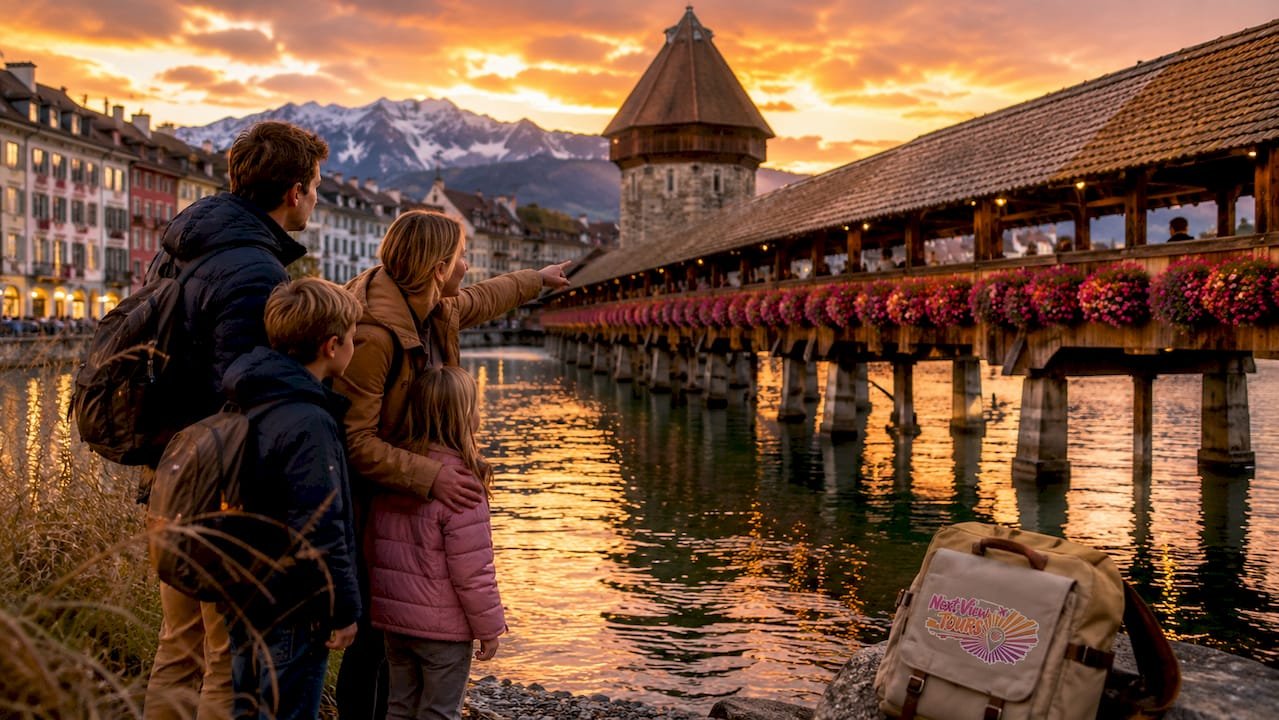
Lucerne ranks among Switzerland’s most beloved cities for good reason. The 14th-century Chapel Bridge arches over the Reuss River with the Water Tower standing sentinel beside it, and the medieval old town behind it rewards slow, unhurried walking. A boat cruise across Lake Lucerne leads directly to the cable car base for Mount Pilatus at 2,128 meters, where the panorama stretches across six cantons on a clear day. Rail connections from Zurich make Lucerne an easy first stop for travelers arriving from Vienna or Prague.
Lauterbrunnen Valley and Trümmelbach Falls
The Lauterbrunnen Valley is one of the most dramatic glacial valleys in the Alps. Waterfalls cascade from sheer cliff walls on both sides of the valley floor, and the Staubbach Fall drops impressively in a single plunge. The standout, though, is Trümmelbach Falls: ten glacier-melt stages roaring through a mountain interior, accessible by elevator cut directly into the rock. No photograph quite prepares you for the sound.
Bernese Oberland: Interlaken, Grindelwald, and Wengen
| Destination | Best For | Seasonal Peak |
|---|---|---|
| Interlaken | Adventure sports, paragliding, base for excursions | June–September |
| Grindelwald | Hiking, Eiger views, Jungfraujoch access | July–August, December–March |
| Wengen | Car-free village charm, quieter alpine pace | Year-round |
| Jungfraujoch | Europe’s highest train station | July–September |
Wengen deserves special mention. This car-free village sits above the Lauterbrunnen Valley and offers a slower, more authentic Swiss alpine experience that most first-time visitors skip entirely in favor of Interlaken’s busier streets.
Bern, Geneva, and Switzerland’s linguistic regions
Bern’s medieval old town is a UNESCO World Heritage Site, its six kilometers of covered arcades sheltering cellar shops and fountains topped by carved folk figures. The Zytglogge clock tower and Bear Park anchor the old city, while the Einstein-Haus marks where the physicist developed his theory of relativity. Geneva, by contrast, is unmistakably French-Swiss: cosmopolitan, lake-facing, and home to the Jet d’Eau fountain and some of the country’s finest museums. Just outside Geneva, the terraced Lavaux vineyards, also UNESCO-listed, produce wines that rarely leave the country. Lugano in Italian-speaking Ticino feels like a different country altogether, with piazza culture and espresso bars replacing the Germanic efficiency of Zurich.
Pro Tip: Recognizing Switzerland’s regional cultural differences before you arrive helps you build a more coherent itinerary. Pairing Lucerne with Bern covers the German-speaking heartland; adding Geneva and the Lavaux vineyards brings in the French-Swiss dimension without backtracking.
Why scenic rail journeys belong on your Switzerland itinerary
Swiss tourism authorities are clear on this point: the Glacier Express and Bernina Express are not merely ways to get between cities. They are experiences worth planning your entire schedule around.
- Glacier Express — eight hours from Zermatt to St. Moritz, crossing 291 bridges and 91 tunnels through the heart of the Alps
- Bernina Express — four hours from Chur to Tirano, Italy, climbing to 2,253 meters at the Ospizio Bernina pass with views of the Morteratsch Glacier
- GoldenPass Express — links Montreux on Lake Geneva to Interlaken and Lucerne, passing through the Lavaux wine region
The Swiss Travel System integrates trains, buses, and boats into a single network, with regional passes offering better value than point-to-point tickets for multi-day travel. For travelers coming from Vienna or Prague, the connection into Switzerland via Zurich or Basel is direct and fast, making it practical to begin a rail circuit on arrival day.
Booking panoramic rail seats in advance is not optional during July and August. Window seats on the right side of the Bernina Express heading south give you the best glacier views. For a scenic mountain experience that complements Switzerland’s rail culture, the approach from Austria’s Vorarlberg region through Bregenz also rewards travelers who take the slower, more scenic route.
Pro Tip: Build your Swiss itinerary around the rail routes rather than around cities. Choose two or three anchor cities, then let the train journeys between them become part of the experience rather than dead time.
How to plan your Switzerland trip for the best experience
A trip length that allows several days is recommended to do Switzerland justice. Shorter visits may involve significant transit time limiting the experience of the regions.
- Getting there from Vienna or Prague: Direct trains reach Zurich in several hours from Vienna and a bit longer from Prague, making Switzerland a convenient addition to a Central European itinerary.
- Regional passes: The Swiss Travel Pass covers unlimited travel on trains, buses, and boats and includes free entry to over 500 museums. It pays for itself quickly on a ten-day trip.
- Jungfraujoch: This excursion requires nearly a full day and benefits from advance ticket booking due to capacity limits. Weather can close the summit without warning.
- Accommodation: Interlaken and Lucerne offer the widest range of hotels near major attractions. Grindelwald and Wengen suit travelers who prefer waking up already in the mountains.
- Best seasons: June through September for hiking and mountain visibility; December through March for skiing in Zermatt and Grindelwald. Shoulder months (May and October) offer fewer crowds and lower prices.
- Safety and customs: Switzerland is exceptionally safe for US travelers. Tipping is appreciated but not obligatory; rounding up the bill is standard. Noise ordinances are taken seriously, particularly in residential areas after 10 PM.
Pro Tip: Early morning visits to Jungfraujoch and Mount Pilatus maximize your chances of clear skies. Afternoon cloud cover is common in summer, and the summit experience drops significantly when visibility closes in.
For families considering a multi-destination trip that combines Switzerland with neighboring Austria, the Switzerland and Austria itinerary from Nextviewtours covers both countries in a structured, guided format that removes the logistics burden entirely.
See Switzerland with Nextviewtours’ local expertise
Nextviewtours operates guided, private, and multi-day tours across Switzerland and neighboring European countries, with departures from Vienna, Prague, Budapest, and Salzburg. The team specializes in multi-country itineraries that combine Switzerland’s alpine highlights with the cultural depth of Central Europe, so you are not piecing together connections on your own.
Tours cover the full range: guided group experiences for travelers who want built-in community, private tours for couples or families who prefer their own pace, and adventure-focused trips that go beyond the standard city circuit into hiking terrain and scenic rail routes. Local guides handle the logistics of Jungfraujoch bookings, rail pass selection, and accommodation near key sites, which saves considerable planning time.
Pro Tip: Travelers booking a private tour can request custom routing that combines Lucerne, the Bernese Oberland, and Zermatt in a single coherent loop, without the backtracking that self-planned itineraries often involve.
Switzerland is closer than you think from Vienna and Prague
Nextviewtours offers a direct path from Central Europe into Switzerland’s most rewarding destinations, without the complexity of building a multi-country itinerary from scratch. Whether you want a guided group experience through Lucerne and the Bernese Oberland or a private trip tailored around the Glacier Express and Zermatt, the trip types available cover every travel style and group size.
The Swiss Alps, medieval cities, and panoramic rail routes are all within reach of your current base in Vienna or Prague. Nextviewtours handles the planning, the bookings, and the local knowledge so you can focus on the experience itself. Browse the Switzerland tour options and check availability for your travel dates today.
Key Takeaways
Switzerland’s must-see destinations reward travelers who plan for regional diversity, scenic rail journeys, and at least ten days on the ground.
| Point | Details |
|---|---|
| Minimum trip duration | Ten days gives you enough time to cover Lucerne, the Bernese Oberland, Zermatt, and Geneva without rushing. |
| Lauterbrunnen Valley | Home to 72 waterfalls, including Trümmelbach Falls with ten glacier-melt stages inside a mountain. |
| Scenic rail journeys | The Glacier Express and Bernina Express are experiences in themselves, not just transport between cities. |
| Regional diversity | French, German, and Italian-speaking regions each offer distinct culture, food, and architecture worth planning around. |
| Nextviewtours | Offers guided, private, and multi-day Swiss tours departing from Vienna and Prague, handling logistics and local expertise. |


Comments are closed