
 Uncategorized
TL;DR:
- Budapest is divided into Buda and Pest, each offering distinct atmospheres and attractions.
- A three-day itinerary balances exploring historic sites, thermal baths, and local neighborhoods.
- Guided tours provide authentic insights, combining structure with spontaneous local experiences.
Budapest has a way of surprising even well-prepared travelers. Most first-timers arrive expecting one city and discover two, each with its own personality, pace, and set of unmissable experiences. The Danube River splits the capital into Buda and Pest, and that divide shapes everything from where you sleep to what you see each morning. This guide cuts through the confusion with curated itineraries, real pricing, honest safety advice, and local discoveries that go far beyond the standard checklist. By the time you finish reading, you will have a clear, flexible plan for a Budapest visit that feels both efficient and genuinely memorable.
Table of Contents
- Getting started: How Budapest is truly two cities
- Ultimate 3-day Budapest itinerary (and how to customize)
- Budapest’s famous thermal baths: Where, when, and how
- Practical tips: Saving money, getting around, and safety
- Beyond the checklist: Local experiences that make Budapest unforgettable
- Why smart travelers look beyond the landmarks
- Explore Budapest more deeply with guided tours
- Frequently asked questions
Key Takeaways
| Point | Details |
|---|---|
| Buda vs. Pest | Split your time between both sides to experience Budapest’s history and modern energy. |
| 3-day itinerary | A planned three-day approach ensures you see all the highlights and have flexibility for local gems. |
| Thermal bath choices | Pick your bath based on crowd, cost, and travel style—there are great options for every traveler. |
| Practical travel tips | Follow insider advice for safe, budget-friendly, and smooth city exploration. |
| Go beyond sightseeing | Authentic markets, cafés, and alternative districts make a Budapest trip truly memorable. |
Getting started: How Budapest is truly two cities
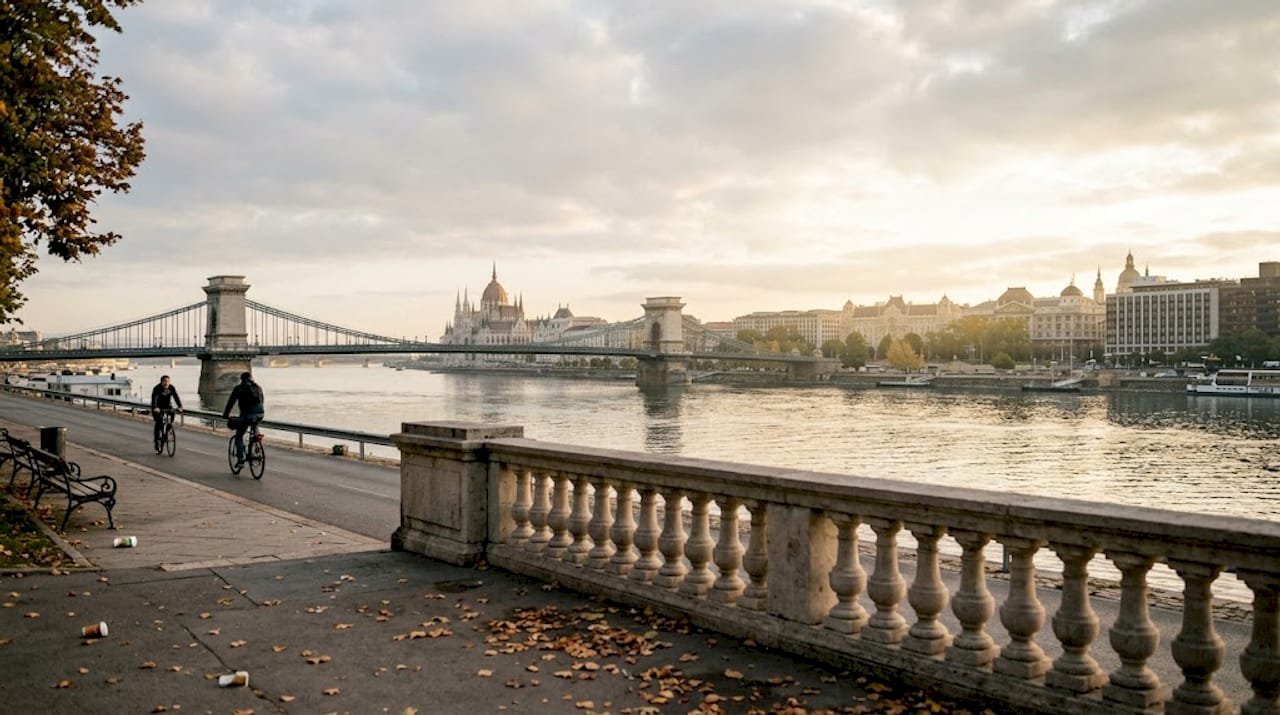
Understanding Budapest starts with understanding its geography. As noted by Hungary Unlocked, Budapest is divided by the Danube into Buda (hilly, historic) and Pest (flat, vibrant) sides, with key sights split across both. That single fact changes how you plan every day of your trip.
Buda sits on the western bank, rising steeply into forested hills. It feels quieter and more contemplative. The Castle District, perched above the city, rewards you with sweeping views and centuries of layered history. Fisherman’s Bastion, with its fairy-tale turrets, is one of the most photographed spots in Central Europe. You can explore the Buda Castle as a standalone half-day experience, and it pairs naturally with a walk along the hilltop promenade.
Pest, on the eastern bank, pulses with urban energy. The Hungarian Parliament Building dominates the riverbank. St. Stephen’s Basilica anchors the city center. The Jewish Quarter hums with history and creative life, and the famous ruin bars of Districts VII and VIII have made Pest a nightlife destination in its own right.
Here is a quick side-by-side comparison to help you plan:
| Feature | Buda | Pest |
|---|---|---|
| Terrain | Hilly, forested | Flat, urban |
| Vibe | Quiet, historic | Energetic, social |
| Top sights | Castle District, Fisherman’s Bastion | Parliament, Basilica, Jewish Quarter |
| Best for | Morning walks, scenic views | Nightlife, dining, culture |
| Recommended stay | Day trips from Pest | Districts V, VI, or VII |
For most visitors, staying in Pest (particularly Districts V through VII) offers the best balance of access, transport, and atmosphere. You can reach Budapest’s highlights on foot or by metro within minutes, and the ruin bars in Pest are practically at your doorstep.
Ultimate 3-day Budapest itinerary (and how to customize)
With Buda and Pest’s personalities clear, here is how to structure your days so you sample both and have options based on your travel style and timeline.
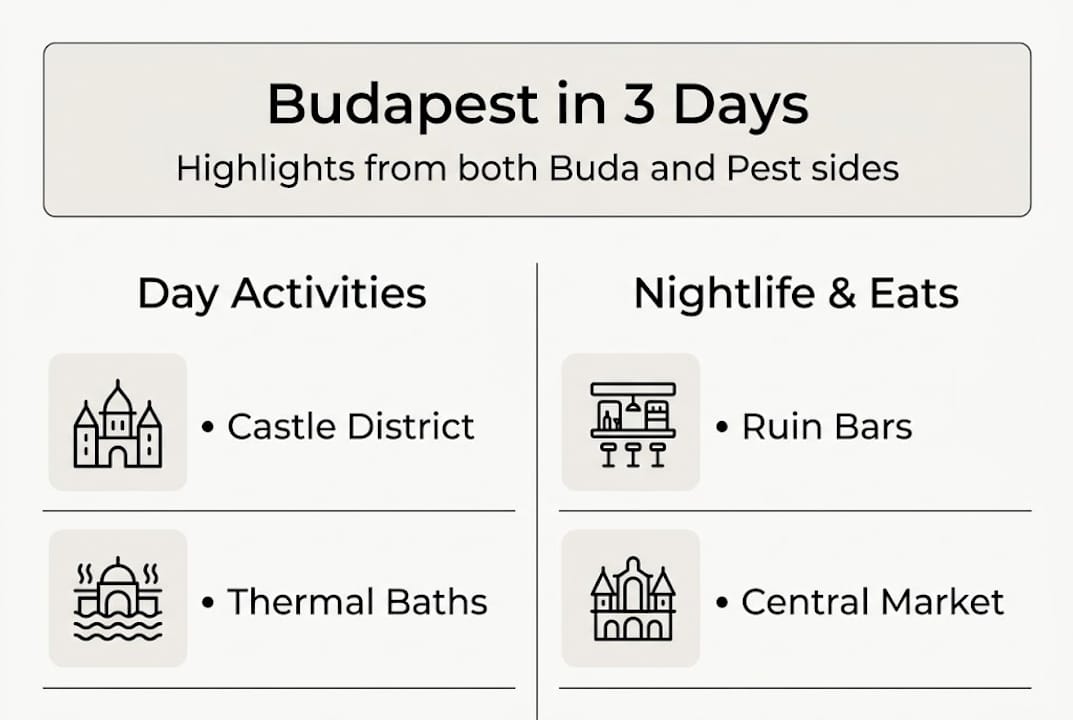
The optimal first-time visit is three days. Day 1 focuses on Pest: walk the Parliament exterior (free), climb the Basilica dome for around 2,000 HUF, wander the Jewish Quarter, and end the evening in the ruin bars. Day 2 crosses to Buda: arrive early at the Castle District and Fisherman’s Bastion, then hike up Gellért Hill for panoramic views. Day 3 is for the thermal baths, Central Market Hall, and a Danube evening cruise.
Here is a numbered breakdown:
- Day 1 (Pest): Parliament exterior, St. Stephen’s Basilica dome, Jewish Quarter walking tour, ruin bar evening
- Day 2 (Buda): Castle District, Fisherman’s Bastion (early morning), Matthias Church, Gellért Hill sunset
- Day 3 (Mix): Thermal bath morning, Central Market Hall lunch, Danube cruise at dusk
For a guided approach to these neighborhoods, local experts can add context that no map or app can replicate. If you are visiting Jewish Budapest, a guided experience reveals stories hidden behind the facades of the Great Synagogue and the memorial courtyards.
For shorter stays, two days is tight but workable. Prioritize the Pest highlights on Day 1 and Buda’s Castle District on Day 2, and squeeze in one thermal bath session in the morning.
Pro Tip: Arrive at Fisherman’s Bastion before 9 a.m. to enjoy the views for free. After that hour, a small entrance fee applies to the upper terraces.
Budapest’s famous thermal baths: Where, when, and how
No guide is complete without explaining the city’s famous baths, a true local experience that adds so much more than a soak to your trip.
Budapest sits on a network of thermal springs, and bathing culture here goes back to the Ottoman occupation of the 16th century. Today, the baths are part spa, part social ritual, and part architectural wonder. Choosing the right one depends on your priorities.
Here is a current pricing and character overview for 2026:
| Bath | Weekday price (approx.) | Best for | Notes |
|---|---|---|---|
| Széchenyi | ~13,000 HUF | Groups, first-timers | Grand Neo-Baroque setting |
| Rudas | ~6,000 to 11,000 HUF | Couples, locals | Ottoman dome, rooftop pool |
| Lukács | ~7,200 HUF | Budget travelers, locals | Less touristy, authentic feel |
| Gellért | Closed | N/A | Closed through 2026 for renovation |
As confirmed by Budapest bath pricing data, Széchenyi runs around 13,000 HUF on weekdays, Rudas ranges from 6,000 to 11,000 HUF, and Lukács sits at approximately 7,200 HUF. Gellért Bath is closed through 2026, so do not plan around it.
Széchenyi is the most iconic, set inside a stunning Neo-Baroque palace in City Park. It is a great first bath experience. Rudas, with its original Ottoman dome and rooftop pool overlooking the Danube, is ideal for couples or travelers seeking a more atmospheric soak. Lukács feels the most local and is a favorite among Budapest residents.
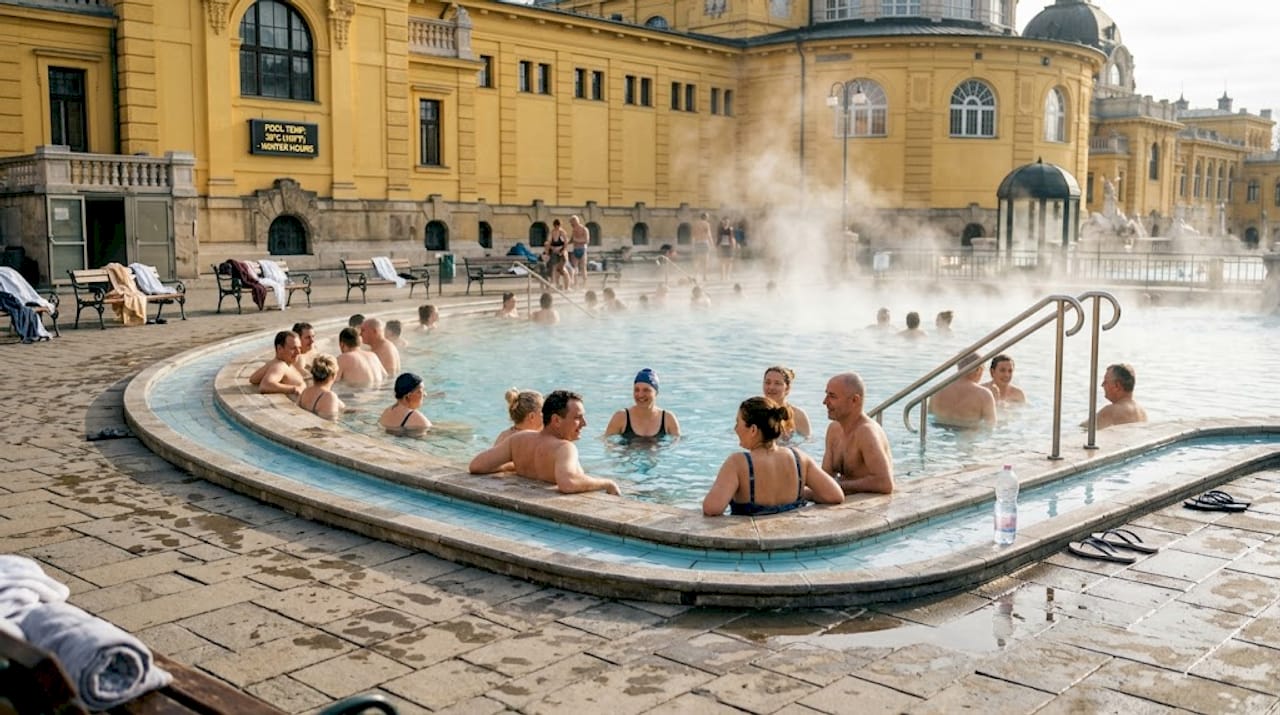
Pro Tip: Book Széchenyi online in advance, especially on weekends when prices rise and crowds peak. Bring a towel, flip-flops, and a waterproof bag for your phone.
The baths also connect beautifully to Budapest’s architectural identity. The Art Nouveau architecture woven through the city’s bathhouses and civic buildings is a visual language worth learning before you visit.
Practical tips: Saving money, getting around, and safety
All these experiences are made better when you know the street-level realities and avoid common mishaps.
Transport in Budapest is excellent and affordable. The 72-hour public transport pass costs around 5,000 HUF and covers unlimited metro, tram, and bus rides. It is far better value than buying individual tickets, especially if you are crossing between Buda and Pest multiple times a day.
Here are the key practical points every visitor should know:
- Transport: Buy the 72-hour pass on arrival. Metro Line 1 is a UNESCO-listed historic line worth riding for its own sake.
- Scams to avoid: Unlicensed taxis outside the airport, overpriced menus at tourist-trap restaurants near the Parliament, and unsolicited invitations to “private clubs.”
- Safe districts: Stay and socialize in Districts V, VI, and VII. These are well-lit, well-policed, and full of legitimate venues.
- Nightlife safety: Never leave your drink unattended in bars. Stick to established ruin bars with visible staff and posted menus.
- Budgeting: A realistic daily budget is 50 to 150 EUR per day, and Budapest remains 30 to 50% cheaper than Vienna or Prague in 2026.
As a general rule, Budapest travel basics are straightforward once you know the layout. The city is very walkable in the central districts, and most major sights cluster within a 20-minute radius of each other on the Pest side.
One more note: Budapest travel tips consistently highlight that the city is safe for tourists, but common sense matters, particularly in crowded areas like the Great Market Hall and busy metro stations where pickpocketing can occur.
Beyond the checklist: Local experiences that make Budapest unforgettable
Practical tips are important, but what truly makes Budapest unforgettable is diving into its local rhythm and offbeat finds.
The key sights split across both sides of the city are well documented, but the experiences between those sights are where Budapest reveals its real character. A morning spent in a neighborhood café, a slow walk through a covered market, or a spontaneous conversation with a local vendor can leave a stronger impression than any landmark.
Here are some local favorites worth adding to your list:
- Café culture: Budapest’s historic cafés from the Belle Époque era are architectural experiences in themselves. Gerbeaud on Vörösmarty Square and the New York Café are the most famous, but smaller neighborhood spots offer a more genuine atmosphere.
- Ruin bars: The ruin bar culture of the 7th District is unlike anything else in Europe. Szimpla Kert, the original, is open during the day as a farmers’ market on Sunday mornings.
- Danube cruise after dark: The city lights reflecting off the river at night are genuinely breathtaking. An evening cruise gives you a perspective of the Parliament and Chain Bridge that no street-level photo can match.
- Hidden museums: The Hungarian National Gallery inside Buda Castle, the House of Terror on Andrássy Avenue, and the Pinball Museum (yes, it exists) offer very different but equally absorbing experiences.
- Local dishes to try: Lángos (fried dough with toppings), gulyás (goulash soup), and chimney cake from a street stall are all essential.
“Budapest rewards the curious. Every district has its own story, and the best ones are never on the first page of a travel guide.”
Photo spots worth seeking out include the panoramic view from Gellért Hill at sunset, the interior of the Parliament on a guided tour, and the ruin bar courtyards after midnight when the lights and murals create something genuinely surreal.
Why smart travelers look beyond the landmarks
After exploring the city by the numbers, here is what we genuinely believe sets apart an extraordinary Budapest experience.
Most visitors leave with beautiful photos and a checklist completed. But many also leave with a quiet feeling that they missed something. They saw the Parliament. They soaked at Széchenyi. They walked the Castle District. And yet, Budapest’s real texture slipped past them because they moved too fast between the obvious stops.
The travelers who come back, or who rave about Budapest for years afterward, almost always describe a moment that was not planned. A wrong turn into a courtyard full of street art. A café recommendation from a hotel receptionist. A ruin bar conversation that turned into a two-hour local history lesson.
We think the smartest approach is to anchor each day around one major landmark and leave the rest deliberately open. Let one afternoon be unplanned. Walk a neighborhood without a destination. That combination of structure and spontaneity is what turns a good trip into a story worth telling.
Guided Budapest tours are one of the best ways to build that structure without losing the spontaneity. A knowledgeable local guide does not just point at buildings. They open doors, share context, and take you to the places that do not appear in any app.
Explore Budapest more deeply with guided tours
Ready to go from planning to living your own Budapest story? The difference between a good visit and a great one often comes down to who is showing you around.

At Next View Tours, we offer Budapest tours designed to take you beyond the surface, from ruin bar crawls and Art Nouveau architecture walks to Jewish Quarter history tours and Danube evening experiences. Whether you prefer a private or group format, we match the experience to your travel style. You can also explore our home city tour options if you want a local-led introduction to Budapest’s neighborhoods on your first day. Every itinerary is built around authentic access, real stories, and the kind of moments that make a city stay with you long after you leave.
Frequently asked questions
What’s the best area to stay in Budapest for first-time visitors?
Districts V through VII put you close to major sights, public transport, nightlife, and are considered safe and well-located for first-time visitors. District VII in particular offers excellent access to both the Jewish Quarter and the ruin bar scene.
Which Budapest thermal bath is best for families or couples?
Palatinus Strand on Margaret Island is the top choice for families, while Rudas Bath’s evening sessions, complete with a rooftop pool and atmospheric Ottoman dome, are ideal for couples.
Is it worth buying a Budapest public transport pass?
Yes. The 72-hour pass at ~5,000 HUF is significantly cheaper than buying individual tickets and covers all metro, tram, and bus routes across the city.
How much do I need to budget per day in Budapest in 2026?
A realistic range is 50 to 150 EUR per day, depending on your accommodation and dining choices. Budapest remains 30 to 50% more affordable than Vienna or Prague, making it excellent value for a European city break.
Are there any major site closures in Budapest in 2026?
Yes. Gellért Bath is closed for major renovations through 2026, so plan your thermal bath visit around Széchenyi, Rudas, or Lukács instead.


Comments are closed