

 Uncategorized
TL;DR:
- Prioritize depth or breadth based on personal interests and trip length for a meaningful experience.
- Incorporate slack days and balanced city, town, and rural stops to prevent travel fatigue.
- Use efficient transportation like open-jaw flights and central accommodations to maximize exploration time.
Crammed itineraries are one of the biggest mistakes European travelers make. You pack in eight cities across ten days, race from train to taxi, and arrive home more exhausted than when you left. The magic of Europe, its layered history, vibrant local markets, and quiet village squares, slips by in a blur. This guide gives you a clear, expert-backed framework for planning multi-day tours that feel rewarding rather than draining. You will learn how to set meaningful goals, build a balanced schedule, choose smart transportation, and secure the right accommodations, so every day abroad feels intentional and alive.
Table of Contents
- Define your travel goals and priorities
- Create a balanced itinerary: cities, towns, and slack days
- Choose transportation and optimize routes
- Book accommodations and finalize essentials
- Our take: why slowing down unlocks richer travel
- Enhance your European journey with expert tour support
- Frequently asked questions
Key Takeaways
| Point | Details |
|---|---|
| Prioritize depth over speed | Slowing down and spending more time in fewer places leads to a richer, less stressful travel experience. |
| Balance cities and towns | Alternating urban and rural destinations adds variety and prevents burnout. |
| Include slack days | Scheduling rest days ensures time for recovery and spontaneous surprises. |
| Use open-jaw routes | Arriving and departing from different cities maximizes efficiency and sightseeing. |
| Centralize your bookings | Keep accommodation, transport, and activity confirmations organized for a smooth journey. |
Define your travel goals and priorities
Before you open a single booking platform, you need to answer one honest question: what do you actually want from this trip? The answer shapes everything, from which cities make your list to how many hours you spend at each stop. Without this clarity, your itinerary becomes a wish list rather than a plan.
The first decision is choosing between depth and breadth. Depth means spending several days in a handful of regions, learning the rhythm of local life, discovering neighborhood cafés, and building real familiarity with a place. Breadth means covering more ground, ticking off iconic capitals, and collecting a wider variety of experiences. Neither approach is wrong. They simply suit different travelers.
Rick Steves recommends aligning destinations with your personal interests and travel companions, because a mismatch between your pace and your partner’s expectations can derail even the most carefully planned trip. If one of you craves slow mornings in a Viennese coffee house and the other wants to sprint through five museums before noon, you need to negotiate before you board the plane.
To help you decide, consider this comparison:
| Factor | Depth-focused tour | Breadth-focused tour |
|---|---|---|
| Number of destinations | 2 to 4 | 6 to 10 |
| Nights per location | 3 to 5 | 1 to 2 |
| Best for | Culture, food, relaxation | First-timers, variety seekers |
| Risk | Missing iconic sights | Surface-level experiences |
| Ideal trip length | 10 to 14 days | 14 to 21 days |
Once you know your style, layer in your specific interests. Ask yourself which of these matters most to you:
- Food and culinary culture: local markets, cooking classes, regional specialties
- Art and history: museums, cathedrals, UNESCO World Heritage sites
- Nature and outdoor adventure: hiking, cycling, scenic landscapes
- Urban energy: architecture, nightlife, contemporary culture
Understanding the multi-day tour basics helps you see how these interest categories translate into actual itinerary structures.
Pro Tip: Write down your top three non-negotiable travel experiences before you plan anything else. These become your anchors. Every destination and activity you add should support at least one of them. If it does not, cut it.
Create a balanced itinerary: cities, towns, and slack days
With your goals locked in, the next step is building a schedule that keeps you energized rather than depleted. The most common planning mistake is treating every day as a full-speed sightseeing day. That approach works for about three days. After that, fatigue sets in and enjoyment drops sharply.

Alternating big cities with small towns and including a slack day per week is one of the most effective ways to avoid burnout on longer trips. A slack day is simply a rest or low-activity day built intentionally into your schedule. It is not wasted time. It is the day you wander without a map, stumble into a local festival, or simply sit by a river and absorb where you are.
Here is a sample week-long plan that balances urban energy with quieter moments:
| Day | Location type | Activity focus |
|---|---|---|
| Day 1 | Major city (e.g., Vienna) | Arrival, orientation walk |
| Day 2 | Major city | Museums, historic center |
| Day 3 | Small town (e.g., Hallstatt) | Nature, local culture |
| Day 4 | Small town | Hiking, slow morning |
| Day 5 | Slack day | Rest, spontaneous exploration |
| Day 6 | Mid-size city (e.g., Salzburg) | Architecture, food |
| Day 7 | Mid-size city | Day trip or departure prep |
To build your own balanced itinerary, follow these steps:
- List all destinations you want to visit in rough geographic order.
- Assign a minimum of two nights to each location.
- Identify natural transition points where a small town sits between two larger cities.
- Insert one slack day for every five to six active days.
- Review the full schedule and remove any stop that feels forced or rushed.
Travel experts consistently warn against what they call “one-night stands” in travel planning. Staying less than two nights in a destination means you spend most of your time arriving and leaving rather than actually experiencing the place.
Exploring the balance between urban vs rural travel can help you find the right rhythm for your specific route. You can also find detailed trip organization tips to support this planning phase.
Pro Tip: Schedule at least one completely open day with zero plans. Leave it blank on purpose. Some of the best travel memories come from the unexpected discovery you made because you had the time to follow your curiosity.
Choose transportation and optimize routes
Your itinerary is only as good as the transportation strategy holding it together. Europe offers a remarkable range of options, and choosing the right mix can save you hours, money, and significant stress.
Here is a quick breakdown of your main options:
- Trains: Comfortable, scenic, and city-center to city-center. Ideal for routes through Central Europe. Can be expensive without advance booking.
- Buses: Budget-friendly and widely available through operators like FlixBus. Slower but useful for shorter regional hops.
- Flights: Fast for long distances but factor in airport transfer time and baggage fees. Best for crossing from one region to another.
- Rental cars: Maximum flexibility for rural areas and off-the-beaten-path destinations. Less practical in major cities due to parking and traffic.
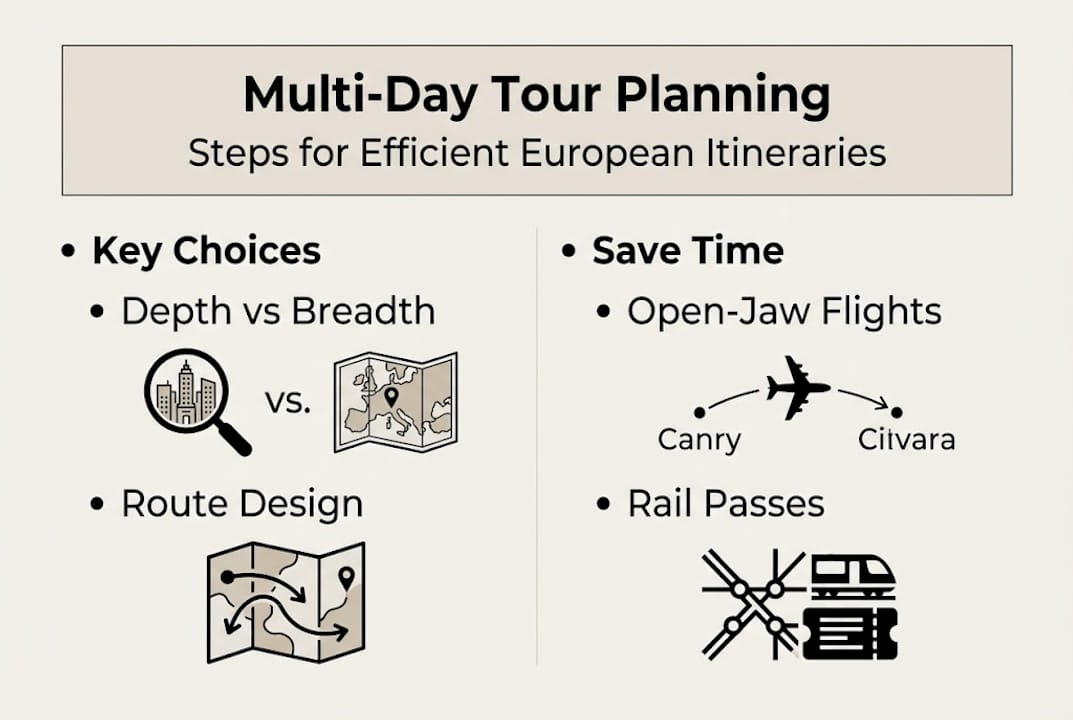
One of the smartest moves for multi-city trips is booking open-jaw flights, which let you fly into one city and depart from a completely different one. This eliminates backtracking and opens up a natural linear route across the continent. For example, fly into Vienna, travel overland through Salzburg and Prague, then fly home from Budapest.
When organizing adventure tours across multiple countries, route efficiency becomes even more critical. Every unnecessary backtrack costs you time you could spend exploring.
For the smoothest experience, also check the European travel workflow to understand how seasoned travelers sequence their bookings and connections.
Pro Tip: Use a free route planner like Google Maps or Rome2rio to visualize your full journey before booking anything. Lay out every stop in sequence and look for obvious inefficiencies. A small adjustment early in planning can save hours of unnecessary travel later.
Also look into regional rail passes such as the Eurail Pass, which can offer significant savings if you plan to take four or more train journeys. Multi-city bus tickets and flight bundles through low-cost carriers can also reduce costs when booked at least six weeks in advance.
Book accommodations and finalize essentials
With your route and transportation confirmed, securing the right accommodations is your next priority. Where you stay shapes your daily experience more than most travelers realize. A centrally located hotel puts you within walking distance of the morning market and the evening restaurant strip. A remote guesthouse might offer stunning views but add 40 minutes of transit to every outing.
Minimum two-night stays in each location, as strongly advocated by experienced travel planners, give you enough time to settle in, explore at a reasonable pace, and actually feel the character of a place rather than just passing through it.
Key factors to evaluate when booking accommodations:
- Location: Prioritize central neighborhoods or areas with easy public transit access.
- Cancellation policy: Choose flexible rates when possible, especially for the first and last nights.
- Reviews: Focus on recent reviews that mention cleanliness, noise levels, and staff responsiveness.
- Breakfast inclusion: Can simplify mornings and reduce daily costs.
Follow these steps to finalize your reservations:
- Book your first and last night accommodations immediately after confirming your flights.
- Work inward, securing stays for each destination in the order you will visit them.
- Confirm every reservation via email and save the confirmation number.
- Organize all documents in a single digital folder and a printed backup envelope.
- Set calendar reminders for any free-cancellation deadlines.
For group travelers, the group travel workflow offers additional guidance on coordinating multiple bookings efficiently. You should also review how to prepare for group tours to cover all the logistical bases before departure.
Your essential pre-departure checklist should include:
- Valid passports (check expiration dates, many countries require six months of validity beyond your return date)
- Travel insurance covering medical, cancellation, and lost baggage
- Printed and digital copies of all hotel and transport bookings
- Local currency or a no-fee travel debit card
- Activity and tour reservations confirmed in advance
Pro Tip: Keep both a digital folder (cloud-synced) and a printed packet of all your key documents. If your phone dies or gets stolen, that printed backup becomes invaluable.
Our take: why slowing down unlocks richer travel
Here is something most travel content will not tell you directly: the travelers who return home with the best stories are almost never the ones who visited the most places. They are the ones who stayed long enough to become a regular at the corner bakery, to learn the name of the local who recommended a hidden trail, to watch a city change from morning light to evening glow.
Rick Steves advises balancing icons with off-the-beaten-path “backdoors” for the richest experiences, and we could not agree more. The Eiffel Tower is magnificent. But the real Paris lives in the arrondissements most tourists never reach.
We work with travelers across Europe every season, and the feedback we hear most often is not “I wish I had seen more.” It is “I wish I had stayed longer.” That insight should reshape how you plan from the very beginning. Choosing multi-day Vienna tours or any extended experience is not about slowing down your ambition. It is about deepening the return on every hour you invest in travel.
Pro Tip: Before finalizing your itinerary, remove one destination. Use that time to go deeper in the places that remain. You will almost always be glad you did.
Enhance your European journey with expert tour support
Planning a multi-day European tour from scratch takes real effort, and even the most organized travelers benefit from expert guidance. At Next View Tours, we design curated experiences that take the guesswork out of logistics while keeping the adventure fully alive.
Whether you are looking for multi-day trip adventure examples to spark your itinerary ideas or want to browse our full range of European trip types from nature escapes to city cultural tours, we have options built for every travel style. If you are traveling with a group, our dedicated support for group tour preparation ensures everyone arrives informed, organized, and ready to enjoy every moment. Let us help you turn a well-planned itinerary into an unforgettable journey.
Frequently asked questions
How many nights should I stay in each destination on a multi-day European tour?
Plan a minimum of two nights per location to reduce travel fatigue and allow for a genuine sense of place. Expert advice discourages one-night stays, as they leave little time for anything beyond arrival and departure logistics.
What is a ‘slack day,’ and why is it important when touring Europe?
A slack day is a rest or low-activity day built intentionally into your schedule to prevent burnout. Including slack days supports sustainable travel pacing and often leads to the most spontaneous and memorable experiences of the trip.
Should I use open-jaw flights for multi-city European tours?
Yes, open-jaw flights let you arrive in one city and depart from another, which eliminates backtracking and makes linear routes far more efficient. Open-jaw flights are recommended specifically for streamlined multi-city travel across Europe.
Is it better to focus on fewer countries or more destinations in one trip?
Most experienced travelers and planners suggest prioritizing depth over breadth for more meaningful connections and memories. Expert recommendation is to balance iconic sights with personal interests rather than chasing a high destination count.
Recommended
- How to Plan Europe Tour: Step-by-Step Trip Guide – Next View Tours
- Step by Step Group Tour Guide for European Adventures – Next View Tours
- Ultimate Multi-Day Trip Organization Guide for Europe – Next View Tours
- Tours – Sailing Holidays | Sail Armada
- Family Adventure Holidays In Switzerland: Planning Guide | Young Explorers Club Switzerland


Comments are closed