

 Uncategorized
A custom Europe itinerary is worth the effort when you’re covering multiple countries, working around a tight schedule, or traveling with people who have different paces and priorities. It’s often unnecessary when you’re staying in one region with a simple back-and-forth route. If you fall into the first camp, your next move is simple: choose your overall trip length and determine your top three must-see destinations first. After that, build your routing, transport, and hotel choices around those key points.
Here’s what to do in the next ten minutes:
- Write your trip length (7, 10, 14, or 21+ days)
- List your three non-negotiable destinations or experiences
- Note your travel party’s pace tolerance (packed days vs. slow mornings)
Specialist planning earns its cost most clearly on complex, multi-country routes and in places where limited availability or tricky logistics make sequencing hard, according to TripTrop’s breakdown of what tailor-made trips actually deliver. For a single-region trip through Western Europe, a good route-planning app and a free weekend will usually get you there. For a loop through Austria, Slovakia, Czech Republic, and Hungary, a planner’s ground knowledge starts paying for itself. Nextviewtours builds both private and customized multi-day trips across this exact corridor, so if your must-see list already spans two or more countries. That’s your starting point.
TL;DR:
- Custom Europe itineraries are most valuable for multi-country trips, complex logistics, or experiences with limited availability that require careful sequencing.
- Proper routing minimizes travel time and backtracking, often outweighing the benefits of longer, poorly planned routes.
- Starting with a clear list of travel dates, budget, pace preferences, and top destinations ensures the itinerary aligns with your constraints.
- Using route-mapping apps suffices for simple trips, but complex routes benefiting from local expertise and booking support should involve a bespoke planner.
- Costs increase with private transfers, peak-season hotel bookings, and private guides, but starting planning 4 to 6 months ahead maximizes availability for high-demand experiences.
Table of Contents
- What a Custom Europe Itinerary Actually Is
- How to Build a Realistic Custom Europe Itinerary Step by Step
- Sample Custom Europe Itineraries by Trip Length
- Choosing the Right Tool or Planner for Your Trip
- What a Custom Itinerary Costs and When to Start Planning
- Next View Tours’ Process for Building Your Custom Itinerary
- Visa and Entry Requirements for a Multi-Country Trip
- Seasonal Timing and Its Effect on Your Route
- Why Most Advice on This Topic Undersells Sequencing
- Start Building Your Custom Europe Itinerary with Nextviewtours
- Key Takeaways
- Sources
What a Custom Europe Itinerary Actually Is
A custom Europe itinerary is a route built around your specific dates, interests, and pace rather than a fixed departure date and a pre-set list of stops. That distinguishes it from two other models you’ll encounter while researching trips.
Packaged group tours run on a schedule set months in advance, with a fixed itinerary, a set group size, and a price that bundles transport, some meals, and guiding. You show up on the departure date and follow the plan. DIY trips put every decision in your hands: you book flights, choose hotels, and figure out train connections yourself, usually across a dozen browser tabs and a spreadsheet. A tailor-made or custom itinerary sits between those two. You bring the destinations, dates, and interests; a planner or a well-built online tool handles the sequencing, logistics, and often the bookings.
Custom planning tends to matter most for a specific set of travelers:
- Multi-country trips where border crossings, train schedules, and regional flight timing can waste entire days if sequenced badly
- Tight schedules where a wrong connection or an overbooked museum eats hours you don’t have back
- Special requests like a private wine tasting, a skip-the-line palace visit, or a specific photography stop
- Families juggling nap schedules, stroller-friendly routes, and kid-tolerable travel days
- Accessibility needs that require confirming step-free access, elevator availability, or accessible transfers before you book anything
The value isn’t just convenience. It’s sequencing (visiting cities in an order that doesn’t backtrack), access (getting into experiences that sell out or require local relationships), flexibility (adjusting when a train gets cancelled or a museum closes unexpectedly), and having one point of contact instead of six separate vendor confirmations sitting in your inbox. Custom itinerary services, as Euro Travel Coach describes them, typically offer tiered packages that range from a planning consultation to full booking and on-trip support, which is a meaningfully different product than either a packaged tour or a DIY spreadsheet.
How to Build a Realistic Custom Europe Itinerary Step by Step
Building your own itinerary, or handing one to a planner, comes down to six moves done in order. Skip the order and you’ll end up with a beautiful list of cities that costs you two travel days you didn’t account for.
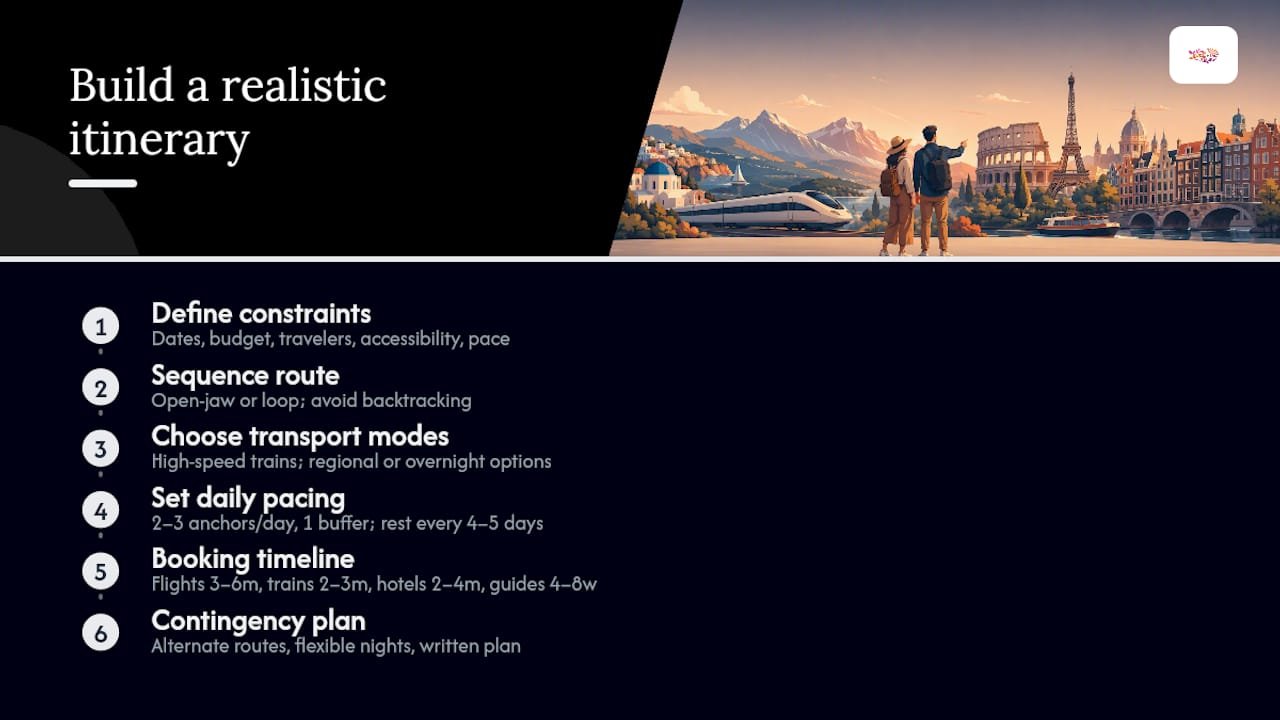
1. Define your constraints before you touch a map. Write down your exact travel dates, total budget, number of travelers, and any accessibility or dietary needs. Note your pace preference: are you a “two cities in four days” traveler or a “one city, slow mornings” traveler? Both are valid, but they produce completely different itineraries.
2. Sequence your route to minimize wasted transit. This is where most first-time planners lose a day without realizing it. Pick a hub strategy (fly into one city, out of another, known as an open-jaw ticket) or build a clockwise or counterclockwise loop that never backtracks. A well-sequenced 12-day route through Central Europe can cover more ground and feel less rushed than a poorly sequenced 18-day route, simply because it cuts out redundant transit legs and overnight backtracking.
3. Choose your transport modes deliberately. High-speed trains between cities like Vienna, Prague, and Budapest are often faster door-to-door than flying once you factor in airport time. Regional flights make sense for longer hops (Vienna to a coastal destination, for example), but they add security lines and check-in buffers that trains skip entirely. Overnight trains can save you a hotel night, though they’re not for travelers who need a real night’s sleep before a big sightseeing day.

4. Set a daily pacing rule of thumb. For a one to two week trip, plan two to three “anchor” activities per day with one buffer slot for the unexpected. For trips longer than two weeks, build in a genuine rest day every four to five days, ideally in a city you’re already staying in rather than a new stop. Families and older travelers usually need one fewer activity per day than solo travelers or couples — planning with a family travel planning guide can help tailor your itinerary to fit everyone’s needs…
5. Work backward from your dates on a booking timeline. Long-haul flights to Europe are typically cheapest and most available 3 to 6 months out. High-speed train reservations for popular routes (especially in peak summer) should go in 2 to 3 months ahead. Hotels in high-demand cities like Prague or Hallstatt during peak season deserve a 2 to 4 month lead time. Private guides and specialty experiences, a sunrise Hallstatt photography walk, a private Danube dinner cruise, often need 4 to 8 weeks notice because good guides book up.
6. Build in a contingency plan and write it into your brief. What happens if a train is cancelled, a flight is delayed, or someone in your party gets sick for a day? A solid itinerary (or a solid planner brief) names a backup day, a flexible hotel cancellation policy, and a point of contact for emergencies.
Pro Tip: If you’re handing this off to a planner instead of DIY-ing it, write your brief in this order: dates and budget, must-see list, pace preference, and any deal-breakers (no early flights, no shared bathrooms, wheelchair access required). Planners can build around constraints fast; they can’t read your mind about what you didn’t mention.
Sample Custom Europe Itineraries by Trip Length
These skeletons are starting points, not finished plans. Swap cities freely, but keep the underlying logic: minimize backtracking, and match the number of stops to your available days.
One week (single-region focus). Base in one country and make day trips or one-way regional hops. Example: fly into Vienna, spend two nights there, take a scenic train to Salzburg for two nights, then loop through Hallstatt as a day trip before returning to Vienna to fly home. This works because you unpack twice, not five times, and every train ride is under three hours.
Ten days (two-region loop). Add a second country without adding transit chaos. Example: Prague (3 nights) to Vienna (3 nights) to Budapest (3 nights), all connected by direct high-speed or express trains, flying in and out of different cities to avoid backtracking. The two-region loop is popular because these three capitals sit close enough that train time stays under four hours per leg.
Two weeks (multi-country corridor). This is where sequencing really earns its keep. Example: Prague, Vienna, Bratislava, Budapest, with two nights in each of the smaller stops and three in the anchor cities, moving in one direction the entire time. A route like this crosses four countries without ever requiring you to double back, which is exactly the kind of routing that specialist planners are built to optimize.
Three weeks or more (deep loop with rest built in). Longer trips can afford one or two additional stops, but the real shift is pace. Add a full rest day every four to five travel days, and consider a longer stay (four to five nights) in one base city, using it as a hub for day trips rather than packing your bags every 48 hours.
Variations worth building into any of these:
- Families: cut daily activities by one, prioritize cities with good playgrounds or kid-friendly museums, and avoid overnight trains
- Couples: add one splurge experience per region (private dinner, sunset boat ride) rather than one per day
- Active travelers: swap one rest day for a hiking or biking day trip and confirm gear rental availability in advance
Choosing the Right Tool or Planner for Your Trip
Four categories cover most of what’s available, and each fits a different kind of traveler.
Online itinerary builders and route-mapping apps let you drag cities onto a map, see driving or train times, and build a shareable plan in an afternoon. Platforms like Triptile’s trip builder fall into this category, and they’re the right call when your route is straightforward and you mostly need a visual sequencing tool.
Booking aggregators handle the transactional side, comparing flights, trains, and hotels, but they don’t sequence a trip for you. Use them after you’ve settled on your route, not before.
Bespoke travel planners take your brief and build a full itinerary, often including bookings and on-trip support. This is the right fit when your trip spans multiple countries, includes hard-to-book experiences, or you simply don’t have the time to research six cities’ worth of logistics yourself.
Specialist tour operators, including companies like Nextviewtours that run private and customized trips across Central Europe, blend planning with execution: you get a tailored route and a guide or driver who actually knows the roads.
Before committing to any planner or tool, run through this checklist:
- Do they respond within a day or two, or does it take a week to hear back?
- Do they have an actual on-the-ground presence in the destinations you’re visiting?
- Can they show you a real sample itinerary, not just a generic template?
- What do independent reviews say? Checking Trustpilot reviews or a Better Business Bureau profile takes five minutes and surfaces patterns a polished website won’t show you.
Pro Tip: Ask any planner for the name of the specific person who will build your itinerary. “Our team will handle it” is a red flag; a named planner with a defined revision window is the mark of an operator who treats your trip as a real project, not a lead to process.
Watch for opaque pricing that only appears after you’ve handed over contact information, no named planner, and no clear answer about what happens if something goes wrong mid-trip. Those three gaps tend to show up together.
What a Custom Itinerary Costs and When to Start Planning
A tailor-made itinerary typically costs more than an equivalent DIY trip, but that premium buys specific things: access to experiences that sell out to the general public, sequencing that saves real travel days, and someone to call when a train gets cancelled at 6 AM. It doesn’t automatically buy a better trip if your route was already simple.
Costs climb fastest with private transfers between cities, hotels booked during peak season (June through August, plus December holiday weeks), and private guides for full days rather than shared small-group experiences. Costs come down when you travel shoulder season, use trains instead of private cars, and mix a few guided experiences with independent exploration rather than guiding every single day.
On timing: DIY planning can start as late as 6 to 8 weeks out for a simple single-region trip. Bespoke planning benefits from starting 4 to 6 months ahead, especially for summer travel, since the best guides, hotels, and experiences book out first.
The decision rule is straightforward: the premium returns real value when your trip has more than two countries, a hard deadline (a wedding, a cruise departure), or experiences with limited capacity. For a simple one-country trip with flexible dates, that same premium buys you convenience more than value.
Budget checklist, regardless of who plans it:
- Intercity transport (trains, regional flights, private transfers)
- Accommodation, priced by season, not just by city
- Entry fees and pre-booked skip-the-line tickets
- At least one contingency buffer (10 to 15% of total budget)
Next View Tours’ Process for Building Your Custom Itinerary
Nextviewtours runs day trips, multi-day adventures, and private tours across Vienna, Hallstatt, Salzburg, Prague, Budapest, Slovakia, the Czech Republic, and Austria, with routing experience that extends across wider Europe. That regional depth is exactly the kind of ground knowledge that turns a good itinerary into a well-sequenced one.
The process runs in five steps:
- Brief: you share dates, must-sees, pace, and any special requests
- Draft itinerary: a route comes back sequenced for minimal backtracking
- Revisions: you adjust based on what fits your travel style
- Booking: transport, guides, and experiences get confirmed
- On-trip support: a point of contact if plans need to shift mid-trip
The difference between a good itinerary and a great one usually isn’t the destinations. It’s whether the route between them respects your time.
For readers who want to see this process applied to a specific trip type, Nextviewtours’ guide on customizing private tours and its breakdown of smart itinerary planning both walk through real planning workflows in more depth.
Visa and Entry Requirements for a Multi-Country Trip
Most travelers building a custom itinerary across Austria, the Czech Republic, Hungary, and Slovakia are moving entirely within the Schengen Area, which means one visa (or visa waiver) generally covers the whole route. That simplifies planning considerably compared to a trip that mixes Schengen and non-Schengen countries.
For American passport holders, tourist stays in the Schengen Area of up to 90 days within a 180-day period currently don’t require a visa. That’s set to change once the EU’s Entry/Exit System and the ETIAS travel authorization roll out, so it’s worth checking the current status before finalizing travel dates, since implementation timelines have shifted multiple times.
The practical planning implication is sequencing: if your custom route includes a non-Schengen stop (the UK, for instance, or parts of the Balkans), that crossing needs its own entry check, and it changes how you count your 90-day window if you re-enter Schengen afterward. Build entry requirement checks into the same step where you’re confirming transport, not as an afterthought. Passport validity matters too: most Schengen countries require at least three months of validity beyond your planned departure date, so check expiration dates before you book anything nonrefundable.
If your brief goes to a bespoke planner, flag any non-Schengen stops upfront. A planner who’s building routes across this region regularly will already know which crossings need extra lead time or documentation.
Seasonal Timing and Its Effect on Your Route
When you travel changes almost every other decision in a custom itinerary, not just the weather.
Summer (June through August) brings the longest days and warmest weather, which is why it’s also peak season for hotel prices and crowd sizes at major sites. Alpine regions and lake towns like Hallstatt are at their most photogenic but also their most crowded, and popular experiences can sell out weeks in advance.
Shoulder seasons (April to May, September to October) tend to offer the best balance: reasonable weather, thinner crowds, and hotel rates that can run noticeably lower than peak summer. For a multi-country custom route, shoulder season also means more flexibility in train and flight availability, since you’re not competing with the entire continent’s vacation schedule.
Winter (November through March) transforms cities like Vienna and Prague with Christmas markets and a quieter, more local atmosphere, though shorter daylight hours mean fewer sightseeing hours per day. Some smaller regional experiences, especially in mountain or lake areas, may have reduced hours or seasonal closures.
Build your season into your pacing decisions early. A summer itinerary might need more buffer time for crowds and heat; a winter one needs realistic daylight-hour planning for any outdoor sightseeing. If flexibility on dates is possible, shoulder season is where a custom itinerary tends to deliver the best ratio of experience to cost.
Why Most Advice on This Topic Undersells Sequencing
Most guides to planning a Europe trip spend their energy on which cities to visit and barely mention the order you visit them in. That’s backward. The research on tailor-made travel is consistent on one point: a well-sequenced route consistently outperforms a longer, poorly sequenced one, because the real cost of a bad itinerary isn’t a missed sight, it’s the half-day lost to a backtracking train or a redundant airport run.
The conventional wisdom also oversimplifies the DIY-versus-planner decision into a binary. It isn’t. A single-region, one-country trip rarely needs a bespoke planner. A four-country loop with limited-availability experiences almost always benefits from one. The honest advice is to match the tool to the complexity of the route, not to your budget alone or to how “adventurous” you feel about planning.
If there’s one thing worth prioritizing above all else, it’s writing your constraints down before you touch a map: dates, budget, pace, and your three must-sees. Every good itinerary, DIY or bespoke, starts there.
— Next
Start Building Your Custom Europe Itinerary with Nextviewtours
If your route already spans two or more countries, or your must-see list includes experiences that need real local access (a private Hallstatt sunrise walk, a skip-the-line palace tour, a group of ten needing a private driver), that’s the exact situation where a done-for-you itinerary earns back its cost in saved time and avoided logistics headaches. Nextviewtours builds private day trips, multi-day adventures, and fully customized tours across Vienna, Hallstatt, Salzburg, Prague, Budapest, and the wider Central European corridor, with routes sequenced by people who drive these roads regularly.

The next step is simple: browse the available trip types to see which format fits your group, whether that’s a private tour, a multi-day route, or a custom combination. When you reach out, include your dates, your top three destinations, your group size, and any pace or accessibility needs, the same brief structure covered earlier in this guide. Expect a draft itinerary back with clear pricing, not a vague quote, and room for revisions before anything gets booked. Pricing will vary by group size, season, and how many private experiences you include, so treat any number you see elsewhere as a starting point, not a fixed rate. For travelers who want full building-block detail before reaching out, the guide to customized tours breaks down exactly what’s included in each package tier.
Key Takeaways
A custom Europe itinerary earns its cost on multi-country routes, tight schedules, or trips with limited-availability experiences, and it’s built around constraints, sequencing, and a realistic booking timeline.
| Point | Details |
|---|---|
| Verdict comes first | Multi-country, tight-schedule, or special-access trips benefit most from custom planning; simple single-region trips often don’t need it. |
| Sequencing beats trip length | A well-sequenced shorter route can outperform a longer, poorly sequenced one by cutting wasted transit time. |
| Start with constraints | Write down dates, budget, pace, and your top three must-sees before choosing any tool or planner. |
| Match tool to complexity | Use route-mapping apps for simple trips and bespoke planners for multi-country or high-access routes. |
| Nextviewtours builds the complex routes | Nextviewtours plans private and customized multi-day trips across Vienna, Hallstatt, Salzburg, Prague, Budapest, and beyond, with a brief-to-booking process and on-trip support. |
Sources
- Trip Builder: design, plan, share and book your next best trip* — Triptile
- How to plan a great trip to Europe — Euro Travel Coach
- The Tailor-Made Tour: What You Are Actually Paying For — TripTrop


Comments are closed