

 Uncategorized
TL;DR:
- Starting preparations at least 12 weeks before international trips ensures sufficient time for passport processing and insurance deadlines. A family travel checklist should cover documents, health essentials, entertainment, and clothing, organized around four key pillars. Overpacking entertainment and understanding TSA exemptions for liquids can prevent stress and improve travel experience.
Packing for a family trip feels like solving a puzzle where the pieces keep changing size. You forget the children’s Tylenol, you overpack five pairs of jeans for a four-day trip, and somewhere in the chaos, someone’s passport almost gets left on the kitchen counter. A solid family travel checklist changes that dynamic completely. It replaces guesswork with a repeatable system, turning pre-trip preparation from a source of dread into something you can actually feel confident about. This guide covers age-specific packing, TSA rules, health essentials, timing strategies, and everything in between.
Table of Contents
- Key takeaways
- 1. Build your family travel checklist on the right foundation
- 2. Age-specific packing: babies and infants
- 3. Age-specific packing: toddlers
- 4. Age-specific packing: school-age children
- 5. Age-specific packing: teenagers
- 6. Core health and safety items every family needs
- 7. Travel documents and what to pack for a family trip
- 8. Comparison table: what to pack based on trip type
- 9. Timing and departure logistics that actually reduce stress
- My honest take on how families actually pack
- Plan your next family adventure with Nextviewtours
- FAQ
Key takeaways
| Point | Details |
|---|---|
| Start 12 weeks early | Begin international trip preparations well in advance to handle passport lead times and insurance deadlines. |
| Pack entertainment heavily | Experienced families overpack entertainment and underpack clothes, especially for toddlers and school-age kids. |
| Know TSA exemptions | Breast milk and medically necessary liquids are exempt from the 3.4-oz rule, with no child presence required. |
| Use age-specific lists | Packing needs differ sharply across babies, toddlers, school-age kids, and teens — one list does not fit all. |
| Emergency carry-on bag | Always pack a dedicated carry-on bag for the first hour after arrival and last hour before departure. |
1. Build your family travel checklist on the right foundation
Before you write a single item on your list, you need a framework. Without one, you end up with six tubes of sunscreen and no children’s pain reliever.
The most important principle: start preparations 12 weeks before any international departure. Passports are the most common culprit for last-minute panic. Routine U.S. passport processing takes 8 to 10 weeks door-to-door, and expedited service still runs 6 to 7 weeks. If your child has never had a passport, or a renewal is due, that timeline needs to be your very first checkbox.
From there, your checklist should be organized around four pillars:
- Documents and legal items (passports, IDs, insurance papers, itinerary copies)
- Health and safety (medications, first aid, sunscreen, insect repellent)
- Comfort and entertainment (age-appropriate, offline-capable options)
- Clothing and gear (right quantities per child’s age and trip length)
One rule that never fails: what goes in the carry-on should be able to sustain your family for 24 hours if your checked bags are lost. That means medications, one change of clothes per person, snacks, and chargers in the cabin bag, always.
Pro Tip: Purchase travel insurance within 14 days of your initial trip deposit. Family travel insurance typically costs $200 to $230 per trip and should include at least $100,000 in emergency medical coverage.
2. Age-specific packing: babies and infants
Babies require the most gear relative to their size of any traveler on earth. The key is ruthless prioritization.
Your baby travel checklist should cover:
- Diapers (calculate actual need plus 30% extra for delays)
- Formula or breast milk packed per TSA guidelines
- Familiar comfort item from home (blanket, stuffed animal)
- Two full outfit changes per day in the carry-on
- Portable sound machine or white noise app downloaded offline
- Changing pad, zip bags for soiled items, hand sanitizer
On the TSA front, parents of nursing infants have more flexibility than most people realize. Breast milk and formula are fully exempt from the standard 3.4-ounce limit. You can carry reasonable quantities through security. Under the 2025 BABES Enhancement Act, TSA officers must accommodate breast milk screening regardless of whether your child is present at the checkpoint. Declare it before screening and request manual inspection if you prefer your milk not go through the X-ray.
3. Age-specific packing: toddlers
Toddlers are unpredictable, enthusiastic, and capable of exhausting two adults before the plane has finished boarding. Your packing strategy should reflect that reality.
Clothing rule for this age group: pack 1.5 outfits per day. Not two, not one. Factor in spills, mud, and mystery stains. Keep at least three outfit changes in your carry-on.
Your toddler travel checklist should include:
- Familiar snacks in easy-open packaging (avoid anything crumbly on planes)
- Small toys that do not require WiFi or batteries
- A tablet loaded with downloaded shows and apps
- Child-safe sunscreen, especially for outdoor European city trips
- Portable potty training supplies if applicable
- A lightweight foldable stroller or carrier based on your itinerary
Pro Tip: Pack a separate small backpack for your toddler with their own “special” snacks and a favorite toy. Giving them ownership of their bag keeps them engaged and buys you genuine quiet time during transit.
4. Age-specific packing: school-age children
This is where your family travel checklist starts to become a shared project. School-age children pack better when given their own checklists and real responsibility. Give them a printed list, supervise the process, and let them make some choices. It reduces what you forget, builds their confidence, and honestly makes packing faster for you.
What to include in their pack:
- One outfit per day plus one extra for the whole trip
- A tablet or e-reader loaded with offline content
- Headphones (the wired kind, because Bluetooth dies)
- Activity kit: coloring book, small notebook, card games
- Reusable water bottle with their name on it
- Their own small first-aid pouch with bandages and antiseptic wipes
The self-packing habit pays dividends beyond this trip. Children who learn to manage their own gear early become genuinely easier travel companions by their teens.
5. Age-specific packing: teenagers
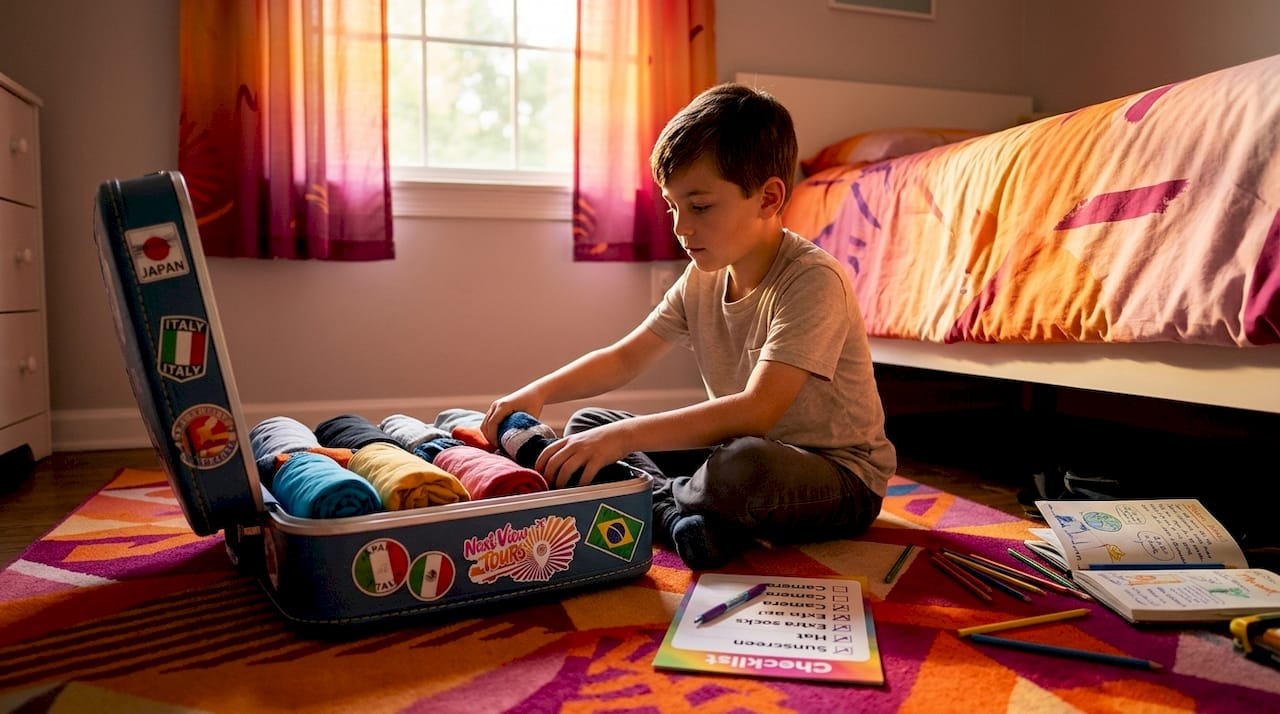
Teens travel lighter and need fewer logistics decisions from you, but they do have strong opinions about their gear. Respect that.
The most useful thing you can do for a teen’s travel checklist is set clear parameters: one carry-on, one personal item, your own charger, your own entertainment. From there:
- One week of clothing in a carry-on using packing cubes (it fits)
- Personal electronics with international adapters
- Their own snack stash for airports and long transfers
- Portable battery pack, fully charged before departure
- Copies of their ID or passport photo on their phone
- Any personal medications clearly labeled in original containers
Teens benefit from having some structured independence during the trip itself, which starts with knowing their own gear is handled.
6. Core health and safety items every family needs
The CDC recommends packing a health kit with items that are hard to find at your destination, especially when traveling internationally. Most U.S. health insurance plans do not cover travel vaccines or medical evacuations abroad, which is exactly why this category deserves its own section of your family vacation essentials list.
Your health and safety checklist should include:
- All prescription medications in original labeled containers, with copies of prescriptions
- Antacids, antihistamines, and anti-diarrhea medication
- Children’s pain reliever and fever reducer (liquid for younger kids)
- Adhesive bandages, antiseptic wipes, tweezers, medical tape
- Broad-spectrum sunscreen SPF 50+ for everyone
- Insect repellent appropriate for children’s ages
- Any destination-specific items (altitude sickness tablets, water purification tablets)
Pack all medications in your carry-on without exception. A checked bag with your child’s asthma inhaler stuck somewhere in airline cargo is not a situation anyone wants.
7. Travel documents and what to pack for a family trip
Documents are the one category where forgetting a single item can derail your entire trip. Build this section of your checklist first and check it last.
| Document | Notes |
|---|---|
| Passports | Check expiry dates; many countries require 6 months validity beyond travel dates |
| Travel insurance papers | Printed copy plus digital backup; include emergency contact numbers |
| Itinerary copies | One per adult; include hotel addresses in local language |
| Medical records/vaccination proof | Required for some destinations; keep in carry-on |
| Emergency contacts list | Separate from your phone; laminate if possible |
Pro Tip: Take a photo of every document and email it to yourself before departure. If your bag is lost or stolen, you have digital access to everything from any device.
8. Comparison table: what to pack based on trip type
Not every trip needs the same checklist. A weekend road trip requires a very different set of family travel gear than a two-week European summer tour. Use this table as a starting framework and adjust from there.
| Category | Weekend trip (warm) | Week-long trip (cold) | Road trip |
|---|---|---|---|
| Outfits per child | 2 to 3 | 7 to 8 plus layers | 3 to 4 with laundry access |
| Entertainment | 1 to 2 items | Tablet plus offline content | Car games, audiobooks, snacks |
| Health kit | Basic first aid | Full kit plus cold meds | Full kit plus motion sickness relief |
| Documents | IDs, insurance | Passports, visas, itinerary | IDs, roadside emergency contacts |
| Snacks | 1 day supply | 3 day carry-on supply | Cooler with fresh options |
Start packing 3 to 5 days before departure, not the night before. Color-coded packing cubes, one color per child, cut the time you spend searching for a matching sock in half and speed up access during the trip itself. This small investment in family travel gear pays off immediately.
9. Timing and departure logistics that actually reduce stress
The most stressful moments of any family trip are not on the plane or at the hotel. The critical stress points are the first hour after arrival and the last hour before departure. Plan for both specifically.
For departure:
- Pack an emergency carry-on bag the night before with snacks, a change of clothes, medications, and chargers
- Charge all devices the evening before, not the morning of
- Plan your departure time around nap and meal schedules to reduce meltdown risk
- Print boarding passes and document confirmations the day before
For arrival:
- Have snacks accessible the moment you land
- Know your hotel address and check-in procedure before you board
- Pack a small comfort item for younger children that comes out immediately at the new location
When building your family travel itinerary, limit daily planned activities to one or two maximum. A schedule packed with four major attractions per day might sound exciting at home. By day three with young children, it creates exhaustion, arguments, and zero enjoyment. Build in breathing room and let the unplanned moments happen.
Pro Tip: On a family road trip checklist, add a separate “car bag” that stays in the back seat with immediate-access items: snacks, wipes, a small toy rotation, and a change of clothes. Never put it in the trunk.
My honest take on how families actually pack
I’ve watched hundreds of families prepare for their first big trip, and the pattern is almost always the same. They pack seven outfits for a five-day trip and three minutes of entertainment per child. Then they spend the flight trading their one set of headphones between two kids while the snacks run out over the Atlantic.
The families who travel well have figured something out: clothes are replaceable and laundromats exist in most countries. But a child who has run out of entertainment at 35,000 feet is a genuine crisis. Overpack entertainment ruthlessly. Books, downloaded shows, card games, art supplies. Two is not enough. Four is reasonable.
I also think the TSA rules conversation is genuinely underrated in most packing guides. Families with infants or children on medication often arrive at security without knowing their rights. Breast milk screening does not require your child to be present. Medically necessary liquids do not follow the 3.4-ounce rule. Knowing this before you reach the checkpoint removes a real source of stress.
Finally, involve your kids in packing. Not as a teaching moment, though that is a side benefit. Do it because a child who packed their own bag knows where their charger is, does not blame you when their book is missing, and feels genuine ownership over the trip before it starts. That mindset shift pays dividends from the moment you leave the house.
— Next
Plan your next family adventure with Nextviewtours
Once your family travel checklist is locked and your bags are packed, the best thing you can do is spend your energy on the experience itself rather than logistics.

Nextviewtours specializes in family-friendly trips across Europe, from private day tours in Vienna and Salzburg to multi-day adventures through Austria, Prague, Budapest, and beyond. Every trip type is designed with families in mind, meaning flexible pacing, expert local guides, and experiences that work for all ages. If you want something built specifically around your family’s interests and schedule, explore the customized tour options for a trip that fits exactly who you are. Your checklist gets you out the door. Nextviewtours handles everything after that.
FAQ
How early should I start my family travel checklist?
Start at least 12 weeks before an international trip to allow time for passport processing, which takes 8 to 10 weeks, and to purchase travel insurance within 14 days of your first deposit.
What liquids can I bring in a carry-on for my baby?
Breast milk, formula, and medically necessary liquids are exempt from the TSA 3.4-ounce rule. Declare them before screening and request manual inspection if preferred.
How many outfits should I pack per child?
Pack 1.5 outfits per day for toddlers and 1 outfit per day for school-age children and teens. Always keep at least one extra outfit per child in your carry-on in case of lost luggage.
What should go in a carry-on emergency bag for families?
Pack a change of clothes for each family member, all medications, snacks for several hours, chargers, and any comfort items. This bag should be accessible for the first hour after arrival and the last hour before departure.
Do I need separate travel insurance for family trips?
Yes. Standard health insurance typically does not cover medical evacuation or treatment abroad. A family travel insurance policy with at least $100,000 in emergency medical coverage is strongly recommended for international travel.


Comments are closed