

 Uncategorized
TL;DR:
- Effective summer packing involves deliberate choices based on climate, activities, and regulations to ensure comfort and convenience. A capsule wardrobe of 3-5 tops, 2-3 bottoms, and supportive shoes helps maximize space while maintaining versatility. Prioritizing hydration, TSA compliance, and activity-specific gear ensures a smooth and enjoyable European travel experience.
Packing for a summer trip sounds simple until you’re standing in front of an overstuffed suitcase wondering why you brought four pairs of jeans for a beach vacation in Vienna. The truth is, summer trip essentials are not just about what you throw in a bag. They are about making deliberate choices that account for heat, shifting activities, TSA regulations, and the unpredictable weather that follows every traveler across Europe and beyond. Get it right, and your trip flows. Get it wrong, and you spend half your vacation shopping for things you forgot or lugging weight you never needed.
Table of Contents
- Key takeaways
- 1. Summer trip essentials: how to choose what actually belongs in your bag
- 2. The capsule wardrobe approach to summer clothing
- 3. Non-clothing essentials: hydration, toiletries, tech, and health items
- 4. Activity-specific gear for beaches, city tours, and long travel days
- 5. Packing systems: capsule vs. traditional and how to organize everything
- My honest take on summer packing after years on the road
- Plan your summer experience with Nextviewtours
- FAQ
Key takeaways
| Point | Details |
|---|---|
| Start with a criteria framework | Evaluate every item against your climate, activities, and travel regulations before packing it. |
| Build a capsule wardrobe | A focused set of 3 to 5 tops, 2 to 3 bottoms, and 2 shoe pairs covers most summer itineraries. |
| Master TSA liquids compliance | Every liquid must be 3.4 oz or less and fit in a single quart-sized resealable bag per person. |
| Prioritize hydration gear | Electrolyte packets and a reusable water bottle are heat management tools, not optional extras. |
| Pack a day-trip reset kit | A small pouch with sunscreen, a compact towel, and a rain shell prepares you for anything mid-day. |
1. Summer trip essentials: how to choose what actually belongs in your bag
Before you pull out a single item from your closet, you need a filter. Not every summer trip is the same, and the right packing criteria framework starts with four questions: What is the climate like? What activities are on your itinerary? What are your travel regulations? And what will genuinely keep you comfortable?
Climate considerations shape everything. Heat and humidity demand moisture-wicking fabrics. Coastal destinations add wind and salt. Mountain towns, even in summer, drop to cool temperatures at night. And rain, regardless of season, arrives without much warning across most of Europe.
Activity types determine gear and outfit requirements. Walking 15,000 steps through Prague’s cobblestoned streets requires completely different footwear than an afternoon at a beach in Portugal. City touring, outdoor dinners, boat excursions, and long bus rides each have their own demands.
- Check average highs and lows for your destination during your travel dates
- List every activity type you have planned, from most to least physically demanding
- Identify any dress codes at restaurants, religious sites, or theaters
- Note how many full days you will have versus transit days
Pro Tip: Write out a typical day from wake-up to dinner. Every item in your bag should appear at least once in that day. If it does not, leave it behind.
2. The capsule wardrobe approach to summer clothing
The most experienced travelers do not pack more. They pack smarter. A capsule wardrobe for summer built around 3 to 5 tops, 2 to 3 bottoms, one outer layer, two pairs of shoes, and one sleepwear set will carry you through a week-long trip without feeling restricted.
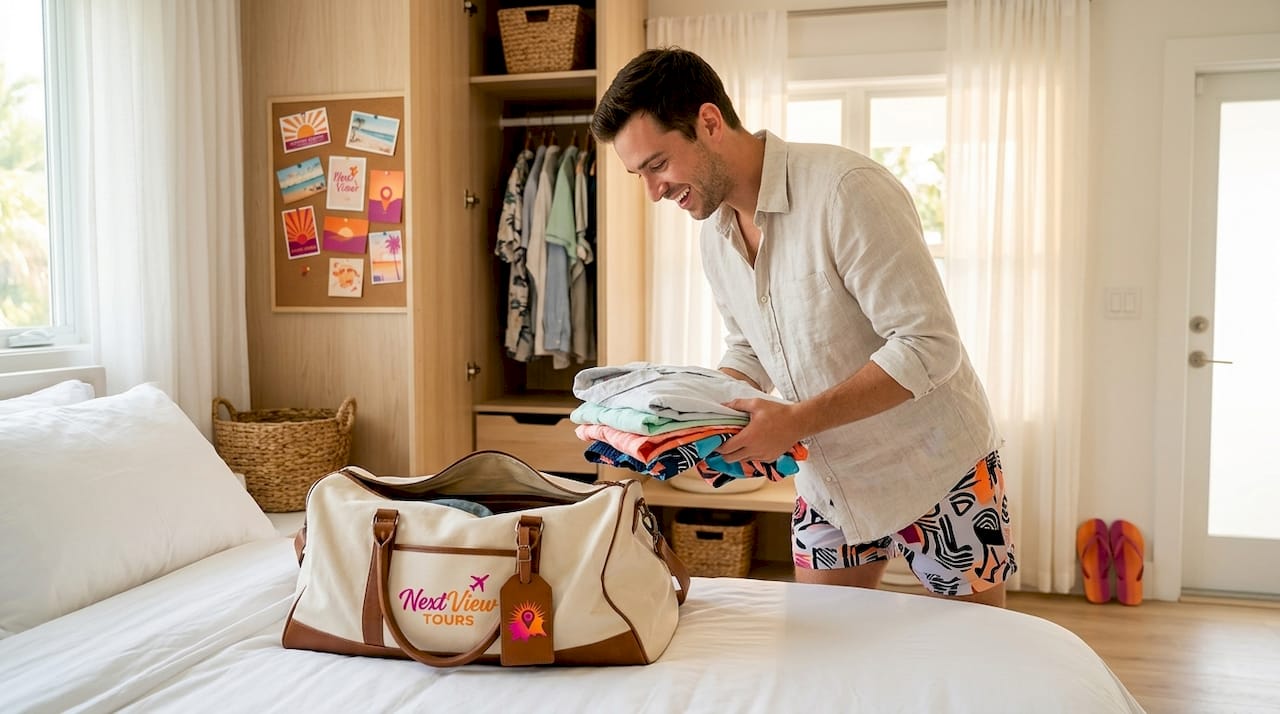
Fabric matters more than style when heat is involved. Linen, lightweight merino wool, and moisture-wicking technical fabrics breathe well and dry fast. Cotton feels good on the first day but stays damp in humidity and takes forever to dry after a wash. Save it for cooler climates.
A packable weather layer earns its spot in every summer bag. An overshirt or lightweight cardigan handles sun protection, aggressive air conditioning on trains and planes, and breezy evenings at outdoor cafes. It serves three roles in one item.
| Item type | Recommended count | Best fabric |
|---|---|---|
| Tops (t-shirts, blouses) | 3 to 5 | Merino wool, linen, technical blend |
| Bottoms (pants, skirts, shorts) | 2 to 3 | Lightweight cotton blend, linen |
| Outer layer | 1 | Packable nylon, knit cardigan |
| Shoes | 2 pairs | Supportive walking shoe + versatile sandal |
| Sleepwear | 1 set | Breathable cotton or modal |
Two pairs of shoes are almost always enough. One supportive walking shoe for long days on your feet, and one sandal or dressier option that works for beaches and evenings. Avoid shoes that lock you into a single look or refuse to pair with more than one outfit.
Pro Tip: Before you zip your bag, do a quick “remix test.” Each top should work with at least two bottoms. If an item only pairs with one other item, it is probably not earning its weight.
3. Non-clothing essentials: hydration, toiletries, tech, and health items
This is where most travelers lose time and money at airport security. The TSA 3-1-1 rule applies to all liquids, gels, aerosols, creams, and pastes in carry-on bags. Each container must be 3.4 ounces (100 mL) or less, and everything must fit in one clear, quart-sized resealable bag per passenger.
The practical hack that experienced travelers use is switching to solid toiletry alternatives. Shampoo bars, toothpaste tablets, solid deodorant, and solid sunscreen sticks free up your quart bag and eliminate the risk of confiscation. Also worth knowing: any clear resealable quart-sized bag is TSA compliant. The “TSA-approved” label printed on specialty bags is a marketing term, not a requirement.
One thing many travelers forget: medically necessary liquids are exempt from the volume limit. Prescription medications, contact lens solution, and similar items just need to be declared at the checkpoint. Keeping original labels on prescription bottles prevents delays.
Heat safety and hydration deserve the same priority as your passport.
- Pack a reusable insulated water bottle and commit to refilling it before leaving every accommodation
- Include electrolyte packets in your day bag. Waiting until thirst hits means dehydration has already begun
- Add a cooling towel to your day bag for midday city walks or beach afternoons
- Heat exhaustion symptoms including heavy sweating, nausea, and muscle cramps can escalate fast. Recognizing them early matters
- Bring blister pads, a mini first aid kit, and any prescription medications in your carry-on
Pro Tip: Store your travel documents, boarding passes, and ID in a dedicated slim pouch at the top of your bag. At security, pull the pouch and liquids bag together in one move. You will clear the line faster than anyone around you.
| Item | TSA carry-on status | Best format |
|---|---|---|
| Shampoo | Must fit 3-1-1 rule | Shampoo bar |
| Sunscreen | Must fit 3-1-1 rule | Solid stick |
| Prescription medication | Exempt with declaration | Original labeled bottle |
| Contact lens solution | Exempt with declaration | Original container |
| Electrolyte packets | No restriction (dry) | Single-serve powder packs |
4. Activity-specific gear for beaches, city tours, and long travel days
Your packing list for summer trips should reflect how you actually spend your days, not a theoretical itinerary. The gear you need for a morning at the beach looks nothing like what you need for an afternoon touring a historic district, and your carry-on setup for a six-hour flight is different again.
Beach days call for quick-dry towels (they pack flat and dry in minutes compared to traditional towels), swimwear, a coverup that works for both sand and a nearby café, and sandals that rinse clean easily. Reef-safe sunscreen is becoming a requirement at many European coastal destinations, not just a courtesy.
City touring is where footwear choice becomes critical. Cobblestones in Budapest, Prague, and Salzburg are uneven and relentless on unsupportive shoes. A crossbody bag or small daypack keeps your hands free and reduces pickpocket risk in crowded markets and public transit.
Long travel days have their own packing list:
- Noise-canceling headphones or good ear plugs
- A light scarf that doubles as a blanket on cold planes
- Snacks that travel well (nuts, dried fruit, protein bars)
- A portable charger that is fully charged before you leave your accommodation
- SPF for any window-seat exposure on daytime flights
A day-trip reset kit sitting in your day bag makes all the difference between a comfortable afternoon and a miserable one. Pack sunscreen, electrolyte mix, a compact towel, and a packable rain shell or poncho in a small zippered pouch. You can explore beach packing ideas on the Nextviewtours site to get destination-specific ideas for coastal summer days.
5. Packing systems: capsule vs. traditional and how to organize everything
How you pack matters almost as much as what you pack. Two approaches dominate the conversation among frequent travelers, and each has real strengths.
| System | Best for | Main drawback |
|---|---|---|
| Capsule wardrobe | Trips over 4 days, multiple destinations | Requires pre-trip planning |
| Traditional packing | Short weekend trips, single-location stays | Encourages overpacking |
| Packing cubes | Any trip length | Small upfront investment |
Packing cubes transform a chaotic bag into a retrievable system. Assign one cube per category (tops, bottoms, accessories) rather than per day. You can pull out one cube without disturbing anything else, which matters enormously when you are unpacking in a small European hotel room at midnight.
The question of flexibility versus minimalism comes down to trip length and destination count. A single-city trip for four days can tolerate a slightly heavier bag. A three-city, ten-day trip across Central Europe rewards ruthless minimalism. The principle that packing around your actual itinerary beats packing for hypothetical “just in case” scenarios holds up across every trip type. For more ideas on preparing for active group itineraries, Nextviewtours has a practical guide on group tour preparation worth reviewing.
- Use compression bags for bulkier items like hoodies or jackets
- Pack your heaviest items (shoes, toiletry bag) closest to the wheels of your roller bag
- Place your reset kit and travel documents in the most accessible pocket every single time
My honest take on summer packing after years on the road
I have watched travelers board buses with bags so heavy they can barely lift them overhead, and I have seen others sprint through a four-country summer trip with nothing but a carry-on. The difference is almost never the number of items. It is the intention behind each choice.
What I have learned is that most packing regrets fall into two categories. You either wish you had left something behind, or you wish you had brought one specific item you overlooked. Nobody regrets skipping the fifth pair of shoes. Almost everyone regrets forgetting a reusable bottle or a packable rain layer.
The insight that changed my own packing permanently was treating hydration gear and sun protection as core essentials, not afterthoughts. Electrolyte tabs and a real sun hat are not optional extras on a summer trip across Southern or Central Europe. They are tools that determine whether you enjoy your afternoon or spend it in the shade feeling miserable.
My practical recommendation: build your own packing template based on your travel style, not a generic list from the internet. Start with what worked on your last trip, cut what you did not touch, and add one specific item for the conditions ahead. That is your actual packing system. Use it, refine it, and trust it.
— Next
Plan your summer experience with Nextviewtours
Smart packing gets you ready for the trip. The right trip makes the packing worth every decision.
Nextviewtours offers a broad range of summer travel experiences across Europe, from day trips out of Vienna, Prague, and Budapest to multi-day adventures through Austria, Slovakia, and the Czech Republic. Whether you are planning a private tour for two, a family adventure, or joining a group itinerary through historic Central European towns, each experience is designed around what travelers actually want to do and see. For those who prefer something tailored to their own pace and interests, customized tour options are available with expert guidance built in. Your packing list and your itinerary should work together. Nextviewtours helps you build the itinerary side.
FAQ
What are the must-have summer trip essentials for European travel?
The core list includes breathable clothing in a capsule wardrobe format, TSA-compliant toiletries, a reusable water bottle, electrolyte packets, a packable weather layer, and two versatile pairs of shoes. A small day-bag reset kit with sunscreen and a rain poncho rounds out the basics.
How do I follow the TSA 3-1-1 liquids rule correctly?
Every liquid, gel, cream, or aerosol in your carry-on must be in a container of 3.4 ounces (100 mL) or less, and all containers must fit inside one clear quart-sized resealable bag. Medically necessary liquids are exempt but must be declared at the checkpoint.
How many outfits should I pack for a one-week summer trip?
A capsule approach of 3 to 5 tops, 2 to 3 bottoms, and 2 shoe pairs gives you enough variety for a full week without overpacking. Choosing items that mix and match with each other multiplies your outfit options significantly.
What is the best way to stay safe from heat on a summer trip?
Drink water and electrolyte solutions proactively before thirst sets in, avoid strenuous outdoor activity during peak midday heat, and recognize early heat exhaustion symptoms like heavy sweating, nausea, and muscle cramps. Cooling towels and shade breaks help during long city touring days.
Are packing cubes worth it for summer travel?
Yes. Packing cubes let you organize by category rather than digging through a full bag to find one item. They are especially useful on multi-city trips where you need to access specific items quickly without repacking everything each night.


Comments are closed