

 Uncategorized
TL;DR:
- A tour operator designs, contracts, and manages the entire package travel experience for travelers. They handle the itinerary, supplier negotiations, bookings, and provide local support and legal responsibility. Choosing a reputable operator with clear schedules and emergency contacts ensures a reliable and accountable travel experience.
A tour operator is the company that creates, prices, and takes contractual responsibility for a packaged travel experience. In plain terms, they buy transport, accommodation, guides, and activities from individual suppliers, then bundle everything into a single itinerary sold at one inclusive price. That distinction matters the moment something goes wrong on your trip.
Here’s what a tour operator handles for you:
- Product creation: Designs the itinerary, selects suppliers, and sets the route
- Supplier contracting: Negotiates bulk rates with hotels, coaches, and local vendors
- Bookings and logistics: Confirms reservations, issues tickets, and manages payments
- On-trip support: Provides local representatives and emergency contacts
- Legal responsibility: Holds the contract and is accountable for package performance
When you should use one: Complex multi-day trips, unfamiliar destinations, group travel, or any itinerary where coordinating multiple suppliers in a foreign language would be genuinely difficult.
What to expect at booking: Most operators collect a deposit at confirmation, with the balance due several weeks before departure for multi-day tours. Day trips are often paid in full upfront.
Table of Contents
- What does a tour operator actually do for your trip?
- How does a tour operator differ from a travel agent?
- What types of tour operators and tour formats should you know?
- Why use a tour operator, and what are the trade-offs?
- What should you expect when you book a packaged tour?
- How do you vet and choose the right tour operator?
- Key Takeaways
- Why accountability is at the center of how we operate
- Plan your European trip with Nextviewtours
What does a tour operator actually do for your trip?
The core function of a tour operator is product creation. According to Wikipedia’s tour operator entry, operators manage the full lifecycle of a trip, from design and booking through to post-tour support. That lifecycle involves far more than most travelers realize.
Product creation and itinerary design come first. The operator maps the route, selects each stop, decides the pacing, and writes the inclusions and exclusions into the itinerary. A well-designed day trip from Vienna to Hallstatt, for example, specifies pickup times, transport type, guided stops, and meal arrangements, leaving nothing ambiguous.
Supplier contracting is where operators earn their pricing advantage. As Tourism Teacher explains, operators act as wholesalers, buying services in bulk and repackaging them at a single price. That bulk-contracting power with hotels, coaches, and local activity providers often yields rates an individual traveler simply cannot access.

Bookings, reservations, and ticketing follow. The operator confirms passenger details with airlines, hotels, and activity providers, as Reslogic notes, and handles any disruptions that arise. On-trip, a local representative or emergency contact number gives you a direct line when plans change.
Pro Tip: Ask your operator for a written emergency contact protocol before you travel. A reliable operator will have a named local contact, not just a general customer service email.
Marketing and distribution round out the picture. Operators sell directly to travelers or through retail travel agents, though the contractual responsibility stays with the operator regardless of which channel you booked through.
How does a tour operator differ from a travel agent?
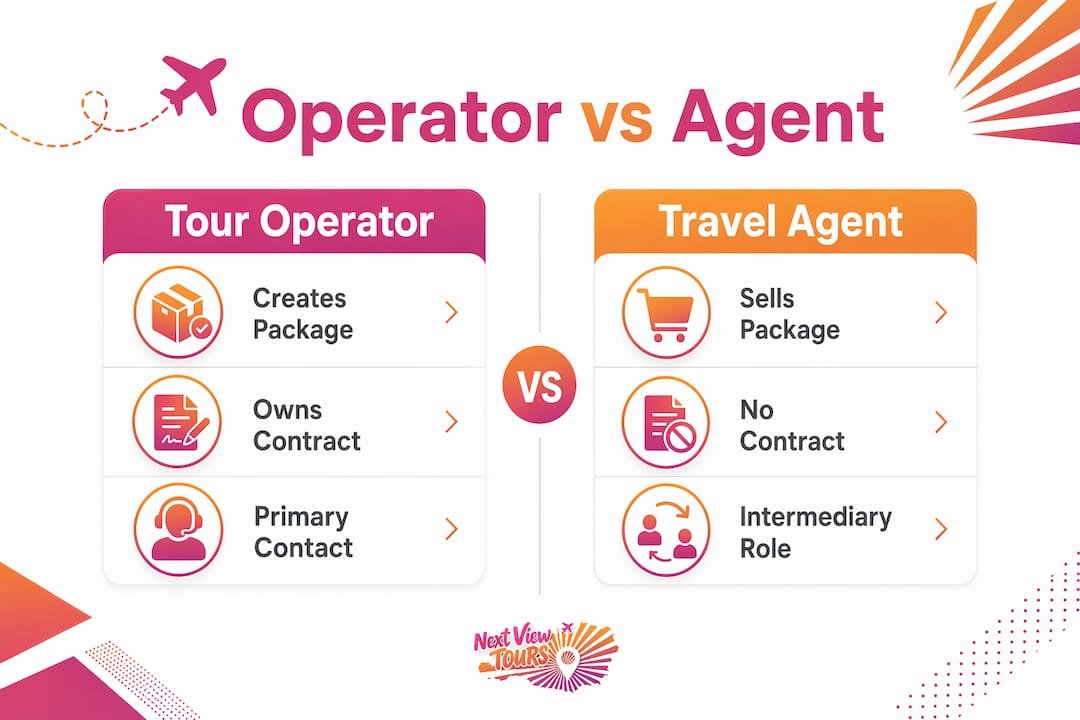
The confusion between these two roles is common, and it has real consequences for your rights. Protected Trust Services puts it clearly: a travel agent sells travel services to consumers on behalf of the supplier, while the tour operator creates the package and holds the contract.
| Role | Creates the package | Holds the contract | Your first contact for claims |
|---|---|---|---|
| Tour operator (organizer) | Yes | Yes | Yes |
| Travel agent (retailer) | No | No (sells on behalf) | Escalates to operator |
| Local guide | No | No | No |
Under EU Directive 2015/2302 on package travel, the organizer is the trader responsible for the performance of all package travel services. When services accounting for 25% or more of the combined value are bundled together, they can constitute a package, triggering full organizer liability, including refund and repatriation protections.
A linked travel arrangement (LTA) offers lighter protection: individual service providers remain separately responsible, and there is no single party liable for the whole trip. If you are booking multiple European services through one website but in separate transactions, confirm whether you are buying a regulated package or an LTA before you pay.
What types of tour operators and tour formats should you know?
Operators vary widely in structure, and matching the right type to your trip shapes both the experience and the price.
By business model:
- Inbound/local operators: Based in the destination country, they handle ground logistics for international visitors. Nextviewtours operates this way across Austria, Czech Republic, Slovakia, and Hungary.
- Specialist/adventure operators: Focus on a niche, such as hiking, cycling, or cultural immersion, and usually employ their own guides and equipment.
- Mass-market operators: Offer high-volume, pre-set packages at competitive prices with less flexibility.
- Wholesale operators: Sell packages to retail travel agents rather than directly to travelers.
By tour format:
- Day trips: Single-day departures from a base city, ideal for adding depth to an existing stay. Nextviewtours runs day trips from Vienna, Prague, Budapest, and Salzburg.
- Multi-day escorted tours: Guided programs covering multiple destinations over several nights, with accommodation and transport pre-arranged.
- Private and customized tours: The itinerary, pace, and group size are tailored to your preferences. These suit families, couples, and travelers with specific interests.
- Activity-focused programs: Adventure, nature, or seasonal tours built around a central activity rather than a destination list.
Pro Tip: Operators who use their own guides and transport tend to offer tighter quality control than those who subcontract everything. Ask whether the guide on your tour is employed by the operator or sourced through a third party.
Integration matters for multi-day adventure logistics: an operator with its own vehicles and trained guides can respond to weather changes or route adjustments far faster than one relying entirely on outside contractors.
Why use a tour operator, and what are the trade-offs?
The case for booking with an operator:
- Single contract covering all components, so one call resolves most problems
- Bulk pricing that can make multi-day packages more cost-effective than booking each element separately
- Local expertise and vetted supplier relationships, especially valuable in destinations where language or logistics are challenging
- On-trip support and emergency procedures already in place before you arrive
- Fixed itinerary reduces planning time for complex, multi-stop trips
The trade-offs to weigh:
- Less day-to-day flexibility once the itinerary is confirmed
- Cancellation policies can be strict, particularly within 30 days of departure
- You depend on the operator’s supplier network, so quality varies by operator
- Markups on individual components may exceed what a confident DIY traveler would pay
The decision usually comes down to complexity. A solo weekend in Prague is easy to self-book. A two-week itinerary crossing Austria, Slovakia, and Hungary, with private guides, mixed transport, and specific accommodation standards, is where an operator’s local expertise and vetted suppliers genuinely reduce risk and save time.
What should you expect when you book a packaged tour?
Typical booking timeline:
- Request or review a sample itinerary with full inclusions and exclusions listed
- Confirm availability and receive a written quote with a pricing breakdown
- Pay a deposit to secure your booking (commonly 20–30% for multi-day tours)
- Receive a booking confirmation and contract with cancellation terms
- Pay the balance, usually 4–8 weeks before departure
- Receive final travel documents, local contact details, and pre-trip briefing materials
What a pricing breakdown should show:
| Component | What to look for |
|---|---|
| Base tour price | Per-person or per-group rate, clearly stated |
| Accommodation | Star rating, board basis (breakfast included?) |
| Transport | Type of vehicle, pickup/drop-off points |
| Guide fees | Included or optional upgrade |
| Taxes and local fees | Entry fees, city taxes, fuel surcharges |
| Optional extras | Activities or meals not in the base price |
The EU Directive requires operators to provide clear pre-contract information before you are bound by any agreement. Read the cancellation windows carefully: most operators distinguish between cancellations made 30+ days out (partial refund) and those within 14 days (little or no refund).
Pro Tip: Travel insurance that covers trip cancellation, medical evacuation, and supplier insolvency is worth buying at the time of deposit, not the week before you fly. Some policies only cover pre-existing conditions if purchased within a set window of your initial deposit.
How do you vet and choose the right tour operator?
- Verify registration and financial protection. Legitimate operators are registered businesses with insolvency protection in place. For European packages, ask specifically whether your booking is covered under package travel regulations.
- Request a sample itinerary. A credible operator provides a detailed day-by-day program with named accommodations, transport types, and guide arrangements, not a vague outline.
- Ask for local emergency contacts. You want a named person or direct phone number in the destination country, not just a head-office email.
- Check cancellation and refund policies in writing. Verbal assurances are not enough. The contract should specify refund amounts for each cancellation window.
- Review supplier relationships. Operators with long-standing local partnerships tend to deliver more consistent experiences than those assembling trips ad hoc.
Red flags to watch for:
- Itineraries that list destinations without specifying accommodations or transport
- No local contact information provided before or during the trip
- Evasive answers about refund timelines or insolvency protection
- Reviews that mention last-minute supplier changes with no communication
The guide qualifications your operator uses are another reliable quality signal. Certified, trained guides who specialize in a destination deliver a meaningfully different experience from generalist staff.
Key Takeaways
A tour operator is the contractual organizer of your packaged trip, legally responsible for performance, refunds, and repatriation when things go wrong.
| Point | Details |
|---|---|
| Operator vs. agent | The operator creates and owns the contract; the agent only sells on their behalf. |
| Legal protection | EU package travel rules make the organizer liable for all services when components form a regulated package. |
| Booking steps | Request a sample itinerary, get a written contract, and buy travel insurance at deposit stage. |
| Vetting criteria | Confirm registration, local emergency contacts, and clear cancellation terms before paying. |
| Nextviewtours | Offers private, group, day, and multi-day tours across Austria, Czech Republic, Slovakia, and Hungary with named local contacts and detailed itineraries. |
Why accountability is at the center of how we operate
Most travelers only discover what a tour operator is truly responsible for when something goes wrong. That is too late. At Nextviewtours, we believe the function of a tour operator is not just logistical — it is a promise. Every itinerary we design for destinations across Austria, Slovakia, Czech Republic, and Hungary names the accommodation, the transport, the guide, and the emergency contact before you pay a single dollar. Our guides are trained specialists, not generalists pulled in for a season. Our local partnerships in Vienna, Prague, Budapest, and Salzburg have been built over time, which means when a road closes or a venue changes, we have a real alternative ready, not a scramble.
The travelers who get the most from a packaged tour are the ones who asked the right questions before booking. We welcome those questions.
Plan your European trip with Nextviewtours

Nextviewtours takes the guesswork out of European travel by doing exactly what a great operator should: building detailed, transparent itineraries with named suppliers, local guides, and on-trip support across Austria, Czech Republic, Slovakia, Hungary, and beyond. Whether you want a single-day escape from Vienna to the Alps or a multi-day private tour through Central Europe, every booking comes with a clear pricing breakdown, written cancellation terms, and a local contact number you can actually call. Browse the full range of trip formats and itineraries to find the experience that fits your travel style, or explore day trips versus multi-day options if you are still deciding how much time to spend on the road.


Comments are closed