

 Uncategorized
TL;DR:
- Travel agencies provide expert planning, advice, and crisis support for complex and luxury trips. They add value through personalized itineraries, exclusive rates, and managing logistics, especially for group and international travel. Their role has evolved into offering comprehensive trip support that online platforms cannot fully replicate.
A travel agency is defined as an expert intermediary that plans, books, and supports travel arrangements on behalf of clients, adding human judgment and logistical management that automated systems cannot replicate. The role of travel agency in tourism industry goes far beyond booking flights and hotels. Agencies function as advisors, advocates, and coordinators who turn complex travel plans into smooth, memorable experiences. The Travel Institute describes modern travel advisors as indispensable professionals who provide comprehensive trip support from initial planning through safe return. Nextviewtours, a European tour and experience provider, exemplifies this model by offering customized group, private, and multi-day tours across Austria, the Czech Republic, Hungary, Slovakia, and beyond.
What is the role of travel agency in tourism industry?
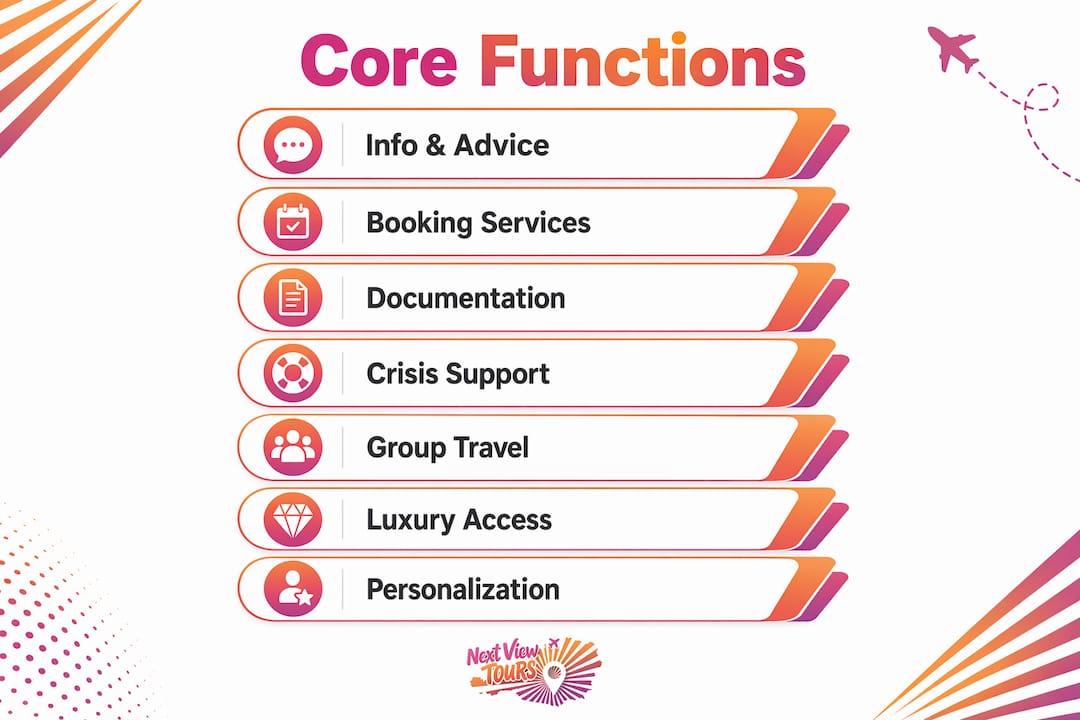
Travel agencies perform seven core functions that define their place in the tourism ecosystem. Understanding these functions helps you see why agencies remain relevant even when direct booking platforms are widely available.

| Core Function | Traveler Benefit |
|---|---|
| Information and advice | Accurate, up-to-date guidance on destinations, visas, and entry requirements |
| Itinerary preparation | Logical, time-efficient trip structure tailored to your schedule |
| Reservations and ticketing | Confirmed bookings with supplier accountability |
| Accommodation booking | Vetted properties matched to budget and preference |
| Package design | Bundled experiences that reduce cost and planning time |
| Travel document assistance | Support with visas, insurance, and health requirements |
| Marketing and promotions | Access to exclusive deals through supplier relationships |
An eighth function has grown significantly in recent years: crisis management. Travel agents advocate for clients during disruptions, handling escalations with airlines, hotels, and local authorities so travelers do not face those battles alone. This advocacy role is what separates a good agency from a simple booking tool.
Travel agencies also divide into two broad categories. Retail agencies serve individual travelers and small groups directly. Wholesale agencies work with tour operators and other businesses, packaging travel products that retail agencies then sell. Both types rely on supplier relationships and specialized knowledge to deliver value that a traveler searching alone cannot easily replicate.
Why do travel agencies remain essential despite digital booking platforms?
Digital platforms give travelers access to millions of options. That abundance is precisely where agencies earn their place. Too many choices without context leads to poor decisions, missed details, and expensive mistakes.
Travel agents excel at managing complex, expensive, multi-destination, and international trips where automated bookings fall short. A solo traveler booking a two-week trip through five European countries faces visa rules, rail pass logistics, hotel cancellation policies, and local transport connections. An experienced advisor handles all of that in a single conversation.
The scenarios where agencies add the clearest value include:
- Group travel of 15 or more people, where coordinating payments, preferences, and logistics becomes a full-time task
- Honeymoons and anniversary trips, where getting details wrong has real emotional consequences
- Luxury travel, where exclusive access and supplier relationships unlock better rates and experiences
- Multi-destination international trips, where regulations, timing, and connections require expert interpretation
- Trips to politically complex or high-risk destinations, where real-time intelligence matters
Approximately 16% of US travelers used a professional travel agent in 2025, with 33% of travel advisors reporting rising demand due to complex self-booking challenges. That rising demand reflects a real shift. Travelers who once managed simple bookings themselves are returning to advisors when trips get complicated.
Pro Tip: Before booking any trip involving more than two countries or more than eight travelers, write down your top three priorities. Budget, pace, and must-see experiences are the most common. Share that list with your advisor before any planning begins. A clear priority list helps advisors curate trips that blend personal preferences with practical logistics.
How do travel agencies enhance the traveler experience?
Personalization is the clearest advantage a travel agency offers over a self-booked trip. An advisor who understands your travel style, budget ceiling, and activity preferences builds an itinerary that fits you specifically, not a generic template.
Agencies are the gold standard for group travel, honeymoons, and luxury tours because of their exclusive access and bulk-buying power. For cruises and luxury hotels, agency supplier relationships unlock rates and cabin categories that are not available to the public. That access translates directly into better value for the traveler.
| Experience Factor | Without an Agency | With an Agency |
|---|---|---|
| Itinerary design | Generic, self-researched | Tailored to your priorities and pace |
| Pricing | Public rates only | Exclusive deals and supplier discounts |
| Problem resolution | You handle it alone | Advisor advocates on your behalf |
| Group coordination | Fragmented communication | Centralized logistics management |
| Local knowledge | Limited to online reviews | Firsthand destination expertise |
For group travel, agencies act as what industry professionals call a “cat herder.” Managing communication, payments, and logistics centrally means no one falls through the cracks. One advisor tracks dietary needs, room preferences, activity sign-ups, and payment deadlines for every member of the group. That coordination saves the group organizer dozens of hours and prevents the conflicts that derail group trips.
Pro Tip: For luxury travel, ask your advisor specifically about advisor-exclusive rates on cruises and high-end hotels. These rates are not listed publicly and are only accessible through agency supplier agreements. Asking directly is the fastest way to find out what you are actually eligible for.
What is the evolving role of travel agencies in a digital-first world?
The travel agency of 2026 looks different from its predecessor. The shift is from transactional booking to advisory and full-trip support. Agents who simply processed reservations face direct competition from online platforms. Advisors who interpret, advocate, and problem-solve are thriving.
Modern travel advisors provide judgment, accountability, and interpretive assistance that no booking algorithm can replicate. When entry requirements change 48 hours before departure, an advisor knows immediately and acts. When a flight is canceled mid-trip, an advisor has direct lines to airline contacts that a traveler calling a general helpline does not.
Technology has become a tool for advisors, not a replacement for them. Advisors use booking platforms, AI-assisted itinerary tools, and real-time travel alerts to work faster. The human layer on top of those tools is what delivers accountability. An algorithm does not call the hotel at midnight to fix a room assignment. An advisor does.
“Travelers no longer want just options; they want reliable judgment and accountability that only a human advisor can provide.” — Why travel agents still matter in a digital-first world
The Travel Institute frames this evolution clearly: travel agency value is measured more by comprehensive trip support than by booking transactions. Advisors who build their practice around that support model are the ones growing their client base. Transactional agents handling simple bookings face tough competition from direct online platforms; specialization and advisory roles drive growth. The agencies that specialize in specific destinations, travel styles, or traveler demographics are the ones building loyal, returning clients.
An agency’s greatest assets are supplier relationships and the ability to provide 24/7 reliable problem-solving. Those two assets compound over time. Every supplier relationship deepens with volume. Every problem solved builds client trust. That compounding effect is why experienced advisors are genuinely hard to replace.
Key takeaways
Travel agencies remain indispensable because they provide human judgment, supplier access, and crisis advocacy that no digital platform can replicate.
| Point | Details |
|---|---|
| Core agency functions | Agencies handle seven functions from advice to document assistance, plus crisis management. |
| Digital-era relevance | Complex, group, and luxury trips consistently benefit most from professional agency support. |
| Personalization advantage | Advisors tailor itineraries to client priorities, unlocking exclusive rates unavailable publicly. |
| Group travel coordination | Agencies centralize logistics for groups of 15 or more, preventing costly communication gaps. |
| Advisory shift | Modern agencies succeed by providing judgment and full-trip support, not just booking transactions. |
Why I believe the advisory model is the future of travel agencies
Working in and around European travel for years, I have watched travelers make the same mistake repeatedly. They assume that because booking a flight is easy, planning a full trip is equally simple. It is not. The gap between clicking “confirm” and actually having a great trip is where agencies earn everything they charge.
The travelers who get the most from an agency are the ones who treat their advisor like a specialist, not a search engine. They share their real budget, their actual concerns, and their honest travel history. That transparency lets an advisor build something genuinely suited to them, not a polished version of what they think they want.
The misconception I hear most often is that agencies are expensive. The reality is that the exclusive rates, avoided mistakes, and crisis support that a good advisor provides almost always offset the fee. For group travel especially, the coordination value alone is worth more than most travelers realize until they try to manage it themselves.
The agencies and advisors I respect most are the ones who specialize. A generalist can book anything. A specialist in Central European travel, or in luxury river cruises, or in family adventure trips, brings knowledge that no amount of online research replicates. That specialization is where the real value lives, and it is exactly the model that Nextviewtours has built across Europe.
— Next
Plan your next trip with Nextviewtours
Nextviewtours brings the advisory model to life across Europe, offering private tours, group tours, and fully customized experiences from Vienna, Salzburg, Prague, Budapest, and beyond.
Whether you are organizing a group tour package for 15 or more travelers or planning a private multi-day adventure through Austria and the Czech Republic, Nextviewtours handles the logistics so you focus on the experience. The team specializes in day trips, multi-day trips, nature and adventure tours, family tours, and couple tours across Central Europe. Explore the full range of trip types and find the format that fits your travel style, group size, and budget.
FAQ
What is the main role of a travel agency in tourism?
A travel agency acts as an expert intermediary that plans, books, and supports travel arrangements for clients. Its core functions include itinerary design, reservations, accommodation booking, document assistance, and crisis management during disruptions.
Are travel agencies still worth using in 2026?
Travel agencies deliver the most value for complex, group, luxury, and multi-destination trips where self-booking creates real risk. Approximately 16% of US travelers used a professional travel agent in 2025, with demand rising as trip complexity increases.
How do travel agencies help with group travel?
Agencies centralize communication, payments, and logistics for groups of 15 or more, acting as a single coordinator for all members. This prevents the fragmented planning that causes conflicts and missed details in self-organized group trips.
What is the difference between a travel agent and a travel advisor?
A travel agent traditionally focused on processing bookings and transactions. A travel advisor provides judgment, destination expertise, and full-trip support from planning through return, which is the model that defines successful agencies today.
How do travel agencies get better rates than booking directly?
Agencies build supplier relationships with airlines, hotels, and cruise lines that give them access to rates and inventory not available to the public. These exclusive deals are most common in luxury travel and cruise bookings.


Comments are closed