

 Uncategorized
TL;DR:
- In 2025, travelers favor longer stays and deeper immersion over quick visits, seeking meaningful cultural experiences.
- They strategically travel during shoulder seasons using AI tools for planning, balancing automation with human guidance.
The way people travel changed more in 2025 than in the previous five years combined. The trends in travel 2025 revealed a collective shift: fewer destinations, longer stays, and a growing hunger for experiences that feel genuinely meaningful rather than just Instagram-worthy. Travelers stopped treating vacations as checklists and started treating them as investments in cultural understanding. At the same time, economic pressures, new AI tools, and smarter trip timing created a more intentional, less impulsive traveler than the world had seen before.
Table of Contents
- Why longer stays and deeper immersion became top travel trends in 2025
- Harnessing shoulder seasons and holiday timing for smarter travel
- AI and personalization: balancing automation with authentic human touch
- Economic and domestic travel shifts redefining trip planning
- Comparing travel strategies: longer immersion vs. budget-conscious shorter trips
- The paradox of innovation and authenticity in travel’s future
- Explore personalized and immersive trips with Next View Tours
- Frequently asked questions
Key Takeaways
| Point | Details |
|---|---|
| Longer immersive trips | Travelers in 2025 prioritize longer stays in single destinations for deeper cultural experiences. |
| Shift to shoulder seasons | Spring and autumn are preferred travel times offering better deals and less crowding. |
| AI-assisted planning | AI supports itinerary creation but travelers want human guidance for authentic trips. |
| Rise in domestic travel | Economic factors boosted local trips, especially in Canada, driving record domestic travel. |
| Value-focused travel | Budget and trip value shape decisions, balancing trip length, cost, and experience quality. |
Why longer stays and deeper immersion became top travel trends in 2025
The numbers tell a striking story. Luxury travelers averaged 13.5 days per trip in 2025, and the concept of “long getaways” replaced the classic five-country-in-ten-days rush tour as the aspirational travel model. This wasn’t just a luxury segment quirk. Across income brackets, travelers began recognizing that a week in one city, region, or country yielded richer memories than two weeks of airport sprints across a continent.
What drove this? Partly remote work flexibility, which let some travelers extend trips without burning all their paid time off. But equally important was a cultural maturation. People had experienced enough quick trips to know what they were missing: the second conversation with a local, the neighborhood market you only find on day four, the restaurant that doesn’t appear on any travel site but the hotel concierge whispers about.
Key shifts that define the longer-stay trend:
- Single-country trips accounted for 76.2% of preferences among luxury travelers, up significantly from prior years
- Itineraries shrank in destination count but grew in activity depth, with more cooking classes, artisan workshops, and guided neighborhood walks
- Return visits increased, with travelers choosing places they had been before to go further rather than surface-skim somewhere new
“The traveler of 2025 doesn’t want a highlight reel. They want the feeling of having actually lived somewhere, even briefly.” This captures the emotional core of why immersive travel became the defining preference of the year.
This shift matters enormously for how you plan trips to Europe. When you think about, say, Vienna or Prague, the question is no longer “what can I see in 48 hours?” but “what would it feel like to understand this city?” That requires time. It requires a guide who knows which courtyard café the locals actually use, or which museum room holds the piece that changes how you see everything else. The guided tours trends across Europe reflect exactly this demand for depth over speed.
Pro Tip: When building an itinerary for a longer stay, plan your first two days loosely. Arrival fatigue and spontaneous discovery are both real. Overscheduling the first 48 hours is the fastest way to turn a meaningful trip into a stressful one.
For groups especially, European group adventures that commit to a single region rather than hopping between countries consistently receive higher satisfaction ratings. Shared depth creates shared stories.
Harnessing shoulder seasons and holiday timing for smarter travel
Longer trips need to be affordable to be realistic. That’s where shoulder season timing became one of the most discussed travel predictions for 2025. Travelers increasingly preferred spring and autumn travel, and airlines responded with noticeably better pricing around public holidays, which allowed strategic trip extension without extra days off work.
Think about what this looks like practically. A Labor Day weekend in the United States means a traveler can fly out Thursday night, arrive in Europe Friday morning, and have nearly ten full days before needing to return to work the following Tuesday. Combined with autumn shoulder season pricing, that trip costs significantly less than the same route in July, and the experience is better because the crowds have thinned.
Advantages of shoulder season travel in 2025:
- Lower accommodation costs, often 20 to 40 percent below summer peak rates in popular European cities
- Reduced crowds at major cultural sites, meaning you actually stand in front of the artwork rather than behind someone’s phone
- Better local atmosphere, because restaurants, markets, and transport systems aren’t strained beyond capacity
- More responsive service, from tour guides to hotel staff, when the destination isn’t overwhelmed
European tour timing in spring, particularly April through early June, hits a sweet spot that many travelers overlook. You get blooming landscapes in Austria, mild temperatures in the Czech Republic, and a Budapest that feels like it belongs to you rather than to a tour bus convoy.
Pro Tip: Book flights midweek in shoulder season rather than on weekends. The price gap is smaller than in peak season, but the airport experience is dramatically calmer, which matters more on a long-haul flight than people realize.
Knowing how to prepare for group tours during shoulder season also means packing for variable weather. Layering matters more in April and October than in July. One extra versatile jacket can save a day.
AI and personalization: balancing automation with authentic human touch
Alongside timing strategies, technology reshapes how travelers plan and customize their trips. The 2025 State of Travel report captured something that anyone paying attention already sensed: travelers use AI for trip planning but seek human reassurance to maintain authenticity and confidence in their choices.
AI tools in 2025 became genuinely useful for the early stages of planning. You could describe your ideal trip in plain language and receive a coherent draft itinerary in seconds. Tools helped surface off-the-beaten-path options, compare accommodation styles, and flag potential scheduling conflicts. That’s real value.
But a pattern emerged just as quickly. Travelers would generate an AI itinerary, feel excited, and then immediately call a travel expert or consult a human guide to validate it. The automation reduced the blank-page anxiety of trip planning. The human confirmation reduced the “what if I’m missing something important” anxiety that followed.
How travelers are using emerging travel technologies in 2025:
- AI for initial discovery: generating destination ideas, comparing neighborhoods, and building rough day-by-day structures
- Human curation for trust: verifying that the AI-suggested restaurant actually has the atmosphere described, or that the “hidden gem” isn’t already on every travel site
- Real-time assistance via eSIM connectivity: eSIM market growth means travelers stay connected across borders without expensive roaming fees, enabling live navigation and spontaneous booking changes
“The most sophisticated 2025 traveler uses AI like a well-read research assistant and a human guide like a trusted friend who knows the place personally.”
For private tour experiences, this dynamic plays out beautifully. AI can help you identify what interests you most about a destination. A human guide then takes that interest and brings it to life in ways no algorithm can predict or replicate.
Economic and domestic travel shifts redefining trip planning
Economic realities combine with technology and timing trends to reshape where and how travelers choose to go. In 2025, cost sensitivity didn’t kill travel; it redirected it. Canadian domestic travel hit record highs, with Airbnb stays inside Canada representing over 60 percent of all Canadian bookings and reflecting 50 percent growth since 2019. Meanwhile, U.S. travelers shifted toward shorter, lower-cost trips while domestic demand remained resilient overall.

| Travel segment | 2025 behavior | Key driver |
|---|---|---|
| Luxury international | Longer stays, single-country focus | Depth over breadth |
| Mid-range international | Shoulder season timing, AI planning | Cost and crowd reduction |
| Domestic (North America) | Record volume, local discovery | Economic pressure |
| Budget travelers | Shorter trips, flexible dates | Affordability priority |
What this means for your planning:
- Explore “near abroad” destinations before assuming international travel is out of reach
- Combine domestic weekends with one international anchor trip per year rather than attempting three or four international trips
- Look for group tour options where shared costs make international travel genuinely affordable
Economic pressure also sharpened travelers’ ability to prioritize. When every dollar spent on travel requires justification, people get clearer about what they actually value. That clarity is driving better trips, not worse ones.
Pro Tip: When budget is genuinely tight, choosing an adventure trip focused on natural landscapes often delivers more emotional impact per dollar than a city-heavy itinerary. Nature doesn’t charge entrance fees.
Comparing travel strategies: longer immersion vs. budget-conscious shorter trips
With insights on key trends in place, this comparison clarifies how travelers decide between distinctive planning approaches in 2025.
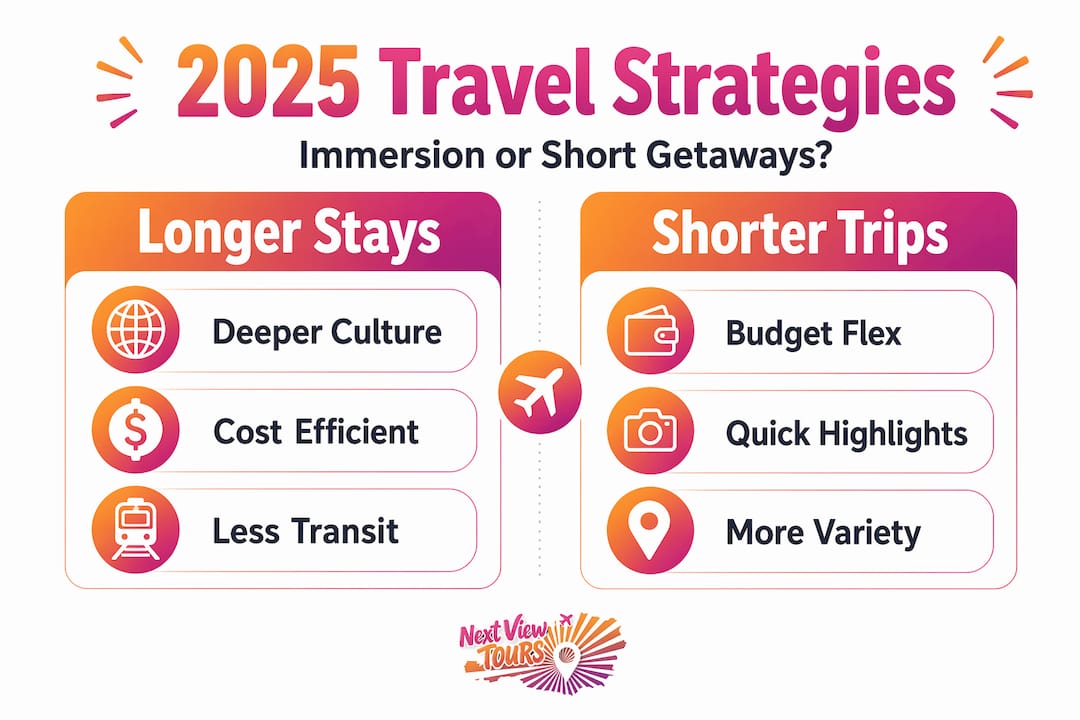
| Factor | Longer immersive trips | Shorter budget trips |
|---|---|---|
| Trip length | 10 to 14 days or more | 3 to 5 days |
| Destinations visited | 1 to 2 countries | 1 region or city |
| Primary focus | Cultural depth, local life | Efficiency, affordability |
| Best for | Remote workers, retirees, annual leave users | Weekenders, budget-conscious planners |
| Technology use | AI for deep research, human guides for delivery | AI for quick booking, minimal extras |
| Cost per day | Higher, but spread across more days | Lower per day, higher per trip frequency |
How to decide which approach works for you in 2025:
- Assess your available time first. A five-day trip can be deeply meaningful if you stay in one city. A poorly planned 14-day trip can feel shallow if you’re moving every two days.
- Identify what you actually remember from past trips. Most people find that a single vivid experience outweighs a dozen surface-level ones.
- Consider travel companions. Groups benefit from structured private versus group tours differently depending on their shared interests and flexibility.
- Match your budget to your goals. A shorter trip done well beats a longer trip done anxiously.
- Look at multi-day trip structures as a middle ground. Three to four days focused on one region, done with intention, often hits the best balance of depth and affordability.
Pro Tip: Whichever strategy you choose, build in one completely unscheduled afternoon. The best travel moments almost never appear in an itinerary.
The paradox of innovation and authenticity in travel’s future
Here is the tension that sits underneath every trend discussed in this article, and that almost no one in the travel industry talks about directly. The biggest behavioral conflict in 2025 travel is travelers’ simultaneous eagerness for technological innovation and their deep desire for authentic, human-centered experiences. And the industry keeps trying to solve for both with more technology, which misses the point entirely.
We have watched this play out across European destinations. A traveler uses an AI tool to plan a “local experience” in Salzburg, arrives at the AI-recommended spot, and finds forty other people who got the same recommendation. The technology worked perfectly. The authentic experience evaporated.
The future of travel that actually satisfies people doesn’t lie in better algorithms. It lies in using technology to remove friction from the forgettable parts of travel (booking, logistics, currency, navigation) so that human energy and attention can flow freely toward the parts that matter. When you’re not anxious about whether your train connection will work, you can actually look out the window. When your accommodation is handled, you can think about the conversation you want to have at dinner.
Why travel Europe in 2025 comes back, ultimately, to this: Europe is one of the few places in the world where history, culture, food, and landscape are so densely layered that no AI can fully map what a single afternoon in a single neighborhood might reveal to a curious traveler. That density is irreplaceable, and it rewards the traveler who gives it time.
The brands and guides that will define travel’s next decade are the ones who understand that technology should be invisible and humans should be central. Not the reverse.
Explore personalized and immersive trips with Next View Tours
Ready to apply these 2025 travel trends to your own plans? Next View Tours designs trips across Europe that reflect exactly what today’s travelers are looking for: depth, authenticity, and experiences that stay with you long after you’ve returned home.
Whether you’re drawn to a longer private tour through Austria and the Czech Republic or want to explore the range of available trip types from day trips to multi-day adventures, every experience is crafted around genuine cultural immersion. You won’t find rushed, checkbox-style itineraries here. From Vienna to Budapest to Hallstatt and beyond, the focus is always on what makes a place worth understanding. Explore multi-day European adventures and find the trip that fits how you want to travel in 2025 and beyond.
Frequently asked questions
What is the main travel trend for 2025?
The dominant trend is travelers taking longer single-destination trips focused on deeper cultural immersion, with 76.2% of luxury travelers preferring single-country itineraries over multi-country tours.
How is AI influencing travel planning in 2025?
AI handles early-stage research and itinerary drafts efficiently, but travelers still rely on human confirmation to ensure their trip feels authentic and personally meaningful rather than algorithmically generic.
Why are travelers choosing shoulder seasons for trips in 2025?
Spring and autumn travel delivers fewer crowds, lower prices, and a more genuine local atmosphere, and airlines offer stronger deals around public holidays that allow travelers to extend trips without extra days off work.
Has domestic travel changed in 2025?
Yes. Canadian domestic travel hit record highs in 2025, with over 60% of Airbnb stays booked within Canada and 50% overall growth since 2019, driven by economic pressure and a stronger interest in local discovery.
Recommended
- Why Travel Europe in 2025: Adventure, Culture, Customization – Next View Tours
- Trend in Europe Tours 2025: Immersive, Sustainable, Social – Next View Tours
- Master European Travel Workflow 2025 for Group Adventures – Next View Tours
- Guided Tours Trends 2025: Impact on European Travel – Next View Tours


Comments are closed