
 Uncategorized
TL;DR:
- Adventure travel involves activities that include physical challenges, cultural immersion, or interaction with nature, often carrying risk. It can be categorized as soft or hard adventure, with soft being accessible and low-risk, and hard involving advanced skills and higher danger. Choosing an appropriate trip depends on evaluating your fitness, risk tolerance, and selecting certified operators to ensure safety and meaningful experiences.
Adventure travel is defined as any trip that combines physical activity, cultural immersion, or interaction with the natural environment in ways that carry an element of risk or challenge. The adventure tourism industry spans everything from a guided wildlife safari in Botswana to a solo mountaineering attempt in the Himalayas. About 50% of Americans engage in some form of outdoor activity each year. That number reflects just how broad the appetite for adventure travel experiences truly is. The key to finding your ideal trip is understanding the spectrum from soft to hard adventure, and knowing where each activity type falls on that scale.
What are the main types of adventure travel?
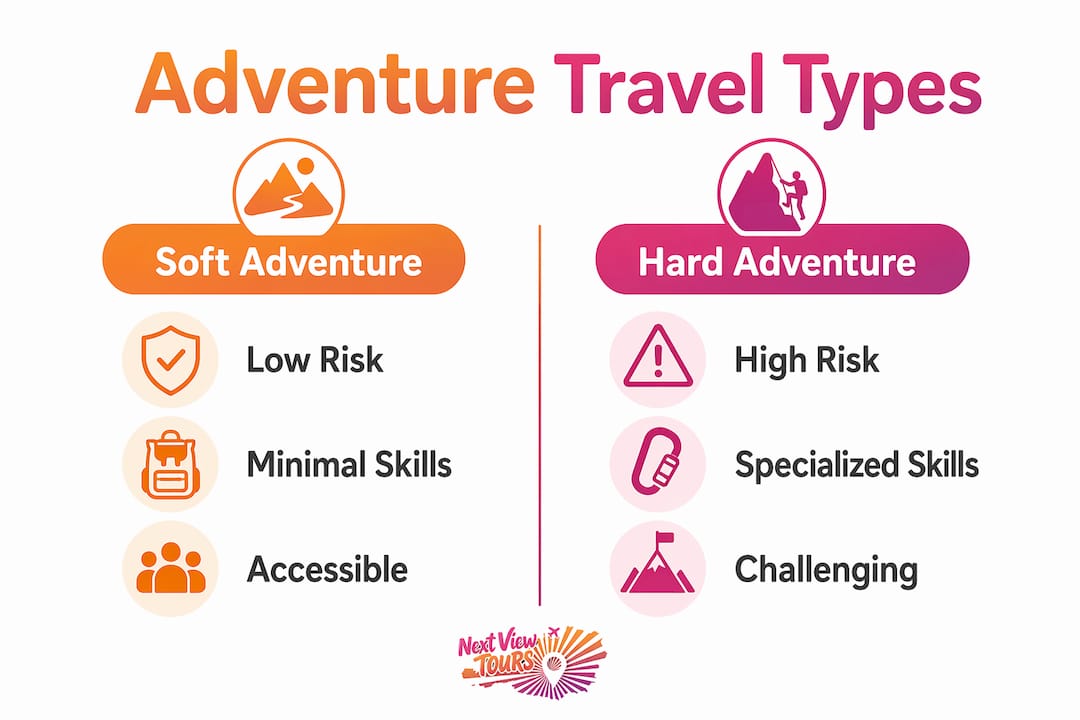
Adventure travel divides cleanly into two primary classifications: soft adventure and hard adventure. These terms come from the outdoor recreation and tourism industry and describe the level of risk, physical demand, and technical skill each experience requires. Understanding this distinction is the single most useful framework for planning any adventure trip.
Soft adventure: accessible and nature-focused
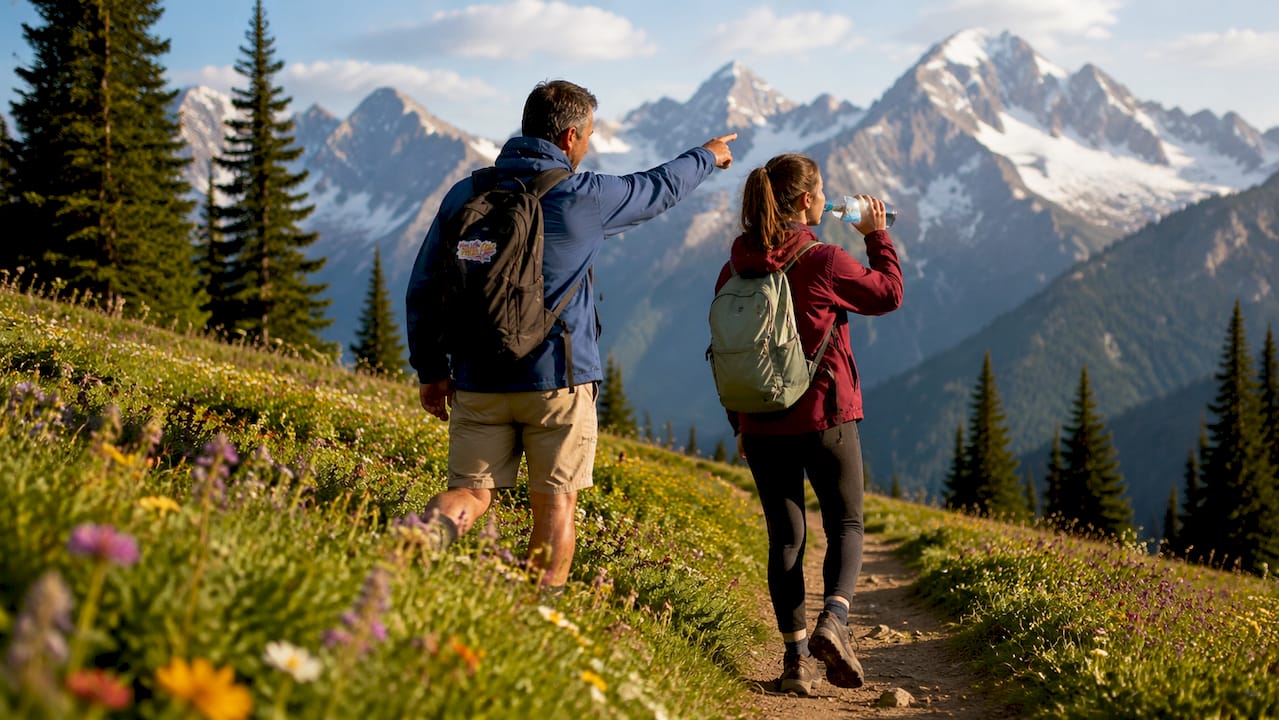
Soft adventure travel involves low risk and minimal skill requirements, designed for average fitness levels. Activities in this category include wildlife safaris, snorkeling, guided hiking, kayaking on calm water, and cycling tours through countryside. You do not need specialized training to participate. These trips typically include guided support, comfortable accommodations, and structured itineraries. The experience centers on connection with nature and culture, not survival or mastery.
Hard adventure: skill-driven and high-stakes
Hard adventure travel demands specialized skills and a high risk tolerance. Mountaineering in the Alps, white-water rafting on Class V rapids, and ice climbing in Patagonia all fall into this category. These trips require advanced preparation, physical conditioning, and often formal certifications. The environment is treated as a challenge to overcome, not a backdrop to enjoy. Mistakes carry real consequences, which is exactly what draws skilled adventurers to them.
Soft vs. hard adventure: a quick comparison
| Feature | Soft Adventure | Hard Adventure |
|---|---|---|
| Risk level | Low to moderate | High |
| Skill required | Minimal | Advanced or specialized |
| Physical demand | Average fitness | Peak conditioning |
| Guided support | Usually included | Often self-reliant |
| Example activities | Safari, snorkeling, hiking | Mountaineering, expedition rafting |
Pro Tip: Before booking any trip, honestly assess your current fitness level and your comfort with uncertainty. A mismatch between your abilities and the adventure type is the leading cause of dangerous situations on the trail or water.
How are adventure travel types categorized by environment?
Beyond the soft and hard distinction, outdoor adventure holidays group naturally by the environment where they take place. Land, water, and air each offer a distinct set of experiences, and cultural adventure travel adds a fourth dimension that many travelers overlook entirely.
Land-based adventures
Land adventures are the most widely practiced category of adventure travel ideas. They include:
- Trekking and hiking: Routes like the Inca Trail in Peru, the Tour du Mont Blanc in France and Italy, and the Camino de Santiago in Spain attract hundreds of thousands of trekkers annually.
- Mountain biking: Destinations like Moab in Utah, Finale Ligure in Italy, and Queenstown in New Zealand offer trails for every skill level.
- Wildlife safaris: Kenya’s Maasai Mara and Tanzania’s Serengeti provide guided game drives that qualify as soft adventure experiences with profound natural impact.
- Rock climbing and mountaineering: Yosemite National Park, the Dolomites, and Chamonix represent the full spectrum from beginner sport climbing to serious alpine ascents.
Water-based adventures
Water environments produce some of the most memorable best adventure trips available anywhere in the world. Options include:
- White-water rafting: The Colorado River through the Grand Canyon and the Zambezi River below Victoria Falls are iconic Class IV and V routes.
- Scuba diving: The Great Barrier Reef in Australia, the cenotes of Mexico’s Yucatan Peninsula, and Raja Ampat in Indonesia offer world-class dive sites.
- Surfing: Nazaré in Portugal, Pipeline on Oahu’s North Shore, and Jeffreys Bay in South Africa draw surfers from beginner to professional level.
- Sea kayaking: British Columbia’s Johnstone Strait and Norway’s fjords offer multi-day paddling routes through spectacular coastal scenery.
Air-based adventures
Extreme adventure activities in the air deliver an unmatched rush and require varying levels of training. Popular options include:
- Skydiving: Tandem jumps are accessible to beginners, while Accelerated Freefall (AFF) programs in locations like Interlaken, Switzerland, train solo skydivers.
- Paragliding: Pokhara in Nepal and Oludeniz in Turkey are considered among the world’s top paragliding destinations.
- Zip lining: Costa Rica’s Monteverde Cloud Forest offers canopy zip line tours that qualify as soft adventure, combining adrenaline with ecological education.
Cultural adventure travel
Cultural adventure is the category most travelers underestimate. It includes homestays with indigenous communities in the Amazon Basin, overland journeys through Central Asia along the ancient Silk Road, and eco-tourism programs in Madagascar that fund local conservation. Travelers increasingly prefer slow travel and deep cultural immersion over checklist tourism. This shift reflects a desire for experiences that are genuinely unpredictable and personally transformative.
What makes unique and high-end adventure experiences different?
Luxury and purposeful adventure travel represent a growing segment of the market. These trips go beyond physical challenge to integrate scientific research, historical discovery, and community partnership into the itinerary. Modern luxury adventure travel often involves purposeful expeditions that include scientific research and cultural preservation partnerships. The result is a trip that feels meaningful long after you return home.
One compelling example is the Kaimana-to-Sorong marine crossing in Raja Ampat, Indonesia. This route has been refined over more than a decade to gradually acclimatize participants before reaching the highest-intensity dive sites. The pacing is deliberate. It protects both the traveler and the reef ecosystem.
At the extreme end of self-reliance sits the Zanskar River expedition in Ladakh, India. This 150-kilometer rafting journey through the Zanskar Gorge offers no infrastructure and no exit once the trip begins. Participants must be fully self-sufficient in logistics, physical preparation, and emergency response. It is one of the clearest examples of hard adventure travel in its purest form.
“The most transformative adventure trips are not the ones that push you hardest physically. They are the ones that place you in an environment so unfamiliar that you have no choice but to pay full attention.”
Pro Tip: If you are drawn to high-end adventure, look for operators who partner with local research institutions or conservation organizations. These partnerships add depth to the experience and support the communities and ecosystems you visit.
How do you choose the best adventure trip for your abilities?
Choosing the right adventure type requires honest self-assessment and clear goal-setting. Follow these steps to match your interests and abilities to the right experience.
- Assess your current fitness level. Be specific. Can you hike for six hours with a loaded pack? Can you swim confidently in open water? Your honest answers determine which category of adventure is safe and enjoyable for you right now.
- Define your risk tolerance. Some travelers want challenge with a safety net. Others want genuine uncertainty. Knowing where you fall on this spectrum narrows your options quickly.
- Research required certifications. Scuba diving requires a PADI or SSI open water certification. Rock climbing instruction from a certified guide is strongly recommended for beginners. Skydiving AFF programs require a structured training course. Understand the skills required before you book, not after you arrive.
- Start one level below your perceived ability. Most experienced adventurers recommend this approach. It builds confidence, reveals gaps in your preparation, and prevents dangerous overreach.
- Choose operators with verified credentials. Look for guides certified by organizations like the American Mountain Guides Association (AMGA), the Professional Association of Diving Instructors (PADI), or national tourism boards. Certification signals accountability.
- Consider a customized tour for your first serious adventure. Custom itineraries allow operators to match the pace, difficulty, and cultural depth of a trip to your specific profile. This is especially valuable for travelers who fall between soft and hard adventure categories.
Choosing adventure trips wisely is not about limiting yourself. It is about building a foundation that lets you take on bigger challenges over time.
Key takeaways
The most effective way to plan adventure travel is to match your skill level and risk tolerance to the right category before selecting a destination or activity.
| Point | Details |
|---|---|
| Soft vs. hard adventure | Soft adventure suits average fitness; hard adventure demands advanced skills and high risk tolerance. |
| Environment categories | Land, water, air, and cultural adventures each offer distinct experiences and difficulty levels. |
| Luxury and purposeful travel | High-end expeditions integrate research or conservation, adding lasting meaning to the experience. |
| Self-assessment first | Honest evaluation of fitness and risk tolerance is the most important step before booking any trip. |
| Certified operators matter | Guides with AMGA, PADI, or equivalent credentials provide accountability and measurably safer experiences. |
What i’ve learned after years of guiding adventure travelers
The most common mistake I see is people confusing adventure with extreme. A guided safari through Kenya’s Maasai Mara is a genuine adventure. So is a week of sea kayaking along Norway’s coast. Neither requires you to risk your life, and both will change how you see the world. The soft-to-hard spectrum exists for a reason. It is not a hierarchy of worthiness.
I have also watched travelers underestimate the preparation that hard adventure demands. The Zanskar Gorge does not forgive poor planning. Neither does a multi-day alpine route in winter. The physical training matters, but the logistical preparation matters just as much. Gear lists, emergency protocols, and acclimatization schedules are not bureaucratic details. They are the difference between a story you tell at dinner and one you never get to tell.
What genuinely surprises most travelers is how much cultural adventure changes them. Spending three days with a Berber family in Morocco’s Atlas Mountains or joining a community reforestation project in Costa Rica produces a kind of reflection that no summit or rapid can replicate. The best adventure trips I have seen combine physical challenge with cultural depth. That combination is rare, but it is worth searching for.
My advice: start with a soft adventure that genuinely excites you, build your skills deliberately, and let your curiosity lead you toward harder challenges over time. Responsible planning and respect for the environments you visit are not optional. They are what make adventure travel worth doing.
— Next
Plan your next adventure with Nextviewtours
Nextviewtours designs adventure trips across Europe for every skill level and travel style, from soft nature escapes in the Austrian Alps to multi-day expeditions through Central Europe’s most dramatic landscapes. Whether you are looking for a private day trip from Vienna, a group adventure through the Czech Republic and Slovakia, or a fully customized outdoor experience, Nextviewtours matches the trip to you.

Every itinerary is built with expert local guidance, flexible pacing, and options for both first-time adventurers and experienced travelers. Explore the full range of adventure trip types available across Europe and find the experience that fits your goals, your fitness level, and your sense of curiosity. Your next great adventure is already waiting.
FAQ
What is the difference between soft and hard adventure travel?
Soft adventure involves low risk and minimal skill requirements, while hard adventure demands specialized training and carries significantly higher physical and environmental risk.
What are the most popular types of adventure travel activities?
The most popular activities include trekking, wildlife safaris, white-water rafting, scuba diving, mountain biking, paragliding, and cultural immersion programs such as homestays and eco-tourism.
Is adventure travel safe for beginners?
Soft adventure travel is broadly accessible and safe for beginners when booked through certified operators. Attempting hard adventure without proper training is a significant safety hazard and should be avoided until the necessary skills are developed.
What makes luxury adventure travel different from standard adventure trips?
Luxury adventure expeditions integrate scientific research, cultural preservation, and community partnerships into the itinerary, transforming the trip into a purposeful expedition rather than a purely recreational experience.
How do i choose the right adventure travel experience for my fitness level?
Honestly assess your endurance, swimming ability, and comfort with physical risk, then select an activity category that matches your current conditioning. Starting one level below your perceived ability is the most reliable way to build confidence and avoid dangerous situations.
Recommended
- How to Choose Adventure Trips for Unforgettable Experiences – Next View Tours
- What Is an Adventure Tour – Real Experiences, Lasting Impact – Next View Tours
- Best 5 Adventure Trips Comparison Europe – Expert Comparison 2026 – Next View Tours
- Adventure Tourism Definition: What Makes It Unique – Next View Tours


Comments are closed