
 Uncategorized
TL;DR:
- Austria offers diverse experiences, from alpine scenery to imperial cultural landmarks, across all seasons. Visitors should plan ahead and combine rail travel with car rentals for authentic exploration of the country’s regions. Its rich history and natural beauty make Austria a rewarding destination beyond the famous cities of Vienna and Salzburg.
Austria is a landlocked country in Central Europe defined by its alpine terrain, imperial history, and year-round cultural richness. When travelers search “austria austria,” they are looking for a complete picture of a country that rewards curiosity at every turn. From the concert halls of Vienna to the glacial peaks of Tyrol, Austria offers experiences that range from world-class art to untouched wilderness. This guide covers everything you need to plan a visit that goes well beyond the postcard version of the country.
What is Austria’s geography and climate like?
Austria covers 83,879 km² of Central European terrain, with 62% of that area classified as mountainous. That proportion shapes everything: the weather, the transport routes, the food, and the pace of daily life.
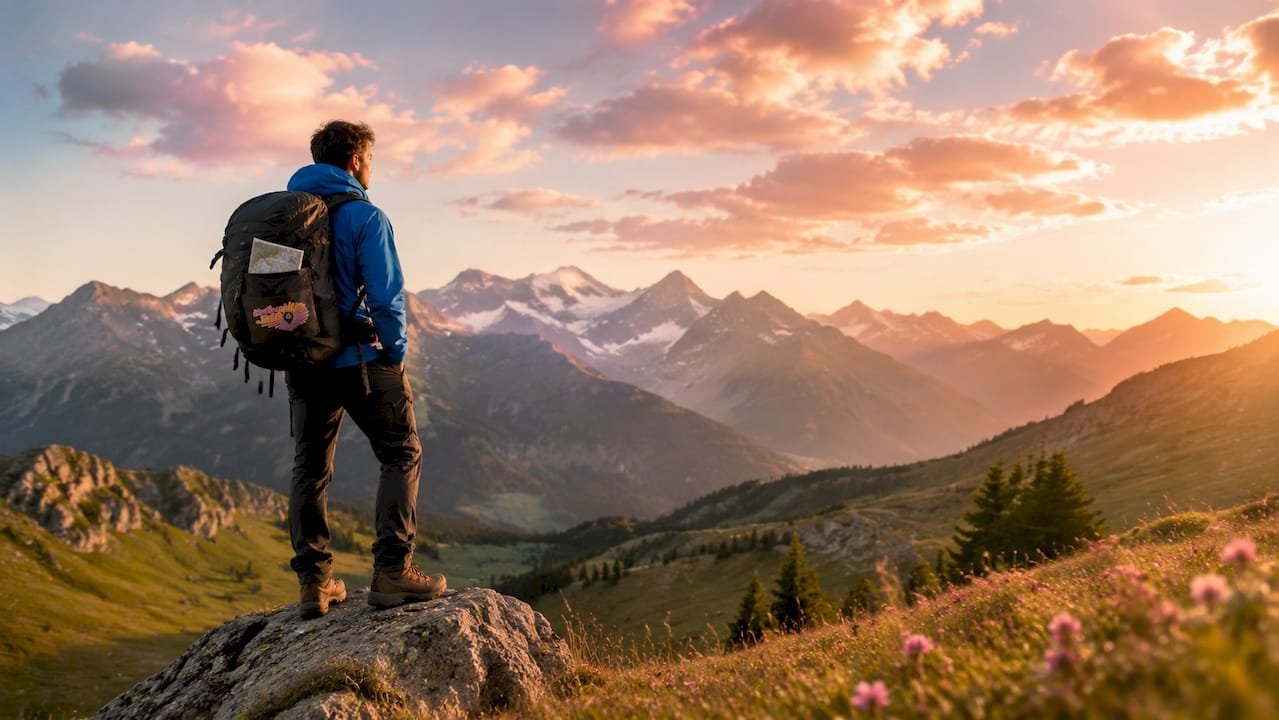
The Alps dominate the western and central regions, divided into three major ranges: the Northern Calcareous Alps, the Central Alps, and the Southern Calcareous Alps. The country’s highest point is the Großglockner at 3,797m, a peak that draws climbers and road-trippers alike. Moving east toward Vienna, the terrain flattens into the Pannonian plain, which produces a warmer, drier climate suited to vineyards and cycling routes.
Austria shares borders with eight countries: Germany, Czech Republic, Slovakia, Hungary, Slovenia, Italy, Switzerland, and Liechtenstein. That geographic position makes it one of the most accessible countries in Europe for multi-country travel.
Climate by region
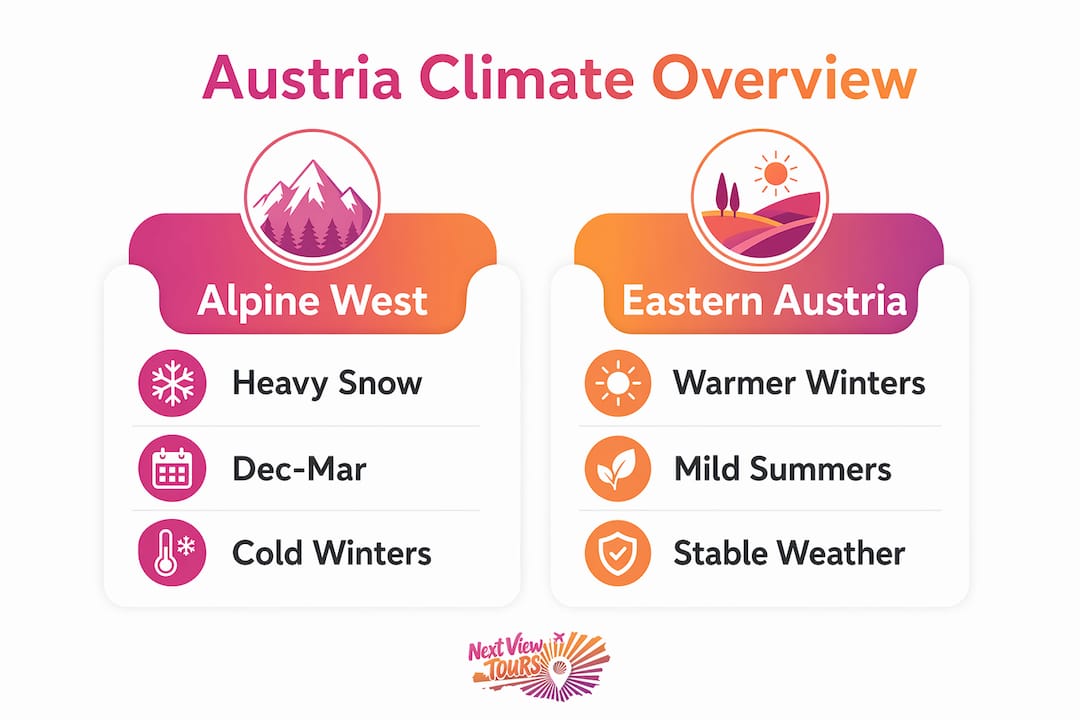
| Region | Season | Typical Conditions |
|---|---|---|
| Alpine West (Tyrol, Vorarlberg) | Winter (Dec–Mar) | Heavy snowfall, temperatures well below 0°C |
| Alpine West | Summer (Jun–Sep) | Cool and clear, 15–22°C at altitude |
| Eastern Plains (Vienna, Burgenland) | Summer | Warm and dry, 25–30°C |
| Eastern Plains | Winter | Mild, occasional snow, 0–5°C |
Average annual temperatures across the country range between 7.5°C and 10°C, though altitude creates dramatic local variation. A summer day in Innsbruck can feel entirely different from the same day in Vienna, which sits at just 170 meters above sea level.
Key geographic highlights to know before you visit:
- Großglockner High Alpine Road: One of Europe’s most scenic mountain drives, open june through october
- Lake Wörthersee: Austria’s warmest lake, popular for swimming and sailing
- Danube River: Flows through Vienna and connects Austria to eight other European nations
- Neusiedler See: A UNESCO-listed steppe lake on the Hungarian border, unique in Central Europe
How has Austria’s history shaped its culture and identity?
Austria’s recorded history begins in 976 AD, when the region was established as a margraviate under the Babenberg dynasty. The name “Ostarrîchi” appears in a document from 996 AD, making it one of the oldest recorded place names in the German-speaking world. That deep historical root explains why Austrians carry a strong sense of cultural identity even today.
The Habsburg dynasty took control in 1273 and held power for over six centuries. At its height, the Habsburg Empire stretched across much of Europe, and Vienna became one of the continent’s great imperial capitals. The legacy of that era is visible everywhere: in the Ringstrasse boulevard, the Kunsthistorisches Museum, the Spanish Riding School, and the Vienna State Opera.
The Austro-Hungarian Empire, which lasted from 1867 to 1918, added another layer of cultural complexity. It brought together German, Hungarian, Czech, Slovak, Slovenian, Croatian, and Italian influences under one political structure. That multicultural inheritance explains why Austrian cuisine, music, and architecture feel so layered and cosmopolitan compared to smaller European nations.
Austria’s musical heritage deserves special attention. Wolfgang Amadeus Mozart was born in Salzburg in 1756. Ludwig van Beethoven spent most of his career in Vienna. Franz Schubert, Johann Strauss, and Gustav Mahler all called Austria home. This concentration of musical genius in one small country is not coincidence. The Habsburg court actively funded composers and performers, creating an ecosystem that attracted talent from across Europe.
Key historical milestones that still shape Austrian tourism today:
- 976 AD: Founding of the Austrian margraviate under the Babenbergs
- 1273: Habsburg dynasty begins its rule
- 1683: Siege of Vienna by Ottoman forces, a turning point in European history
- 1867: Formation of the Austro-Hungarian Empire
- 1918: End of World War I and the Habsburg Empire; Austria becomes a republic
- 1955: Austria regains full sovereignty after post-WWII occupation
When should travelers visit Austria and what are seasonal highlights?
The honest answer is that Austria rewards visitors in every season, though each period offers a different experience. Summer and winter are both peak periods, but for entirely different reasons.
Summer (june through september) is the season for outdoor exploration. Hiking trails open across the Alps, lake temperatures rise enough for swimming, and cultural festivals fill the calendar. The Salzburg Festival, held each july and august, is one of the world’s premier classical music events. The Hallstatt and Salzburg region draws enormous crowds in summer, so early booking is non-negotiable.
Winter (december through march) transforms Austria into a skiing destination of the highest order. Resorts like Kitzbühel and St. Anton rank among Europe’s best, with reliable snow cover and world-class infrastructure. Austria’s winter scenery extends well beyond ski slopes: Christmas markets in Vienna and Salzburg run through december, and the alpine villages take on a quiet, almost cinematic quality.
Pro Tip: Visit Vienna’s major museums between 2:00 PM and 5:00 PM to avoid the peak 10:00 AM to 2:00 PM crowd window. You will get more space, better lighting for photography, and a calmer overall experience.
The most overlooked travel period is spring (april through may) and early autumn (september through october). Crowds thin out, prices drop, and the landscape shifts dramatically. Alpine meadows bloom in may, and the wine harvest in the Wachau Valley makes october a particularly rich time to visit eastern Austria.
| Season | Best For | Drawback |
|---|---|---|
| Summer (Jun–Sep) | Hiking, lakes, festivals, sightseeing | Crowds at major sites, higher prices |
| Winter (Dec–Mar) | Skiing, Christmas markets, alpine scenery | Cold temperatures, resort costs |
| Spring (Apr–May) | Wildflowers, fewer crowds, mild weather | Unpredictable mountain weather |
| Autumn (Sep–Oct) | Wine harvest, foliage, cultural events | Shorter daylight hours |
Many travelers misunderstand Austria as only a winter ski destination. Summer activities like hiking and lake swimming at Wörthersee offer equally compelling experiences, and the country records 157 million overnight stays annually, spread across all four seasons.
What are the top cultural landmarks and natural attractions in Austria?
Austria’s appeal lies in a balanced mix of nature, culture, cuisine, and infrastructure that makes it attractive year-round. The country’s nine federal provinces each carry a distinct character, and the most authentic experiences often come from exploring beyond Vienna and Salzburg.
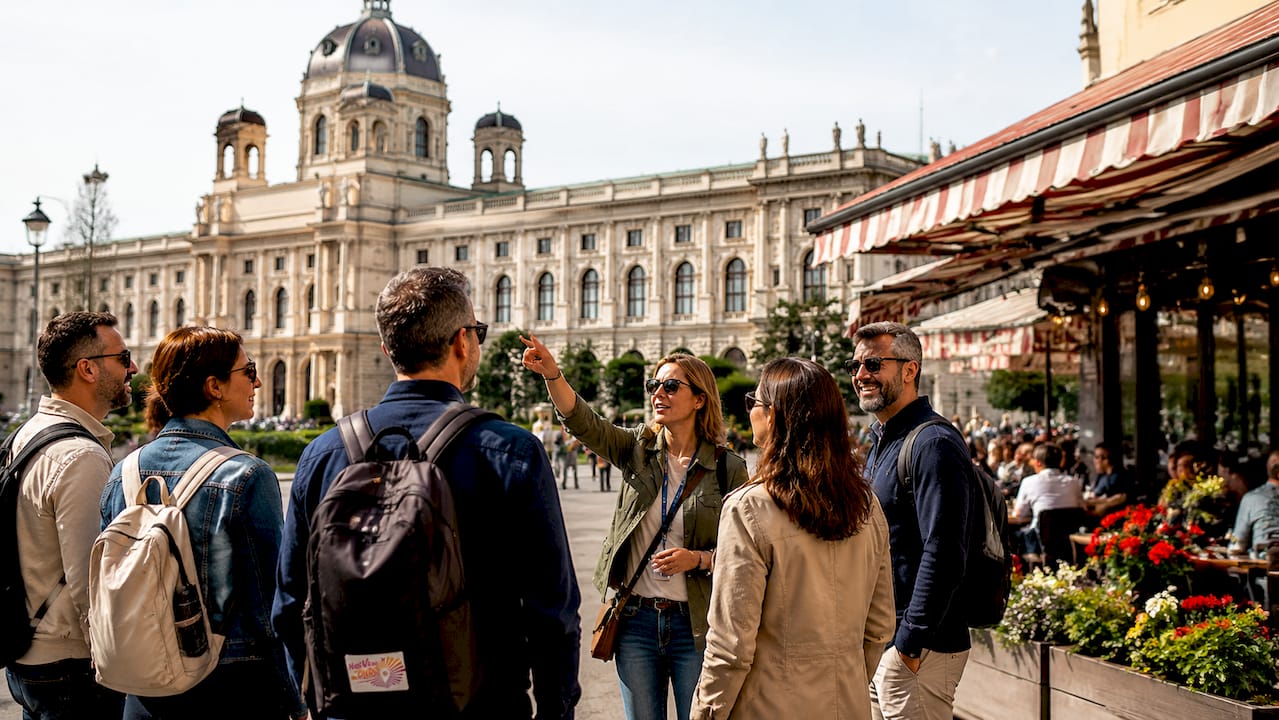
Vienna is the obvious starting point. The Kunsthistorisches Museum houses one of the world’s great art collections, including works by Vermeer, Raphael, and Caravaggio. The Belvedere Palace contains Gustav Klimt’s “The Kiss,” arguably the most recognized painting in Austrian history. The Ringstrasse, commissioned by Emperor Franz Joseph I in the 1850s, remains one of Europe’s most impressive urban planning achievements.
Salzburg is compact, walkable, and deeply musical. The old city is a UNESCO World Heritage Site. Mozart’s birthplace on Getreidegasse draws visitors from every continent. The Hohensalzburg Fortress, built in 1077, offers panoramic views over the city and the surrounding Alps.
Beyond the two major cities, Austria’s regional attractions are where the real depth lies:
- Hallstatt (Upper Austria): A lakeside village with over 7,000 years of human settlement, recognized as a UNESCO World Heritage Site
- Innsbruck (Tyrol): A medieval old town surrounded by peaks above 2,000 meters, with the Golden Roof as its most iconic landmark
- Kitzbühel and St. Anton (Tyrol): World-class ski resorts with summer hiking infrastructure equally developed
- Wörthersee (Carinthia): Austria’s warmest lake, lined with Art Nouveau villas and water sports facilities
- Vorarlberg: Austria’s westernmost province, bordering Switzerland, known for contemporary architecture and Bregenzer Festspiele, an open-air opera festival held on a floating stage
Provinces like Vorarlberg and Carinthia are where authentic cultural lifestyle is strongest, yet they remain undervisited compared to Vienna and Salzburg. The gap between what most tourists see and what Austria actually offers is significant.
Local cuisine is also a defining part of the cultural experience. Wiener Schnitzel, Tafelspitz, Kaiserschmarrn, and Apfelstrudel are not just dishes. They are cultural artifacts tied to specific regions and historical periods. Understanding how local cuisine shapes tourism helps explain why Austrian food culture draws visitors as powerfully as its architecture.
What practical travel tips enhance a visit to Austria?
Austria ranks fourth in the 2026 Global Peace Index, making it one of the safest destinations in Europe for solo travelers, families, and couples. Public infrastructure is reliable, English is widely spoken in tourist areas, and the healthcare system is among Europe’s best.
-
Understand your visa situation. EU and Schengen-area citizens travel freely. Most other nationalities, including Americans and Australians, can visit visa-free for up to 90 days under Schengen rules. Starting in late 2026, ETIAS authorization will be required for visa-exempt non-EU travelers. Apply online before departure.
-
Use ÖBB rail for city-to-city travel. Austria’s national rail network connects Vienna, Salzburg, Innsbruck, and Graz efficiently. ÖBB flexible tickets start around €29 per day and cover most intercity routes. Regional passes save money on multi-day itineraries.
-
Rent a car for alpine and rural areas. Public transport becomes infrequent outside major towns. Combining rail travel with a car rental gives you access to alpine valleys, small villages, and scenic roads like the Großglockner High Alpine Road that no bus schedule can match.
-
Budget realistically. Daily travel costs range from €80 for budget travelers to €250 or more for luxury experiences. Mid-range travelers spending €120–€160 per day can access quality accommodation, good restaurants, and paid attractions without compromise.
-
Learn a few German phrases. English is common in tourist spots, but locals genuinely appreciate a greeting in German. “Grüß Gott” (the regional hello), “Danke” (thank you), and “Bitte” (please/you’re welcome) go a long way in smaller towns and rural areas.
Pro Tip: Book the Austria itinerary for 2026 well in advance. Summer festival periods and ski season weekends sell out months ahead, and accommodation prices spike sharply without early reservations.
Key Takeaways
Austria rewards travelers who look beyond Vienna and Salzburg, combining alpine nature, imperial culture, and year-round activities across nine distinct provinces.
| Point | Details |
|---|---|
| Geography defines the experience | 62% of Austria is mountainous, shaping climate, transport, and activities across all regions. |
| History runs deep | Austria’s cultural identity traces back to 976 AD, with Habsburg and Austro-Hungarian legacies visible in every major city. |
| Both seasons deliver | Summer offers hiking and lake tourism; winter delivers world-class skiing at resorts like Kitzbühel and St. Anton. |
| Safety is a genuine asset | Austria ranks fourth in the 2026 Global Peace Index, making it reliable for solo travelers, families, and couples. |
| Plan for ETIAS in 2026 | Visa-exempt non-EU travelers must secure ETIAS online authorization before visiting, starting late 2026. |
What I’ve learned from years of guiding travelers through Austria
Most visitors arrive with a two-city plan: Vienna and Salzburg. Both are magnificent. Neither tells the full story of what Austria actually is.
The provinces are where Austria’s character lives. Carinthia’s lakes have a warmth and ease that feels nothing like the imperial grandeur of Vienna. Vorarlberg’s contemporary architecture and mountain culture feel closer to Switzerland than to the Ringstrasse. Tyrol’s alpine valleys, particularly around the Ötztal and Zillertal, offer a version of Austria that most tourists never reach.
Timing matters more than most guides admit. Visiting Hallstatt on a tuesday in october is a completely different experience from arriving on a saturday in july. The village is the same. The experience is not. I always tell travelers to treat the calendar as seriously as the itinerary.
The combination of rail and car rental is the single most effective way to see Austria authentically. Rail gets you between cities quickly and comfortably. A car gives you the freedom to stop at a roadside Heuriger (a traditional wine tavern), take the Großglockner road at your own pace, or find a lake that does not appear on any top-ten list. That combination, more than any single attraction, is what makes an Austrian trip memorable.
Austrian cuisine also deserves more attention than it typically gets. Wiener Schnitzel is famous for good reason, but the regional variations across nine provinces tell a richer story. Carinthian Kasnudeln, Tyrolean Gröstl, and Viennese Tafelspitz each reflect the geography and history of their home region. Eating locally is not just pleasant. It is one of the most direct ways to understand a place.
— Next
Plan your Austria experience with Nextviewtours
Austria’s depth makes it one of Europe’s most rewarding destinations, and having the right guide makes all the difference between a surface visit and a genuinely memorable trip.
Nextviewtours offers a full range of Austria tour options designed for every type of traveler. Whether you want a private alpine adventure, a group cultural tour through Vienna and Salzburg, or a multi-day ski package in Tyrol, Nextviewtours builds itineraries that reach beyond the obvious. Expert local guides provide cultural context that no guidebook can replicate. From day trips out of Vienna to week-long alpine expeditions, every tour is structured to give you more of what Austria actually is.
FAQ
What is Austria best known for?
Austria is best known for its alpine scenery, imperial architecture, and classical music heritage. Vienna, Salzburg, and the Alps are its most recognized symbols globally.
Do I need a visa to visit Austria?
Most non-EU travelers, including Americans, can visit Austria visa-free for up to 90 days under Schengen rules. Starting in late 2026, ETIAS online authorization will be required before travel.
What are the best cities in Austria to visit?
Vienna, Salzburg, Innsbruck, and Graz are the top cities. Each offers a distinct character, from imperial grandeur in Vienna to alpine culture in Innsbruck.
How do I get around Austria?
ÖBB rail connects major cities efficiently, with flexible tickets starting around €29 per day. Car rental is recommended for alpine regions and rural areas with limited public transport.
Is Austria a good destination for summer travel?
Austria is an excellent summer destination. Hiking, lake swimming, and major cultural festivals like the Salzburg Festival make june through september one of the country’s most active travel periods.


Comments are closed