

 Uncategorized
Yes, you can do the Danube Bend as a day trip from Budapest. For most travelers, it’s one of the best excursions in Hungary. The real question isn’t whether it’s possible, it’s which approach fits how you like to travel.
If you value flexibility and don’t mind figuring out a bus schedule, go self-guided: take the HÉV suburban train to Szentendre and pair it with one more town. If you want to see all three towns (Szentendre, Visegrád, and Esztergom) without worrying about missed connections, book a guided full-day tour or private transfer.
Here’s the quick breakdown before you commit to a plan:
- Self-guided, one or two towns: a small amount in transport per person, 7 to 9 hours round trip, best for budget travelers who like control over their pace.
- Guided full-day tour, all three towns: typically covers transport, a guide, and sometimes lunch in one price, best for travelers who want depth without logistics stress.
- Seasonal river boats run April through September only. Outside that window, buses and trains are your only options to Visegrád and Esztergom.
Your choice really comes down to one tradeoff: speed and coverage versus flexibility and cost.
Key Takeaways
A Danube Bend day trip from Budapest works best when you either self-guide two towns using the H5 HÉV plus one bus or boat connection, or book a guided tour that covers all three without transfer stress.
| Point | Details |
|---|---|
| Yes, it’s doable in a day | Choose self-guided for flexibility or a guided tour to cover all three towns comfortably. |
| Pair Szentendre with one town | Independent travelers who try all three towns often end up rushing at least one stop. |
| Boat season is April to September | Seasonal Mahart river boats only run in warmer months; buses and trains work year-round. |
| Check timetables the morning of travel | Confirm HÉV, bus, and rail schedules the day you leave, since they shift seasonally. |
| Guided tours solve the scheduling gap | Nextviewtours’ small-group and private options handle transfers so you can focus on the sites. |
Table of Contents
- Two Sample Danube Bend Day Trip Itineraries From Budapest
- How Do You Get From Budapest to the Danube Bend?
- What Should You See in Szentendre, Visegrád, and Esztergom?
- What Should You Know Before Booking Tickets and Packing?
- When Does a Guided Danube Bend Tour Make More Sense?
- Why We Think Pacing Matters More Than Coverage
- How Nextviewtours Makes the Danube Bend Easier
- Sources
Two Sample Danube Bend Day Trip Itineraries From Budapest
A day trip only works if the timing is realistic. Hungary’s regional buses to Visegrád and Esztergom don’t run every 15 minutes like a city tram, so you need buffer time built into any plan. Below are two itineraries: one built for covering ground, one built for a slower, more enjoyable pace.
Fast variant (two towns, more walking, tighter connections):
- 7:30 AM: Depart Budapest (Batthyány tér) on the H5 HÉV toward Szentendre.
- 8:15 AM: Arrive Szentendre. Walk the old town, visit one museum or gallery, grab coffee.
- 10:30 AM: Catch a Volánbusz service or seasonal boat toward Visegrád.
- 11:45 AM to 1:30 PM: Explore Visegrád, including the climb (or shuttle) to Fellegvár for the panoramic Danube view.
- 1:45 PM: Lunch near the river before your onward connection.
- 2:30 PM: Optional continuation to Esztergom if your bus timing lines up, otherwise begin the return trip.
- 6:00 PM: Back in Budapest.
Relaxed variant (one town plus a scenic river leg):
- 9:00 AM: Depart Budapest on the H5 HÉV.
- 9:45 AM: Arrive Szentendre. Spend the whole morning browsing the artists’ quarter and riverside promenade at an easy pace.
- 1:00 PM: Long lunch by the river.
- 2:30 PM: Board the seasonal ferry to Visegrád (April through September only) for the boat ride itself, one of the prettiest stretches of the Danube.
- 4:00 PM: Walk up to the castle viewpoint, then relax with a coffee before heading back.
- 6:30 PM: Return to Budapest by bus or the last ferry connection.
Pro Tip: Stick to Szentendre plus one other town. Travel planners at Frommer’s point out that visitors who try to squeeze all three towns into an independent day trip usually end up rushing through at least one of them, and sometimes missing the last connection back. Two towns done well beats three done in a sprint.
How Do You Get From Budapest to the Danube Bend?
You have five realistic ways to reach the Danube Bend, and each one suits a different kind of traveler. Here’s what each involves, what it costs, and where to check the schedule before you leave your hotel.

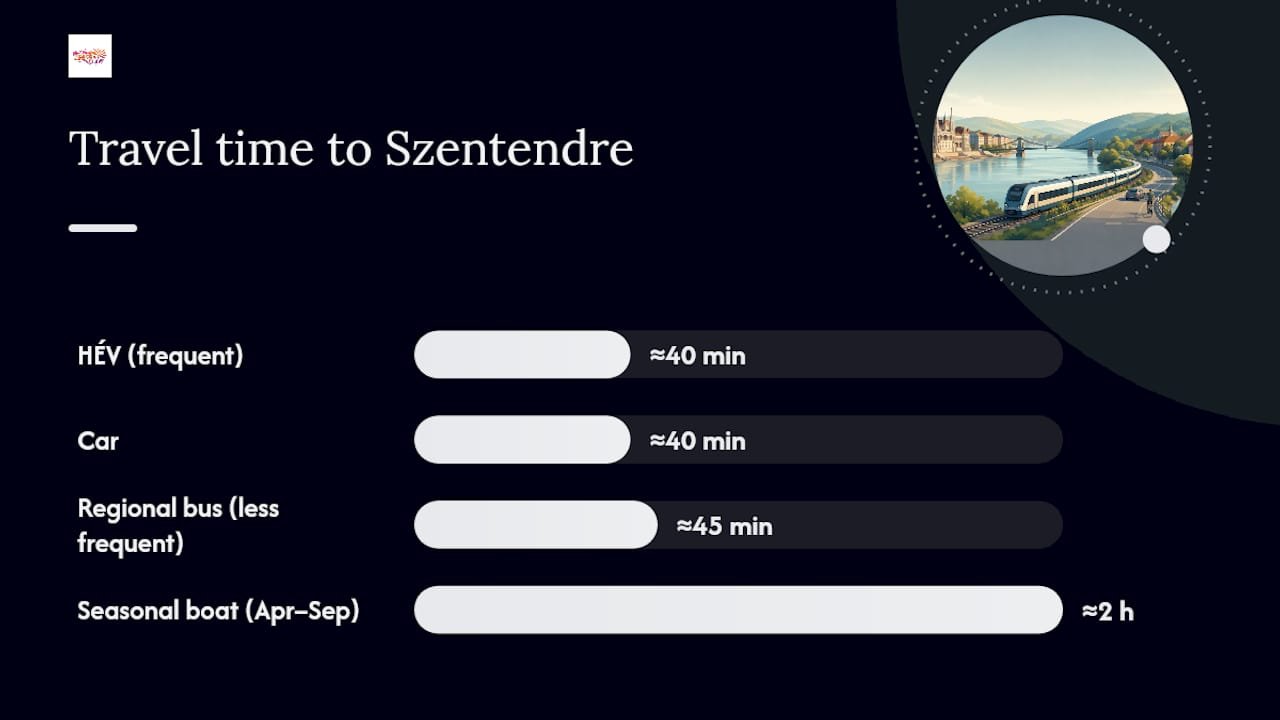
HÉV suburban train (Budapest to Szentendre): The H5 line runs from Batthyány tér and takes about 40 minutes. It departs frequently throughout the day, and a single ticket runs a few hundred forints depending on zone. This is the easiest leg of the whole trip. Check current departures on BKK’s timetable portal before you go, since holiday schedules shift.
Regional bus (Volánbusz) to Visegrád and Esztergom: Bus 880 departs from Árpád híd and takes approximately 75 to 90 minutes to reach Visegrád, and around 90 to 110 minutes to Esztergom. These buses run less frequently than the HÉV, sometimes hourly, so plan your return trip in advance. Fares run a few thousand forints round trip. Buy and check timings directly through Volánbusz’s official site.
Regional rail (MÁV): Some travelers combine a MÁV train leg with a bus transfer, particularly toward Esztergom. Schedules and fares are published by MÁV, and it’s worth cross-checking against bus options since one might save you a transfer.
Seasonal river boats: Mahart-operated boats connect Budapest to the Danube Bend towns from April through September, according to Budapest by Locals. Expect roughly two hours to Szentendre, three and a half hours to Visegrád, and longer still to Esztergom. This is the slowest option, but also the most scenic. Outside boat season, you’re relying entirely on road and rail.
Driving: It takes about 40 minutes to Szentendre, an hour to Visegrád, and around an hour and 15 minutes to Esztergom by car. Parking is generally easy to find in Szentendre’s outer lots and in Visegrád near the ferry pier, though spaces near Esztergom’s basilica fill up fast on weekends in high season.
Guided tours and private transfers: A shared group tour typically bundles transport, a guide, and often lunch into a single per-person price, while a private transfer or custom tour costs more but adapts to your pace and pickup location.
| Transport Mode | To Szentendre | To Visegrád | To Esztergom |
|---|---|---|---|
| HÉV / train | ~40 min, low cost | Not direct (bus transfer needed) | Not direct (bus/rail transfer needed) |
| Regional bus | ~45 min | ~75 to 90 min | ~90 to 110 min |
| Seasonal boat (April to September) | ~2 hours | three and a half hours | Longer, limited departures |
| Car | ~40 min | about an hour | ~75 min |
| Guided tour | Included in itinerary | Included in itinerary | Included in itinerary |
Pro Tip: Always check BKK, Volánbusz, and MÁV the morning you travel, not the night before. Hungarian regional schedules shift for holidays and seasonal service changes, and an outdated timetable screenshot has stranded more than one traveler at a bus stop in Visegrád.
What Should You See in Szentendre, Visegrád, and Esztergom?
Each town rewards a different kind of visitor, and knowing what each offers helps you decide where to spend your limited hours.
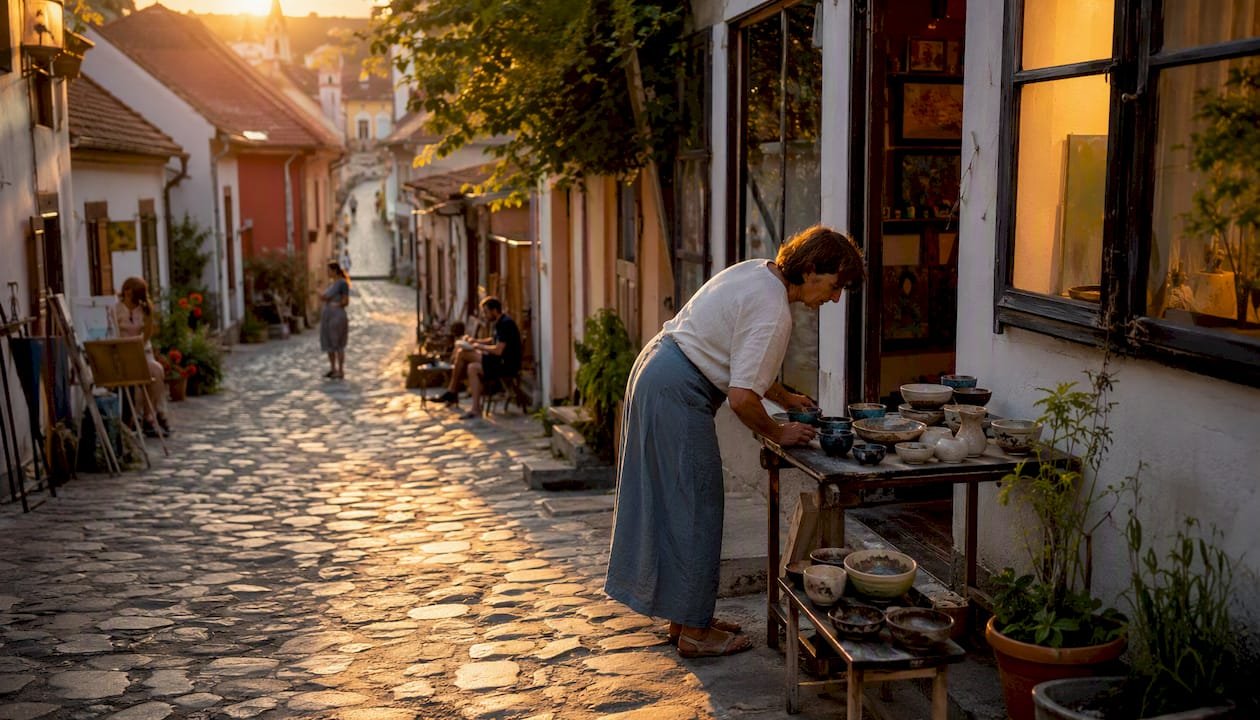
Szentendre is the easiest stop for independent travelers, and also the most compact. The artists’ quarter is full of small galleries and craft studios, the Serbian Orthodox churches reflect the town’s 18th-century merchant history, and the riverside promenade is a pleasant place to end a visit. Plan on 2 to 3 hours: one hour is enough for a quick walk through the main square, two hours lets you add a museum, and three hours gives you time for a proper lunch by the river.
Visegrád rewards travelers willing to climb (or ride a shuttle) up to Fellegvár, the Upper Castle, for one of the best panoramic views of the Danube’s curve anywhere in the region. Budget 2 to 4 hours depending on whether you hike up or take transport, and whether you linger at the museum inside the castle walls. One hour covers a quick look from the lower town; the full four hours lets you combine the castle, a short trail walk, and lunch by the river.
Esztergom centers on its basilica, Hungary’s largest church and a dramatic sight from the river. The historic town below has cobblestone streets and quiet riverside paths. Plan 2 to 4 hours, keeping in mind that the basilica’s dome and crypt involve stairs that aren’t easy for visitors with mobility limitations. The main nave and cathedral treasury are accessible without climbing, so a shorter visit still delivers the highlight.
For meals, all three towns lean casual: riverside cafes in Szentendre, simple Hungarian fare near Visegrád’s ferry pier, and a handful of solid sit-down restaurants in Esztergom’s old town. Picnic supplies from a Szentendre market stall are a smart backup if your schedule is tight and you’d rather eat on the move.
What Should You Know Before Booking Tickets and Packing?
A few planning decisions determine whether your day runs smoothly or turns into a scramble at a bus stop.
Buying tickets: For the HÉV, buy tickets at the station machines or through the BKK app before boarding; validate them if using paper tickets. Volánbusz tickets can be bought online in advance or from the driver, though online booking guarantees your seat during busy periods. MÁV tickets are available through their app or at station counters. The most common mistake independent travelers make is assuming a bus ticket bought at the counter also covers a return trip. It usually doesn’t.
Best time to go: April through October offers the most reliable weather for walking around cobblestone town centers and climbing to viewpoints. According to Frommer’s, shoulder months like May and September bring thinner crowds than July and August while keeping the boat service running. If you’re set on the river route, remember the seasonal window runs April through September only.
Money matters: Cards are widely accepted in restaurants and larger shops across all three towns, though small cafes and market stalls often prefer cash. A casual lunch runs affordably by Western European standards, and tipping around 10% is customary in sit-down restaurants.
Accessibility and families: Szentendre’s flat old town is stroller-friendly, though cobblestones can be bumpy. Visegrád’s castle requires either a hike or a paid shuttle, since there’s no fully step-free route to the top. Esztergom’s basilica has stairs to the dome, but the main level is accessible without them.
Pack smart:
- Comfortable walking shoes for cobblestones and, if you’re headed to Visegrád, an uphill climb.
- A refillable water bottle, since summer days get warm fast on exposed viewpoints.
- Sun protection and a light rain layer, since Danube Bend weather can shift quickly.
- A portable charger and offline maps, as coverage gets spotty in some riverside stretches.
- A printed or downloaded copy of your bus timetable, since you can’t always count on the internet working exactly when you need it.
Safety notes: Keep an eye on bags in crowded ferry queues and bus stations, where petty theft is more common than violent crime. If you’re taking a river boat, follow standard dock safety, and don’t rush boarding when a boat is crowded.
Pro Tip: Before you leave Budapest, write down the exact departure time of your last return bus or train. Regional buses to Visegrád and Esztergom can run hourly, and missing the second-to-last one by five minutes means a long wait, or an expensive taxi back to the capital.
If you’re staying overnight in the region instead of rushing back, pairing your lodging with a solid dining plan makes the extra time worthwhile rather than just an afterthought.
When Does a Guided Danube Bend Tour Make More Sense?
The math changes once you factor in how often Hungarian regional buses run. The H5 HÉV to Szentendre is dependable, but onward connections to Visegrád and Esztergom can space out to once an hour, and that gap eats into a day trip fast if you’re trying to see more than one town beyond Szentendre.
A guided tour solves that problem directly. Instead of timing your museum visit around a bus departure, the transport, route, and often lunch are already arranged. You also get something independent travel doesn’t offer on its own: a guide who can explain why Visegrád’s castle mattered to Hungarian kings, or what the Esztergom Basilica’s dome represents in the country’s religious history. Reviewers on TripAdvisor consistently point to that packed, all-three-towns itinerary as the appeal of a guided day, something that’s genuinely difficult to pull off independently.
There are two common tour styles worth knowing:
- Small-group shared tours cost less per person and follow a fixed schedule, a good fit for solo travelers or couples who don’t mind a set pace.
- Private or custom tours cost more but flex around your timing, mobility needs, or photography stops, better suited to families, older travelers, or anyone who wants to linger at one site longer than the group allows.
If someone in your group has mobility limitations, or you’re traveling with young children who tire out mid-afternoon, a private transfer usually beats a group tour since it can adjust the day on the fly rather than sticking to a fixed itinerary.
Why We Think Pacing Matters More Than Coverage
Operating day trips across this region for years has taught us one thing above all: the itineraries that get the best feedback aren’t the ones that cram in the most stops, they’re the ones that leave room to actually stand at the Visegrád viewpoint for ten extra minutes instead of rushing back to the bus. Nextviewtours builds its Danube Bend itineraries around that principle, sequencing towns so the transfers are already handled and the guide’s commentary lands at the right moment, not squeezed into a walk between bus stops.
We also customize private tours around what a traveler actually wants out of the day, whether that means prioritizing photography stops at the castle, slowing down for a Basilica tour of Esztergom, or building in extra time for a family with young kids who need frequent breaks. Logistics should be invisible. The Danube Bend itself should be what you remember.
How Nextviewtours Makes the Danube Bend Easier
If juggling bus schedules and ferry seasons isn’t how you want to spend your one free day in Hungary, that’s exactly the gap a guided option closes. Nextviewtours structures its Danube Bend itineraries so the transfers between towns are already solved, letting you actually enjoy Visegrád’s castle view instead of watching the clock for your next connection.

Our trip types page breaks down the difference between small-group day trips and fully private tours built around your pace, whether that means an early pickup for a fast three-town day or a relaxed private itinerary with more time in each spot. If you’re weighing whether a single day is even enough or whether an overnight stop makes more sense, it’s worth checking your options before locking in a plan. Browse current Danube Bend departures and get a feel for what’s included, then reach out to customize the day around your group’s priorities.
Sources
Before you leave, confirm your route against the official sources rather than relying on a screenshot from months ago.
Check whichever source matches your transport mode the morning you travel, since Hungarian regional schedules do shift around holidays and seasonal changes.


Comments are closed