
 Uncategorized
TL;DR:
- Budapest’s history spans nearly 2,000 years, from Roman origins to modern UNESCO heritage sites.
- Key landmarks like Buda Castle, Parliament, and Andrássy Avenue reflect its layered architectural and cultural evolution.
- The city offers rich cuisine, vibrant neighborhoods, and hidden local experiences beyond typical tourist routes.
Budapest is one of Europe’s most layered cities, and most visitors only scratch the surface. Formed by the merger of three cities in 1873, Buda, Pest, and Óbuda, the city carries Roman origins dating back to Aquincum, a military outpost founded in 89 AD. That is nearly 2,000 years of continuous human story packed into one riverside capital. This guide walks you through Budapest’s history, its iconic landmarks, its living culture, and the practical details that make a visit truly memorable. Whether you are planning your first trip or returning for a deeper look, you will leave with a clearer picture of what makes this city so captivating.
Table of Contents
- A city built on history: From Roman times to modern Budapest
- Where history meets wonder: Budapest’s landmark attractions explained
- Culture and cuisine: Experiencing Budapest beyond the postcard
- Practical tips for planning your Budapest adventure
- Budapest beyond the guidebook: What most travelers overlook
- Ready for Budapest? Start your adventure with Next View Tours
- Frequently asked questions
Key Takeaways
| Point | Details |
|---|---|
| Fusion of history | Budapest uniquely blends Roman roots and Austro-Hungarian heritage in its streets and skyline. |
| Iconic landmarks | Travelers should not miss Budapest’s UNESCO-listed Danube banks, Buda Castle, and Andrássy Avenue. |
| Vibrant culture | Budapest offers distinctive cuisine, lively café scenes, and rich local traditions for immersive experiences. |
| Plan smart | Knowing when and where to go in Budapest makes all the difference for a rewarding visit. |
A city built on history: From Roman times to modern Budapest
Budapest does not just have history. It wears it. Every cobblestone street, thermal bath, and riverside promenade carries the memory of a different era, and understanding that layering is what separates a good Budapest trip from a great one.
The story begins with Aquincum, the Roman settlement established on the western bank of the Danube in 89 AD. It served as the capital of the Roman province of Pannonia Inferior and housed tens of thousands of soldiers and civilians. You can still visit the Aquincum Museum today, where excavated ruins, mosaics, and artifacts bring that ancient world back to life in a surprisingly vivid way.
For centuries after the Romans, the area evolved through Magyar conquest, medieval kingdom, Ottoman occupation, and Habsburg rule. Each chapter left architectural and cultural marks that you can still read across the city today. Then came 1873, the year that changed everything. Buda, Pest, and Óbuda unified into a single city, launching Budapest onto the stage of European capitals with remarkable speed.
| Era | Key development |
|---|---|
| 89 AD | Roman Aquincum established |
| 896 AD | Magyar tribes settle the Carpathian Basin |
| 1361 | Buda becomes the royal capital |
| 1541 | Ottoman occupation begins |
| 1686 | Habsburg forces reclaim the city |
| 1873 | Buda, Pest, and Óbuda merge into Budapest |
| 1987 | UNESCO World Heritage status awarded |
What followed unification was a golden age. The late 19th and early 20th centuries brought grand boulevards, ornate parliament buildings, a metro system (the second oldest in the world), and a burst of Art Nouveau architecture that still defines the city’s visual identity.
“Budapest’s UNESCO World Heritage designation reflects a city where Roman, medieval, Ottoman, and modern European history exist not in museums alone, but in the streets themselves.”
For history lovers, Budapest rewards curiosity at every turn. You are not just looking at old buildings. You are reading a civilization’s autobiography written in stone, tile, and thermal water.
Now that you know Budapest’s origins, let’s look at what makes its landscape and neighborhoods so captivating.
Where history meets wonder: Budapest’s landmark attractions explained
Budapest’s most celebrated sights are not just beautiful. They are meaningful. Knowing the story behind each one transforms a sightseeing walk into something far more rewarding.
The Danube River is the city’s spine. It divides Buda on the west from Pest on the east, and the contrast between the two banks is striking. Buda rises steeply with forested hills and castle walls. Pest spreads flat and wide, buzzing with cafés, markets, and grand architecture. The Banks of the Danube, Buda Castle Quarter, and Andrássy Avenue together form Budapest’s UNESCO World Heritage area, recognized for their outstanding universal value.
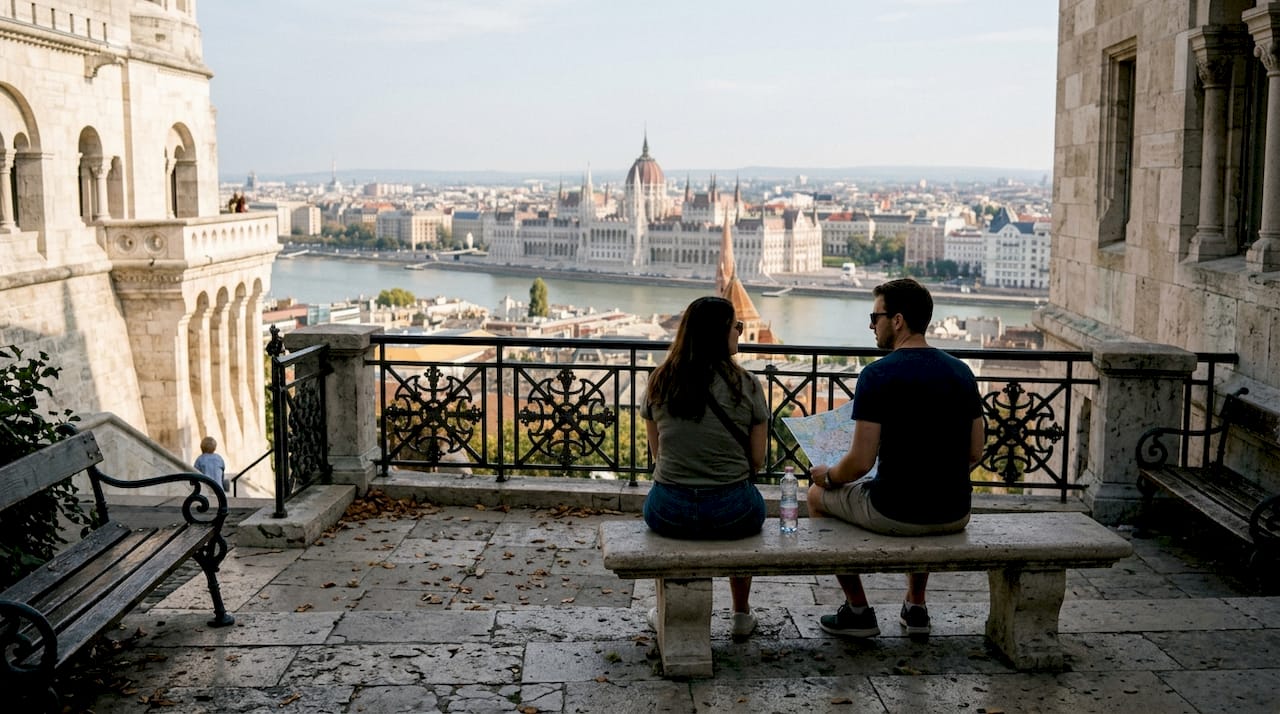
Buda Castle Quarter sits high above the river and offers some of the finest panoramic views in Central Europe. The castle complex itself has been rebuilt multiple times after sieges and wars, yet it retains a commanding presence. Matthias Church, with its geometric Zsolnay tile roof, and Fisherman’s Bastion, with its fairy-tale turrets, are two highlights within the quarter that draw visitors year-round.
Andrássy Avenue is Budapest’s answer to Paris’s Champs-Élysées. Lined with Neo-Renaissance mansions, embassies, and the Hungarian State Opera House, it connects the city center to Heroes’ Square and City Park. Walking its length gives you a strong sense of the ambition and elegance of late 19th-century Budapest. You can explore the city’s Art Nouveau heritage along streets nearby, where ornate facades and decorative ironwork reveal a city that once competed with Vienna for architectural prestige.
Key spots to prioritize on your visit:
- Fisherman’s Bastion: Best at sunrise before crowds arrive
- Hungarian Parliament Building: Most dramatic from the Pest riverbank at dusk
- Great Market Hall: Ideal for food, folk art, and local atmosphere
- Széchenyi Thermal Bath: A genuine local experience, not just a tourist attraction
- Dohány Street Synagogue: The largest in Europe and a deeply moving site
Pro Tip: For the best panoramic photos of the Parliament Building and Pest skyline, position yourself on the Buda side near Fisherman’s Bastion just after sunrise. The light is golden, the crowds are thin, and the reflection on the Danube is extraordinary.
If you want a guided introduction to these sites, exploring Budapest tour types can help you match the right experience to your interests. And for a slower, more atmospheric side of the city, the café culture of the Belle Époque era is a world unto itself.
Landmarks are just the beginning. Budapest’s cultural scene brings even more flavor to your visit.
Culture and cuisine: Experiencing Budapest beyond the postcard
Budapest’s culture is warm, proud, and sometimes wonderfully eccentric. Getting beneath the surface means eating well, staying out late in the right places, and paying attention to the small rituals that locals live by every day.
Hungarian cuisine is hearty, paprika-forward, and deeply satisfying. A few dishes you absolutely must try:
- Goulash (gulyás): A slow-cooked beef and paprika stew, best eaten in a traditional étterem (restaurant)
- Lángos: Deep-fried dough topped with sour cream and cheese, sold at market stalls
- Chimney cake (kürtőskalács): A sweet spiral pastry cooked over an open flame
- Halászlé: A spicy fisherman’s soup from the Danube region, bold and warming
- Dobos torte: A layered sponge cake with chocolate buttercream and caramel, a Budapest classic
The city’s café culture is equally essential. Budapest’s grand coffee houses, places like Gerbeaud and the New York Café, are UNESCO-recognized cultural spaces in spirit if not always by name. They were once the living rooms of writers, artists, and intellectuals, and they still carry that energy.
Nightlife in Budapest has its own identity. The ruin bar scene, centered in the 7th District, grew from abandoned buildings and courtyards repurposed into eclectic bars and cultural spaces. Szimpla Kert is the most famous, but the neighborhood holds dozens of variations. Exploring ruin bars and alternative communities in the 7th and 8th Districts gives you a window into Budapest’s creative, rebellious spirit.
The 7th District is also the heart of Jewish Budapest, a neighborhood with a rich and complex history. The Dohány Street Synagogue, the Jewish Museum, and the Emanuel Tree memorial together tell a story of community, loss, and resilience that every visitor should take time to understand.
Pro Tip: A true local haunt rarely has an English menu displayed outside. If you see a hand-written daily special board and mostly Hungarian-speaking guests inside, you have found the real thing. Ask for the napi menü (daily set menu) for the best value and most authentic meal.
A great trip depends not just on what you see and taste, but also on how you plan and navigate your Budapest adventure.
Practical tips for planning your Budapest adventure
Good planning turns a good trip into a great one. Budapest is very manageable for first-time visitors, but a few smart decisions upfront will save you time and help you see more of what matters.
-
Choose your season wisely. Spring (April to May) and early fall (September to October) offer mild weather, blooming parks, and a full calendar of cultural events without the peak summer crowds. Summer is vibrant but hot and busy. Winter brings Christmas markets and a quieter, more local atmosphere.
-
Pick your base neighborhood carefully. First-timers do well staying in District V (Inner City) or District VI (Terézváros) for central access. Return visitors often prefer District VII for its creative energy or the Buda side for a quieter, more residential feel.
-
Use public transport confidently. Budapest’s metro, tram, and bus network is efficient and affordable. The tram 2 line along the Pest riverbank is one of the most scenic urban rides in Europe. A 24-hour or 72-hour travel card gives you unlimited access and saves money instantly.
-
Walk more than you think you need to. Many of Budapest’s best discoveries happen between the landmarks, in a courtyard, a side-street bakery, or a tucked-away bookshop. The city rewards slow, attentive walking.
-
Add a riverboat journey. Daytime and evening boat tours on the Danube offer perspectives on the city that no walking route can match. The Parliament Building seen from the water at night is genuinely breathtaking.
-
Mix structured tours with free exploration. A guided experience in the morning gives you context and history. An unguided afternoon in a neighborhood gives you texture and surprise. Both are essential.
Budapest’s layered development from Roman Aquincum through modern unification means that each district has its own personality. Matching your interests to the right neighborhood is one of the most rewarding planning decisions you can make. Browse Budapest itineraries to find structured options, or consider group tours and private tours for more tailored experiences.
After covering the essentials, it is time for an honest perspective: what most travel guides miss about Budapest.
Budapest beyond the guidebook: What most travelers overlook
Most visitors to Budapest follow a well-worn path: castle, parliament, thermal bath, ruin bar. That path is well-worn for good reason. These places are genuinely extraordinary. But the city’s real depth lives in the spaces between those checkboxes.
Budapest’s UNESCO heritage status reflects a city where history is not curated into neat exhibits. It is embedded in everyday life. The woman buying bread from the same bakery her grandmother used. The chess players at Széchenyi Bath who have been meeting every Tuesday for decades. The synagogue courtyard where silence carries more meaning than any guidebook caption.
We have seen travelers rush through Budapest in two days and leave feeling they have seen it. We have also seen travelers spend a week and still feel like they have barely started. The difference is pace. Slowing down, getting genuinely lost in the 8th District or crossing to the Buda hills for an afternoon, reveals a city that is still very much alive and not performing for tourists.
Connecting with locals, even briefly, through a cooking class, a neighborhood walk, or a conversation in a café, changes the quality of what you take home. Exploring hidden Jewish heritage sites is one example of the kind of experience that stays with you long after the photos fade.
Ready for Budapest? Start your adventure with Next View Tours
Budapest is a city that rewards the curious, the patient, and the well-prepared. If this guide has sparked your interest, the next step is finding the right experience to match your travel style.

At Next View Tours, we offer a full range of adventure trip types designed for travelers who want more than a surface-level visit. From private tours tailored to your exact interests to group experiences that bring the city’s history and culture to life, our expert-led Budapest tours are built around genuine connection and lasting memory. Whether you are traveling solo, as a couple, or with family, we will help you see Budapest the way it deserves to be seen.
Frequently asked questions
What is the historical significance of Budapest’s origins?
Budapest was established in 1873 from the merger of Buda, Pest, and Óbuda, with Roman roots tracing back to Aquincum, a military settlement founded in 89 AD. This layered origin gives the city an unusually deep and varied historical character.
Which parts of Budapest are UNESCO World Heritage sites?
The Banks of the Danube, Buda Castle Quarter, and Andrássy Avenue were designated UNESCO World Heritage sites in 1987 for their outstanding architectural and historical value.
What is the best way to get around Budapest as a visitor?
Public transport, including the metro, trams, and buses, is efficient and affordable, while walking reveals hidden details between landmarks. Riverboats offer a scenic alternative for moving between parts of the city.
What food is Budapest best known for?
Budapest is celebrated for Hungarian dishes like goulash, lángos, chimney cake, and paprika-rich stews that reflect centuries of culinary tradition. The city’s grand coffee houses also serve iconic pastries like Dobos torte.
When is the best time to visit Budapest?
Spring (April to May) and early fall (September to October) offer the most balanced experience, with pleasant temperatures, lively festivals, and fewer crowds than the peak summer months.


Comments are closed