

 Uncategorized
TL;DR:
- Multi-country tours offer cultural immersion, variety, and meaningful experiences across regions.
- Proper pacing and limiting destinations enhance enjoyment and prevent burnout.
- Hybrid travel combining guided tours with independent exploration provides flexibility and depth.
Most travelers assume that visiting more countries automatically means a richer experience. The reality is more nuanced. Overloading itineraries results in more transit time than actual exploration, leaving you exhausted rather than inspired. Multi-country tours in Europe can be extraordinary, but only when they are built around depth, smart pacing, and genuine cultural immersion. This article walks you through what makes these tours work, what makes them fail, and how to find the approach that fits your travel style and ambitions.
Table of Contents
- What makes multi-country tours unique for travelers
- Top reasons to join a multi-country tour
- Common pitfalls: Why some multi-country tours disappoint
- Hybrid travel: Pairing guided tours with independent exploration
- Perspective: Why quality trumps quantity in European tours
- Ready to plan your perfect multi-country adventure?
- Frequently asked questions
Key Takeaways
| Point | Details |
|---|---|
| Plan for depth over breadth | Select fewer countries to maximize true exploration and minimize burnout. |
| Hybrid travel offers flexibility | Combine guided tours with independent time for the best of both worlds. |
| Trust curated expertise | Multi-country tours streamline logistics, enhance safety, and provide authentic experiences with knowledgeable guides. |
| Avoid itinerary overload | Overscheduling multiple countries in a short time results in transit fatigue and missed cultural moments. |
| Tailor your adventure | Look for customizable tour options to fit your interests and travel style. |
What makes multi-country tours unique for travelers
A multi-country tour is exactly what it sounds like: a structured journey that takes you through two or more countries within a single trip. What separates it from independent travel is the layer of organization that removes friction. Borders, transport, accommodations, and cultural highlights are all woven together into a coherent experience. You move through countries without the mental load of constant replanning.
Europe is the ideal setting for this kind of travel. The Schengen Area allows borderless movement across 27 member states, meaning you can wake up in Vienna, cross into Bratislava by midday, and reach Budapest by evening without a single passport check. That kind of geographic intimacy is rare anywhere else in the world.
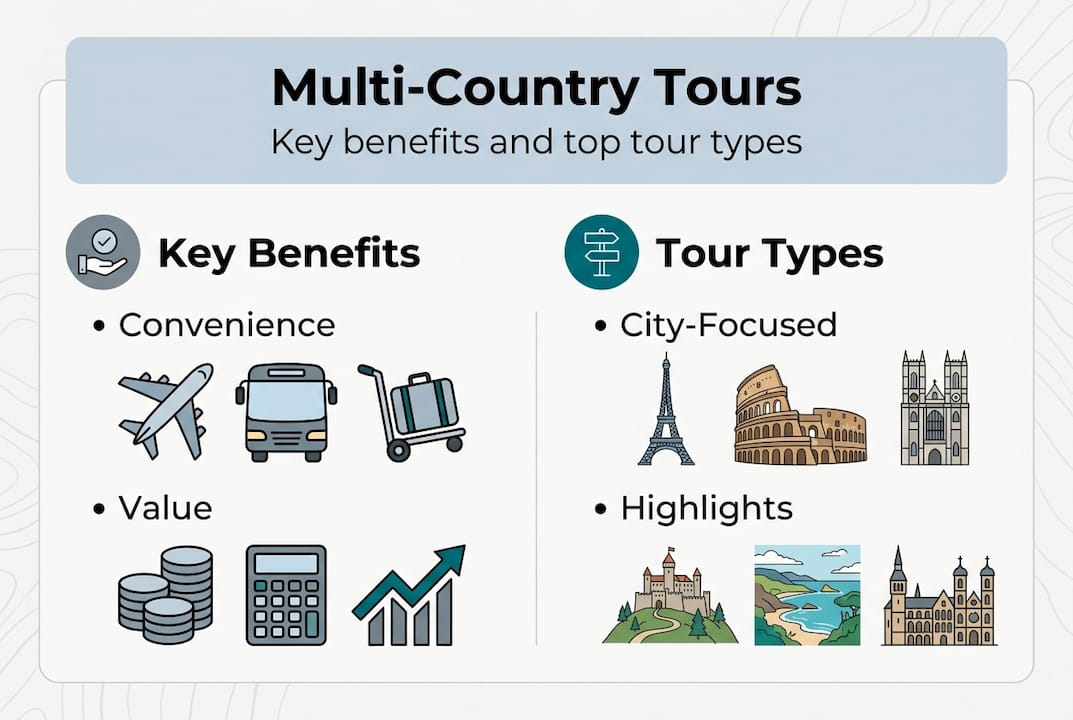
Cross-border travel is surging, with 63% of intra-European travelers planning trips that cross national borders, driven primarily by cultural diversity and value. This tells us something important: travelers are not just chasing landmarks. They want contrast, variety, and meaning packed into a single journey.
Here is what most travelers are genuinely seeking when they book a multi-country tour:
- Culinary diversity: Tasting Austrian Wiener Schnitzel, Czech trdelník, and Hungarian goulash within the same week
- Historical depth: Moving from Baroque palaces in Salzburg to Gothic cathedrals in Prague
- Natural contrast: Experiencing the Alps, the Danube, and Central European plains in sequence
- Artistic richness: Encountering distinct national art movements across different museums and galleries
- Authentic local interaction: Meeting people shaped by vastly different histories and traditions
Understanding the group tour benefits adds another dimension. Shared experiences create a social energy that solo travel rarely replicates. You process each country’s culture alongside people who are equally curious and engaged.
| Tour style | Countries covered | Avg. days | Best for |
|---|---|---|---|
| City-focused | 1 | 3-5 | Deep urban immersion |
| Regional circuit | 2-3 | 7-10 | Cultural contrast |
| Multi-country grand tour | 4-6 | 14-21 | Broad European overview |
Exploring group tour types helps you match the right format to your travel goals before you commit to a specific itinerary.
Top reasons to join a multi-country tour
Understanding what makes these tours special, let’s look at the top reasons travelers choose them for their European adventures.
The most immediate benefit is convenience. Planning a multi-country trip independently requires coordinating trains, hotels, entry requirements, and local guides across multiple destinations. A curated tour handles all of that. You show up, and the experience unfolds around you.
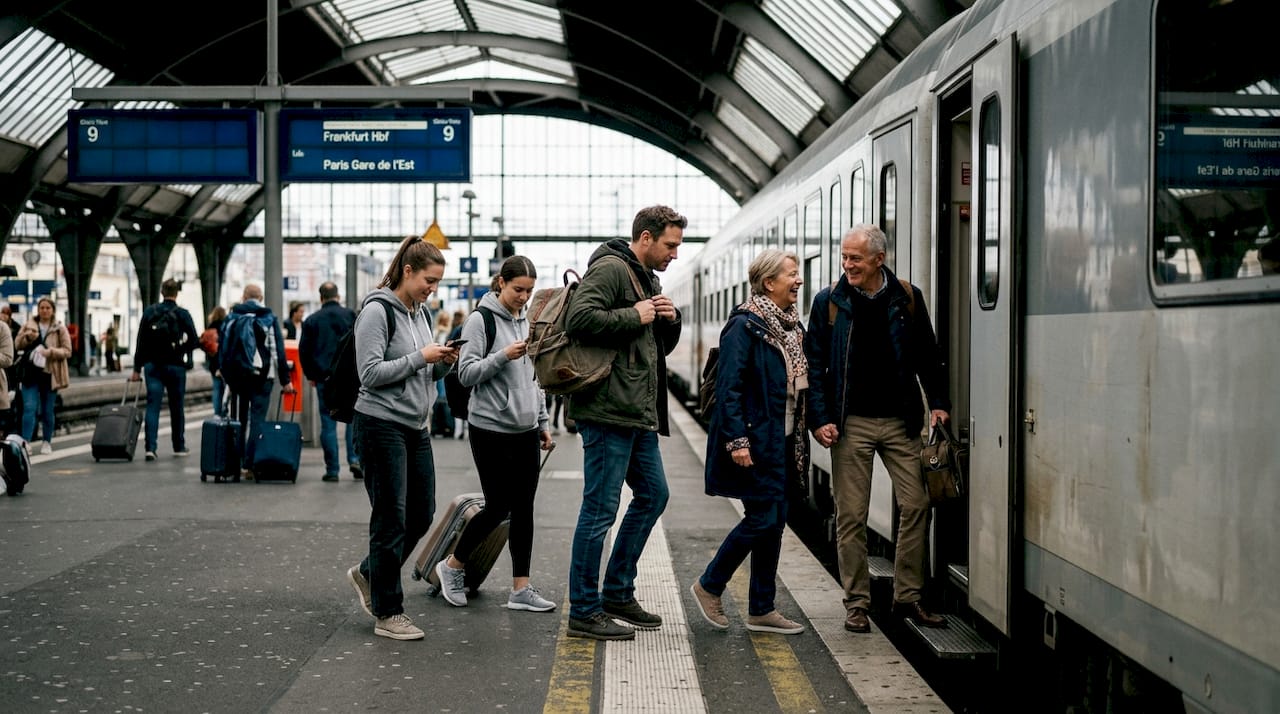
Value is another powerful draw. Bundled pricing typically covers accommodation, guided experiences, and transport between cities. When you add up the time saved and the insider access gained, the cost per experience often beats what you would pay piecing things together yourself.
Travelers consistently prioritize safety, weather predictability, and value when booking multi-country European trips. Guided tours address all three. Your expert guide knows which routes are reliable, which neighborhoods are welcoming, and how to adapt if conditions change.
Here is a quick comparison to put the choice in perspective:
| Factor | Independent travel | Guided multi-country tour |
|---|---|---|
| Planning time | High | Minimal |
| Local insider access | Limited | Strong |
| Safety support | Self-managed | Group and guide backed |
| Flexibility | Maximum | Moderate |
| Cost predictability | Variable | Fixed and transparent |
Beyond logistics, there is the value of camaraderie. Traveling with a group of like-minded people creates shared memories that deepen the experience. You are not just seeing places together; you are interpreting them together.
Key advantages travelers consistently report:
- Stress-free border crossings and transport
- Access to experiences not available to independent visitors
- Built-in social connections with fellow travelers
- Expert commentary that adds layers of meaning to every site
- Flexible extensions for those who want extra time in a destination
Pro Tip: When comparing tour providers, ask specifically about the guide-to-traveler ratio. Smaller groups with experienced guides consistently deliver richer, more personalized experiences. Understanding what multi-day tours involve before booking helps you set realistic expectations and choose wisely.
Common pitfalls: Why some multi-country tours disappoint
Even with clear advantages, it is important to recognize the hidden risks and mistakes that can turn a dream itinerary into a travel-worn blur.
The most common mistake is packing too many countries into too few days. A “10 days, 6 countries” itinerary sounds exciting on paper. In practice, it often means spending the majority of your time on trains, buses, or in transit hubs rather than absorbing the culture around you.
Overloading itineraries leads directly to cultural whiplash and burnout, two experiences that no traveler wants. Cultural whiplash happens when you move so quickly between destinations that nothing has time to settle. You end up with a blur of impressions rather than meaningful memories.
Here are the most common pitfalls to watch for:
- Too many countries, too little time: Visiting five or more countries in under ten days almost always sacrifices depth for breadth
- Ignoring transit time: A three-hour train ride sounds manageable until you factor in check-in, check-out, and arrival orientation
- Skipping rest days: Continuous sightseeing without downtime leads to physical exhaustion and emotional flatness
- Choosing tours by price alone: The cheapest option often cuts corners on guide quality, accommodation, or included experiences
- Neglecting personal interests: A tour packed with art museums is frustrating if you came for outdoor adventure
“The best European itineraries are not the longest ones. They are the ones that leave you wanting to return.”
Pro Tip: Aim for a minimum of two nights in each destination. One night barely gives you time to orient yourself. Two nights allow you to explore beyond the main square and actually feel the rhythm of a place. Learning how to organize adventure tours with proper pacing built in is one of the smartest investments you can make before booking. Reviewing seamless trip planning strategies also helps you spot red flags in an itinerary before committing.
Hybrid travel: Pairing guided tours with independent exploration
To get the best of both worlds, forward-thinking travelers have embraced a hybrid model that balances group advantages with solo exploration.
Hybrid travel means combining a structured guided tour with independent pre-tour or post-tour extensions. For example, you might join a seven-day guided tour through Austria, Slovakia, and Hungary, then spend three additional days exploring Budapest on your own terms. You get the efficiency and insider knowledge of the group experience, followed by the freedom to wander without a schedule.
Hybrid travel styles are rising in popularity among enthusiasts who want both structure and freedom, and it is easy to see why. The guided portion handles the complexity. The independent extension handles the depth.
Who benefits most from a hybrid approach?
- Solo explorers who want social connection during the main tour but personal freedom afterward
- Families who need the structure of a guided tour but also want flexible downtime for their own pace
- Adventure seekers who combine a cultural circuit with a hiking extension in the Alps or a cycling day along the Danube
- First-time European travelers who want the confidence of a guide for the unfamiliar parts and independence for the familiar ones
Stat callout: Among the 63% of travelers planning cross-border European trips, a growing share are deliberately structuring their journeys as hybrids, mixing organized tours with self-directed days in specific cities.
The practical benefits are clear. Your tour provider handles the hard logistics. You handle the personal touches. You arrive at each destination already oriented, with local knowledge from your guide, and then use your free days to go deeper into whatever resonated most.
Exploring guided tour trends for 2026 reveals that providers are increasingly building hybrid flexibility into their standard offerings. And if you are still weighing your options, comparing guided versus self-guided tours gives you a clear framework for deciding what fits your personality and travel goals.
Perspective: Why quality trumps quantity in European tours
There is a persistent myth in travel culture that a longer destination list signals a better trip. We see it in social media posts, in conversation, and in the way some itineraries are marketed. “Eight countries in twelve days” sounds impressive. But impressive to whom?
In our experience working with travelers across Europe, the people who come back most satisfied are almost never the ones who rushed through the most countries. They are the ones who spent a slow afternoon in a Viennese coffee house, who got lost in the backstreets of Prague, who watched the sun set over the Danube from a quiet bench in Budapest.
Depth creates memory. Speed creates fatigue.
The travelers who find the most meaning in their journeys are those who resist the fear of missing out and instead lean into fewer, well-chosen destinations. Understanding the advantages of customized tours is often the turning point. When your itinerary reflects your actual interests rather than a generic checklist, every day feels purposeful rather than pressured.
Wise pacing is not a compromise. It is the strategy that turns a good trip into an unforgettable one.
Ready to plan your perfect multi-country adventure?
If the ideas in this article have sparked something in you, the next step is exploring what a well-crafted multi-country tour actually looks like in practice. At Next View Tours, we design experiences across Austria, Czech Republic, Hungary, Slovakia, and beyond with exactly this balance in mind: enough structure to keep things seamless, enough flexibility to keep things personal.
Browse our full range of trip types to find the format that matches your travel style. Whether you want a fully guided group experience or something more tailored, our customized tour options let you shape the journey around what matters most to you. For inspiration, explore our multi-day trip examples and see how real itineraries come together across Europe’s most rewarding destinations.
Frequently asked questions
How many countries should I include in a European tour?
For a 10 to 14 day trip, focusing on 2 to 4 countries gives you enough variety without sacrificing depth. Overloading your itinerary consistently leads to more transit time and less meaningful exploration.
Is it safe to join multi-country tours in Europe?
Yes, guided multi-country tours are generally very safe. Travelers prioritize safety when booking these trips, and experienced guides provide local knowledge, vetted routes, and group security throughout the journey.
Can I customize my itinerary on a multi-country tour?
Many providers offer flexible extensions and personalized options. Hybrid tour formats combining guided group travel with independent days are increasingly standard and allow meaningful personalization.
What is the best way to avoid burnout during a multi-country trip?
Allow at least two nights per destination and resist the urge to cram in extra countries. Fitting too many countries into a short window is the leading cause of cultural fatigue and traveler burnout.
Are multi-country tours a good value for money?
Absolutely. Bundled accommodation, curated activities, and pre-arranged transport make these tours highly cost-effective. Travelers seeking value consistently find that guided multi-country tours outperform the cost and effort of independent planning.
Recommended
- Trend in Europe Tours 2025: Immersive, Sustainable, Social – Next View Tours
- Why book family tours for Europe trips in 2026 – Next View Tours
- Why Travel Europe in 2025: Adventure, Culture, Customization – Next View Tours
- Why Indonesian Families Consider European Summer Options | Young Explorers Club Switzerland


Comments are closed