

 Uncategorized
TL;DR:
- A travel itinerary is a structured schedule that sequences your travel dates, bookings, activities, and logistics for an efficient trip. Locking fixed anchors first and grouping activities geographically help create a flexible, realistic plan that minimizes transit time and stress. Including buffer time and limiting daily activities ensures you can adapt to unexpected delays and enjoy spontaneous discoveries.
A step by step travel itinerary is a structured schedule that sequences your travel dates, bookings, activities, and logistics to maximize your trip’s enjoyment and efficiency. Think of it as the backbone of your entire travel experience. Without one, you risk wasted hours, missed reservations, and the creeping stress of deciding everything on the fly. The good news: building a detailed travel itinerary is a learnable skill, and this guide walks you through every stage, from locking your travel frame to choosing the right tools, so you arrive at each destination ready to explore rather than scramble.
What are the essential elements of a step by step travel itinerary?
A solid trip itinerary starts with what travel planners call the “frame,” and locking this frame first creates the structure from which all other planning flows. Your frame includes four non-negotiable elements: travel dates, destination or destinations, party size, and total budget. Get these confirmed before you touch a single activity or restaurant.
Here is what to gather before you open any planning tool:
- Travel dates: Confirm exact departure and return dates, including any flexibility windows.
- Destinations: List every city or region you plan to visit, in order.
- Party size and composition: Traveling with children, elderly relatives, or first-time international travelers changes everything from pace to activity selection.
- Budget breakdown: Separate your budget into flights, accommodation, food, activities, and a contingency reserve.
- Trip goals: Are you prioritizing culture, food, adventure, or rest? Knowing this shapes every decision that follows.
Once you have these details, estimate your usable travel days. A seven-night trip rarely gives you seven full days of activity. Subtract arrival day, departure day, and any travel days between cities. What remains is your real planning canvas.
Pro Tip: Keep all your foundational trip details in a single shared Google Sheet or Notion page. Every update happens in one place, and your travel companions always see the current version without a single email thread.

For group trips, the group travel planning workflow at Nextviewtours offers a structured approach to managing multiple preferences without losing your mind.
How do you book fixed anchors and organize activities by geography?
Fixed anchors are the time-bound commitments that cannot move: flights, accommodation check-ins, timed museum entries, guided tours, and restaurant reservations. Booking these first gives your itinerary its skeleton and prevents scheduling conflicts that unravel everything else.
Follow this sequence when booking:
- Book flights and intercity transport. These set your arrival and departure times, which determine everything else.
- Book accommodation. Confirm check-in and check-out times. These are hard boundaries.
- Reserve timed headline experiences. Tickets to the Schönbrunn Palace in Vienna, the Alhambra in Granada, or the Colosseum in Rome sell out weeks in advance. Lock these early.
- Reserve key restaurants. Dinner at a popular spot in Prague or Budapest requires advance booking, especially in peak season.
- Add guided tours. If you are booking a private tour through Nextviewtours, confirm the meeting point and start time and treat it as a fixed anchor.
Once your anchors are in place, group activities geographically each day. Clustering by neighborhood rather than by interest type saves hours and reduces fatigue. Visiting the Jewish Quarter and the Old Town Square in Prague on the same morning makes far more sense than crossing the city twice.
| Approach | What It Looks Like | Result |
|---|---|---|
| Interest-based grouping | Museums on Monday, food tours on Tuesday regardless of location | Excessive transit, wasted time |
| Geography-based grouping | All morning stops within walking distance of each other | Efficient, relaxed, more enjoyable |
Limit each day to roughly two anchored activities plus flexible time. Overly packed days cause the itinerary to collapse early in the trip. Two solid anchors per day leave room for the unexpected: a street market you stumble upon, a café that deserves an extra hour, or simply the need to sit and absorb where you are.
Pro Tip: Open Google Maps and drop pins for every location you plan to visit in a given city. Group the pins by day. If your day’s pins are scattered across the map, reorganize until they form a logical geographic cluster.
How do you build a realistic daily schedule with buffer time?
Buffer time is the most underestimated element in any trip planning guide. Traffic, security lines, and local delays silently consume several hours on travel days. Buffer time is not wasted time. It is the elasticity that keeps your schedule from snapping under pressure.
A realistic daily schedule follows these principles:
- Arrival and departure days are half-days. A flight arriving at 2pm realistically allows only one low-effort activity that day. Plan accordingly. Use arrival evenings for a neighborhood walk or a casual dinner, not a timed museum visit.
- Build in 3–5 hours of buffer per day. This sounds like a lot until you factor in a 45-minute queue at a popular attraction, a delayed train between Salzburg and Vienna, or a lunch that stretches pleasantly into the afternoon.
- Separate confirmed, preferred, and backup options. Separating these three categories prevents daily collapse if an activity closes unexpectedly or needs rescheduling. Your confirmed anchors are fixed. Your preferred activities fill the gaps. Your backup options activate when something falls through.
- Front-load your must-see experiences. Place your highest-priority activities in the first half of the trip. Fatigue and weather are unpredictable. You want your non-negotiables done before either becomes a factor.
- Allocate 3–5 main activities per day, not more. This is the ceiling, not the floor. Some of your best travel memories will come from unplanned moments that only happen when you leave space for them.
“A successful itinerary balances structure with flexibility, allowing you to know what’s next while enabling spontaneous discoveries. Too rigid or too loose a plan reduces trip satisfaction and increases stress.”
Think of buffer time as a pressure valve. When everything runs on schedule, you use it to linger somewhere beautiful. When things go sideways, you use it to recover without panic.
What tools and templates help you create and customize your itinerary?
The right tool does not plan your trip for you. It holds your plan together so you can focus on the experience. A practical itinerary template includes day-by-day overviews with 3–5 main activities and separate logistics and reference sections. This structure prevents minute-by-minute scheduling while keeping operational details accessible.
Here is what every strong itinerary document should include:
| Field | Why It Matters |
|---|---|
| Activity name and address | Eliminates searching on the day |
| Confirmation codes | Speeds up check-in at hotels and tours |
| Opening hours | Prevents arriving at a closed attraction |
| Estimated cost | Keeps spending on track |
| Transit notes | Clarifies how to get from point A to point B |
| Emergency contacts | Provides backup when things go wrong |
Effective itinerary documents reduce decision load on the trip by consolidating all operational details in one place. Google Sheets works well for collaborative trips because multiple people can view and edit in real time. Google Docs suits travelers who prefer a narrative format. Specialized apps like TripIt and Wanderlog automatically parse confirmation emails and organize bookings into a timeline.
AI-based travel planners, including tools built into Google Search’s AI Mode, create personalized base itineraries that you then refine with your own preferences. Use AI output as a starting draft, not a finished plan. The AI does not know that you prefer walking to taxis, hate early mornings, or have a child who needs a nap at noon.
For travelers who want to learn how to customize travel itineraries from scratch, Nextviewtours has published a practical guide covering flexible structures for diverse trip styles.
Pro Tip: Create a separate reference tab or page in your itinerary document for static information: visa requirements, local emergency numbers, currency exchange rates, and neighborhood maps. Keeping this separate from your daily schedule reduces clutter and speeds up on-the-ground decisions.
What are the most common itinerary planning mistakes?
Most itinerary problems are predictable. Recognizing them before you depart is far easier than fixing them mid-trip.
- Overscheduling every hour. Treating your itinerary like a corporate calendar is the fastest way to exhaust yourself. Leave white space. Unscheduled time is not a planning failure.
- Ignoring transit time between activities. Walking from the Belvedere to the Vienna State Opera takes 20 minutes on a good day. Add crowds, a wrong turn, and a coffee stop, and you are looking at 40 minutes. Always check transit times on Google Maps using the actual travel date and time.
- Failing to separate confirmed from flexible activities. When everything on your list feels equally important, nothing has priority. Categorize ruthlessly: confirmed anchors, preferred additions, and backup options.
- Treating arrival and departure days as full days. This is one of the most common mistakes first-time international travelers make. A morning flight home means your last evening is your last real opportunity. Plan it intentionally.
- Skipping document and health preparation. A great itinerary means nothing if your travel insurance is inadequate, your passport expires in less than six months, or you forgot to check visa requirements for Slovakia or the Czech Republic. Add a document checklist to your planning process as a distinct step.
- Never revisiting the itinerary after the first draft. Circumstances change. A new restaurant opens, a museum closes for renovation, or a travel companion changes their mind. Build in a review session two weeks before departure to update and confirm everything.
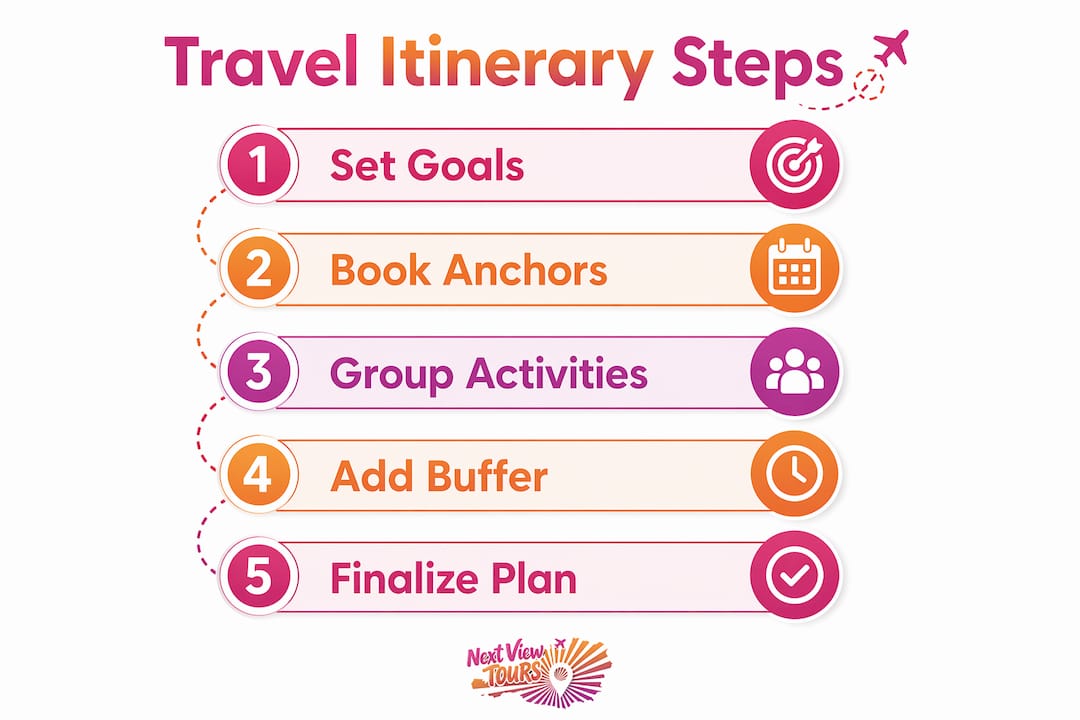
The stepwise planning sequence that moves from goals through bookings, daily activities, transport, documents, and final confirmations is the most reliable way to catch these errors before they cost you time or money.
Key takeaways
A well-built trip itinerary succeeds because it locks fixed anchors first, groups activities geographically, and treats buffer time as a structural requirement rather than an afterthought.
| Point | Details |
|---|---|
| Lock the frame first | Confirm travel dates, destinations, party size, and budget before planning any activities. |
| Book anchors before activities | Flights, accommodation, and timed tours set the skeleton that all other plans attach to. |
| Group activities geographically | Clustering stops by neighborhood saves hours and reduces transit fatigue each day. |
| Cap daily commitments | Limit each day to two anchored activities plus flexible time to prevent schedule collapse. |
| Build in buffer time | Reserve 3–5 hours of buffer daily to absorb delays and keep the itinerary resilient. |
What i have learned from planning hundreds of european itineraries
The most common mistake I see travelers make is confusing a detailed itinerary with a rigid one. These are not the same thing. A detailed plan tells you exactly where you are going and how you are getting there. A rigid plan refuses to adapt when reality intervenes. The goal is the former.
I have found that the travelers who enjoy their trips most are the ones who plan thoroughly and then hold their plans loosely. They know their confirmed anchors cold. They have their backup options ready. And when something unexpected happens, they treat it as part of the experience rather than a failure of planning.
Buffer time changed how I build every itinerary. I used to see it as wasted capacity. Now I see it as the feature that makes everything else work. The afternoons I have spent wandering through a neighborhood I had not planned to visit, simply because the morning wrapped up early, have produced some of my most vivid travel memories.
One more thing: generic itineraries pulled from travel blogs are starting points, not finished products. Your trip is shaped by your pace, your interests, and your travel companions. Use templates and AI drafts to get 60% of the way there, then customize your private tour or daily plan to reflect what actually matters to you.
— Next
Plan your next european trip with Nextviewtours

Nextviewtours specializes in exactly the kind of travel experiences that make a well-built itinerary come alive. Whether you are planning a private day trip from Vienna, a multi-day adventure through Austria and the Czech Republic, or a customized family tour across Central Europe, Nextviewtours offers pre-designed and fully flexible options to match your schedule. Browse the full range of trip types and experiences to find tours that slot directly into your itinerary as confirmed anchors. For travelers who want curated inspiration, the top multi-day trip examples across Europe give you a ready-made framework you can build around or book outright.
FAQ
What is a step by step travel itinerary?
A step by step travel itinerary is a structured, sequential plan that organizes your travel dates, bookings, daily activities, and logistics into a clear schedule. It works by locking fixed anchors first, then filling in activities around them in a logical geographic and time-based order.
How many activities should you plan per day?
Plan 3–5 main activities per day, with no more than two of those being fixed, timed anchors. This cap prevents overscheduling and leaves room for transit, meals, and spontaneous discoveries.
How much buffer time should a travel itinerary include?
Include 3–5 hours of buffer time per day to absorb delays from transport, queues, and weather. Buffer time keeps your schedule flexible without requiring you to abandon your plan.
What tools work best for building a travel itinerary?
Google Sheets and Google Docs work well for collaborative planning. Apps like TripIt and Wanderlog parse confirmation emails automatically. AI planners generate useful base drafts that you then refine with your personal preferences and trip-specific details.
How do you handle arrival and departure days in an itinerary?
Treat arrival and departure days as half-days. A flight arriving at 2pm realistically supports one low-effort activity. Plan these days with lighter schedules and use them for neighborhood orientation, rest, or a relaxed meal rather than timed attractions.


Comments are closed