 Uncategorized
TL;DR:
- Expert guides enhance travel by transforming experiences into participatory, culturally rich encounters that apps cannot replicate. They support local economies by increasing visitor spending and promote environmental stewardship through responsible management. Choosing qualified, adaptable guides ensures deeper engagement, safety, and lasting connections with the destinations visited.
Most travelers believe a good map and a few saved articles are enough to experience a destination fully. They are not. The importance of expert guides goes far beyond pointing out landmarks or reciting historical dates. A skilled local guide transforms you from a spectator into a genuine participant, unlocking the social, cultural, and environmental layers that no app can replicate. Whether you are trekking through the Austrian Alps, wandering the streets of Prague, or standing before a medieval castle in Slovakia, an expert guide shapes what you see, what you understand, and what you carry home.
Table of Contents
- Key takeaways
- Importance of expert guides: the economic case
- Social and cultural depth that only guides provide
- How guides protect the places you love to visit
- How to find and vet a trustworthy expert guide
- Expert-guided vs. self-guided vs. group tours
- My take on what guides actually change
- Discover expert-led tours with Nextviewtours
- FAQ
Key takeaways
| Point | Details |
|---|---|
| Guides increase traveler spending | Guided travelers spend roughly 20% more per trip, supporting stronger local economies. |
| Cultural depth is guide-dependent | Expert guides move you from observer to participant by translating place into lived context. |
| Sustainability starts with guidance | Guides reduce ecological damage by directing visitor behavior and teaching conservation values. |
| Vetting quality matters more than credentials | Tailored knowledge and adaptability are stronger quality signals than certifications alone. |
| Guides benefit communities directly | Structured guide programs create jobs and improve well-being for hundreds of residents. |
Importance of expert guides: the economic case
When you book an expert-guided tour, your spending does not just benefit you. It ripples outward into the entire destination economy. Guided visitors spend about 20% more per trip ($1,020 vs. $826) than non-guided travelers, according to data from Oregon’s tourism sector. That difference compounds quickly when you multiply it across thousands of annual visitors.
Here is what that spending increase actually looks like on the ground:
- Local restaurants and markets receive more foot traffic when guides recommend them over generic tourist traps
- Artisan workshops and cultural venues gain visibility and revenue because guides bring context that turns a passing glance into a genuine purchase
- Transportation and accommodation providers in smaller towns benefit when guides route travelers beyond city centers
- Public infrastructure and conservation funds receive more support through fees and taxes generated by higher visitor spending
The numbers also tell a compelling story about employment. Guides integrate economic, social, and environmental goals in ways that multiply community benefit far beyond what the tourism sector typically achieves on its own.
| Travel Style | Average Spend per Trip | Community Economic Impact |
|---|---|---|
| Self-guided | $826 | Moderate, concentrated in mainstream venues |
| Expert-guided | $1,020 | Higher, distributed across local businesses |
| Group tours (large) | Variable | Mixed, often routed to partner vendors |
The value of professional guides, viewed through an economic lens, is not abstract. It is measurable, repeatable, and supported by real spending data across multiple destinations.
Social and cultural depth that only guides provide
No translation app teaches you why a community celebrates the way it does. No travel blog explains the unspoken rules around a sacred site. That is the territory where expert local guides become genuinely irreplaceable. Guides serve as vital cultural ambassadors, helping travelers cross language and social barriers that would otherwise make meaningful connection impossible.
The professional guidance benefits here are both personal and communal:
- Language fluency in context means your guide does not just translate words but also interprets tone, humor, and etiquette
- Community relationships built over years of guiding give you access to local families, craftspeople, and storytellers who do not appear on any website
- Safety and authenticity improve when guides come from structured programs with trained community members
- Local businesses receive direct support when guides recommend them by name, rather than sending visitors to chain establishments
A striking example of this comes from community-based tourism in Jaflong, where a training program created 50 direct jobs benefiting over 1,200 residents. That kind of impact does not happen when travelers navigate alone. It happens when professional guidance benefits flow through organized, community-rooted programs.
Durable community benefits require guide programs that prioritize skill development and employment quality. Simply creating guide jobs is not enough. When those jobs come with ongoing training, local guides become more effective cultural connectors, and travelers receive richer, more honest experiences.

Pro Tip: Ask your guide to recommend a family-owned restaurant or a local artisan before your tour ends. That single question often leads to the most memorable part of your trip.
How guides protect the places you love to visit
There is a quiet paradox at the heart of modern travel. The more people visit a beautiful place, the more they risk damaging it. Expert guides are one of the most effective tools for breaking that cycle. When you travel with a knowledgeable guide, you are not just gaining insight. You are actively contributing to the preservation of the destination itself.
Here is how that environmental stewardship works in practice:
- Site selection and crowd management. Guides direct groups to appropriate locations, away from fragile ecosystems or over-visited spots, reducing erosion and habitat disruption.
- Conservation education. A skilled guide explains why certain behaviors matter, not just what the rules are. That distinction turns compliance into genuine understanding.
- Cultural stewardship values. In places like Hawaiʻi, guides teach the concept of mālama, a Hawaiian value meaning to care for and protect the land and people, which shapes how visitors behave long after they leave.
- Sustainable fee structures. Many guided programs channel green fees and entrance contributions directly into conservation funds that maintain the destinations travelers love.
- Behavior modeling. Guides demonstrate how to move through sensitive environments, and travelers naturally follow that example.
“Professional guides reduce tourism’s ecological footprint by managing visitor behavior, educating on conservation, and embedding stewardship values that outlast the trip itself.” — National Extension Tourism Network
Understanding this connection between expert guidance and environmental health is part of what makes experiential travel so rewarding. When you choose a responsible guide, your presence in a destination becomes part of its protection rather than a threat to it.
How to find and vet a trustworthy expert guide
The expert guide advantages you read about only materialize if you choose the right person. The market for guides is not uniformly regulated, and the difference between a mediocre guide and a great one shapes your entire trip. Knowing how to evaluate your options before you book is one of the most practical skills a traveler can develop.
Quality guides are better judged by their ability to tailor experiences and demonstrate local knowledge than by credentials alone. That said, credentials still matter as a starting filter. Here is what to look for:
- Specialization over generalism. A guide who specializes in medieval history, alpine ecology, or culinary traditions will always outperform a generalist covering the same ground. Ask specifically what they know best.
- Languages spoken and cultural fluency. Multilingual guides in destinations like Prague or Budapest open doors that language-barrier moments would otherwise close.
- Years of active experience in the region. Institutional knowledge of a place accumulates over seasons, not just trips. Ask how long they have been guiding in that specific area.
- Referrals from travel advisors or local tourism boards. Peer-validated recommendations carry far more weight than online reviews, which can be manipulated.
- Affiliations with recognized programs. Look for ties to national tourism associations, UNESCO-recognized programs, or community-based tourism networks.
- Willingness to adapt. The best guides adjust the plan when conditions change, not guides who rigidly follow a script. Ask how they handle unexpected situations.
Pro Tip: During your first conversation with a potential guide, ask them to describe one moment when they had to change their plan mid-tour. The quality of that answer tells you more than any certificate.
Vetting your guide through trusted sources significantly reduces the risk of a generic, uninspiring experience. The role of guides in success on any adventure trip depends almost entirely on their preparation and their passion for the specific place.
Expert-guided vs. self-guided vs. group tours
Choosing how to travel is not just a logistical decision. It determines the depth of your experience. Each format has its place, but understanding the trade-offs helps you make a smarter choice.
| Travel Format | Cultural Depth | Personalization | Safety Management | Sustainability Impact |
|---|---|---|---|---|
| Self-guided | Surface level | Full control | Traveler-managed | Unmanaged |
| Large group tours | Moderate | Very limited | Partially managed | Mixed |
| Expert-guided (private) | Deep and contextual | High | Expertly managed | High |
| Expert-guided (small group) | Deep | Moderate | Expertly managed | High |
Self-guided travel gives you freedom, but it frequently produces surface-level experiences. Without local context, you photograph what everyone else photographs and miss what makes a place genuinely distinctive. Language misunderstandings, cultural missteps, and missed entry opportunities are common outcomes.
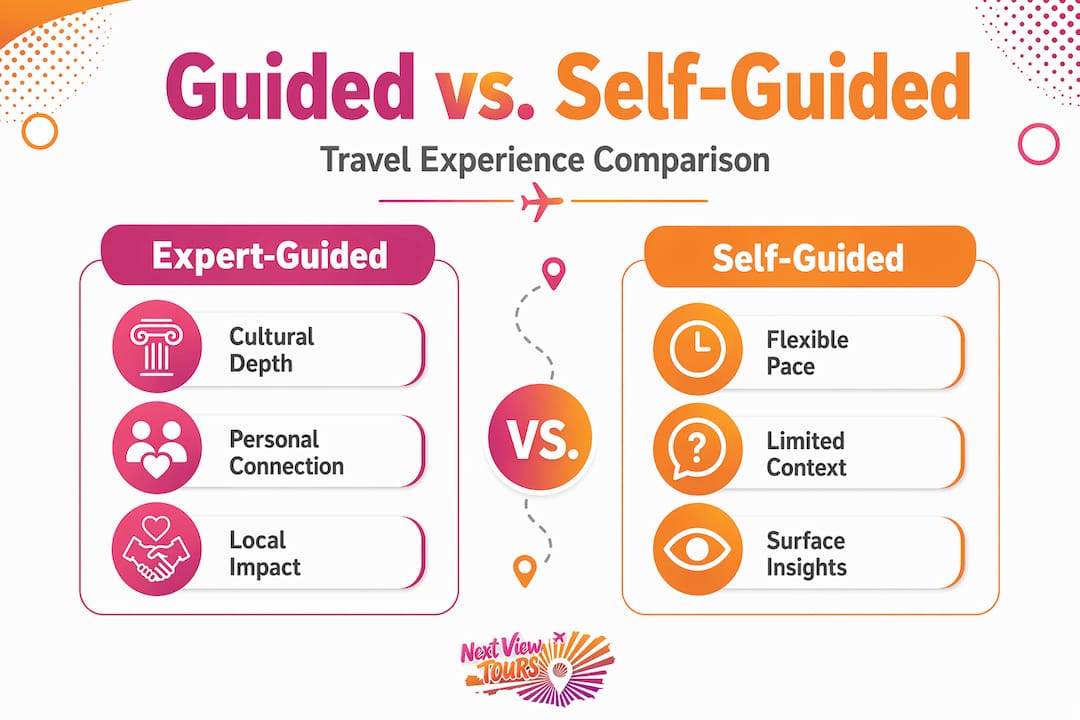
Large group tours solve the logistics problem but often sacrifice the intimacy that makes travel meaningful. When your guide is managing 30 people, your questions get lost in the crowd. Expert guides working in private or small-group formats find the balance between local knowledge, personal flexibility, and safety management. They adapt to your pace, your curiosity, and your comfort level in ways that no standardized itinerary can.
My take on what guides actually change
I have spent years working with travelers across Europe, from day trips out of Vienna to multi-day adventures through the Czech Republic and Slovakia. What I have learned is that most people who skip a guide do not realize what they missed until they travel with one.
The difference is not just information. It is timing and trust. A great guide knows when to stop talking and let a cathedral’s silence do the work. They know which local to introduce you to, and when. They see the rain coming before you do and already have an alternative planned. Adventure travelers gain especially from guides who manage safety decisions in real time, freeing travelers to be fully present in the experience rather than managing risk.
What I find most compelling about the role of guides in success is this: a good guide does not just show you a place. They change how you travel everywhere after that. You start noticing what you used to walk past. You start asking the questions you used to skip. That shift in how you engage with the world is the most lasting thing any guide ever gives you. At Nextviewtours, we have seen this transformation happen again and again, and it never gets old.
— Next
Discover expert-led tours with Nextviewtours
If this article has shifted how you think about the value of traveling with a guide, the next step is finding the right experience for your next adventure.
At Nextviewtours, every tour across Austria, the Czech Republic, Hungary, Slovakia, and beyond is designed around expert local guides who bring cultural depth, personal warmth, and genuine knowledge to each itinerary. Whether you want to explore multiple tour styles that match your interests, or you prefer the flexibility of a private guided experience shaped entirely around you, Nextviewtours has the right format. You can also explore customized tour options that let expert guides design your itinerary from scratch. Your destination deserves more than a quick scroll. It deserves a guide who truly knows it.
FAQ
What is the importance of expert guides in travel?
Expert guides transform travel from observation into participation by providing cultural context, language support, and local knowledge that no app or guidebook can replicate. They also increase traveler spending, support local economies, and reduce environmental impact.
How do expert guides benefit local communities?
Structured guide programs create direct employment and distribute visitor spending more broadly across local businesses. A community-based program in Jaflong, for example, created 50 guide jobs that benefited over 1,200 residents.
How do I verify a guide’s quality before booking?
Ask about their regional specialization, years of experience, and how they handle unexpected changes during a tour. Referrals from travel advisors and affiliations with recognized tourism organizations are stronger quality signals than online reviews alone.
Are expert guides worth the extra cost?
Yes. Guided travelers spend about 20% more per trip than non-guided travelers, but they also report deeper cultural experiences, fewer logistical frustrations, and greater overall satisfaction. The return on that investment is both experiential and practical.
When does self-guided travel make more sense than hiring an expert?
Self-guided travel works well for repeat visitors who already have deep familiarity with a destination and its language. For first-time visits, culturally complex locations, or adventure trips requiring safety management, an expert guide consistently delivers a richer, safer experience.


Comments are closed