
 Uncategorized
TL;DR:
- Cross-country touring involves long-distance, self-supported travel across diverse terrains using modes like bicycles, motorcycles, or skis. It emphasizes endurance, preparation, and immersion, offering physical and cultural benefits while presenting logistical and weather challenges. Starting with supported tours and thorough planning enhances the experience, with iconic routes across Europe showcasing its rich diversity.
Cross-country touring is one of travel’s most misunderstood terms. Many people hear it and think immediately of ski slopes or a casual drive to a neighboring state. But what is cross-country touring in its fullest sense? It refers to extended, self-supported travel across wide geographies, and it spans multiple modes including bicycle, motorcycle, and ski. Whether you are dreaming of pedaling through Central Europe, riding a motorcycle across mountain passes, or gliding through a winter backcountry, this guide covers every angle: how each mode works, how to prepare, where to go, and why it matters.
Table of Contents
- Key Takeaways
- What cross-country touring really means
- Comparing touring types: bicycle, motorcycle, and ski
- Planning and preparation for cross-country touring
- Popular routes and cross-country adventure destinations
- Benefits and challenges of long-distance touring
- My honest take on cross-country touring
- Explore touring adventures with Nextviewtours
- FAQ
Key Takeaways
| Point | Details |
|---|---|
| More than one activity | Cross-country touring covers bicycle, motorcycle, and ski travel over long distances. |
| Gear is purpose-built | Each touring mode uses specialized equipment designed for endurance, load carrying, and weather protection. |
| Planning support matters | Choosing between self-supported and guided touring shapes your gear load, pacing, and overall experience. |
| Route options are rich | From the Danube Cycle Path to alpine ski trails, iconic routes exist for every touring style. |
| Benefits go beyond distance | Long-distance touring builds physical endurance, mental resilience, and cultural appreciation simultaneously. |
What cross-country touring really means
At its core, cross-country touring is a travel philosophy built around distance, self-reliance, and immersion in a place. The standard industry term for this broader category is long-distance touring, and the two phrases are often used interchangeably by experienced travelers. What separates it from a weekend trip or recreational outing is the combination of scale and intention. You are not just passing through. You are making the route itself the experience.
Touring bicycles are designed specifically for multi-day, load-carrying travel, and that design philosophy tells you everything about what long-distance touring demands. Durability. Comfort over speed. The ability to carry what you need without falling apart on day four.
Cross-country touring also gets confused with cross-country skiing, which is understandable. Travelers often conflate these terms, missing the much broader travel and modality context that “cross-country touring” actually covers. Skiing is one expression of it. Cycling and motorcycle travel are others. All three share the emphasis on endurance and self-sufficiency, but the gear, terrain, and experience differ considerably.
Pro Tip: Think of cross-country touring as a spectrum of travel intensity. You can tour lightly with supported accommodations or go fully self-contained. Both count. What matters is the long-distance, exploratory intent.
Here is what defines any form of long-distance touring:
- Load carrying: Your gear travels with you, either on racks, panniers, luggage cases, or a pack.
- Weather protection: Touring-specific equipment accounts for exposure across changing conditions.
- Endurance focus: Daily distances are planned around sustained effort, not maximum speed.
- Geographic scope: You cover meaningful ground, often crossing regions, countries, or mountain ranges.
Understanding these core features helps you make smarter choices when planning your own cross-country adventure.
Comparing touring types: bicycle, motorcycle, and ski
Each touring modality has its own culture, gear requirements, and terrain preferences. Here is a direct comparison to help you understand the differences.
| Touring type | Typical range per day | Key gear features | Best terrain |
|---|---|---|---|
| Bicycle | 60 to 120 km | Racks, panniers, relaxed geometry | Paved cycle paths, gravel roads |
| Motorcycle | 300 to 600 km | Windshield, large fuel tank, hard luggage | Highways, mountain passes, off-road |
| Ski touring | 10 to 30 km | Skins, backcountry skis, beacon | Groomed trails, open snowfields |
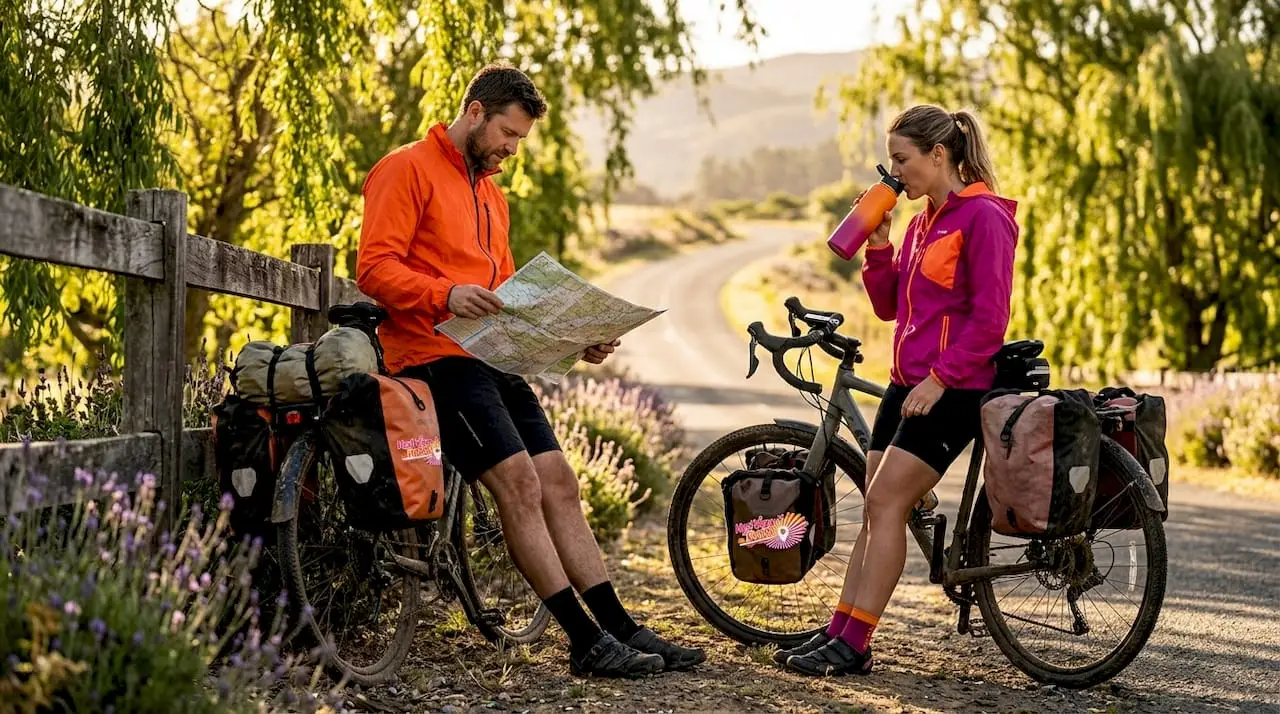
Bicycle touring is arguably the most accessible form of long-distance touring. Bicycle touring is about making the journey the destination, carrying everything you need for multi-day rides and embracing freedom over speed. A dedicated touring bike features a relaxed riding geometry, a durable steel or chromoly frame, and multiple mount points for racks and panniers. It is heavier than a road or gravel bike by design.
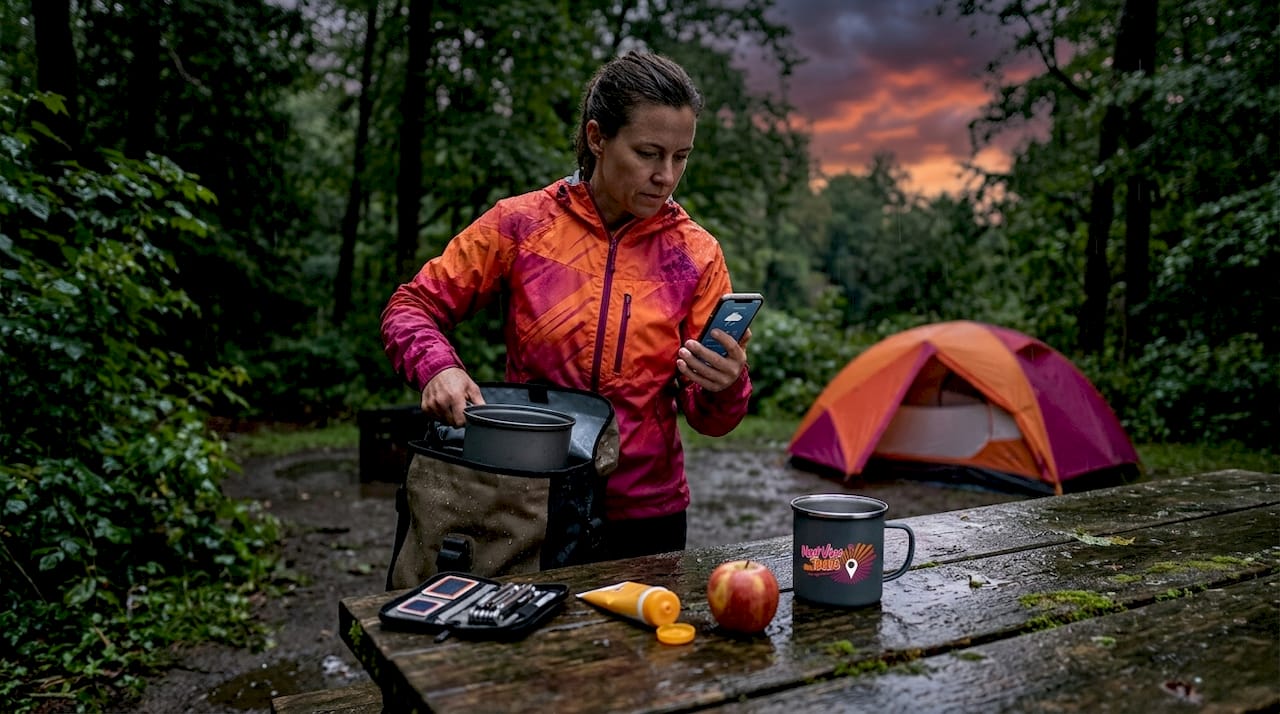
There is also a meaningful distinction between bike touring and bikepacking. Bike touring prioritizes comfort and carrying capacity, while bikepacking leans toward lightweight, rugged setups for technical terrain. If you want to stay at guesthouses along the Danube, bike touring is your style. If you want to camp in a forest midway through a mountain traverse, bikepacking gets closer.
Motorcycle touring operates at a completely different scale. Touring motorcycles are purpose-built for long-range comfort, featuring windshields, large fuel capacities, and relaxed seating. Models designed specifically for this purpose integrate hard luggage into the frame and offer exceptional weather protection. Adventure touring motorcycles push further, combining on-road performance with off-road capability through features like skid plates and knobby tires. Think of bikes like the BMW R1200GS, which can carry you comfortably from Vienna to the Croatian coast and then pivot onto a mountain forest track.
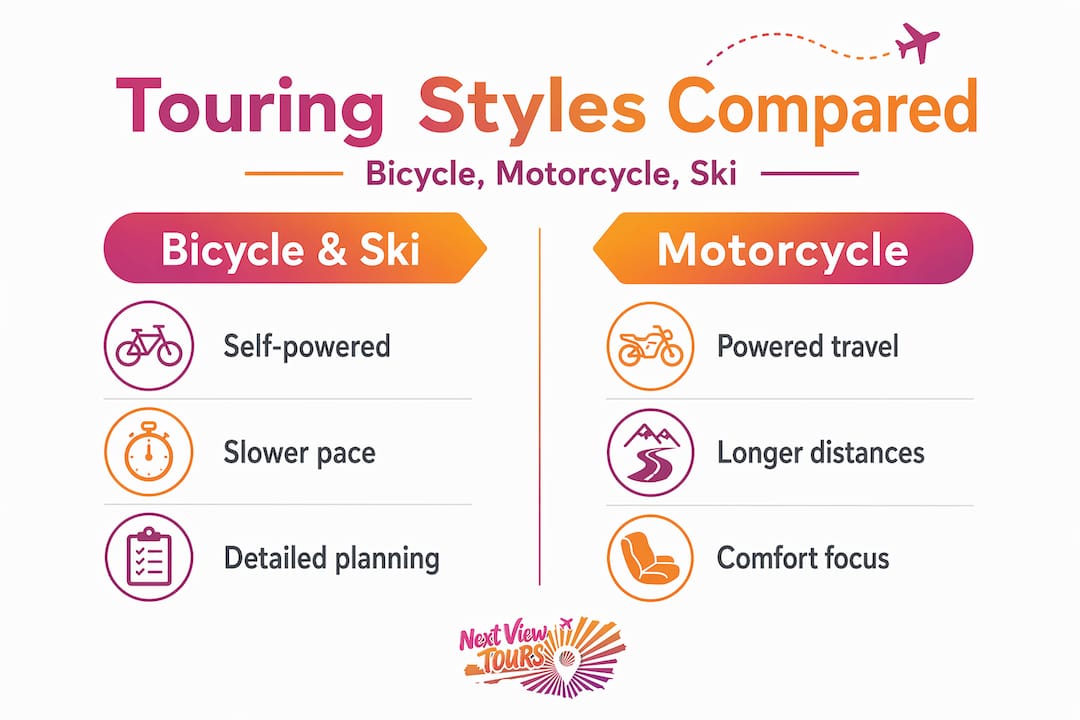
Ski touring brings the long-distance mindset to winter terrain. It differs from resort skiing in a fundamental way: you earn your descents by climbing first. Cross-country skiing provides significant cardiovascular benefits and a full-body workout, and its touring variants range from groomed Nordic trails to true backcountry expeditions. Classic Nordic touring uses a kick-and-glide technique on prepared tracks. Backcountry ski touring adds climbing skins, avalanche equipment, and off-trail navigation to the picture.
Planning and preparation for cross-country touring
Good planning separates a memorable cross-country road trip from an exhausting one. The first decision you need to make is whether you want a self-supported tour or a guided, supported experience.
Self-supported tours require carrying heavier loads but offer total independence. You set the pace, choose the stops, and adapt on the fly. Supported tours reduce your gear burden significantly and are better suited for those new to long-distance travel or those who prefer to focus on the experience rather than the logistics. Planning your support model early is one of the most consequential decisions you will make in the preparation phase.
Here is a step-by-step approach to planning a cross-country journey:
- Choose your modality. Decide whether you are touring by bicycle, motorcycle, or ski based on your fitness level, available time, and the type of terrain that excites you.
- Define your route scope. Are you crossing a single country or multiple borders? Europe offers exceptional infrastructure for all three modes, from the EuroVelo network to alpine ski touring corridors.
- Plan your support level. Self-contained touring demands more gear. Supported touring requires booking accommodations and coordinating with operators in advance.
- Build your gear list modality by modality. Bicycle tourers need panniers, a repair kit, and lightweight camping gear. Motorcycle tourers prioritize weather gear and navigation systems. Ski tourers need skins, avalanche safety equipment, and layered clothing.
- Map your resupply and emergency points. Know where you can refuel, restock food, find a mechanic, or access a hospital on your planned route.
- Train for the demands of your tour. A 700-kilometer motorcycle trip through mountain passes requires different preparation than a 10-day ski traverse.
Pro Tip: Use a multi-day trip planning guide to map out your daily distances, accommodation stops, and contingency options before you leave home. Overcommunicating your plan to someone back home is never a bad idea on a long-distance tour.
For budget considerations, a Europe travel budget guide can help you estimate costs across accommodation, food, and gear without unpleasant surprises mid-route.
Popular routes and cross-country adventure destinations
Europe is one of the best-connected touring continents on the planet, and the routes available reflect that. Here are some iconic options across each modality.
For bicycle touring:
- The Danube Cycle Path (EuroVelo 6): Stretching from the Black Forest in Germany to the Black Sea, this is among the most popular bicycle touring routes in the world. The Austrian section alone through Vienna and the Wachau Valley offers extraordinary scenic variety with excellent infrastructure.
- EuroVelo 9 (Baltic to Adriatic): This north-to-south corridor cuts through Slovakia, Austria, and Slovenia, making it a natural fit for travelers based in Central Europe.
For motorcycle touring:
- The Alpine Road Network (Austria and Bavaria): A cross-country motorcycle trip through the Austrian and Bavarian Alps rewards riders with technical passes, dramatic elevation changes, and charming valley towns between legs.
- The Balkan Peninsula loop: Increasingly popular among adventure touring riders, this route combines on-road stretches with off-road sections and passes through landscapes that feel genuinely remote.
For ski touring:
- The Haute Route (Chamonix to Zermatt): Widely considered one of the most iconic ski touring traverses in the Alps, covering roughly 180 kilometers across glaciers and high-altitude terrain.
- Austrian Ski Touring Trails: Austria offers a dense network of ski touring routes across the Tyrol and Salzburg regions, ranging from half-day excursions to multi-day traverses with alpine hut accommodation.
Benefits and challenges of long-distance touring
Long-distance touring offers rewards that are hard to replicate through any other form of travel. But it also demands honesty about what you are taking on.
The benefits include:
- Physical conditioning: Regular touring days build cardiovascular endurance, muscular strength, and body awareness in ways that gym workouts rarely match.
- Mental resilience: Self-supported touring in particular develops problem-solving ability and comfort with uncertainty. When your map is wrong or weather turns, you adapt.
- Cultural depth: Moving slowly through a region, whether by bike, motorcycle, or ski, puts you in contact with local communities, food cultures, and landscapes that a faster form of travel skips entirely.
- Genuine disconnection: Extended time in motion, especially in nature, creates a quality of mental rest that is rare in daily life.
The challenges are equally real:
- Fatigue management: Multi-day tours accumulate physical strain. Rest days are not optional. They are part of the program.
- Weather exposure: Touring at elevation or in shoulder seasons means you will encounter conditions that test your gear and your patience.
- Logistics complexity: Route changes, equipment failures, and accommodation gaps require flexibility and a reserve of calm.
“Cross-country touring teaches you that the hardest part is rarely the distance. It is the willingness to keep going when the route does not go the way you expected.”
Good preparation mitigates most of these challenges. The travelers who struggle most are those who underestimate logistics, not those who underestimate fitness.
My honest take on cross-country touring
I’ve worked with travelers across many touring styles, and the pattern I see most often is this: people arrive thinking they understand what long-distance touring involves, and they leave having experienced something much wider and more textured than they anticipated.
What surprises people most is not the distance. It is the shift in perspective that happens when you move slowly enough to actually notice where you are. A motorcycle rider who covers 400 kilometers in a day and a cyclist who covers 80 are having fundamentally different experiences of the same geography. Neither is wrong. But the experience of touring by bicycle through the Wachau Valley or skiing into an untouched alpine bowl is qualitatively different from passing through by train or car.
I’ve also seen a lot of confusion about terminology hold people back from committing to a touring adventure. They read “cross-country touring,” assume it means something narrow, and miss the fact that there is a version of it perfectly suited to their pace, fitness level, and interests. Matching your touring style to your honest goals matters more than picking the most ambitious route.
My strongest advice: start with a supported tour if you are new to the format. Use it to learn the rhythm and the gear. Then take what you learn and plan a self-supported leg. The tour planning process is where most of the real learning happens.
— Next
Explore touring adventures with Nextviewtours
At Nextviewtours, we have spent years designing trips that capture exactly what makes cross-country touring so compelling: the combination of movement, discovery, and expert guidance that turns a route into a genuine experience. Whether you are drawn to a guided ski traverse through the Austrian Alps, a multi-day cycling trip along Central European rivers, or an adventure motorcycle journey through the Balkans, we offer structured, deeply planned options to match.
Our adventure and touring trip catalog covers everything from private and family tours to group adventures, with departures from Vienna, Salzburg, Prague, Budapest, and across the continent. If you are still deciding which touring style suits you, our adventure trip selection guide walks you through the decision clearly and honestly.
Every tour we offer is built around quality accommodations, locally knowledgeable guides, and thoughtful hospitality that makes even demanding touring days feel rewarding. Browse our tours and find the route that fits your next adventure.
FAQ
What does cross-country touring mean in travel?
Cross-country touring refers to long-distance, self-supported or guided travel across broad geographies, using modes like bicycle, motorcycle, or ski. It emphasizes endurance, exploration, and covering meaningful ground rather than quick point-to-point transit.
How is cross-country touring different from cross-country skiing?
Cross-country skiing is one discipline within the broader world of touring. Long-distance touring encompasses multiple modalities including cycling and motorcycle travel, while cross-country skiing specifically refers to a Nordic ski discipline focused on flat or rolling terrain.
What gear do you need for a cross-country bicycle tour?
A dedicated touring bicycle with racks and panniers is the foundation, paired with a repair kit, weather-appropriate clothing, navigation tools, and lodging or camping equipment depending on your support model.
What are the best routes for a cross-country touring trip in Europe?
The Danube Cycle Path and EuroVelo network are top choices for cyclists. Motorcycle tourers favor the Austrian Alpine road network and Balkan routes. Ski tourers frequently pursue the Haute Route and Austrian alpine hut traverses.
Is cross-country touring suitable for beginners?
Yes, especially with a supported tour format. Guided options reduce logistical complexity and gear demands, allowing beginners to experience long-distance touring authentically before committing to a fully self-supported adventure.


Comments are closed