

 Uncategorized
TL;DR:
- Travel agencies serve as intermediaries that plan, book, and manage entire travel experiences for clients. They offer personalized, expert support for complex trips, saving time and providing better access to rates and assistance. Modern agencies focus on advocacy, transparency, and strategic partnerships, making them valuable for intricate or large-scale travel arrangements.
A travel agency is a professional service that acts as an intermediary between travelers and suppliers such as airlines, hotels, cruise lines, and tour operators. The core function of a travel agency goes far beyond booking a flight. Today’s agencies plan, manage, and protect entire travel experiences, from the first itinerary draft to real-time support when a connection falls apart at 11 p.m. in Prague. Whether you are planning a solo European adventure or managing corporate travel for a global team, understanding what travel agencies actually do helps you decide when to use one and how to get the most from the relationship.
What is the function of a travel agency?
A travel agency sells travel products on behalf of suppliers without holding inventory in most cases. That distinction matters. The agency does not own the hotel rooms or airline seats. It coordinates access to them, negotiates terms, and packages components into a coherent trip. Think of it as a skilled architect who does not manufacture bricks but knows exactly which ones to use and how to build something that will not fall down.
The industry term for this role is travel intermediary, and it covers a wide spectrum. At one end, you have retail travel agencies handling leisure bookings for families and couples. At the other, you have travel management companies (TMCs) running complex corporate programs for multinational firms. Both share the same foundational purpose: removing friction between the traveler and the supplier.
Three core functions define every travel agency:
- Planning and itinerary design: Structuring a trip so that connections, timings, and experiences align logically.
- Booking and ticketing: Securing reservations across airlines, hotels, transfers, and activities through systems like Amadeus, Sabre, or Travelport.
- Ongoing management: Handling changes, cancellations, and disruptions before and during travel.
Pro Tip: Ask your agency which Global Distribution System (GDS) they use. Amadeus and Sabre access different fare inventories, and knowing this tells you whether they can reach the best available rates for your route.
How do travel agencies operate and what services do they offer?
Agencies use GDS platforms like Amadeus, Sabre, and Travelport alongside travel CRMs to manage bookings, store client preferences, and apply complex fare rules. This technology layer is invisible to the traveler but critical to the agency’s ability to deliver accurate pricing and reliable reservations at scale.

The services offered by travel agencies fall into two broad categories: leisure and corporate. Leisure agencies focus on vacation packages, honeymoons, group tours, cruises, and adventure travel. Corporate agencies, often called TMCs, focus on policy compliance, cost control, and traveler safety. The tools overlap, but the priorities differ sharply.
Core services you can expect from a full-service agency include:
- Flight ticketing: Access to published fares plus negotiated or consolidator rates not available on consumer booking sites.
- Hotel reservations: Preferred rates through wholesale contracts, often with added perks like room upgrades or breakfast.
- Package assembly: Combining flights, hotels, transfers, and experiences into a single, price-protected booking.
- Visa and documentation guidance: Advising on entry requirements, travel insurance, and health documentation.
- Group travel coordination: Managing multi-component group trips including rooming lists, group fares, and activity scheduling.
The leisure versus corporate divide also shapes pricing. Leisure agencies typically earn supplier commissions ranging from 5% to 15% on hotels and packages. Corporate agencies increasingly charge management fees on top of commissions, reflecting the complexity of policy enforcement and reporting.
How has the travel advisor role evolved in 2026?
The shift from transactional agent to trusted advisor is the defining change in the industry over the past decade. Modern travel advisors handle complex trips, provide personal advocacy, and support clients throughout the entire trip lifecycle. That means they are reachable when your flight cancels at midnight, not just when you are signing the booking form.
This consultative model rests on four pillars:
- Expertise: Deep knowledge of destinations, suppliers, and logistics that takes years to build.
- Advocacy: Acting on your behalf with airlines, hotels, and tour operators when things go wrong.
- Personalization: Designing experiences around your preferences, budget, and travel style rather than defaulting to the cheapest available option.
- Continuity: Maintaining a relationship across multiple trips, so each booking benefits from accumulated knowledge of your preferences.
“Travelers value human oversight more than automated options for complex travel decisions and disruptions.” — Khaleej Times, 2026
Fee structures have also evolved. Advisor fees range from $100 to $500+ for consultation or planning services, depending on complexity and service level. This shift toward explicit service fees reflects a broader industry trend. Non-commissionable fares are growing, reducing effective commissions and pushing advisors to charge directly for their time. Transparency about this model is a sign of a trustworthy advisor, not a red flag.
What are the specific functions of travel agencies in corporate travel?
Corporate travel management is a specialized function that extends well beyond booking flights and hotels. Travel managers negotiate contracts, enforce policy, handle duty of care, and report travel spending to finance teams. The role connects travel logistics directly to financial controls, making it a strategic function rather than an administrative one.
The key corporate travel agency functions, in order of business impact:
- Travel program design: Building a policy framework that balances cost control with traveler comfort and productivity.
- Supplier contract negotiation: Securing preferred rates with airlines, hotel chains, and car rental companies based on projected volume.
- Policy compliance monitoring: Tracking bookings in real time to flag out-of-policy choices before they become expense report problems.
- Duty of care management: Knowing where every traveler is at any given moment and having protocols to reach and assist them in an emergency.
- Spend reporting and KPI management: Delivering data on travel costs, savings achieved, and program performance to finance and procurement teams.
Corporate travel functions overlap with financial controls such as expense auditing and KPI accountability. This is why large organizations treat their TMC relationship as a strategic partnership rather than a vendor arrangement. The agency becomes embedded in the company’s financial and risk management processes.
Travel agency vs. self-booking: which option delivers more value?
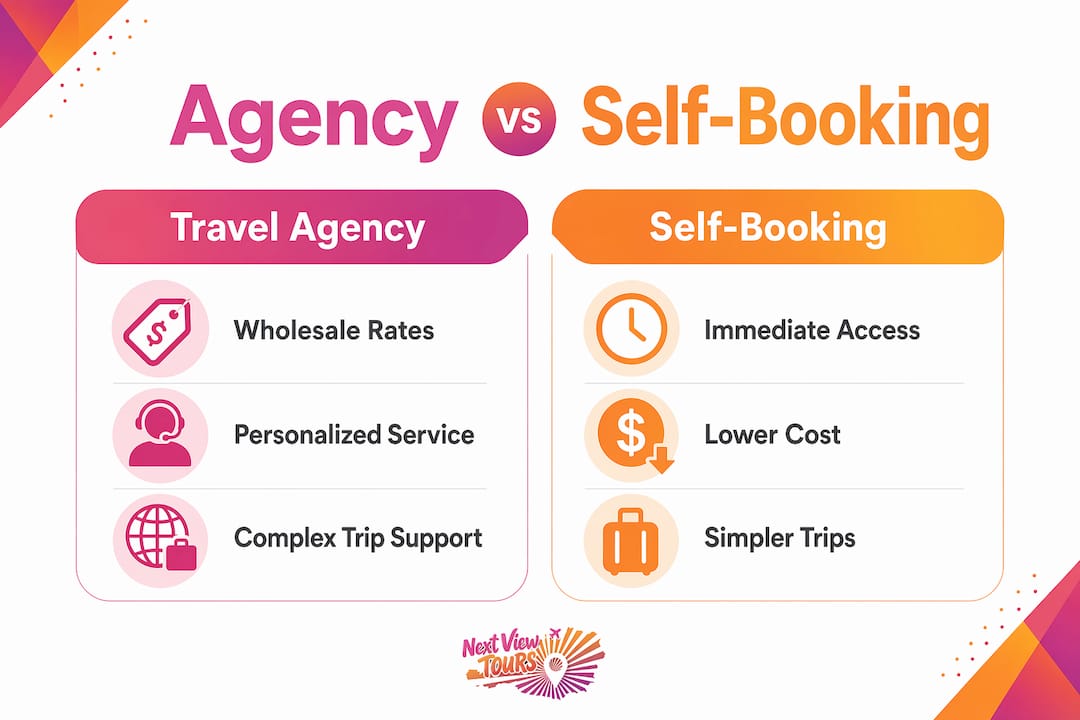
The honest comparison between using a travel agency and booking online yourself depends entirely on the complexity of your trip. For a direct flight and one hotel, a consumer platform like Google Flights or Booking.com is fast and sufficient. For a 14-day multi-country itinerary with a cruise segment, a family with specific needs, or a business trip requiring policy compliance, the calculation changes dramatically.
| Factor | Travel Agency | Self-Booking Platform |
|---|---|---|
| Access to wholesale rates | Yes, through supplier contracts | Limited to published fares |
| Complex itinerary support | Strong, advisor-managed | Weak, user-managed |
| Disruption assistance | Real-time human support | Automated, often slow |
| Personalization | High, based on client profile | Low, algorithm-driven |
| Time investment | Low for client | High for client |
| Cost for simple trips | May include service fees | Usually free to book |
Travelers using advisors more often perceive their trip as a good bargain and value the personalized, stress-free experience. That perception is backed by real outcomes. NerdWallet reports travelers saving hundreds or thousands of dollars through advisor expertise and exclusive rates, especially on cruises and multi-leg trips. The savings are not guaranteed on every booking, but the risk reduction on complex travel is consistent.
Pro Tip: If your trip involves more than three suppliers, a visa application, or a group of five or more people, the time and risk savings from using an advisor almost always outweigh any service fee.
How do you choose the right travel agency?
Choosing the right agency starts with matching their specialization to your travel needs. A luxury safari specialist and a corporate TMC both call themselves travel agencies, but their expertise, supplier networks, and service models are entirely different. The role of travel agencies as intermediaries means their value is directly tied to the depth of their supplier relationships in your specific travel category.
Key questions to ask before committing to an agency:
- What is your specialization? Look for agencies with demonstrable expertise in your destination or travel type.
- How are you compensated? A transparent answer covering both commissions and service fees signals a trustworthy advisor.
- What happens if something goes wrong during my trip? The answer reveals how much real support you will receive beyond the booking.
- Can you provide references or reviews from similar travelers? Past client experience is the most reliable indicator of service quality.
- What is included in your planning fee? Clarify whether itinerary revisions, visa guidance, and disruption support are covered.
Transparency about fees and commission models is the clearest signal of a trustworthy advisor relationship. Agencies that explain exactly what they earn and why are the ones most likely to act in your interest rather than the supplier’s.
Key takeaways
Travel agencies deliver the most value when trip complexity exceeds what any single booking platform can manage, combining supplier access, human judgment, and real-time support into one accountable relationship.
| Point | Details |
|---|---|
| Core intermediary function | Agencies coordinate and sell travel products on behalf of suppliers without holding inventory. |
| Consultative advisor role | Modern advisors provide personalized planning, advocacy, and disruption support throughout the trip. |
| Corporate travel specialization | TMCs design programs, negotiate contracts, enforce policy, and report spend to finance teams. |
| Cost and time advantages | Advisors access wholesale rates and save clients time, especially on complex or multi-leg trips. |
| Choosing the right agency | Match specialization to your travel type and prioritize transparency about fees and compensation. |
Why human judgment still wins in travel planning
From my experience working with travelers across Europe, the most common regret I hear is not “I spent too much on an advisor.” It is “I wish I had used one.” The trips that go sideways are almost never the simple ones. They are the multi-city itineraries where one missed connection cascades into three rebookings, or the group tours where one supplier change affects 20 people’s plans simultaneously.
Technology has made self-booking faster and cheaper for straightforward trips. I genuinely respect that. But human judgment remains critical for travel success in ways that no algorithm has replicated. An advisor who knows that a particular airline’s rebooking policy is unusually rigid, or that a specific hotel’s “sea view” rooms face a construction site, is not replaceable by a search engine.
The agencies I trust most are the ones who tell you upfront what they earn and why. That transparency is not just good ethics. It is a reliable predictor of how they will behave when your interests and a supplier’s interests diverge. Choose advisors who offer customised tour advantages built around your needs, not around the highest commission rate. The difference shows up in the details of your trip, and you will feel it from the first day.
— Next
Plan your next european adventure with Nextviewtours
Nextviewtours brings the full function of a travel agency to life across Europe, from day trips out of Vienna and Salzburg to multi-day adventures through Austria, the Czech Republic, Hungary, and Slovakia. Every trip is designed by people who know these destinations deeply, not assembled by an algorithm.

Whether you are looking for a private tour crafted around your interests or a group experience that handles every logistical detail, Nextviewtours offers tailored trip formats for solo travelers, couples, families, and corporate groups. Browse the full range of curated European experiences and let an expert handle the planning while you focus on the experience itself.
FAQ
What does a travel agency do exactly?
A travel agency acts as an intermediary between travelers and suppliers, handling itinerary planning, booking, ticketing, and ongoing support. Modern agencies also provide personalized advice and real-time assistance during travel disruptions.
Are travel agents worth the cost in 2026?
Yes, particularly for complex trips. NerdWallet reports travelers saving hundreds or thousands of dollars through advisor expertise and exclusive wholesale rates, especially on cruises and multi-leg itineraries.
How do travel agencies make money?
Agencies earn through supplier commissions, typically 5%–15% on hotels and packages, and increasingly through explicit service fees ranging from $100 to $500+ for planning and consultation services.
What is the difference between a travel agency and a travel management company?
A travel agency primarily serves leisure travelers with vacation planning and bookings. A travel management company (TMC) serves businesses, focusing on policy compliance, supplier contract negotiation, duty of care, and travel spend reporting.
Can a travel agency save me time compared to booking online?
Yes. Agencies manage all supplier coordination, documentation guidance, and disruption handling on your behalf. A L.E.K. Consulting survey confirms travelers see advisors as providing strong value by reducing stress and securing experiences not easily available through online platforms.


Comments are closed