

 Uncategorized
TL;DR:
- A family trip planning workflow helps coordinate schedules, budgets, and activities to make travel less stressful. It involves a collaborative, phase-based system that reduces conflict by surfacing expectations early and organizing decisions logically. Using shared digital tools and clear deadlines ensures smooth execution and keeps the trip enjoyable for all family members.
A family trip planning workflow is a structured process that helps families coordinate schedules, budgets, accommodations, and activities into one organized, stress-free experience. Most families approach vacation planning reactively, booking flights first and figuring out the rest later. That reactive approach is exactly why so many trips feel exhausting before they even begin. A deliberate workflow changes that. It gives every family member a role, keeps decisions transparent, and turns a chaotic to-do list into a clear sequence of steps anyone can follow.
What is a family trip planning workflow and why does it matter?
A family trip planning workflow is the travel industry’s term for a repeatable, phase-based planning system applied to multi-person, multi-need vacations. It differs from a simple checklist because it sequences decisions in the right order, assigns ownership, and builds in flexibility for the unexpected.
The core benefit is reduced conflict. Family trips feel like five different trips happening at once, because every traveler carries different expectations. A shared workflow surfaces those differences early, during planning, rather than at the airport gate. That shift alone prevents the majority of family travel arguments.
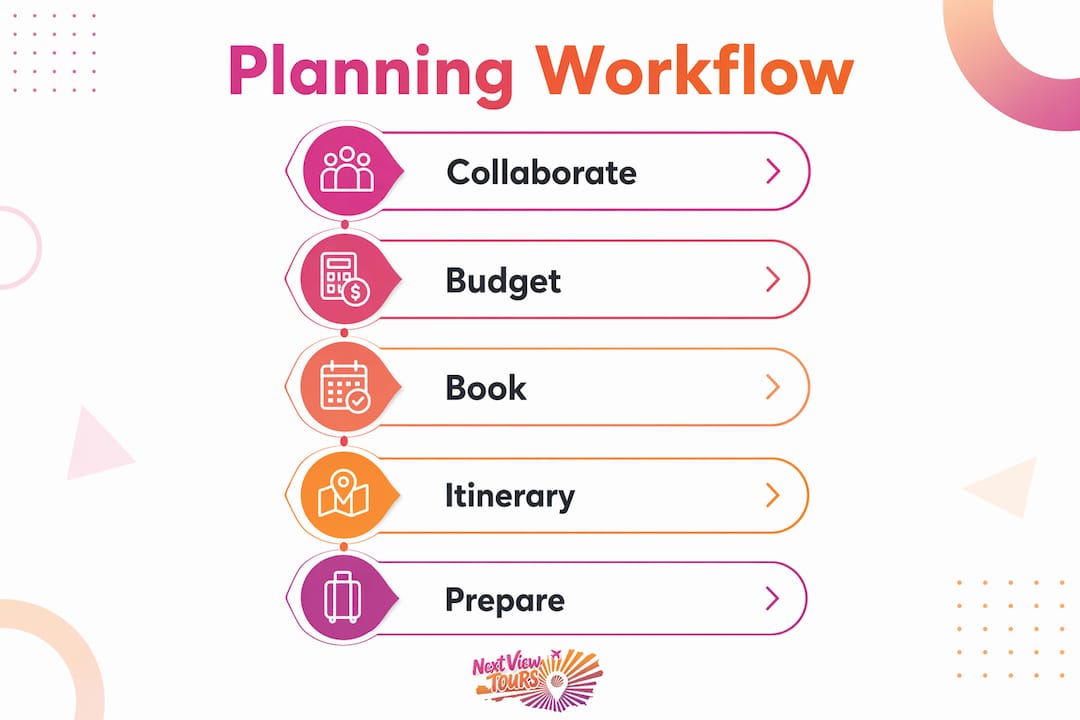
Three elements define a strong workflow: a collaborative decision phase, a realistic budget and booking sequence, and a pace-aware itinerary. You will find all three covered in detail below, along with the digital tools that hold each phase together.
How to start your family travel planning with a collaborative brainstorm
The first step in any solid family travel planning guide is defining the “why” before the “where.” Choosing a destination that fits family goals, whether rest, exploration, or cultural discovery, prevents trips that look great on paper but leave everyone underwhelmed. Schedule a dedicated 30-minute family session and ask one question: what do we want to feel at the end of this trip?
Once the goal is clear, move to destination selection as a group. Here is a simple process that works for families with mixed ages:
- List three destination options that match the trip goal and your available travel window.
- Vote anonymously using a shared Google Form or a free tool like Mentimeter so no one feels pressured by louder voices.
- Rank priorities for each traveler: outdoor activities, city culture, beach relaxation, or historical sites.
- Check logistics early: visa requirements, flight duration, and whether the destination suits the youngest traveler’s stamina.
- Set a decision deadline of no more than one week so planning momentum does not stall.
Involving kids in this phase builds genuine excitement. Children who help choose the destination ask fewer “are we there yet” questions and show more patience during travel days.
Pro Tip: Create a shared Google Doc titled “[Destination] Family Trip 2026” from day one. Every idea, vote result, and decision goes into that single document. You will thank yourself six weeks later when someone asks why you chose Prague over Vienna.
For families planning group travel across Europe, this collaborative brainstorm phase is especially important because multi-generational groups carry the widest range of expectations.
How to set a budget and book the right components early
Budget clarity is the second phase of any reliable family trip planning guide, and it should happen before a single booking is made. A typical family trip budget allocates 30–40% to transportation, 25–35% to accommodation, 15–20% to food, 10–15% to activities, and 5–10% to miscellaneous expenses. Use those percentages as guardrails, not guarantees.

Booking timing matters as much as budget allocation. Families should start planning at least 12 weeks before a standard domestic vacation, and 4–6 months ahead for international or peak-season travel. Passport processing alone takes 4–6 weeks as of Q1 2026, which catches many families off guard.
The table below shows recommended booking windows by trip type:
| Trip type | Start planning | Book flights | Book accommodation |
|---|---|---|---|
| Domestic weekend | 4–6 weeks out | 1–3 months ahead | 3–4 weeks ahead |
| Domestic week-long | 8–12 weeks out | 1–3 months ahead | 6–8 weeks ahead |
| International | 4–6 months out | 3–6 months ahead | 3–4 months ahead |
| Peak-season Europe | 5–6 months out | 4–6 months ahead | 4–5 months ahead |
For accommodation booking workflows specifically, the step-by-step booking guide from SwappaHome walks through how to compare stay options systematically, which is useful when you are weighing hotels against vacation rentals for a family of five.
Set fare alerts on Google Flights or Kayak the moment your destination is confirmed. Price drops of 15–20% are common in the 6–8 week window before departure for European routes. Track your total spend in a shared spreadsheet so both adults see the running total in real time.
Pro Tip: Book your most critical, non-refundable element first: usually the flight. Everything else, hotels, tours, and car rentals, can flex around confirmed air travel. Reversing that order creates expensive conflicts.
How to build a family vacation itinerary that does not exhaust everyone
A well-built family vacation itinerary is not a packed schedule. It is a paced one. Limiting structured activities to 1–2 main events per day is the leading predictor of trip satisfaction. Overscheduling is the single most common reason families return from vacation more tired than when they left.
The key to pacing is anchoring your day to the youngest traveler. Match daily plans to the youngest child’s nap schedule, attention span, and energy window. A toddler’s productive window runs roughly 9 a.m. to noon and again from 4 p.m. to 6 p.m. Build your main activities inside those windows.
Here is a three-tier pacing model that works across family types:
- Relaxed pace: One main activity per day, long lunches, afternoon rest, and one optional evening outing. Best for families with children under five or grandparents traveling along.
- Moderate pace: Two main activities per day with a midday break of at least 90 minutes. Works well for school-age children aged 6–12.
- Active pace: Two to three activities per day with deliberate transitions and built-in snack stops. Suited to teenagers and adults without young children.
For multi-age groups, the moderate pace is almost always the right default. You can always add an activity on a high-energy day. You cannot undo an overtired six-year-old at a museum.
Useful tools for building your itinerary include:
- Google Maps: Save locations to a custom map so everyone can see the day’s geography at a glance.
- TripIt: Consolidates booking confirmations into a single day-by-day itinerary automatically.
- Notion or Trello: Lets you build a visual day-by-day plan with drag-and-drop flexibility.
For families exploring Europe, Nextviewtours offers a detailed family-friendly trips guide with pacing advice specific to destinations like Vienna, Salzburg, and Prague.
What digital tools keep a family travel workflow on track?
The most effective family travel planning workflow runs through a single centralized digital hub. Experienced planners build one shared document or app before booking anything, storing flight details, reservation confirmations, contact numbers, and daily notes in one accessible place. That single source prevents the “I thought you had the hotel address” moment at 11 p.m. in a foreign city.
The best digital hub setup for families combines three tools:
- Google Drive folder: Holds the master itinerary, budget spreadsheet, packing lists, and scanned copies of passports and travel insurance.
- WhatsApp or Slack group: Used for real-time updates during travel, not for planning decisions, which belong in the Drive folder.
- A shared calendar (Google Calendar or Apple Calendar): Displays departure times, check-in windows, and activity bookings so every adult sees the same schedule.
Assign specific tasks with hard deadlines in the final weeks before departure. Three weeks before travel is the critical finalization phase: stop researching and start executing. Named duties with firm deadlines, such as “Mom confirms hotel by Tuesday, Dad checks passport expiry by Wednesday,” prevent last-minute chaos and duplicate effort.
Pro Tip: Share your Google Drive folder with every traveling adult, not just your partner. If one person’s phone dies at the airport, someone else can pull up the booking confirmation instantly.
Final preparations and common pitfalls to avoid
The last two weeks before departure are about execution, not decisions. Your family travel checklist for this phase should cover four areas:
- Documents: Confirm passport validity (most countries require 6 months beyond your return date), print or download boarding passes, and save digital copies of travel insurance and hotel confirmations.
- Packing: Use a shared packing list in Google Keep or Notion so nothing gets duplicated or forgotten. Assign each family member their own list.
- Home security: Arrange mail holds, notify your bank of travel dates, and set timers on lights if you are away for more than a few days.
- Backup plans: Identify one alternative activity for each major day in case of weather or closures. European museums, for example, are frequently closed on Mondays.
The most common pitfalls in family trip planning workflows are predictable and avoidable. Overscheduling tops the list, followed closely by ignoring the youngest traveler’s needs, unclear communication between adults, and failing to build buffer time between activities.
“The best family trips are not the ones where everything went perfectly. They are the ones where the family handled the imperfections together.”
Keep expectations realistic. A delayed train in Budapest or a rainy afternoon in Hallstatt is not a failure. It is an opportunity for the kind of unscripted memory that outlasts any planned highlight.
Key takeaways
A structured family trip planning workflow, built around collaboration, realistic budgeting, and pace-aware itineraries, is the most reliable way to turn a complex vacation into a genuinely enjoyable experience.
| Point | Details |
|---|---|
| Start with the “why” | Define trip goals before choosing a destination to match the vacation to family needs. |
| Book early and in order | Flights first, then accommodation; international trips need 4–6 months of lead time. |
| Pace to the youngest traveler | Limit structured activities to 1–2 per day and anchor the schedule to the youngest child’s energy window. |
| Use one digital hub | Store all bookings, documents, and itinerary details in a single shared folder before travel begins. |
| Finalize three weeks out | Assign named tasks with hard deadlines to stop planning and start executing. |
What I have learned from planning family trips across Europe
Planning family travel is one of those skills that looks straightforward from the outside and reveals its complexity the moment you are coordinating a 7 a.m. train departure for two adults, a teenager, and a five-year-old who decided last night was a great time to refuse sleep.
What I have found, after helping families plan trips across Austria, the Czech Republic, Hungary, and beyond, is that the workflow itself is not the hard part. The hard part is getting every adult in the family to trust the workflow. Most travel stress comes from one person carrying all the information in their head. The moment you move that information into a shared system, the dynamic shifts. Everyone feels ownership. No one feels blindsided.
I also think the travel industry undersells the value of involving children in real decisions. Not token decisions like “do you want the window seat,” but genuine ones: which castle do we visit, do we spend the afternoon at the market or the park? Kids who feel heard during planning are more patient during execution. That is not a theory. I have seen it play out on dozens of family trips.
The other thing I would push back on is the idea that a perfect itinerary equals a perfect trip. Some of the most memorable moments I have witnessed on family tours through Salzburg or Prague happened because a plan fell apart and the family had to improvise. Build the structure, then hold it loosely.
— Next
Plan your next family trip with Nextviewtours
Nextviewtours specializes in customizable family tours across Europe, from day trips in Vienna and Salzburg to multi-day adventures through Austria, the Czech Republic, Slovakia, and Hungary. Every itinerary is built around your family’s pace, ages, and interests, so you are not fitting into someone else’s schedule.

Whether you are looking for a private tour that moves at a toddler’s pace or a multi-day adventure for a family of teenagers, Nextviewtours offers trip types for every family across the full range of European destinations. You can also explore customized tour options designed to match exactly what your family wants from a trip. Browse the full range and start building your itinerary today.
FAQ
How far in advance should families start planning a trip?
Families should start planning at least 12 weeks before a domestic vacation and 4–6 months before international or peak-season travel. Passport processing alone takes 4–6 weeks, so early action prevents avoidable delays.
What is the best way to involve kids in family trip planning?
Use shared voting tools like Google Forms or Mentimeter to let children rank destination options and activity preferences. Kids who participate in decisions show more patience and enthusiasm during the actual trip.
How many activities should a family schedule per day?
The recommended limit is 1–2 structured activities per day, balanced with downtime for rest and spontaneity. Overscheduling is the leading cause of exhaustion and conflict on family vacations.
What should a family travel checklist include?
A complete family travel checklist covers passport validity, travel insurance confirmation, digital copies of all bookings, a shared packing list, bank notifications, and at least one backup activity per day in case of weather or closures.
What digital tools work best for family trip planning?
Google Drive for document storage, TripIt for itinerary consolidation, and Google Calendar for shared scheduling form a reliable three-tool system. A single shared folder accessible to all traveling adults prevents the most common communication failures.


Comments are closed