

 Uncategorized
TL;DR:
- Selecting the right tour type depends on your flexibility, experience, and group needs.
- Summer travel costs in Europe rise due to demand, with small-group tours often offering higher quality.
- Family and group tours benefit from customization, balancing activity levels, accessibility, and downtime.
Europe in summer is breathtaking, overwhelming, and full of choices that can feel paralyzing. From the sparkling coasts of Croatia to the alpine meadows of Austria and the baroque streets of Vienna and Prague, the options multiply faster than you can scroll through them. Picking the wrong tour type or skipping a key planning step can turn a dream trip into a stressful blur. This guide walks you through four essential decisions, covering tour types, costs, family needs, and customization, so you can make a confident, well-informed choice and experience Europe in a way that feels genuinely yours.
Table of Contents
- Identify your ideal tour type
- Calculate and compare costs for maximum value
- Tailor your tour for family and group needs
- Check if tour customization adds value
- A realistic insider take: What most guides miss about summer tour choices
- Where to find your perfect European summer tour
- Frequently asked questions
Key Takeaways
| Point | Details |
|---|---|
| Match tour type to needs | Guided, self-guided, or hybrid tours offer different levels of freedom and support—choose what fits your group and travel style. |
| Consider family features | Tailored equipment, pacing, and lodging are vital for family and group satisfaction on European tours. |
| Balance cost and quality | Compare tour prices, star ratings, and inclusions to get the best value for your summer adventure. |
| Customization adds flexibility | Custom and hybrid tours let you shape your trip to special interests and group needs. |
Identify your ideal tour type
The first real decision you face is not where to go but how to go. Tour styles vary enormously, and each one suits a different kind of traveler. Understanding what each type actually delivers is the most important step you can take before spending a single dollar.
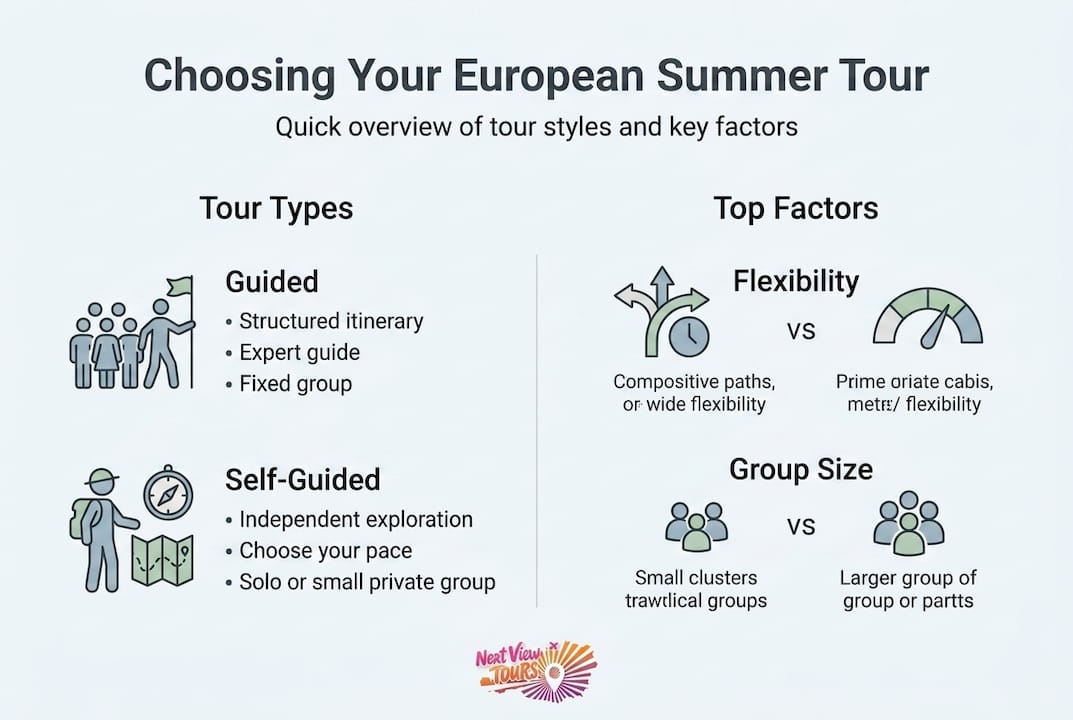
Guided tours are the classic option. Your accommodation, meals, transportation, and a knowledgeable local guide are all arranged in advance. You show up and follow a well-worn, expertly curated path. This structure is ideal for first-time visitors to Europe, for older travelers who prefer not to navigate foreign transit systems, and for anyone who simply wants to absorb experiences without managing logistics. According to escorted group tour research, guided tours are specifically praised for being logistics-free, with hotels, meals, and expert guides included.
Self-guided tours flip the model. You move at your own pace, using GPS devices, mobile apps, luggage transfer services, or e-bikes to connect the dots between pre-booked accommodations. This option suits experienced travelers and adventurous types who want full control over their mornings and evenings. You decide when to linger over coffee in a Viennese café or speed through a medieval town to catch an afternoon hike.
Hybrid tours sit in a genuinely sweet spot. You get the pre-arranged backbone of a guided tour, including lodging and route planning, but enjoy free time at every stop to explore independently. These tours have grown popular because they reduce friction without eliminating spontaneity. Research into guided vs self guided tours consistently shows that hybrid options attract travelers who want structure on travel days but freedom on sightseeing days.
Customized tours are built around your specific interests. A provider like Next View Tours works with you to design the itinerary, pace, and activity mix from scratch. This is especially valuable for groups with varied interests, travelers with accessibility needs, or families who need both adventure and downtime built into the same week.
Here is a quick comparison to help you decide:
| Tour type | Flexibility | Planning effort | Best for |
|---|---|---|---|
| Guided | Low | Very low | First-timers, seniors |
| Self-guided | High | High | Independent adventurers |
| Hybrid | Medium | Low to medium | Most travelers |
| Customized | Very high | Low (done with provider) | Families, mixed groups |
- Guided: Expect included meals, expert commentary, and zero logistical surprises.
- Self-guided: Expect GPS support, luggage transfers, and flexible daily schedules.
- Hybrid: Expect fixed accommodations with free-choice activity windows.
- Customized: Expect a tailor-made day-by-day plan built around your priorities.
Pro Tip: Choosing choosing summer tours with a hybrid structure can save you 10 to 20 hours of research and booking compared to piecing together a fully independent trip yourself. That is a full workday or two that you get to spend enjoying Europe instead of staring at spreadsheets.
Calculate and compare costs for maximum value
Once you’ve decided on a tour type, it’s essential to weigh costs and quality to match your travel priorities. Summer in Europe is genuinely more expensive than other seasons, and understanding why helps you make smarter decisions rather than just cheaper ones.

Summer pricing explained
Southern European destinations, think the Amalfi Coast, Croatian islands, and the Greek archipelago, typically see 20% price hikes during peak summer months compared to spring or fall. Northern and Central European destinations like Vienna, Prague, and Salzburg see moderate increases but remain more stable. When you see a tour priced significantly higher than its off-season equivalent, those costs are driven by higher hotel rates, busier local suppliers, and increased demand for guides and drivers.
Group size and quality ratings
One of the most consistent data points across the European tour industry is this: small group tours, typically 12 or fewer participants, consistently earn average ratings above 4.8/5. The reasons are intuitive. Smaller groups get more personalized attention from guides, can access restaurants and sites that large buses cannot, and move at a more comfortable pace. If you see a tour rated 4.8 stars or above with a group cap under 15 people, that is usually a strong quality signal worth the slightly higher price point.
Here is a realistic cost comparison across common tour formats:
| Tour format | Typical price per person (7 days) | Average rating | Group size |
|---|---|---|---|
| Large group guided | $900 to $1,400 | 4.2 to 4.5 | 20 to 40 |
| Small group guided | $1,400 to $2,200 | 4.7 to 5.0 | 6 to 14 |
| Hybrid (self-guided + support) | $1,100 to $1,800 | 4.6 to 4.9 | Variable |
| Fully customized private | $2,000 to $4,000+ | 4.8 to 5.0 | 2 to 10 |
Smart strategies for managing your budget
- Book early, ideally four to six months in advance, to access early-bird pricing before summer demand drives up availability.
- Consider shoulder months. Late May and early September offer near-summer weather with meaningfully lower prices at popular destinations.
- Compare what is actually included. A tour priced at $1,600 with all meals, entrance fees, and airport transfers may be better value than a $1,100 tour where every meal is extra.
- Investigate budgeting for Europe travel before you start comparing tours so you know your total trip budget, not just the tour fee.
The real insight here is that the lowest sticker price often hides the highest real cost. A hybrid or small-group tour with transparent inclusions frequently delivers more value than a bargain option that nickels and dimes you on every extra.
Tailor your tour for family and group needs
Tour type and pricing sorted. Now, how do you ensure your tour fits every family or group member? This is where many travelers underestimate the complexity, and where the right tour provider makes an enormous difference.
What families actually need from a summer tour
Family travel, especially multi-generational trips, requires features that standard adult tours rarely prioritize. E-bikes with child trailers allow active parents to cover real distance while keeping young children comfortable and safe. Villa and apartment-style accommodations give families space to cook, spread out, and decompress in ways that a standard hotel room simply cannot provide. Family bike tours in destinations like Austria and Croatia are specifically designed with these needs in mind, covering approximately 100 kilometers over four days with kid seats, gentle pacing, and rest days built in.
Croatia and Austria consistently rank as the best destinations for family cycling tours in Europe. Both countries offer:
- Dedicated cycling paths with minimal road traffic
- Flat to gently rolling terrain suitable for all ages
- Accommodation options ranging from lakeside villas to charming farmhouses
- Local cuisine that genuinely appeals to younger travelers
- Flexibility to add kayaking, swimming, or hiking without disrupting the core itinerary
Multi-generational group dynamics
One of the trickiest parts of planning a group tour is accommodating different energy levels. A 68-year-old grandparent and a 12-year-old child both deserve to enjoy the same trip, just differently. The best family tours Europe are structured around a mix of active segments and relaxed exploration, giving every generation a moment to shine without exhausting anyone.
“The most successful multi-generational tours are designed with permission to rest. When every day has at least one optional activity and one genuinely relaxed window, travelers of all ages stay energized and enthusiastic rather than burned out by day three.”
Pro Tip: When you research what is a family tour, look specifically for operators who offer customizable activity levels within a single itinerary. This feature matters more than nearly any other amenity when you are traveling with a mixed-age group.
Group tours for friend groups, sports teams, or professional retreats have a different set of requirements. You want negotiated group pricing, coordinated meal arrangements, and ideally a dedicated point of contact who manages logistics on your behalf. Always confirm these details before booking.
Check if tour customization adds value
Family and group needs often mean customization is key. Flexible booking can transform a good trip into one that feels personally meaningful rather than just professionally organized.
When customization genuinely makes sense
Customization is not always necessary. For straightforward couple travel or solo exploration of a single city, a well-rated guided or hybrid tour usually covers everything you need. But customization delivers real value when:
- Your group includes travelers with accessibility requirements
- You have a very specific interest, like cycling along the Danube, visiting medieval fortresses, or focusing on culinary experiences
- Your group spans ages, fitness levels, or cultural backgrounds that a standard tour cannot accommodate
- You want to combine multiple destinations, for example Prague and Budapest, without following a rigid group schedule
How to build or request a customized tour: a step-by-step approach
- Define your non-negotiables. Write down the two or three experiences that would make the trip unforgettable for your group. These are the fixed points around which everything else is built.
- Establish your flexible elements. Identify what you are willing to adjust: start dates, specific hotels, pace of travel, or activity types.
- Contact the provider early. Customized tours take longer to build. Reaching out four to six months before your travel date gives providers enough time to secure preferred accommodations and activities.
- Request a transparent cost breakdown. A clear line-item budget helps you understand what you are paying for and where there is room to adjust.
- Review the itinerary critically. Check that each day balances activity with downtime, that travel distances are realistic, and that optional activities genuinely are optional.
Pitfalls to avoid
Over-customization is a real risk. Travelers sometimes request so many unique elements that the itinerary becomes logistically fragile, where one delayed train or closed attraction unravels the whole plan. Build in buffer time and keep at least 30 percent of each day as genuinely flexible.
Explore summer trip options to understand the full range before you start customizing, and check the customized tours guide for a detailed breakdown of what a well-built custom itinerary looks like.
The core benefits of hybrid and custom tours for adventurous travelers
- Freedom to pursue niche interests without abandoning group logistics
- Ability to adjust pace mid-trip when energy levels change
- Access to local experiences that pre-packaged tours often skip
- Personalized guide expertise matched to your group’s specific interests
- A final itinerary that reflects your group’s values, not a generic template
A realistic insider take: What most guides miss about summer tour choices
Having covered the main practical steps, here is some insider advice that most published guides overlook entirely.
Star ratings and inclusions tell only part of the story. A tour rated 4.9 stars by 12 reviewers is not necessarily better than one rated 4.7 stars by 800 travelers. Volume and recency of reviews matter just as much as the score itself. Look for recent reviews, particularly from travelers whose group profile matches yours.
Overplanning is a trap. Many travelers, especially first-timers, fill every hour of their European summer tour with scheduled activities. The result is exhaustion rather than wonder. The best trips leave room for serendipity: the canal-side bar you stumbled into, the market you did not expect, the conversation with a local that changed how you see the city.
Fit and flexibility beat prestige every time. A tour run by a boutique regional operator who knows the importance of small group travel often outperforms a well-branded large operator simply because the experience is built around real places and real people rather than efficiently managed tourist circuits.
Choose a tour that fits your rhythm, not one that looks impressive on paper.
Where to find your perfect European summer tour
Ready to make your choice? Here is where to dig deeper or book your tour.
At Next View Tours, we specialize in connecting travelers with European summer adventures that actually match who they are and how they travel. Whether you are planning a solo adventure through Central Europe, a family cycling week in Austria, or a mixed-group getaway spanning Vienna, Prague, and Budapest, we have built the tools and routes to make it work.
Start with our expert guide to customized tours if you want a fully tailored itinerary. Browse our group tours guide if you are organizing a shared experience for friends or colleagues. And explore our unforgettable family tours if you need a multi-generational adventure with the right pace, equipment, and flexibility built in from day one. Every tour we offer is designed with genuine care for the places we visit and the people we bring together.
Frequently asked questions
What’s the main benefit of guided versus self-guided tours?
Guided tours handle all logistics and are ideal for first-timers, while self-guided options give you full control over pace and daily schedule.
Are hybrid tours really easier to plan?
Yes. Hybrid tours save significant planning time compared to fully independent trips because the core structure, accommodations, and routing are already arranged for you.
Which destinations are best for family bike tours?
Croatia and Austria are consistently the top choices, with Croatia and Austria bike tours offering kid-friendly equipment, gentle terrain, and flexible daily pacing that works across age groups.
How can I avoid paying summer peak prices?
Book four to six months early, consider shoulder-season dates in late May or early September, and compare small group tours with full inclusions to get the best overall value rather than just the lowest headline price.


Comments are closed