

 Uncategorized
TL;DR:
- A function travel agency, or TMC, manages travel logistics through core services like booking, policy compliance, expense support, duty of care, and spend reporting. It acts as an operational partner, ensuring seamless coordination, real-time disruption management, and strategic value beyond simple bookings. Its role becomes crucial during complex trips, events, or emergencies where personalized support and integrated planning significantly enhance the traveler experience.
A function travel agency is a business that helps individuals and groups plan, book, and manage their travel through a coordinated set of services designed to simplify the entire experience. The industry term for this model is a Travel Management Company, or TMC, and understanding how one operates gives you a real advantage when planning any trip, from a weekend city break to a multi-country corporate program. Whether you are organizing a family vacation through Vienna, coordinating a conference in Prague, or managing a team trip across Central Europe, knowing what these agencies actually do tells you exactly what to expect and what to ask for.
What are the five core functions of a function travel agency?
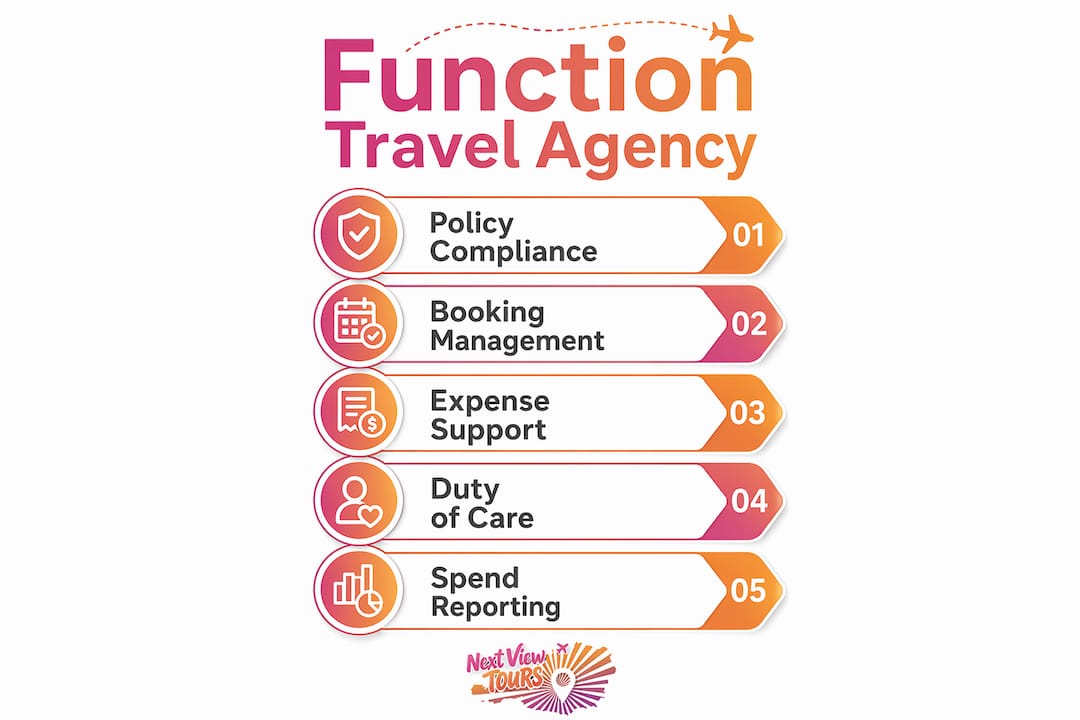
Travel Management Companies perform five core functions: travel policy compliance, booking and supplier management, expense support, traveler duty of care, and spend reporting. Together, these functions make travel predictable, measurable, and far less stressful than managing everything yourself.
| Point | Details |
|---|---|
| Travel policy compliance | Agencies enforce booking rules and approval workflows so every trip stays within agreed guidelines. |
| Booking and supplier management | Agencies negotiate with airlines, hotels, and ground transport providers to secure preferred rates and availability. |
| Expense support | Agencies capture and reconcile travel costs, reducing the manual effort required from travelers and finance teams. |
| Traveler duty of care | Agencies track traveler locations and communicate proactively during emergencies or disruptions. |
| Spend reporting | Agencies generate data on travel patterns, helping organizations identify savings and optimize future programs. |
Each function connects to the others. Booking management feeds expense data. Expense data informs spend reporting. Spend reporting shapes policy. This circular structure is what separates a genuine travel management agency from a simple ticket vendor.
Pro Tip: When evaluating any travel agency, ask specifically how they handle duty of care. Duty of care is a legal and ethical obligation embedded into booking flows, and agencies that cannot describe their emergency communication process are not equipped for complex travel.
Travel managers must uphold company travel policies and internal approval workflows, but agencies enforce rather than create compliance culture. That distinction matters. The agency is your operational partner, not your policy author. You set the rules; they make sure every booking follows them.

Travel management should be seen as business infrastructure driving efficiency and visibility, not simply a cost center or support function. Organizations that treat their TMC as a strategic partner consistently extract more value from their travel programs than those who use agencies only for transactional bookings.
How do travel agencies differ from tour operators and online booking platforms?
Travel agencies act as intermediaries booking services, whereas tour operators create the travel products themselves. This distinction is one of the most misunderstood in the industry, and getting it wrong leads to booking the wrong type of provider entirely.
A travel agency sources and arranges services that already exist. It books a flight on Lufthansa, reserves a room at a hotel in Budapest, and organizes a transfer from Salzburg airport. A tour operator, by contrast, designs and packages the experience from scratch. Nextviewtours, for example, operates as a tour and experience provider across Austria, the Czech Republic, Slovakia, Hungary, and beyond, building day trips, multi-day itineraries, and private tours as original products. You can explore how tour operators shape Europe trips differently from agencies to understand where each type of provider adds the most value.
Online travel agencies such as Booking.com or Expedia function more like search engines with a checkout button. They aggregate options and let you self-serve, but they offer limited personalized support and no proactive management once you have booked. Human travel consultants are critical for handling last-minute changes and complex itineraries that automated platforms simply cannot manage.
Here is a clear breakdown of when to choose each provider type:
- Travel agency or TMC: Best for complex itineraries, business travel, group logistics, or any trip where disruption management and policy compliance matter.
- Tour operator: Best when you want a pre-designed, curated experience with built-in expertise, local knowledge, and guided elements.
- Online travel agency: Best for simple, single-destination bookings where price comparison is the primary need and flexibility is low.
Knowing which type of provider fits your situation saves both time and money before you even start comparing options.
What makes event and group travel management so specialized?
MICE travel management requires precise coordination of group travel aligned with event production timelines, with 24/7 support for groups managing flights, hotel blocks, and on-site logistics. MICE stands for Meetings, Incentives, Conferences, and Exhibitions, and it represents the most logistically demanding category of travel management.
The complexity comes from the sheer number of moving parts. A conference in Prague might involve 200 attendees flying from six different cities, hotel blocks across three properties, shuttle transfers timed to keynote sessions, and contingency plans for weather delays or flight cancellations. One missed connection can cascade into a scheduling disaster for the entire event.
Event travel requires integration of travel plans with production schedules to avoid logistical fragmentation. When travel and event timelines are managed separately, operational risks multiply. A speaker who misses their flight because no one monitored the connection is not just an inconvenience. It is a program failure.
Specialized event travel agencies use centralized coordination and real-time monitoring to handle disruptions and schedule shifts proactively. This is the core difference between a general booking service and a dedicated event travel management partner. You can see how group travel planning workflows operate in practice to appreciate the level of coordination involved.
Pro Tip: When briefing an event travel agency, share the full production schedule, not just the travel dates. Agencies that understand your event’s internal timeline can build contingency windows into every booking, protecting the program from single-point failures.
Key services a specialized event travel agency provides include:
- Attendee registration and travel profile management
- Group flight negotiations and seat block reservations
- Hotel room block contracting and attrition risk management
- Ground transportation coordination synced to event schedules
- Real-time disruption monitoring and rebooking support
How do travel agencies add value beyond online booking tools?
Corporate travel management companies provide cohesive programs combining booking, policy enforcement, reporting, traveler support, and risk management. This contrasts sharply with standalone booking platforms, which handle the transaction but nothing that follows.
The value of a travel agency becomes most visible when something goes wrong. A flight cancellation at 11 p.m. in a foreign city is a very different experience depending on whether you have a human agent available or are navigating an airline’s automated rebooking system alone. Clients value steady communication and a named consultant familiar with their travel needs for consistent, stress-free management. That familiarity is not a luxury. It is the mechanism that makes complex travel manageable.
Here is how travel agencies deliver value at each stage of a trip:
- Pre-trip: Agencies enforce travel policies during booking, apply negotiated rates, and flag compliance issues before they become problems.
- During travel: Agents monitor itineraries in real time, proactively rebook disrupted flights, and communicate with travelers during emergencies.
- Post-trip: Agencies capture expense data, reconcile costs against budgets, and generate reports that inform future travel decisions.
Travel management companies reduce total cost of ownership by automating expense reconciliations, enforcing policy, and minimizing manual effort. The savings come not just from cheaper fares but from eliminating the hidden costs of disorganized travel: missed connections, out-of-policy bookings, and hours spent on manual expense reports. Savings through travel agencies arise largely from reducing manual processes and enhancing traveler safety, not just discounted fares. That reframing is worth holding onto when you are comparing agency fees against the apparent simplicity of booking everything yourself.
Understanding how to track travel spending gives you a clearer picture of where agency-managed programs consistently outperform self-service approaches over time.
Key takeaways
A function travel agency delivers the most value when it operates as an integrated partner across booking, compliance, expense management, duty of care, and reporting, not as a transactional booking service.
| Point | Details |
|---|---|
| Five core functions | TMCs cover compliance, booking, expense support, duty of care, and spend reporting as an integrated system. |
| Agencies vs. operators vs. OTAs | Each provider type serves a different need; matching the right type to your trip saves time and money. |
| Event travel complexity | MICE travel requires travel plans integrated with production schedules and real-time disruption management. |
| Value beyond booking | Human agents provide irreplaceable support during disruptions, emergencies, and complex itinerary changes. |
| Cost savings reframed | Agency savings come from reduced manual effort and better compliance, not only from lower fares. |
Why the function of a travel agency still surprises most travelers
Most people I speak with assume a travel agency is essentially a more expensive version of a booking website. That assumption costs them, sometimes in money, more often in stress.
What I have observed across both leisure and corporate travel is that the real function of a travel agency only becomes visible at the edges of a trip: the delayed connection, the hotel that lost the reservation, the conference speaker who needs to reroute through Vienna at midnight. These are the moments that reveal whether you have a genuine travel management partner or just a booking confirmation in your inbox.
There is also a common misconception that automation has made human agents redundant. The opposite is closer to the truth. Customization transforms travel planning in ways that no algorithm fully replicates, particularly for group travel, event logistics, and itineraries that cross multiple countries and cultures. A named consultant who knows your preferences, your budget, and your tolerance for risk is a fundamentally different resource than a search filter.
My honest advice: do not evaluate a travel agency by its booking interface. Evaluate it by what happens when the plan changes. That is where the function of a true travel management partner becomes undeniable.
— Next
Plan your next trip with Nextviewtours
Nextviewtours brings expert travel planning to life across Austria, the Czech Republic, Hungary, Slovakia, and the wider European region. Whether you are looking for a private day trip from Vienna, a multi-day adventure through the Alps, or a fully coordinated group experience, Nextviewtours offers the kind of personalized, knowledgeable support that makes every detail feel considered. Explore the full range of trip types available to find the experience that fits your group, your schedule, and your sense of adventure. From family tours to couple getaways and custom itineraries, the options are designed to match real traveler needs, not just fill a catalog.
FAQ
What is a function travel agency?
A function travel agency, also called a Travel Management Company, is a business that manages travel planning and logistics through five core services: booking, policy compliance, expense support, duty of care, and spend reporting. It acts as an intermediary between travelers and suppliers such as airlines, hotels, and ground transport providers.
How does a travel agency differ from a tour operator?
A travel agency books existing travel services on your behalf, while a tour operator designs and creates the travel product itself, such as a guided tour or packaged itinerary. Choosing the right type depends on whether you need logistics management or a curated experience.
What is MICE travel management?
MICE stands for Meetings, Incentives, Conferences, and Exhibitions. MICE travel management involves coordinating group flights, hotel blocks, and on-site transport in alignment with event production schedules, typically with 24/7 support to handle real-time disruptions.
Why use a travel agency instead of booking online?
Online platforms handle transactions but offer no proactive support after booking. A travel agency provides human agents who monitor itineraries, manage disruptions, enforce travel policies, and reconcile expenses, delivering value that extends well beyond the initial booking.
How do travel agencies save money beyond cheaper fares?
Travel agencies reduce costs by automating expense reconciliation, enforcing policy compliance, and eliminating manual administrative effort. The total cost savings come from operational efficiency and traveler safety improvements, not only from negotiated fare discounts.


Comments are closed