

 Uncategorized
TL;DR:
- An experience provider owns and delivers the full journey, ensuring outcome accountability across industries.
- In travel, they design immersive, narrative-centered experiences that engage multiple senses and adapt in real time.
An experience provider is a professional or organization that architects and delivers comprehensive, end-to-end interactions designed to create lasting, meaningful impact for guests or clients. The term spans three distinct industries: travel and events, IT managed services, and professional documentation consultancy. Each uses the phrase differently, but all share one defining principle. The provider owns the full journey, not just a single transaction within it. Understanding these distinctions helps individuals and organizations make smarter decisions when selecting a partner for immersive travel, operational IT support, or verified career documentation.
What is an experience provider in travel and events?
An experience provider in travel and events is an entity that designs, operates, and delivers the complete visitor journey, from pre-trip research through post-trip memories. Destination BC defines visitor experience as everything a traveler encounters across that full arc, making the provider responsible for every touchpoint along the way. This is a fundamentally different role from a simple transport company or ticket vendor. The provider shapes meaning, not just logistics.

The term “experience provider” is the informal, SEO-friendly phrase most travelers use when searching. The recognized industry term is experience developer or experience designer, used by tourism bodies like Destination BC and the Canadian Tourism Commission. Both phrases describe the same discipline: a systematic practice of building repeatable, emotionally resonant guest journeys. Knowing the standard terminology helps you evaluate providers with genuine credentials versus those using marketing language without the methodology behind it.
Organizations like ExperienceFirst operate in this space by placing trained Experience Concierges on premium trips. These professionals combine narrative shaping with real-time operational execution, adapting story, pace, and content live to match guest energy and interest. That live adaptability is what separates a true experience provider from a tour operator that simply runs a fixed itinerary on schedule.
How do experience providers design and deliver visitor experiences?
Experience provision in travel is a systematic discipline built around four repeatable phases: discovery, narrative design, sensory engagement, and operational delivery. Destination BC notes that experiences are designed around stories with sensory and emotional connections built in to create lasting memories. This is not accidental. It is engineered from the first planning conversation.
The discovery phase involves understanding who the guest is, what they value, and what kind of memory they want to take home. A family touring Vienna has different emotional needs than a couple on a private Hallstatt excursion. Skilled providers use this insight to build a narrative arc for the trip, one that gives each moment context and emotional weight.
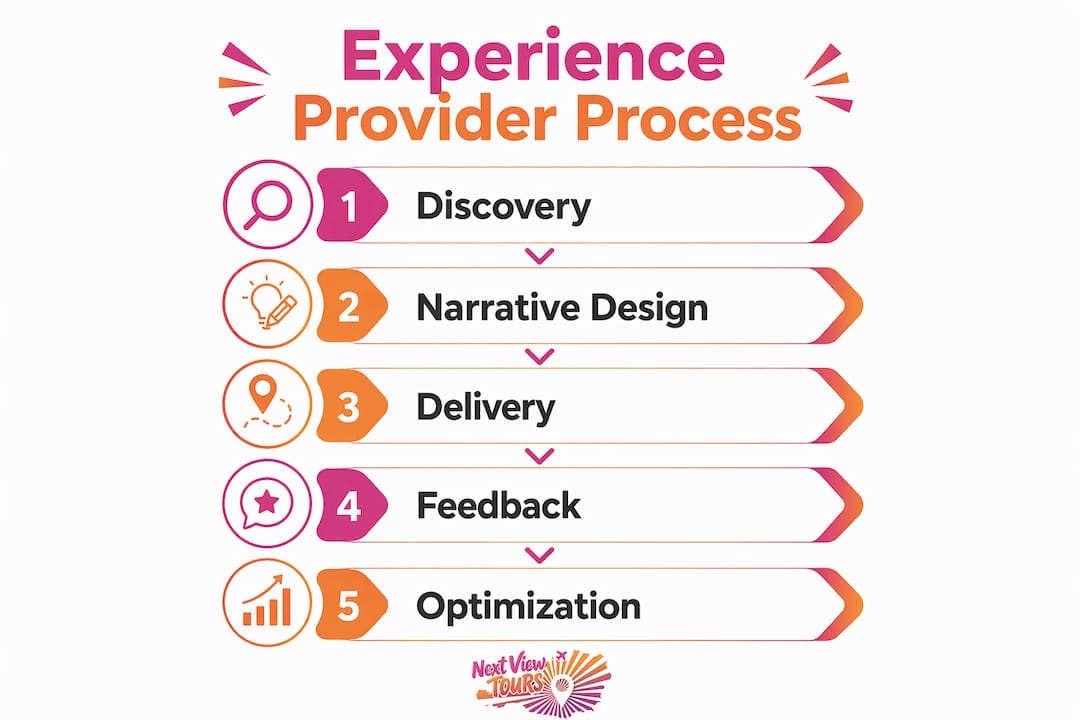
Sensory engagement is where the design becomes tangible. Providers select locations, timing, and activities that activate multiple senses simultaneously. Standing at the edge of a salt lake at dawn in Hallstatt is not just visually striking. The cold air, the silence, and the reflection on the water create a multi-sensory memory that a photograph cannot replicate.
Operational delivery is where most providers either succeed or fail. ExperienceFirst’s Experience Concierge model emphasizes blending storytelling with behind-the-scenes coordination so guests never feel the friction of logistics. The best providers make the operational work invisible.
- Discovery: Profile the guest’s interests, travel history, and emotional goals before designing anything.
- Narrative design: Build a thematic arc that gives the trip a beginning, middle, and resolution.
- Sensory engagement: Select moments that activate sight, sound, touch, and context simultaneously.
- Operational delivery: Execute logistics discreetly so the guest experiences flow, not friction.
- Unplanned moments: Design flexibility into the schedule to capture spontaneous, memorable interactions.
Pro Tip: Ask any prospective travel experience provider how they handle unplanned moments. A provider who has a real answer, not a scripted one, has actually thought about the full journey.
What are the different types of experience providers?
The phrase “experience provider” carries three distinct meanings depending on the industry context. Recognizing which type you are dealing with prevents misaligned expectations and wasted investment.
Travel and event experience providers own the guest journey from start to finish. Their success metric is guest satisfaction and the quality of memories created. They operate through storytelling, personalization, and operational ownership. Examples include tour operators like Nextviewtours, which designs and delivers immersive European trips across Vienna, Salzburg, Prague, Budapest, and beyond.
IT Managed Experience Providers (MxPs) represent a newer category. Synoptek contrasts traditional MSPs with MxP providers who measure success through Experience Level Agreements (XLAs) rather than traditional uptime metrics. XLAs focus on customer satisfaction, employee engagement, and business outcomes. Synoptek integrates AI-powered workflow automation with these experience metrics to drive continuous optimization. This model is gaining traction because uptime alone no longer satisfies modern enterprise clients.
Professional documentation consultancies branded as experience providers form the third category. These firms, such as Experience Provider Consultancy, specialize in verifiable career documentation and background checks for HR and visa applications. They have almost nothing in common with travel providers beyond the shared label.
| Type | Primary role | Success metric | Key example |
|---|---|---|---|
| Travel and event provider | Full guest journey design and delivery | Guest satisfaction and memory quality | Nextviewtours, ExperienceFirst |
| IT Managed Experience Provider (MxP) | Outcome-based IT service management | Experience Level Agreements (XLAs) | Synoptek |
| Documentation consultancy | Career record verification and management | Accuracy and legal compliance | Experience Provider Consultancy |
Pro Tip: When evaluating an IT provider claiming to be “experience-led,” ask specifically which XLA metrics they track. Providers without a clear answer are rebranding traditional SLA models without changing the underlying delivery approach.
What benefits do experience providers offer individuals and organizations?
Experience providers deliver measurable value that transactional vendors cannot replicate. The core benefit is the shift from service delivery to outcome ownership. When a provider owns the full journey, accountability is concentrated in one place rather than distributed across multiple vendors who each blame the others when something goes wrong.
For individual travelers, the benefits are immediate and personal. Authentic sensory immersion over cost-saving shortcuts produces memories that last years, not days. Travelers who book with experience providers rather than assembling trips themselves consistently report higher satisfaction because the narrative coherence of a well-designed trip feels qualitatively different from a collection of disconnected activities. Experiential travel gifts, for example, create lasting memories and build brand loyalty in ways that physical products rarely achieve.
For organizations booking group or corporate travel, the benefits extend to operational clarity and risk reduction. A single accountable provider eliminates the coordination overhead of managing multiple vendors across transportation, accommodation, guiding, and activity booking. This is particularly valuable for companies organizing incentive travel or team retreats in unfamiliar destinations like Prague or Budapest.
Key benefits of working with a qualified experience provider include:
- Single point of accountability: One provider owns every element of the journey, reducing coordination failures.
- Personalization at scale: Providers with strong discovery processes can tailor group experiences without losing the personal feel.
- Narrative coherence: A well-designed trip arc creates emotional resonance that random activity booking cannot produce.
- Outcome-based performance: In IT contexts, XLAs replace vague service promises with measurable satisfaction benchmarks.
- Brand loyalty: Memorable experiences create repeat clients and word-of-mouth referrals more reliably than discounts.
How can you choose the right experience provider for your needs?
Choosing the right provider starts with one non-negotiable criterion: contractual accountability for end-to-end delivery. Wikipedia’s framing of service providers stresses the importance of operational ownership and defined service-level commitments. A provider who cannot articulate what they are responsible for is not a true experience provider. They are a broker.
Follow this process when evaluating candidates:
- Define your outcome first. Before contacting any provider, write down what a successful experience looks like. For travel, this might be “a three-day trip to Vienna where our team of 20 leaves with a shared cultural memory.” For IT, it might be “measurable improvement in employee satisfaction scores within six months.”
- Ask for their discovery process. A qualified travel experience provider will ask you detailed questions before proposing anything. If they send a generic itinerary without asking about your group’s interests, they are not designing for you.
- Check their operational ownership. Do they manage guides, transportation, and accommodation directly, or do they outsource everything and add a margin? Direct operational control produces better experiences and faster problem resolution.
- Request references from similar clients. A provider who has successfully run private tours in Europe for families is not automatically the right fit for a corporate incentive group. Ask for references that match your specific context.
- Evaluate their flexibility. Ask what happens when a planned activity falls through due to weather or a venue closure. Providers with genuine experience design capability have contingency plans. Brokers do not.
- Review their measurement approach. In travel, this means post-trip feedback and repeat booking rates. In IT, this means documented XLA performance data.
Pro Tip: Request a sample itinerary or service proposal before signing anything. The quality of that document tells you more about a provider’s capabilities than any sales conversation.
Key takeaways
Experience providers are defined by journey ownership and outcome accountability, not by the number of services they offer.
| Point | Details |
|---|---|
| Core definition | An experience provider owns and delivers the full guest or client journey, not isolated transactions. |
| Three distinct types | Travel providers, IT Managed Experience Providers, and documentation consultancies all use the term differently. |
| Design methodology | Qualified travel providers follow a systematic process: discovery, narrative design, sensory engagement, and delivery. |
| Selection criterion | Contractual accountability for end-to-end outcomes separates true providers from brokers or resellers. |
| Measurable outcomes | XLAs in IT and satisfaction metrics in travel give experience providers objective performance benchmarks. |
Why journey ownership is the only metric that matters
The travel industry has spent years debating whether experiences can be designed or only discovered. My view, shaped by years of operating tours across Central Europe, is that this debate misses the point entirely. Experiences can absolutely be designed. What cannot be designed is the guest’s emotional response to them. That distinction changes everything about how you build a provider relationship.
The most common failure I see is providers who confuse activity planning with experience design. Booking a boat tour on the Danube is activity planning. Building a narrative around the river’s role in connecting Vienna, Bratislava, and Budapest, then timing the boat departure to catch the late afternoon light on the Parliament building, is experience design. The second approach requires the provider to own the story, not just the schedule.
The shift toward experience-led models in IT, as Synoptek’s MxP framework demonstrates, confirms that this principle extends well beyond travel. When any service provider starts measuring success by how the client feels about the outcome rather than whether the system stayed online, the entire relationship changes. Accountability becomes personal, not contractual. That is the standard every experience provider in every industry should be held to.
The organizations that get this right, whether they are running day trips from Vienna or managing enterprise IT infrastructure, share one trait. They are genuinely curious about the people they serve. That curiosity is what makes the difference between a transaction and a memory.
— Next
Discover immersive European experiences with Nextviewtours
Nextviewtours designs and delivers end-to-end travel experiences across Europe, from day trips out of Vienna and Salzburg to multi-day adventures through Prague, Budapest, Slovakia, and the Czech Republic. Every trip is built around the principles covered in this article: a clear narrative arc, sensory engagement, and full operational ownership from booking to the final moment of the journey.
Whether you are planning a private couple’s escape, a family adventure, or a group tour, Nextviewtours handles every detail so you experience the destination, not the logistics. Explore the full range of trip types available and find the experience designed for you.
FAQ
What is the experience provider definition in travel?
An experience provider in travel is an organization or professional that designs and delivers the complete visitor journey, from pre-trip planning through post-trip memories. Destination BC defines this as encompassing every interaction a traveler encounters, making the provider accountable for the full arc of the experience.
Who is an experience provider in IT services?
In IT, an experience provider is a Managed Experience Provider (MxP) that measures service success through Experience Level Agreements (XLAs) focused on customer satisfaction and business outcomes rather than traditional uptime metrics. Synoptek is a recognized example of this model.
What does an experience provider do differently from a tour operator?
A tour operator runs a fixed itinerary. An experience provider designs a narrative arc, personalizes delivery in real time, and owns operational accountability for every element of the journey. ExperienceFirst’s concierge model illustrates this distinction clearly, with guides adapting storytelling and pacing live based on guest response.
What are the main types of experience providers?
The three main types are travel and event experience providers, IT Managed Experience Providers (MxPs), and professional documentation consultancies. Each operates in a different industry and measures success by different criteria, so clarifying which type you need is the first step in any selection process.
How do I choose the right experience provider for group travel?
Start by confirming that the provider holds direct operational control over guides, transportation, and accommodation rather than outsourcing to third parties. Then request references from groups of a similar size and travel profile, and ask specifically how they handle unplanned disruptions during a trip.


Comments are closed