

 Uncategorized
TL;DR:
- True sustainable tours support local economies, protect ecosystems, and respect cultural heritage.
- Certifications like GSTC and ETIS verify operators’ adherence to sustainability standards.
- Supporting community-focused, off-peak, and transparent operators leads to more genuine sustainability.
Choosing a sustainable tour in Europe sounds straightforward until you actually try to do it. The market is flooded with labels like “eco-friendly,” “green,” and “responsible travel,” yet many of these claims rest on little more than good marketing. Demand for conscious travel is rising fast, but so is the sophistication of greenwashing. The reality is that a truly sustainable tour does far more than reduce plastic use or plant a tree. It supports local economies, protects ecosystems, and honors cultural heritage in ways that are measurable and verifiable. This guide cuts through the noise, giving you the frameworks, certifications, and practical strategies you need to make choices that genuinely matter.
Table of Contents
- What makes a tour sustainable?
- Certifications, standards, and frameworks for sustainable tours
- How sustainability works on the ground: Best practices and challenges
- Booking and experiencing truly sustainable tours: Practical tips
- Most travelers miss this: The real impact of sustainable tours in Europe
- Plan your sustainable European tour with Next View Tours
- Frequently asked questions
Key Takeaways
| Point | Details |
|---|---|
| True sustainability pillars | Sustainable tours balance environmental, social, and economic benefits for destinations. |
| Certifications matter | Standards like GSTC and ETIS help travelers find real eco-friendly operators and avoid greenwashing. |
| Best practices vary by region | Effective sustainability approaches depend on local context and involve ongoing monitoring and improvement. |
| Individual and systemic action | While your choices count, large-scale change and genuine impact require community and industry-wide efforts. |
What makes a tour sustainable?
True sustainable tourism is not simply about being “low impact.” The UNEP and UNWTO definition describes it as tourism that fully accounts for current and future economic, social, and environmental impacts, addressing the needs of visitors, the industry, the environment, and host communities. This definition ties directly to the United Nations Sustainable Development Goals, making sustainability a broad, multi-layered responsibility rather than a single checkbox.
Most credible frameworks organize sustainable tourism around three pillars:
- Environmental: Minimizing carbon emissions, protecting biodiversity, reducing waste, and conserving water and energy
- Social: Respecting local cultures, supporting community wellbeing, and ensuring fair treatment of workers and residents
- Economic: Keeping money circulating within local economies, supporting small businesses, and creating fair wages for guides and staff
A common myth is that any tour marketed as “green” automatically qualifies as sustainable. In practice, environmental effort alone is not enough. A tour that uses electric vehicles but funnels all revenue to a foreign-owned company fails the economic and social pillars entirely. Another myth is that carbon offsetting alone makes a tour responsible. Offsets can play a role, but they are not a substitute for reducing emissions at the source.
Greenwashing, the practice of making misleading sustainability claims, is surprisingly easy to spot once you know what to look for. Watch for vague language like “we care about the planet” with no supporting data. Look for missing metrics, no third-party verification, and a complete absence of local community involvement in the tour’s design or delivery. Genuine operators will tell you exactly how much of your tour fee stays in the local economy, which specific conservation projects they support, and how they measure their environmental footprint.
Understanding tour trends in Europe shows that travelers increasingly want this transparency, and the role of tour operators in delivering it has never been more significant.
Pro Tip: Before booking, ask the operator for a single, specific number: what percentage of your tour fee stays within the local community? A genuine operator will have an answer. A vague response is a warning sign.
Certifications, standards, and frameworks for sustainable tours
Once you understand the pillars of sustainability, the next step is learning which certifications and standards actually hold operators accountable. The landscape can feel like an alphabet soup, but a few key frameworks stand out.
The Global Sustainable Tourism Council (GSTC) sets the most widely recognized international baseline. The GSTC Criteria are organized around four themes: sustainable management, socioeconomic impacts, cultural impacts, and environmental impacts. When a tour operator holds GSTC-recognized certification, it means an independent body has audited their practices against these criteria, not just their marketing claims.
The European Tourism Indicator System (ETIS) takes a destination-level approach. The ETIS framework measures categories including destination management, economic value, social and cultural impact, and environmental impact. Cities like Ljubljana and Copenhagen use ETIS data to benchmark their progress and identify gaps, making it a powerful tool for destinations rather than individual operators.
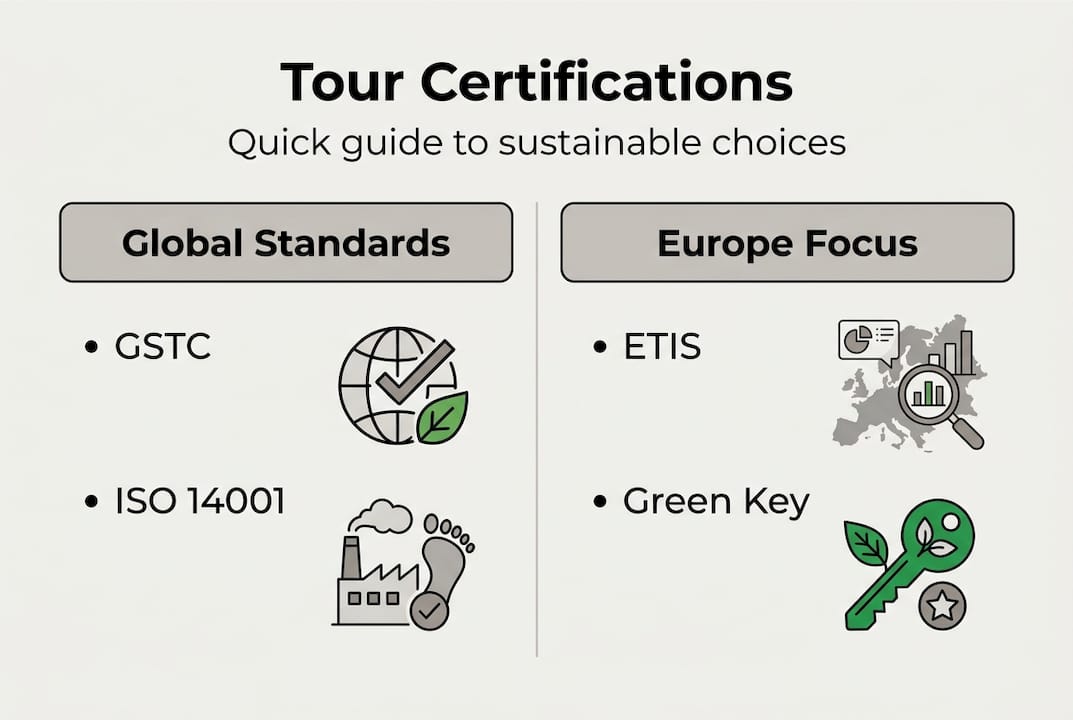
Here is a quick comparison of the most relevant certifications you will encounter when booking tours in Europe:
| Certification | Scope | What it verifies | Who uses it |
|---|---|---|---|
| GSTC | Global | Operator practices across 4 themes | Tour operators, hotels |
| Green Key | Global | Environmental management | Accommodations, attractions |
| Travelife | Global | Supply chain sustainability | Tour operators, agencies |
| EU Ecolabel | European | Environmental performance | Accommodations, campsites |
| ETIS | European | Destination-level indicators | Municipalities, regions |
A certification tells you that a standard has been applied and verified. What it does not tell you is whether the operator goes beyond the minimum required to pass. This is why tour planning frameworks that combine certifications with direct operator questions give you a more complete picture.
Here is a numbered approach to evaluating certifications when you book:
- Confirm the certification is current, not expired
- Identify the certifying body and check if it is GSTC-accredited
- Ask what specific practices the certification covers
- Request one concrete example of a community or environmental project funded through your tour
- Check if the operator publishes an annual sustainability report
Pro Tip: The GSTC website maintains a public database of accredited certification bodies. Cross-referencing an operator’s claimed certification against this database takes two minutes and can save you from a greenwashed experience.
How sustainability works on the ground: Best practices and challenges
Theory is one thing. Seeing sustainable tourism principles in action across European destinations reveals both inspiring progress and honest challenges.
Some cities are leading the way. Amsterdam has adopted Doughnut Economics as a city planning model, aiming to keep tourism within ecological limits while meeting social needs. Slovenia earned the title of Europe’s first green country destination, with its national regeneration efforts built around a Green Scheme that certifies destinations, parks, and agencies together. Dubrovnik introduced visitor caps and timed entry systems to reduce overcrowding in its UNESCO-listed old town, a direct response to mass tourism pressure.

The European Green Pioneer of Smart Tourism program highlights cities using innovative approaches to balance visitor experience with community wellbeing, from sea wall restoration in Benidorm to off-season promotion strategies that spread tourist spending more evenly across the year.
Yet challenges persist. Mass tourism and carbon emissions remain deeply intertwined. Air travel to reach a destination can dwarf the carbon savings made during the tour itself. Overtouristed spots like Venice and Santorini continue to struggle with resident displacement and ecosystem stress, even as local governments introduce new fees and access restrictions.
Here is a snapshot of where European destinations currently stand:
| Destination | Key challenge | Sustainability action |
|---|---|---|
| Amsterdam | Overtourism, housing pressure | Doughnut Economics model, tourist tax increase |
| Dubrovnik | Cruise ship crowds | Daily visitor caps, timed entry |
| Slovenia | Balancing growth | National Green Scheme certification |
| Venice | Resident displacement | Day-tripper entry fee pilot |
| Benidorm | Coastal ecosystem stress | Sea wall and marine habitat restoration |
The most effective approaches share a common thread: they involve local communities in decision-making rather than imposing top-down solutions. Tours that reflect this community-centered design tend to be more authentic, more resilient, and more genuinely sustainable.
- Prioritize transportation choices that reduce emissions, such as rail over short-haul flights
- Choose customized tour options that avoid peak-season crowds at sensitive sites
- Support operators who actively contribute to local ecosystem or cultural restoration projects
“Regeneration goes beyond sustainability. It asks not just how we can do less harm, but how tourism can actively restore the places and communities it touches.”
Booking and experiencing truly sustainable tours: Practical tips
Knowing the theory is not enough. You need a practical process for vetting operators and making choices that hold up under scrutiny.
Start with a checklist of questions to ask any operator before booking:
- What certifications do you hold, and who issued them?
- What is your maximum group size, and why?
- What percentage of your guides and staff are local residents?
- Can you describe one specific environmental or community project your tours directly fund?
- How do you measure and report your carbon footprint?
- What is your policy for avoiding overtouristed sites during peak season?
Warning signs of greenwashing include: broad claims with no supporting data, no mention of specific certifications, a lack of local staff or partnerships, and an inability to describe measurable impact. Verifying certifications and asking for specifics is the single most effective defense against being misled.
When choosing tour types, off-peak and community-run experiences tend to score higher on genuine sustainability. They distribute economic benefit more evenly, reduce pressure on fragile sites, and often deliver a richer cultural experience because you are engaging with places and people outside the tourist bubble.
Pro Tip: Research shows that tourism efficiency benchmarks vary significantly between operators of similar size. Asking for a sustainability report or impact summary is a reasonable request that any serious operator should be able to fulfill.
It is also worth recognizing the limits of individual action. Your choices matter, but systemic change requires operators, governments, and industry bodies to raise the baseline for everyone. When you compare tour providers, look for those who advocate publicly for higher industry standards, not just those who market their own credentials.
- Book local and small-group tours wherever possible
- Avoid single-use plastic on tours and ask operators about their waste policies
- Support guides who are community members, not outside contractors
- Choose destinations and seasons that reduce pressure on overtouristed sites
Most travelers miss this: The real impact of sustainable tours in Europe
Here is something most sustainability guides will not tell you directly: placing all the responsibility on individual travelers is itself a form of misdirection. The carbon footprint concept was popularized in part by fossil fuel companies to shift focus away from systemic industry emissions. The same dynamic plays out in tourism.
Your personal choices are meaningful, but they operate within a system that greenwashing can corrupt at every level. Even well-intentioned travelers can be misled by operators who have mastered the language of sustainability without the substance. The shift toward regeneration in destination management thinking reflects a growing recognition that tourism must actively restore communities and ecosystems, not merely reduce its damage.
The most powerful thing you can do is support operators who push for systemic change: those who lobby for better industry standards, publish transparent impact data, and design tours around tour planning principles that put community benefit at the center. Sustainable tourism done right is not about guilt-free travel. It is about travel that leaves places genuinely better than it found them.
Plan your sustainable European tour with Next View Tours
Ready to put these insights into action? At Next View Tours, we design experiences across Europe with transparency, local expertise, and genuine community connection at the core. Whether you are drawn to nature, history, or cultural discovery, our range of eco-friendly trip types gives you options that align with real sustainability principles.

Explore our expert tour comparisons to see how different operators approach sustainability, or work with us to build customized sustainable tours tailored to your values, travel style, and preferred destinations across Austria, the Czech Republic, Slovakia, Hungary, and beyond. Your next journey can be one that truly gives back.
Frequently asked questions
What are the main differences between a sustainable and a regular tour?
A sustainable tour intentionally benefits local communities, minimizes environmental impact, and meets recognized standards, while regular tours may not address these factors at all.
How can I tell if a tour operator is truly sustainable?
Look for independent certifications like GSTC accreditation, transparent impact metrics, and specific descriptions of environmental and community actions rather than vague marketing language.
Does traveling sustainably cost more?
Some sustainable options carry higher upfront costs, but they often maximize local benefit and can reduce expenses by steering you away from peak-season markups and mass-tourism pricing at overcrowded sites.
Are there truly zero-impact tours?
All travel carries some footprint; the realistic goal is regeneration, meaning tours that actively contribute to local conservation or community restoration rather than simply minimizing harm.


Comments are closed