

 Uncategorized
TL;DR:
- A seven-day trip in Europe efficiently explores two or three iconic cities, balancing sightseeing with cultural depth.
- Choosing well-connected cities and using high-speed trains help maximize time and minimize fatigue during the journey.
A 7 day Europe trip is the most efficient way to experience two or three of the continent’s iconic cities without burning through your vacation time. Seven days gives you enough depth to feel each place rather than just photograph it. The right approach covers destinations like Paris, Rome, and Barcelona while keeping travel fatigue low and cultural richness high. This guide walks you through city selection, transportation, daily pacing, budgeting, and the practical details that separate a memorable week from an exhausting one.
How to choose the best cities for a 7 day Europe trip
The single most important decision you make is which cities to visit. Choose wrong and you spend half your week on trains or in airports. Choose well and every day feels full without feeling rushed.
19 of the top 50 cities globally are in Europe, which means you have genuine options at every interest level. That concentration of world-class destinations is what makes a one-week Europe itinerary so rewarding compared to other regions.
The strongest starting point for most travelers is a two or three city combination. London, Paris, and Berlin rank as the top European cities for visitors in 2026, measured by livability and cultural appeal. London alone scored nearly 99% approval for arts and culture in 2026 visitor surveys. That number reflects how consistently the city delivers across museums, restaurants, green spaces, and everyday street life.
When selecting your cities, weigh these criteria:
- Travel time between cities. Aim for connections under four hours by train or one hour by flight. Paris to London via Eurostar takes about two and a half hours city center to city center.
- Cultural balance. Mix a history-heavy city like Rome with a design-forward one like Barcelona to keep each day feeling fresh.
- Personal interests. Art lovers should prioritize Paris and Vienna. Food travelers get more from Barcelona and Bologna. Nature seekers can swap one city for the Swiss Alps or the Austrian lakes.
- City size and walkability. Compact cities like Prague or Salzburg reward slow exploration. Larger cities like London need more planning to avoid wasted transit time.
One underrated combination is Vienna, Salzburg, and Prague. All three cities connect by train in under three hours, they share a Central European cultural thread, and costs run lower than Western Europe. Nextviewtours operates day trips and multi-day itineraries across exactly this corridor, which makes planning far simpler than piecing it together alone.
Pro Tip: Limit yourself to two cities if this is your first time in Europe. Three cities in seven days is achievable, but two cities done well beats three cities done poorly every time.
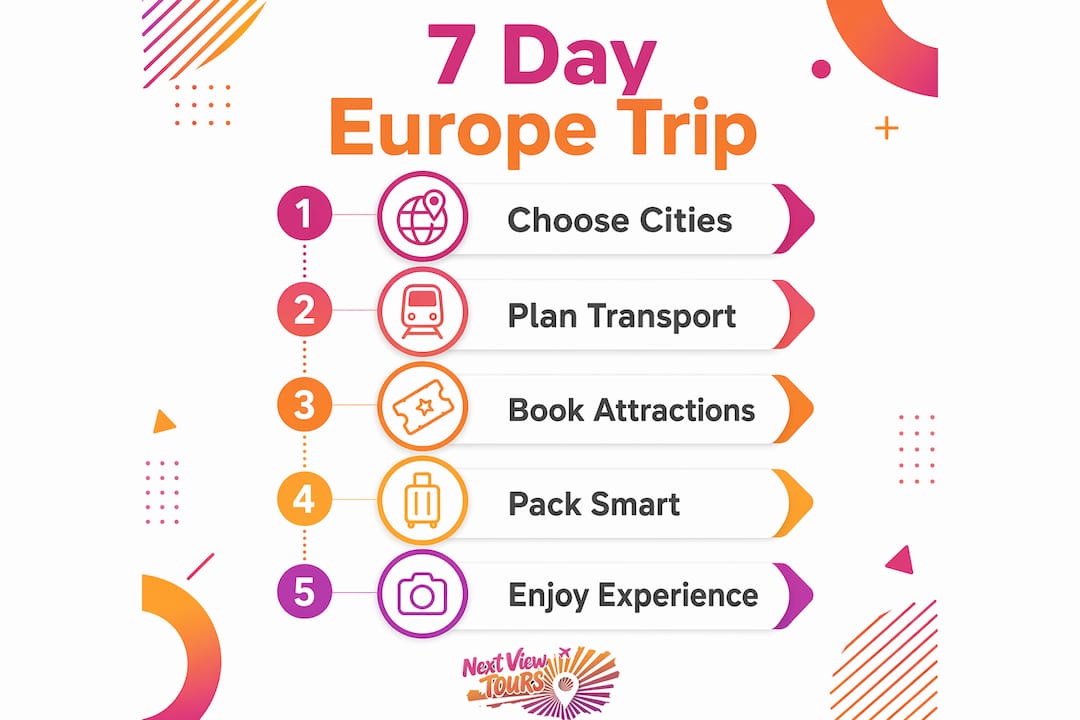
What is the best way to get between European cities?
Transportation is where most one-week itineraries lose time. The instinct to fly between cities feels efficient, but airport security, boarding, and transit add 2–3 hours to every flight. On a seven-day trip, that overhead eats a meaningful share of your available hours.

High-speed rail solves this problem on most Central and Western European routes. The train drops you at a city center station, not an airport 45 minutes from the action. You board 10 minutes before departure, not 90. Rail travel in Europe remains a sustainable, efficient choice that genuinely improves the quality of condensed itineraries.
Follow these steps to get transportation right:
- Book trains at least four to six weeks out. High-speed rail tickets on routes like Paris to Amsterdam or Vienna to Prague sell out and rise in price quickly.
- Use early morning departures. A 7:00 AM train between cities puts you at your next destination by mid-morning, preserving the full afternoon for sightseeing.
- Buy city transit passes on arrival. London’s Oyster card, Paris’s Navigo pass, and Vienna’s 72-hour transit card all pay for themselves within a day of regular use.
- Choose hotels near central train stations. This cuts intra-city transit time and makes luggage management far less stressful.
- Account for realistic transfer times. Underestimating airport and intra-city transfer times is the single most common cause of missed connections and lost sightseeing hours.
Flying makes sense for longer jumps, like London to Rome or Barcelona to Vienna, where the distance genuinely favors air travel. On those routes, book the earliest available flight and select airports closest to the city center.
Pro Tip: When booking a multi-city trip, price a single multi-leg rail pass against individual tickets. For three or more train journeys, a regional pass often saves both money and booking time.
How to build a daily itinerary that actually works
A strong daily structure follows a simple rule: two to three days per city, with the first day dedicated to orientation and the last day kept light for travel. Popular 7-day itineraries allocate two days in Paris, two in Rome, and three in Barcelona, and that rhythm works because it gives each city enough time to breathe.
Structure each city stay around these priorities:
- Day one in any city: Arrive, check in, walk the main neighborhood on foot, and eat one excellent local meal. Skip the major museums. Let the city introduce itself.
- Peak days: Hit the two or three landmarks that define the city. In Paris, that means the Louvre and the Eiffel Tower area. In Rome, the Colosseum and Vatican. In Vienna, the Belvedere and the Ringstrasse. Book timed entry tickets in advance for every major site.
- Afternoon rhythm: Alternate between structured sightseeing and unstructured wandering. The best travel memories often come from a market, a side street, or a café you found by accident.
- Departure day: Keep it free of major commitments. Use the morning for a final neighborhood walk or a relaxed breakfast, then head to your station or airport without rushing.
Travelers now prioritize unique cultural, culinary, and local experiences over simply ticking landmarks. That shift matters for how you plan each day. One afternoon at a local food market or a guided neighborhood walk often delivers more satisfaction than a fourth museum in a row.
For cultural activities worth building your schedule around, Nextviewtours has curated a list of must-try cultural experiences across Europe that fit neatly into a one-week format.
What does a 7 day Europe trip actually cost?
Budget is the variable that shapes every other decision. A 7-day multi-city Europe trip costs roughly $750–$1,200 for budget travelers and $1,500–$2,500 for mid-range experiences, excluding international airfare. Switzerland runs significantly higher than Central Europe or Portugal on every cost category.
| Traveler type | Estimated daily spend | Best-value destinations |
|---|---|---|
| Budget | $107–$171 per day | Prague, Budapest, Lisbon |
| Mid-range | $214–$357 per day | Paris, Barcelona, Vienna |
| Premium | $400+ per day | Zurich, London, Swiss Alps |
Timing shapes cost as much as destination choice. May, June, and September are the optimal months to visit Europe, offering good weather and smaller crowds compared to the July and August peak. Shoulder season travel also means lower hotel rates and easier access to popular sites without advance booking pressure.
A few specific ways to reduce costs without reducing quality:
- Book accommodations with breakfast included. One less meal to budget for each day adds up across a week.
- Eat lunch at restaurants and dinner at markets or casual spots. Lunch menus in France, Spain, and Austria often include two or three courses at half the dinner price.
- Use free museum days. Most major European museums offer free entry one evening per week or one day per month.
- Read up on booking a weekend stay strategically to find the best accommodation deals for short European trips.
Winter travel brings lower prices but shorter days and some attraction closures. Peak summer brings crowds, heat, and prices that can push mid-range budgets into premium territory.
Common challenges and how to avoid them on a one-week trip
Fast-paced itineraries carry real risks. Three-city 7-day trips require comfort with early mornings, frequent hotel changes, and packing light. Without that preparation, travel fatigue sets in by day four and the final days feel like obligations rather than experiences.
The most common pitfalls and how to handle them:
- Overpacking. A carry-on only approach eliminates checked baggage fees, speeds up every transit, and removes the stress of dragging large bags through train stations. Pack for five days and do laundry once.
- Ignoring hotel location. A cheap hotel 40 minutes from the city center costs you 80 minutes of travel per day. That time is worth more than the savings.
- Rigid scheduling. Build one free afternoon into every city stay. If a neighborhood grabs you, stay longer. If a museum disappoints, leave early. Flexibility is the difference between a good trip and a great one.
- Skipping health basics. Carry a small kit with pain relief, blister plasters, and any prescription medication. European pharmacies are excellent, but finding one when you need it wastes time.
“The travelers who enjoy multi-city trips most are the ones who treat the itinerary as a framework, not a contract. Plan well, then hold the plan loosely.”
Pro Tip: Use Google Maps offline downloads for every city before you arrive. Real-time navigation without data roaming saves money and works even in underground transit systems.
For more detailed day-by-day planning advice, Nextviewtours offers expert tips for day trip itineraries that apply directly to multi-city European weeks.
Key Takeaways
A successful 7 day Europe trip depends on choosing two to three well-connected cities, using high-speed rail over short-haul flights, and building daily schedules that balance landmarks with genuine local experience.
| Point | Details |
|---|---|
| Limit city count | Two to three cities gives enough depth; more cities increases fatigue and transit time. |
| Choose rail over flying | High-speed trains save 2–3 hours per journey compared to flying between nearby cities. |
| Travel in shoulder season | May, June, and September offer the best weather, smaller crowds, and lower prices. |
| Budget realistically | Expect $750–$1,200 for budget travel and $1,500–$2,500 for mid-range, excluding airfare. |
| Prioritize location | Staying near central train stations cuts daily transit time and simplifies luggage logistics. |
What I’ve learned from planning multi-city European weeks
After planning and running multi-city European itineraries across Vienna, Salzburg, Prague, Budapest, and beyond, the lesson that keeps proving itself is this: quality of experience beats quantity of cities, every single time.
Travelers who arrive with a tight three-city plan often spend their energy managing logistics rather than absorbing what’s around them. The ones who arrive with two cities and genuine curiosity come home with stories. They found the wine bar behind the cathedral. They spent an extra hour in a gallery because the guide said something that changed how they saw the whole collection.
I also think the planning phase matters more than most travelers realize. Knowing your rail connections, your hotel neighborhoods, and your two or three non-negotiable experiences per city before you land removes the daily friction that drains energy. You can be spontaneous within a well-planned structure. You cannot recover lost days from poor planning.
The other thing worth saying plainly: Europe rewards slow attention. Infrastructure like the Grand Paris Express and London’s transit upgrades keep these cities genuinely livable and easy to move through. Use that infrastructure. Walk more than you think you need to. The best version of any European city reveals itself at street level.
— Next
Plan your ideal European week with Nextviewtours
Nextviewtours specializes in exactly the kind of trip this article describes: multi-city European experiences built around real cultural depth, efficient logistics, and itineraries that fit your pace and budget.
Whether you want a private tour with a personal guide through Vienna and Salzburg, a group experience across Central Europe, or a custom itinerary that mixes city days with nature escapes, Nextviewtours has a format that fits. Browse the full range of trip types and formats to find the option that matches your interests, travel style, and available days. Expert guidance makes the difference between a trip you planned and a trip you remember.
FAQ
How many cities can you realistically visit in 7 days in Europe?
Two to three cities is the realistic range for a 7 day Europe trip. Three cities works if they connect by train in under three hours; two cities allows a more relaxed and rewarding pace.
Is high-speed rail better than flying between European cities?
High-speed rail is generally more efficient than flying for routes under 600 miles. Airport overhead adds 2–3 hours per journey, while trains connect city centers directly with minimal wait time.
What is the best time of year for a one-week Europe itinerary?
May, June, and September offer the best combination of good weather, manageable crowds, and reasonable prices. July and August bring peak crowds and higher costs across most major destinations.
How much does a 7 day Europe trip cost without flights?
Budget travelers spend roughly $750–$1,200 for seven days, while mid-range travelers spend $1,500–$2,500. Switzerland and London run higher; Central European cities like Prague and Budapest run lower.
Do I need to book attractions in advance for a Europe trip?
Yes. Major sites like the Colosseum in Rome, the Louvre in Paris, and the Belvedere in Vienna require timed entry tickets booked well in advance, especially during spring and summer travel.


Comments are closed