
 Uncategorized
For families traveling to Europe in 2025, private or purpose-built small-group family tours are the clearest path to a trip that actually works with kids. They give you control over pace, guarantee child-friendly logistics, and remove the guesswork from daily planning. Private tours let families include babysitting, private transfers, and activity swaps that standard group departures simply cannot accommodate. Small-group family departures offer a practical middle ground when budget matters.
Here is what you can expect from this guide:
- Tour types explained: private, small-group, and self-guided options with clear decision rules
- Sample itineraries: 7-, 10-, and 14-day blueprints with day-by-day notes and age-swap ideas
- Booking timeline: when to lock in flights, tours, and guides for 2025 peak and shoulder seasons
- Operator checklist: questions to ask, red flags to watch for, and hidden costs to clarify
- Practicalities: packing, safety, health, jet lag, and documentation for U.S. families
- Cultural tips: child-friendly etiquette and emergency services across European countries
Table of Contents
- What types of family tours in Europe actually fit your family?
- Sample kid-friendly itineraries for Europe trips
- How do you pick a family-friendly tour operator?
- Booking timing, costs, and logistics for U.S. families in 2026
- Packing, safety, and health tips for families touring Europe
- Why private, customizable tours make family travel easier
- Emergency services and medical care across Europe
- Cultural considerations and child-friendly etiquette in Europe
- Key Takeaways
- What planning family trips has taught me about slowing down
- Plan your family trip to Europe with Nextviewtours
- Useful sources and next reads
What types of family tours in Europe actually fit your family?
Three formats dominate the market for families, and each suits a different travel style.
Private and bespoke tours give your family the entire vehicle, guide, and itinerary. You set the pace, choose the restaurants, and swap any activity that does not suit your kids’ ages. This format works best for families with children under eight, mixed-age groups spanning toddlers and teens, or anyone who needs accessibility accommodations. The trade-off is cost: private tours run higher per person than shared departures, though the per-family price often becomes competitive once you factor in four or five travelers.
Small-group family departures gather several families on a shared itinerary designed specifically for children. Guides are trained for mixed-age groups, and the schedule already builds in slower pacing and kid-friendly stops. Budget-conscious families with children aged six and up tend to find this format the best balance of value and structure.
Self-guided and flexible packages provide pre-booked accommodation, transport passes, and suggested daily routes, but no guide. You move at your own speed and make daily decisions on the ground. This suits confident travelers with older children (ten and up) who enjoy spontaneity, though it demands more pre-trip research and a higher tolerance for logistical surprises.
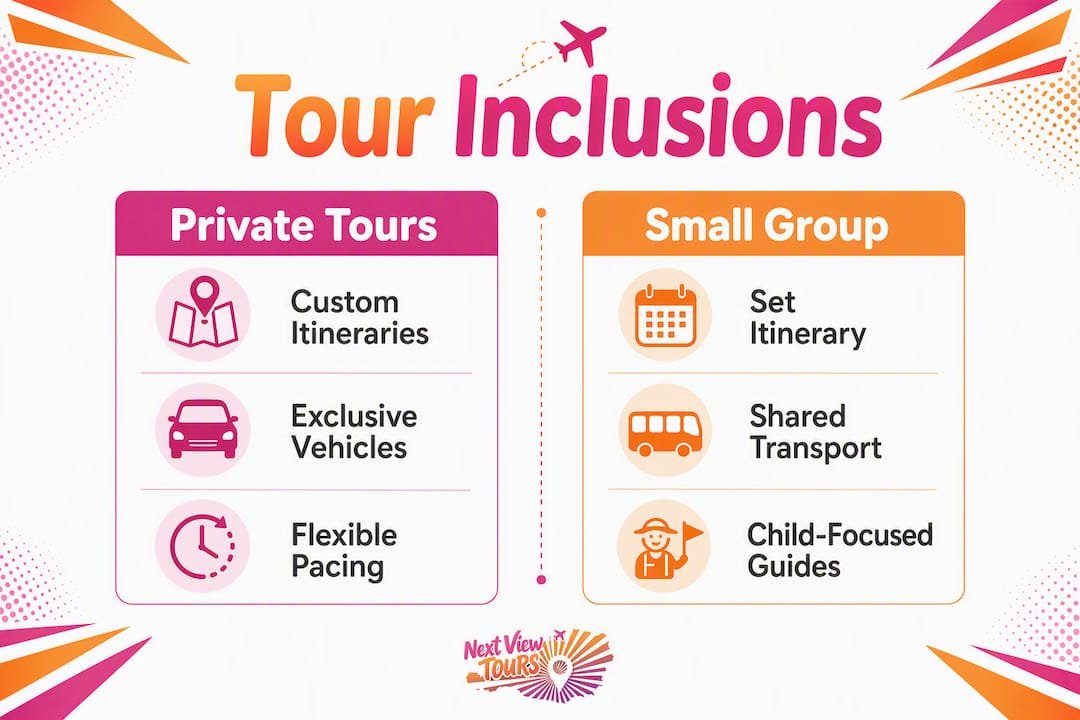
Typical inclusions by tour type
- Private tours: — family rooms, private airport transfers, babysitting on request, kid-friendly restaurant pre-booking, activity swaps, flexible daily start times
Pro Tip: Mix formats within a single trip. Use a private guide for high-density cities like Vienna or Prague, where navigating crowds with young children is exhausting, then switch to a self-guided coastal or countryside segment where the pace is naturally slower and the environment is more forgiving.
When comparing formats, the difference between group and private tours often comes down to one question: how much daily flexibility does your family genuinely need?
Sample kid-friendly itineraries for Europe trips
These three blueprints are starting points, not rigid scripts. Each includes a pacing note and age-swap suggestions so you can adapt them to your children’s ages and energy levels.
7-day itinerary: Vienna and Hallstatt
Day 1: Arrive Vienna, private transfer to hotel, easy neighborhood walk, early dinner
Day 2: Morning at the Schönbrunn Palace gardens (interactive for all ages); afternoon at the Natural History Museum; evening stroll along the Ringstrasse
Day 3: Day trip to Klosterneuburg or the Vienna Woods; picnic lunch; return for a relaxed evening
Day 4: Train to Hallstatt (approx. 3.5 hours); check in, lake walk, boat ride
Day 5: Salt mine tour (minimum age typically 4); afternoon free at the lake; local dinner
Day 6: Return to Vienna; afternoon at the Prater (giant Ferris wheel, amusement park)
Day 7: Departure
Age swap: For preschoolers, replace the salt mine with a lakeside nature walk and a boat rental. For teens, add a half-day hike above the village with a local guide.
10-day itinerary: Prague, Salzburg, and the Austrian countryside
Days 1–3: Prague. Old Town Square, the Astronomical Clock, and a boat ride on the Vltava. Afternoon visits to the Prague Zoo (one of Europe’s largest). Evening puppet show at a traditional theater.
Day 4: Train to Salzburg (approx. 4.5 hours). Check in, Mozart’s birthplace, Mirabell Gardens.
Days 5–6: Salzburg base. Sound of Music filming locations (a genuine hit with kids aged 8 and up), Hohensalzburg Fortress, and a half-day at Hellbrunn Palace with its trick fountains.
Day 7: Day trip into the Salzkammergut lake district. Slower pace, swimming or kayaking depending on season.
Days 8–9: Drive or train into the Austrian countryside. Farm stay or village accommodation; hiking, cycling, or local cooking class.
Day 10: Return to Salzburg or Vienna for departure.

Age swap: Toddlers do best with the gardens and boat rides; skip the fortress climb and substitute a horse-drawn carriage ride. Teens can add a guided cycling day in the Salzkammergut.
14-day itinerary: Central Europe multi-region with rest days
Days 1–3: Budapest. Buda Castle, the thermal baths (family pools at Széchenyi), a Danube river cruise, and the Hungarian Natural History Museum.
Days 4–5: Slow train through Slovakia. Stop in Bratislava for a half-day castle visit and old town walk. Overnight in a family-friendly guesthouse.
Days 6–8: Vienna. Schönbrunn, the Kunsthistorisches Museum (excellent children’s programs), and a day trip to Baden or the Wachau Valley.
Day 9: Rest day in Vienna. No scheduled sightseeing. Playground, local market, or a cooking class.
Days 10–12: Prague. Boat trips, the zoo, and a day excursion to Český Krumlov (fairy-tale castle, river rafting for older kids).
Day 13: Flexible buffer day for weather delays or a spontaneous detour.
Day 14: Departure from Prague.
Age swap: For families with children under five, cut Bratislava and use that day as a second rest day in Vienna. For teens, add a guided street-art walk in Budapest and a kayaking afternoon in Český Krumlov.
Trip comparison at a glance
| Trip length | Recommended min. child age | Pacing | Typical price band (per person) |
|---|---|---|---|
| 7 days | 3+ | Relaxed | Price varies by group size and accommodation |
| 10 days | 5+ | Moderate | Price varies by group size and accommodation |
| 14 days | 6+ | Moderate/active | Price varies by group size and accommodation |
Pricing bands reflect private-tour estimates and vary by group size, accommodation standard, and season. Per-family pricing for a group of four often reduces the per-person figure meaningfully. Nextviewtours publishes family-friendly tour ideas with sample itineraries and activity-swap options across these regions.
How do you pick a family-friendly tour operator?
The operator you choose shapes every day of your trip. A checklist makes the evaluation faster and more consistent.
Operator evaluation checklist
- Does the operator have documented experience running tours for families with children your ages?
- Are itineraries paced for kids, with built-in rest time and flexible start times?
- Do inclusion lists specify family rooms (not just double rooms), child menus, and private transfers?
- Are local guides trained to engage children, not just adults?
- Is there a clear protocol for medical emergencies, including contacts for local clinics and hospitals?
- What is the cancellation policy, and does it account for illness-related changes common with children?
- Does the operator offer trip cancellation and medical insurance, or clearly recommend a provider?
Questions to ask before you book
- What is the minimum age for each activity on the itinerary?
- How do you handle activity swaps if a child cannot participate?
- Are family rooms guaranteed, or subject to availability?
- Can babysitting be arranged, and what does it cost?
- Who is our point of contact if something goes wrong on the ground?
- What local taxes, optional excursions, or single-room supplements are not included in the quoted price?
- How much walking is involved each day, and is there a slower-pace option?
Red flags to watch for
- Vague inclusion lists that use phrases like “accommodation as described” without specifying room type
- No mention of child-specific activities or minimum age guidance
- No local guide support, only a remote customer service line
- Itineraries that schedule six or more hours of sightseeing daily with no rest periods
- Operators who cannot answer the minimum-age question for specific activities
Hidden costs catch many families off guard. Single-room supplements, optional excursions priced separately, local city taxes (common in Vienna, Prague, and Budapest), and gratuities for guides and drivers can add meaningfully to a quoted price. Ask for a full cost breakdown before paying a deposit. Nextviewtours’ guidance on customizing private tours includes a practical checklist of what to confirm before finalizing any itinerary.
Booking timing, costs, and logistics for U.S. families in 2026
When to book
Nextviewtours advises booking flights and main tour components 6–9 months ahead of peak summer travel. For a July or August departure, that means locking in the core itinerary by October or November of the prior year. Shoulder-season departures (April through May, or September through October) allow more flexibility, with good availability often remaining 3–4 months out.
School-holiday windows drive the tightest inventory. U.S. spring break (late March through April) and summer (mid-June through August) align with European peak season, when family-friendly accommodations and guided experiences sell out fastest. Early autumn is the sweet spot for families who can travel outside the traditional school calendar: crowds thin, temperatures stay comfortable across Central Europe, and prices ease.
Seasonality and pacing
| Season | Months | Crowd level | Typical weather | Best for |
|---|---|---|---|---|
| Spring shoulder | April–May | Moderate | Mild, some rain | Younger kids, city tours |
| Summer peak | June–August | High | Warm to hot | All ages, outdoor activities |
| Early autumn | September–October | Low–moderate | Warm, stable | Older kids, hiking, cycling |
| Winter | November–March | Low | Cold, some snow | Festive markets, fewer crowds |
Typical cost ranges and inclusions
Private family tours across Central Europe generally run $1,800–$3,200 per person for 7 days and $3,800–$6,500 per person for 14 days, depending on accommodation standard and group size. A family of four on a private tour often pays less per person than two adults on a luxury small-group departure, because the per-group cost is split four ways.
Standard inclusions in well-structured family packages typically cover: private airport transfers, daily guided activities, family-room accommodation, breakfast, and a 24/7 support contact. Lunches, dinners (beyond select meals), optional excursions, and gratuities are usually extra.
Logistics checklist for U.S. families
- Passports: All U.S. citizens need a valid passport. Children require their own individual passport, regardless of age. Renew any passport expiring within six months of your return date.
- Visa requirements: U.S. citizens do not need a visa for short stays (up to 90 days) in most European countries, including Austria, Czech Republic, Hungary, and Slovakia. The EU’s ETIAS travel authorization system is expected to launch for U.S. travelers; check the official EU ETIAS site for the current status before booking.
- Train travel with kids: European rail networks are excellent for families. Book reserved seats in advance, especially on high-speed routes. Most trains have family compartments or designated quiet zones.
- Car seats: If your itinerary includes private vehicle transfers, confirm with your operator that child car seats appropriate for your children’s ages and weights are provided. European regulations require car seats for children up to 135 cm in height.
- Airport transfers: Pre-book private transfers for arrival days, especially with young children and luggage. Shared shuttles save money but add unpredictability when kids are tired and jet-lagged.
Packing, safety, and health tips for families touring Europe
Family packing essentials
- Documents folder: passports, travel insurance cards, emergency contacts, printed hotel confirmations, and a copy of each child’s birth certificate (useful for unaccompanied minor situations or medical care)
- Medicines: pediatric pain reliever, antihistamine, motion-sickness tablets, rehydration sachets, and any prescription medications with a doctor’s note translated into the local language
- Day bag for kids: small backpack with a water bottle, snacks, a comfort item, headphones, and a downloaded show or audiobook for long transfers
- Comfort items: a familiar stuffed animal or blanket for younger children makes unfamiliar hotel rooms feel safer
- Layers: European weather shifts quickly in spring and autumn; pack light layers rather than heavy jackets
Safety checklist
- Write each child’s name, your cell number, and your hotel address on a card tucked into their pocket or clipped to a bag
- Take a photo of each child each morning so you have a current image of what they are wearing if you get separated
- Teach children the local emergency number (112 works across the EU) and your hotel’s name
- Carry a basic first-aid kit: adhesive bandages, antiseptic wipes, blister pads, and a digital thermometer
- Locate the nearest pharmacy (marked with a green cross in most European countries) and clinic on arrival in each new city
Travel insurance
Check that your family travel insurance policy covers: emergency medical evacuation, trip cancellation for illness, lost luggage, and 24/7 assistance in Europe. Many standard U.S. health insurance plans provide minimal or no coverage abroad. A dedicated travel medical policy is worth the cost, particularly for families with young children.
Managing jet lag with kids
Europe is typically 6–9 hours ahead of U.S. time zones. The adjustment is harder for children under ten, who tend to wake very early for the first two or three days. Schedule your first day as a gentle arrival day with no structured sightseeing. Get outside in natural light as soon as possible after landing, keep bedtime close to the local time from night one, and avoid long naps during the day.
Pro Tip: Book your first hotel near a park or open space. A morning run or playground visit in daylight on day one resets children’s internal clocks faster than any supplement or strategy.
Nextviewtours’ group tour preparation guide covers packing lists and how to handle mixed-ability groups, which translates directly to families managing different ages and energy levels.
Why private, customizable tours make family travel easier
The case for private, customizable family tours comes down to one practical reality: children do not travel on a standard adult schedule. A private tour gives your family the flexibility to start later after a rough night, skip a museum that is not landing with your kids, and linger at the castle courtyard where everyone is genuinely engaged.
Nextviewtours builds family itineraries across Austria, Czech Republic, Hungary, Slovakia, and beyond, departing from Vienna, Salzburg, Prague, Budapest, and Hallstatt. Core features families rely on include:
- Private transfers from airports and between destinations, so no one is hauling luggage through crowded transit hubs with a tired toddler
- Family rooms confirmed at booking, not subject to availability on arrival
- Activity swaps built into the planning process, so a museum visit can become a cooking class or a boat ride depending on the day
- Local guides who know which spots genuinely captivate children and which are adult-oriented despite the marketing
- Kid-friendly restaurant pre-booking so you are not searching for a suitable dinner at 7 PM with hungry kids
Nextviewtours also accommodates slower pacing on request, childcare arrangements, and thematic itineraries (castles, nature, food, history) that give children a narrative thread to follow across the trip. Sample itinerary transparency is a standard part of the booking process: you see the day-by-day plan before paying a deposit, and adjustments are made in conversation, not after the fact.
Emergency services and medical care across Europe
Europe’s emergency infrastructure is reliable and accessible, though it varies by country. Across the EU, 112 is the universal emergency number and connects to police, fire, and ambulance services in every member state, including Austria, Czech Republic, Hungary, and Slovakia. English-speaking operators are available in most urban areas.
Austria has a well-funded public health system. Vienna’s general hospitals (Allgemeines Krankenhaus, or AKH) are among the best-equipped in Central Europe. Pharmacies are widespread and pharmacists can advise on minor ailments without an appointment.
Czech Republic maintains a strong network of public hospitals in Prague and regional cities. The emergency number is 112, and private clinics in Prague (such as the Canadian Medical Center) offer English-language services, though at higher out-of-pocket costs.
Hungary provides public emergency care through its national system, with 112 as the primary number. Budapest’s larger hospitals have English-speaking staff in emergency departments. Travel insurance with medical evacuation coverage is particularly worth having here, as private care costs can be significant for non-EU visitors.
Slovakia operates a public health system with 112 for emergencies. Bratislava has several hospitals with English-speaking staff. Rural areas have fewer English-language resources, so carrying a translated medical summary for children with any health conditions is practical.
For non-emergency situations, pharmacies across all four countries can handle minor illnesses, fevers, and travel-related complaints. Bring a list of your children’s medications by generic name (not just brand name), as European pharmacies stock different brand equivalents.
Cultural considerations and child-friendly etiquette in Europe
European cultures are generally welcoming to families, but a few norms differ from what U.S. families expect.
Noise levels in public spaces tend to be lower than in the U.S., particularly in restaurants, museums, and public transport. Children running or shouting in a quiet restaurant will draw attention. Choosing family-oriented restaurants (often marked as “family-friendly” or located near parks and tourist areas) avoids most friction.
Meal timing shifts later across Central Europe. Lunch is typically 12–2 PM and dinner rarely starts before 7 PM. With young children, eating at the early end of these windows is practical and usually means quieter, less crowded restaurants.
Tipping customs vary. In Austria and Czech Republic, rounding up the bill or leaving 5–10% is standard. Hungary follows a similar convention. Slovakia is less tip-dependent. Tipping in cash is preferred even when paying by card.
Museum and historic site etiquette is taken seriously. Many European museums ask visitors to keep voices low, avoid touching exhibits, and follow designated routes. Preparing children in advance with a brief explanation of what they will see and why it matters makes the visit more engaging and reduces the chance of a difficult moment.
Food allergies and dietary needs are increasingly well understood in urban European restaurants, but less so in rural areas. Carry a translated allergy card for any child with a serious allergy. Apps like Google Translate handle menu translation reliably, and most family-oriented restaurants in tourist areas offer English menus.
Dress codes at religious sites (churches, cathedrals) require covered shoulders and knees for adults and older children. Carrying a light scarf or a spare layer in your day bag solves this without planning ahead for every visit.
Key Takeaways
Private and customizable family tours are the most practical choice for U.S. families visiting Europe in 2025, especially for children under eight, because they guarantee flexible pacing, confirmed family rooms, and kid-focused logistics from the first day.
| Point | Details |
|---|---|
| Book early for peak season | Reserve flights and tour components 6–9 months ahead for summer departures; shoulder seasons allow 3–4 months. |
| Choose private for youngest kids | Private tours confirm family rooms, activity swaps, and babysitting in advance, reducing on-trip stress. |
| Use the operator checklist | Ask about minimum ages, activity swaps, hidden costs, and emergency protocols before paying any deposit. |
| Pack documents and medicines carefully | Every child needs their own passport; carry medications by generic name and a translated allergy card. |
| Nextviewtours for customized itineraries | Nextviewtours builds private family tours across Central Europe with transparent day-by-day itineraries and confirmed inclusions. |
What planning family trips has taught me about slowing down
The most common mistake families make when designing a European trip is treating it like a highlights reel. Ten cities in fourteen days sounds ambitious on paper. By day five, the kids are done, the parents are managing logistics instead of experiencing anything, and the itinerary becomes something to survive rather than enjoy.
The families who come back genuinely happy from Central Europe trips are the ones who chose depth over breadth. Three or four destinations with real time in each, a rest day built in without apology, and at least one afternoon with no plan at all. That is where the memorable moments actually happen: a spontaneous boat ride, a local bakery the guide knows, a castle courtyard where the kids ran free for an hour while the adults finally exhaled.
Mixed-age groups need the most deliberate pacing. When a family spans a five-year-old and a fourteen-year-old, the instinct is to split activities or rush through the younger child’s needs to get to the teen’s interests. A better approach is to find experiences that genuinely work across ages: boat trips, castle walks, food markets, and nature trails tend to land well from age four to forty. Reserve the specialized teen activity (kayaking, a street-art tour, a cooking class) for one afternoon while the younger child naps or rests at the hotel.
One practical note from the planning side: off-peak reservations at popular sites are worth every extra minute of coordination. Schönbrunn Palace at 9 AM before the tour buses arrive is a completely different experience from the same palace at 11 AM. Your guide can usually arrange early entry or timed tickets that the general public cannot access. Ask specifically for that when you are building the itinerary.
Plan your family trip to Europe with Nextviewtours
Nextviewtours offers something most family travel packages in Europe do not: a genuinely customized itinerary built around your children’s ages, interests, and pace, not a fixed group schedule you adapt to. The planning process starts with a conversation, not a catalog.

After your initial inquiry, the Nextviewtours team drafts a day-by-day itinerary for your family, incorporating your preferred destinations, activity types, and any special requirements (dietary needs, accessibility, babysitting). You review and adjust before any deposit is collected. The booking timeline is clear, the inclusions are specified in writing, and your local guide is confirmed in advance.
Families traveling from the U.S. to Central Europe, including Austria, Czech Republic, Hungary, and Slovakia, can browse trip types and private tour options to see the range of formats available. For families ready to go deeper on customization, the customized tours guide walks through exactly how the process works and what you can request. Reach out to start building your family’s 2025 itinerary now.
Useful sources and next reads
- Family tours explained: creating unforgettable Europe trips — Nextviewtours overview of what family tours include and how they differ from standard group departures
- Best family-friendly tour ideas for Europe trips — Nextviewtours collection of sample itineraries and activity-swap options
- How to customize family tours in Europe for every interest — Nextviewtours practical guide to age adjustments and bespoke touches
- Why book family tours for Europe trips — Nextviewtours booking timeline guidance and school-holiday planning advice
- Top tips for private tours: plan your perfect European adventure — Nextviewtours planning advice for families using private tours
- Guided tours trends 2025: immersive, sustainable, social — Nextviewtours context on 2025 traveler preferences and activity choices
- EU ETIAS travel authorization — Official EU site for U.S. travelers checking visa and travel authorization requirements before booking


Comments are closed