

 Uncategorized
TL;DR:
- Self-guided tours allow travelers to explore independently using curated tools like apps, audio, or GPS files. They are ideal for flexible, private, and budget-conscious trips across Europe, offering control over pace and timing. Reliable providers offer emergency support and offline maps to ensure safety and seamless navigation.
A self-guided tour is an independent travel experience where you explore a destination using curated tools — mobile apps, downloadable audio, printed booklets, or GPX route files — rather than following a live guide. For international travelers booking European tours, it’s the right format when flexibility, privacy, or pace matters more than real-time Q&A.
At a glance:
- Mobile app tours: streaming or offline, often with geofenced audio triggers
- Downloadable audio tracks: listen at your own speed, pause and rewind freely
- Printed or PDF itineraries: low-tech, reliable, no battery required
- GPX/KML route files: import into mapping apps for offline GPS navigation
- Hybrid options: app plus local contacts, or audio plus pre-booked tickets
Reputable paid providers add a 24-hour local emergency contact so you’re never truly on your own, even when exploring independently.
Table of Contents
- What does a self-guided tour actually look like in practice?
- Why self-guided tours work so well for European travel
- What are the real drawbacks, and how do you stay safe?
- Self-guided or guided? A quick decision checklist
- How to plan and prepare for a self-guided tour step by step
- What does a paid self-guided tour typically cost, and what’s included?
- What technology features should you expect from a reputable provider?
- Timing is the secret weapon: a note from Nextviewtours
- Key Takeaways
- How Nextviewtours blends self-guided and guided options
- Nextviewtours: guided and customized tours across Europe
- Useful sources and further reading
What does a self-guided tour actually look like in practice?
The format varies more than most travelers expect. A self-guided tour can mean anything from a smartphone app that narrates each stop automatically to a laminated map tucked into your jacket pocket. What they share is a curated structure you follow at your own pace.
- Mobile app tours use GPS and geofencing to trigger audio or text the moment you arrive at a specific location — no tapping required.
- Downloadable audio tracks work offline and pair well with a simple map; ideal when data roaming is expensive.
- PDF or printed booklets suit travelers who prefer analog reliability, especially in historic centers where signal can drop.
- GPX/KML files are exportable route formats you import into apps like Maps.me or Gaia GPS for turn-by-turn offline navigation.
- Hybrid products combine a digital guide with pre-booked entry tickets and a local contact number — the closest thing to a guided tour without the fixed schedule.
| Format | Ease of use | Storytelling depth | Offline reliability | On-trip support |
|---|---|---|---|---|
| Mobile app (geofenced) | High | High | Medium (download required) | Varies by provider |
| Downloadable audio | Medium | High | High | None built-in |
| PDF/printed booklet | High | Medium | High | None built-in |
| GPX/KML file | Medium | Low | High | None built-in |
| Hybrid (app + contact) | High | High | Medium–High | 24-hour local contact |
A focused route of 3–5 km with 6–10 highlights typically delivers a satisfying half-day experience when paired with audio or local context.
Why self-guided tours work so well for European travel
The advantages stack up quickly, especially for international travelers dealing with jet lag, mixed-interest groups, or tight budgets.
- Flexible start times: you leave when you’re ready, not when the bus departs.
- Your own pace: linger in the Schönbrunn gardens or sprint through a gallery — no group pressure either way.
- Lower cost: removing per-person guide fees can meaningfully reduce the per-head price, particularly for families or small groups.
- Privacy: a couple or a family of four gets the experience entirely to themselves.
- Crowd avoidance: you can time your visit to a popular viewpoint for early morning or late afternoon without coordinating a group.
- Bundled logistics on multi-day trips: paid self-guided packages often include accommodation, luggage transfers, and intercity transport, closely resembling small-group trips while keeping independent pacing.
Pro Tip: Before you book, identify your single biggest priority: pace control, cost, or privacy. A city half-day usually rewards self-guided freedom; a multi-day hiking route through the Austrian Alps rewards a bundled package where logistics are handled for you.
What are the real drawbacks, and how do you stay safe?
Self-guided travel has genuine trade-offs. Knowing them in advance lets you plan around them rather than be caught off guard.
- No live Q&A: if you want to ask why a fresco was painted over or what the Habsburg crest symbolizes, a recorded audio track can’t answer back.
- Navigation errors: wrong turns happen, especially in medieval city centers where streets don’t follow logic.
- Unexpected closures: many European museums close on Mondays, and local holidays can shut entire districts without warning.
- Variable content quality: not all providers invest equally in research, audio production, or route accuracy.
- Device failure: a dead battery or cracked screen can strand you without your guide or your map.
Mitigations that actually work:
- Choose providers that offer a 24-hour local emergency contact — this is the single most important trust signal for paid self-guided products.
- Download offline maps and import your GPX/KML file before you leave the hotel.
- Save key addresses, opening hours, and ticket confirmations in a plain offline note as a backup when apps fail.
- Carry a power bank and compact headphones; a waterproof case is worth it in Atlantic-facing cities.
Pro Tip: Use one earbud only, or choose bone-conduction headphones that sit outside the ear canal. You’ll hear the audio narration clearly while staying aware of trams, cyclists, and cobblestone hazards — a small habit that makes a real difference in busy European streets.
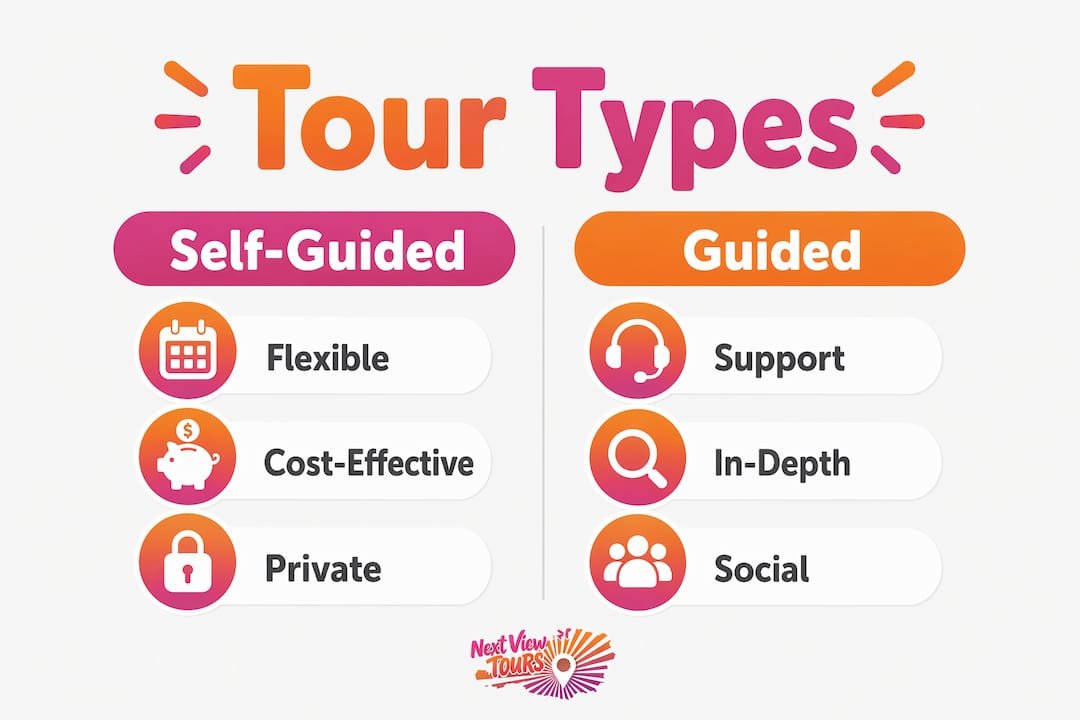
Self-guided or guided? A quick decision checklist
Use this to decide before you book, not after you arrive.
- Trip length: a single-city half-day strongly favors self-guided; a multi-stop regional itinerary with tight timing often favors guided or hybrid.
- Navigation comfort: confident with offline maps and GPX files? Self-guided works. Prefer someone else to handle routing? Go guided.
- Need for expert Q&A: if deep historical or cultural context matters to you, a live guide earns its price.
- Mobility and pacing: travelers with mobility considerations benefit from a guide who can adapt the route in real time.
- Language: self-guided audio is usually pre-recorded in your language; a live guide can switch and clarify on the spot.
- Budget: self-guided typically costs less per person, especially for groups of three or more.
- Support needs: solo traveler in an unfamiliar city? A provider with 24-hour local contact closes most of the safety gap.
Quick rules of thumb by traveler type:
| Traveler type | Recommended format |
|---|---|
| Solo traveler, confident navigator | Self-guided app or hybrid |
| Family with young children | Self-guided with bundled logistics |
| Small private group wanting deep context | Private guided tour |
| Couple on a city day trip | Self-guided audio or PDF route |
How to plan and prepare for a self-guided tour step by step
Good preparation is what separates a smooth self-guided day from a frustrating one. Experts recommend plotting anchor points first and grouping stops by neighborhood to keep a realistic walking pace rather than chasing a famous-sites checklist across an entire city.
Before you travel:
- Read the full provider itinerary and note any timed-entry requirements.
- Check opening hours and confirm whether your target day is a closure day (Monday closures are common across European museums).
- Download offline maps and audio; export or import your GPX/KML file into your chosen navigation app.
- Save the provider’s local emergency contact number offline.
- Print or screenshot key confirmations so you have them without data.
Timing as a planning tool: local holidays, peak hours, and light conditions all shape the experience. The golden hour before a major cathedral or hilltop viewpoint is worth planning around. A well-designed self-guided walk balances theme, route logic, and practical notes like distances and terrain.
Pro Tip: Estimate a minimum and a likely time for each stop, then add a 10–15 minute buffer per major stop. One unexpected queue or a spontaneous detour into a side street market won’t cascade into a ruined afternoon.
What does a paid self-guided tour typically cost, and what’s included?
Pricing varies widely, but the structure is consistent across reputable providers.
Price drivers:
- Single-day vs. multi-day (multi-day packages cost more but bundle accommodation and transfers)
- Content quality: professionally recorded audio and accurate GPS files cost more to produce
- Whether pre-booked entry tickets are included or sold separately
- Per-person vs. per-group pricing (families often save significantly with flat per-group rates)
Common inclusions in paid products:
- Curated route with downloadable audio or GPX/KML
- Local emergency contact (24-hour, for reputable providers)
- Pre-booked tickets for key attractions when relevant
- Optional add-ons: airport pick-up, luggage transfers, intercity transport
Always clarify the cancellation and refund policy before you pay. European weather and local events can change plans quickly, and a flexible cancellation window is worth more than a small discount.
What technology features should you expect from a reputable provider?
The gap between a basic PDF route and a well-built app tour is significant. Here’s what product-grade self-guided technology looks like:
- Geofenced audio triggers: the app detects your location and plays the relevant narration automatically — no tapping, no searching.
- Downloadable GPX/KML: the route works offline in standard mapping apps, so signal loss in a medieval quarter doesn’t strand you.
- Background audio with progress tracking: the narration continues while your screen is locked; you can see how far through the route you are at a glance.
- Roam or suggestion mode: features like Roam Mode let you take a spontaneous detour and return to the narrative thread without losing your place.
- 24-hour local contact integration: the best providers embed the support number directly in the app so you’re never hunting for it.
Before you commit to a provider, test the demo: check whether offline download works on your device, listen to a sample audio clip for production quality, and verify GPS accuracy on a short walk near your hotel.
Timing is the secret weapon: a note from Nextviewtours
Nextviewtours runs guided and customized tours across Austria, the Czech Republic, Hungary, Slovakia, and beyond, departing from cities like Vienna, Prague, Salzburg, and Budapest. Across those routes, one planning advantage stands out above all others: timing.
Many clients combine a self-guided morning with a guided afternoon highlight on multi-day itineraries. The self-guided portion handles the atmospheric, unhurried exploration; the guided session delivers the deep historical context that a recorded track can’t replicate.
Key Takeaways
A self-guided tour gives you a curated route and expert content while keeping full control of your pace, start time, and detours — making it the strongest format for flexible European travel when paired with offline maps and a provider that offers 24-hour local support.
| Point | Details |
|---|---|
| Core definition | Independent exploration using apps, audio, GPX files, or printed routes instead of a live guide. |
| Best use case | City half-days, family trips, and multi-day packages where flexibility and privacy matter most. |
| Top pre-trip actions | Download offline maps and GPX/KML, confirm closure days, and save the local emergency contact before you leave. |
| Safety signal to look for | A 24-hour local emergency contact is the clearest trust indicator for any paid self-guided product. |
| Nextviewtours option | Offers guided, private, and customized tours across Europe for travelers who want expert logistics alongside or instead of self-guided freedom. |
How Nextviewtours blends self-guided and guided options
At Nextviewtours, we’ve seen both formats work beautifully — and both fail when mismatched to the traveler. Families consistently choose self-guided options for the flexibility: no rushing children through a timed group schedule, no guilt about spending forty minutes at one fountain. Small private groups, on the other hand, tend to choose private guided tours when they want the depth of expert Q&A and the reassurance of someone who knows the route cold.
The most satisfying itineraries we see are hybrid ones: a self-guided morning in a neighborhood market district, followed by a private guided session at a major cultural site in the afternoon. That combination captures the best of both formats without the compromises of either.
Nextviewtours: guided and customized tours across Europe
If you’ve read this far and realized you want expert logistics alongside your independence, Nextviewtours offers exactly that. Private tours, customized multi-day itineraries, and day trips departing from Vienna, Prague, Budapest, Salzburg, and beyond are available for individuals, couples, families, and small groups.
The difference from a pure self-guided product is concrete: a local expert who adapts the route in real time, pre-arranged entry to key sites, and the kind of historical depth that no audio track fully replaces. For travelers who want the freedom of self-guided exploration with the safety net of professional planning, a customized tour from Nextviewtours is worth a close look. Browse the full range of trip types and check availability for your travel dates.
Useful sources and further reading
- Self-guided tour overview — Wikipedia: clear baseline definition covering formats from audio booklets to smartphone apps.
- Smart Traveler’s Guide to Planning a Self-Guided Walking Tour — Narrate My Trip: practical route-sizing advice, timing guidance, and tech feature explanations including Roam Mode and progress tracking.
- How to create a self-guided heritage walk with GPS routes — Cultural Heritage Online: detailed guidance on GPX/KML file creation, coordinate precision, and neighborhood sequencing.
- How to organize a self-guided tour with a clear plan — Wikispeedia: covers common planning pitfalls, anchor-point mapping, and geographic flow.
- Planning a self-guided historical landmark tour — Wordtheque: offline backup strategies including Google Maps downloads and offline address lists.
- Self-Guided Walking Tours: Mapping, Timing and Storytelling — Travelled Online: route design principles, ideal walk lengths, and storytelling structure for themed routes.
- Customised Tours Explained — Nextviewtours: explains what paid multi-day packages typically include and how customized logistics compare to pure DIY travel.
- Guided vs. Self-Guided Tours — Nextviewtours: a direct comparison of both formats to help you decide which fits your trip goals.


Comments are closed